Pyramid Tea Bags Market Size
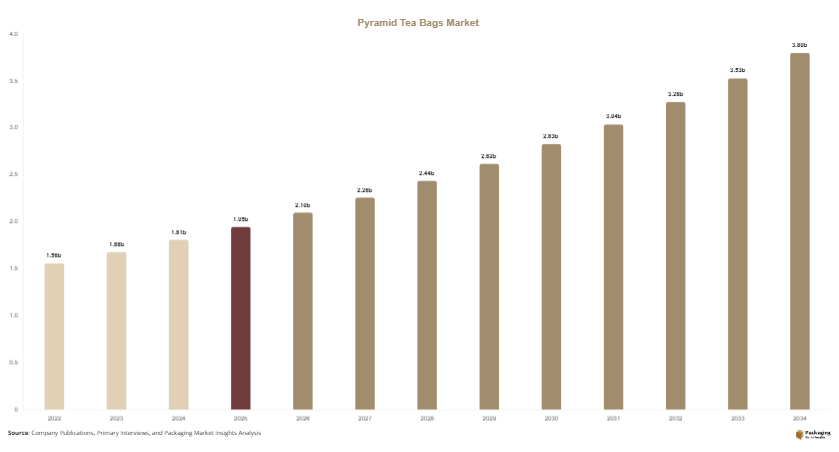
Pyramid Tea Bags market size is projected at USD 2.1 billion in 2026 and is expected to hit USD 3.8 billion by 2034 with a CAGR of 7.7%.
Pyramid tea bags are advanced tea packaging formats designed with a three-dimensional structure that provides improved water circulation and enhanced tea infusion compared with traditional flat tea bags. Global production of pyramid tea bags exceeded 85 billion units in 2025, driven by increasing demand for premium tea experiences and specialty beverages. Nylon pyramid tea bags accounted for nearly 45% of total consumption, while biodegradable pyramid tea bags represented approximately 30% share due to growing sustainability preferences. Premium black tea applications contributed around 40% of demand, followed by green tea at 35% and herbal tea at 25%. Increasing penetration of specialty teas, convenient brewing formats, and eco-friendly packaging solutions continues to strengthen the Pyramid Tea Bags Market.
Explore more data points, trends and opportunities Download Free Sample Report
Pyramid Tea Bags Market Trends
Growing Adoption of Sustainable and Biodegradable Tea Bag Materials
The pyramid tea bags industry is experiencing significant transformation due to increasing adoption of biodegradable and compostable materials. More than 40% of newly launched pyramid tea bag products in 2025 used plant-based materials such as PLA and cellulose fibers. Global production of sustainable pyramid tea bags exceeded 25 billion units, supported by consumer demand for plastic-free packaging solutions. Tea brands are investing in advanced sealing technologies and biodegradable mesh structures that improve durability while reducing environmental impact by nearly 30%. These developments are accelerating Pyramid Tea Bags Market Trend adoption.
Increasing Demand for Premium and Specialty Tea Products
Premium tea consumption has increased significantly, with specialty tea brands contributing more than 50% of new pyramid tea bag product launches between 2023 and 2025. Global pyramid tea bag production reached approximately 85 billion units annually, with green tea and herbal tea segments showing growth rates above 8%. Advanced designs allow larger tea leaves to expand during brewing, improving flavor extraction by nearly 20% compared with conventional tea bags. Rising demand from cafes, hotels, and premium retail channels continues to support Pyramid Tea Bags Market Trend expansion.
Pyramid Tea Bags Market Drivers
Rising Consumer Preference for Premium Tea Experiences
Increasing consumer interest in premium beverages is a major driver for pyramid tea bag adoption. Global tea consumption exceeded 7 million tons in 2025, with premium and specialty teas representing nearly 35% of retail value. Pyramid tea bags provide enhanced infusion quality and attractive packaging, increasing adoption among high-income consumers. More than 60% of premium tea brands now offer pyramid-shaped packaging formats to differentiate products. These factors are supporting Pyramid Tea Bags Market growth.
Pyramid Tea Bags Market Restraints
Higher Production Costs Compared with Conventional Tea Bags
Pyramid tea bags require specialized materials, advanced machinery, and precise manufacturing processes, increasing production costs by approximately 20–35% compared with traditional tea bags. Premium mesh materials and biodegradable films contribute nearly 40% of packaging expenses. Small and medium tea manufacturers face challenges due to equipment investments ranging from USD 200,000 to USD 1 million. These cost-related barriers limit adoption in price-sensitive markets and impact Pyramid Tea Bags Market expansion.
Pyramid Tea Bags Market Opportunities
Expansion of Eco-Friendly Tea Packaging Solutions
Growing demand for sustainable packaging creates significant opportunities for pyramid tea bag manufacturers. More than 55% of global consumers prefer environmentally responsible beverage packaging, encouraging brands to replace conventional plastic-based materials. The biodegradable tea packaging segment is expected to generate more than USD 1 billion in opportunities by 2034. Investments in compostable films, recyclable materials, and innovative designs are creating new growth avenues in the Pyramid Tea Bags Market.
Challenges in Pyramid Tea Bags Market
Supply Chain Limitations and Material Availability Issues
Manufacturers face challenges related to availability and pricing of specialty tea bag materials. Biodegradable polymers and premium mesh fabrics account for nearly 30–40% of production costs, creating supply chain pressure. Approximately 25% of producers experience fluctuations in raw material availability due to limited suppliers. Companies are focusing on alternative materials and local sourcing strategies to overcome these challenges in the Pyramid Tea Bags Market.
Report Scope
| Report Metric | Details |
|---|---|
| Market Size in 2025 | USD 1.95 billion |
| Market Size in 2026 | USD 2.1 billion |
| Market Size in 2034 | USD 3.8 billion |
| CAGR | 7.7% (2026-2034) |
| Base Year for Estimation | 2025 |
| Historical Data | 2022-2024 |
| Forecast Period | 2026-2034 |
| Report Coverage | Revenue Forecast, Competitive Landscape, Supply Chain Disruption, Growth Factors, Environment & Regulatory Landscape and Trends |
| Geographies Covered | North America, Europe, APAC, Middle East and Africa, LATAM |
| Countries Covered | U.S., Canada, U.K., Germany, France, Spain, Italy, Russia, Nordic, Benelux, Rest of Europe, China, South Korea, Japan, India, Australia, Singapore, Taiwan, South East Asia, Rest of Asia-Pacific, UAE, Turky, Saudi Arabia, South Africa, Egypt, Nigeria, Rest of MEA, Brazil, Mexico, Argentina, Chile, Colombia, Rest of LATAM |
Explore more data points, trends and opportunities Download Free Sample Report
Pyramid Tea Bags Market Segmentation
Pyramid Tea Bags Market segmentation is based on type and application, with nylon pyramid tea bags dominating with approximately 45% share due to superior durability and infusion performance. Black tea applications accounted for nearly 40% of market demand, while green and herbal tea segments continue expanding due to health-conscious consumers.
BY TYPE
Nylon Pyramid Tea Bags
Nylon pyramid tea bags represented approximately 45% market share in 2025, with global production exceeding 38 billion units annually. These tea bags provide high transparency, strength, and improved water flow during brewing. Nylon materials typically withstand temperatures above 90°C and support premium loose-leaf tea applications. Their durability and aesthetic appearance make them popular among luxury tea brands.
Biodegradable Pyramid Tea Bags
Biodegradable pyramid tea bags accounted for nearly 30% share, with production exceeding 25 billion units in 2025. These bags use PLA, corn starch, and cellulose-based materials designed for compostability. Growing environmental awareness has increased adoption by approximately 12% annually, particularly among premium and organic tea manufacturers.
Paper Pyramid Tea Bags
Paper pyramid tea bags contributed around 25% market share with production volumes exceeding 20 billion units. These products offer cost efficiency and are widely used in mainstream tea applications. Advanced paper filtration technologies improve strength, sealing performance, and brewing efficiency.
BY APPLICATION
Black Tea
Black tea applications dominated the segment with nearly 40% share and consumption exceeding 34 billion pyramid tea bags in 2025. Premium black tea brands use pyramid formats to preserve larger tea leaves and enhance flavor extraction. Adoption among specialty tea retailers increased by approximately 9% annually due to consumer preference for premium brewing experiences.
Green Tea
Green tea represented around 35% market share with consumption exceeding 30 billion units annually. Health-focused consumers and increasing demand for antioxidant beverages are driving adoption. More than 50% of premium green tea products launched after 2024 adopted pyramid tea bag formats.
Herbal Tea
Herbal tea applications accounted for approximately 25% share with production exceeding 20 billion units. Chamomile, peppermint, and wellness-focused herbal blends are increasingly packaged in pyramid formats due to improved ingredient expansion and infusion quality.
Pyramid Tea Bags Market Segmentations
Type
- Nylon Pyramid Tea Bags
- Biodegradable Pyramid Tea Bags
- Paper Pyramid Tea Bags
- Silk-Based Pyramid Tea Bags
Application
- Black Tea
- Green Tea
- Herbal Tea
- Specialty and Flavored Tea
Distribution Channel
- Supermarkets and Hypermarkets
- Online Retail Platforms
- Specialty Tea Stores
- Cafes and Foodservice Outlets
Pyramid Tea Bags Market Regional Outlook
Europe
Europe dominated the global market with approximately 35% share in 2025, consuming more than 30 billion pyramid tea bags annually. The United Kingdom, Germany, and France are major contributors due to strong tea consumption culture and premium beverage demand. Sustainable pyramid tea bag adoption exceeded 50% among new product launches.
North America
North America accounted for nearly 30% share with consumption exceeding 25 billion units. The United States contributed more than 80% of regional demand due to increasing specialty tea consumption and premium retail expansion. Organic and herbal tea segments represent more than 45% of regional pyramid tea bag demand.
Asia-Pacific
Asia-Pacific represented approximately 25% share, producing more than 20 billion units annually. China, Japan, and India are major contributors due to large tea production bases and increasing premium tea consumption. Regional demand is growing at nearly 9% annually.
Latin America and Middle East & Africa
These regions collectively contributed around 10% share with consumption exceeding 8 billion units. Growth is supported by expanding tea cafes, hospitality sectors, and rising interest in premium beverage products.
Top players in Pyramid Tea Bags Market
- Unilever PLC
- Tata Consumer Products Limited
- Twinings (Associated British Foods plc)
- Lipton Teas and Infusions
- The Republic of Tea
- Harney & Sons Fine Teas
- Bigelow Tea Company
- Dilmah Ceylon Tea Company PLC
- Tazo Tea Company
- Celestial Seasonings
- Barry’s Tea
- Teekanne GmbH
Unilever PLC
-
Unilever PLC holds a leading position in the pyramid tea bags industry with an estimated market contribution of approximately 12–15%.
-
The company operates major tea brands offering premium tea bag formats across global markets.
-
Its focus on sustainable packaging, responsible sourcing, and innovative tea products strengthens its competitive positioning.
-
The company serves millions of consumers worldwide through extensive retail distribution networks and premium tea offerings.
Tata Consumer Products Limited
-
Tata Consumer Products maintains approximately 8–10% market influence through its global tea portfolio.
-
The company produces billions of tea bags annually and focuses on premium tea segments, including pyramid formats.
-
Strong presence in Asia, Europe, and North America supports its growth strategy.
-
Investments in sustainable packaging and specialty tea products enhance its positioning in the Pyramid Tea Bags Market.