Coffee Bags Market Size and Growth
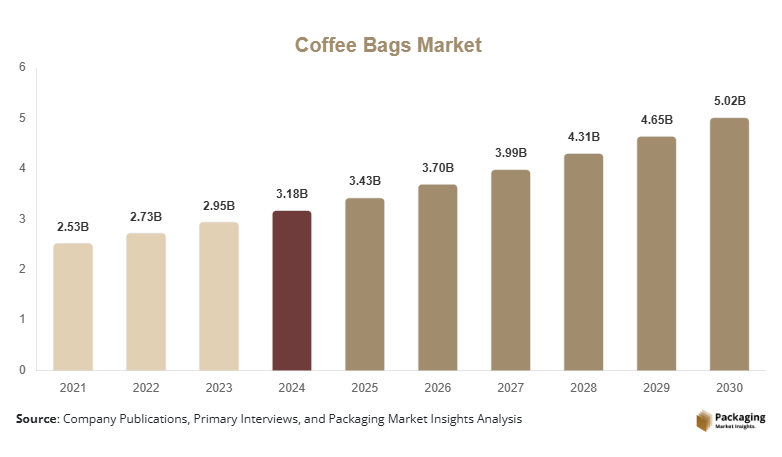
The global coffee bags market size was valued at approximately USD 3.18 billion in 2024 and is projected to grow from around USD 3.43 billion in 2025 to reach nearly USD 5.02 billion by 2030, expanding at a CAGR of about 7.9% during the forecast period (2025–2030). Coffee bags are specialized flexible packaging solutions designed to preserve the aroma, flavor, and freshness of roasted, ground, and instant coffee. They play a critical role in maintaining product integrity throughout storage, transportation, and retail display, making them a core component of the global coffee value chain.
Market growth has been supported by the continued expansion of global coffee consumption, particularly driven by urbanization and evolving lifestyle patterns. Rising disposable income levels and the increasing popularity of specialty coffee have pushed manufacturers to adopt high-performance packaging solutions. Coffee brands are focusing on packaging that ensures longer shelf life, offers convenience, and aligns with brand differentiation strategies. As a result, advanced barrier materials, resealable formats, and innovative pouch designs have gained significant adoption across retail and foodservice channels.
Executive Summary
| Theme | Key Points |
|---|---|
| Market Size & Outlook | Global Coffee Bags Market reached USD 3.92 billion in 2025; projected at USD 5.20 billion by 2030. Growth reflects steady volume gains and a mix shift to premium, high-barrier, valve-equipped formats. |
| Growth Rate | CAGR of 5.8% during 2026–2030 supported by rising coffee consumption and packaging upgrades. Demand steady across retail and specialty channels with improving macro stability. |
| Key Drivers | Global coffee consumption expansion and macro stabilization in 2025–2026. Premiumization and freshness needs increase adoption of barriers, valves, and reclose features. |
| Restraints | Volatile energy and input costs and logistics disruptions pressured margins and delayed format upgrades. Buyers managed risk with shorter contracts and slower specification changes. |
| Segments — Leaders | Material: Plastic laminates (USD 2.10B). Bag type: Stand-up pouches (USD 1.46B). Feature: With degassing valve (USD 2.62B). Closure: Zipper (USD 1.28B). Capacity: 250 g–500 g (USD 1.75B). Printing: Flexographic (USD 2.05B). |
| Segments — Fast Growers | Paper-based materials (7.1% CAGR), flat-bottom pouches (8.0% CAGR), up to 250 g packs (7.6% CAGR), and digital printing (9.1% CAGR) over 2026–2030. |
| End-Use Highlights | Retail packaged coffee led at USD 2.71B in 2025. Direct-to-consumer specialty roasters to expand at 8.4% CAGR with digital print, small runs, and premium valves. |
| Regional View | North America steady with premium and private label; Europe advancing recyclable designs; Asia-Pacific fastest-growing on modern retail and e-commerce; MEA and Latin America expanding from smaller bases. |
| Competition | Top 5 hold ~30% share; market remains fragmented. Leaders invest in mono-material barriers, paper coatings, solventless lamination, and digital printing for agility. |
| Opportunities | Premium freshness protection raising unit value; digitally printed short runs for specialty and D2C; policy and retailer commitments accelerating recyclable and fiber-forward adoption. |
Explore more data points, trends and opportunities Download Free Sample Report
Latest Market Trends
Shift Toward Sustainable and Eco-Friendly Coffee Bags
Sustainability has emerged as a defining trend in the Coffee Bags Market. Coffee brands and roasters are increasingly transitioning from conventional multi-layer plastic packaging to recyclable, biodegradable, and compostable coffee bags. This shift has been driven by heightened environmental awareness among consumers and brand commitments to reduce plastic waste. Packaging suppliers are responding by developing mono-material structures and paper-based laminates that deliver barrier performance comparable to traditional materials. These innovations have reshaped product portfolios and accelerated investments in sustainable packaging technologies.
Growing Adoption of Valve-Equipped Coffee Bags
Another notable trend is the widespread adoption of one-way degassing valve coffee bags. These valves allow carbon dioxide to escape from freshly roasted coffee while preventing oxygen ingress, thereby preserving flavor and aroma. Specialty coffee brands and premium product lines have increasingly favored valve-equipped bags to support product differentiation and quality positioning. The trend has been particularly strong in retail and online channels, where extended shelf life and product integrity are critical.
Market Drivers
Rising Global Consumption of Specialty Coffee
The increasing demand for specialty and premium coffee has been a major driver of the Coffee Bags Market. Consumers are showing a growing preference for high-quality, single-origin, and artisanal coffee products, which require advanced packaging solutions to maintain freshness and sensory attributes. Specialty coffee roasters often rely on high-barrier, resealable coffee bags with valves to protect product quality. This shift toward premium offerings has significantly increased per-unit packaging value, supporting market expansion.
Expansion of Retail and E-Commerce Coffee Channels
The rapid growth of organized retail and online coffee sales has boosted demand for standardized, visually appealing, and logistics-friendly coffee bags. E-commerce channels, in particular, require lightweight yet durable packaging that minimizes damage during shipping. Coffee bags with enhanced sealing strength and puncture resistance have gained traction, driving consistent demand from both established brands and emerging direct-to-consumer players.
Market Restraints
Volatility in Raw Material Prices
Fluctuating prices of raw materials such as polyethylene, aluminum foil, and specialty papers have posed a restraint on the Coffee Bags Market. Packaging manufacturers face margin pressure due to unpredictable input costs, which can impact pricing strategies and profitability. Smaller suppliers, in particular, experience challenges in absorbing cost fluctuations, leading to cautious capacity expansion and slower adoption of innovative materials.
Market Opportunities
Growth of Compostable and Bio-Based Coffee Bags
The increasing emphasis on circular economy principles has created opportunities for compostable and bio-based coffee bags. Manufacturers developing plant-based polymers and fiber-based laminates are well-positioned to capture demand from environmentally conscious coffee brands. These solutions offer differentiation potential and align with long-term sustainability goals across the coffee industry.
Emerging Demand from Developing Coffee-Consuming Markets
Rising coffee consumption in developing economies presents significant growth opportunities. As consumption shifts from traditional formats to packaged coffee products, demand for modern coffee bags is expected to rise. Local roasters entering organized retail channels are likely to adopt standardized packaging formats, supporting long-term market expansion.
Report Scope
| Report Metric | Details |
|---|---|
| Market Size in 2024 | USD 3.18 Billion |
| Market Size in 2025 | USD 3.43 Billion |
| Market Size in 2030 | USD 5.02 Billion |
| CAGR | 7.9% (2025-2030) |
| Base Year for Estimation | 2024 |
| Historical Data | 2021-2023 |
| Forecast Period | 2025-2030 |
| Report Coverage | Revenue Forecast, Competitive Landscape, Supply Chain Disruption, Growth Factors, Environment & Regulatory Landscape and Trends |
| Geographies Covered | North America, Europe, APAC, Middle East and Africa, LATAM |
| Countries Covered | U.S., Canada, U.K., Germany, France, Spain, Italy, Russia, Nordic, Benelux, Rest of Europe, China, South Korea, Japan, India, Australia, Singapore, Taiwan, South East Asia, Rest of Asia-Pacific, UAE, Turky, Saudi Arabia, South Africa, Egypt, Nigeria, Rest of MEA, Brazil, Mexico, Argentina, Chile, Colombia, Rest of LATAM |
Explore more data points, trends and opportunities Download Free Sample Report
Segmental Analysis
By Product Type
The Valve Coffee Bags subsegment, which includes one-way degassing valve bags commonly used for freshly roasted coffee, accounted for a dominant 46.8% share of the Coffee Bags Market by product type in 2024. This substantial share was primarily driven by the need to preserve the aroma, flavor, and freshness of coffee beans while allowing carbon dioxide to escape. Specialty coffee brands and premium roasted coffee lines widely adopt these bags, as they offer extended shelf life and maintain product integrity. The convenience of resealable valves has further strengthened their adoption across retail and e-commerce channels globally.
The Flat-Bottom Coffee Bags subsegment is projected to be the fastest-growing, demonstrating a CAGR of 9.6% from 2025 to 2030. This growth will be fueled by their enhanced shelf presence, increased surface area for branding, and rising popularity among retail consumers. Coffee brands aiming to differentiate their products on store shelves are increasingly shifting toward flat-bottom designs, which provide superior stability and aesthetic appeal compared to traditional side-gusset bags.
By Material
The Plastic-Based Coffee Bags subsegment, encompassing materials such as polyethylene, polypropylene, and multi-layer laminates, held a substantial 52.3% share of the Coffee Bags Market by material in 2024. This dominance was attributable to the durability, flexibility, and superior barrier properties of plastics, which are widely used to protect coffee from moisture, oxygen, and light. Plastic bags also offer cost-effectiveness, lightweight handling, and ease of manufacturing, making them a preferred choice for both mass-market and specialty coffee products.
The Paper-Based Laminated Bags subsegment is anticipated to grow at the fastest CAGR of 10.1% from 2025 to 2030. This growth is driven by the increasing adoption of sustainable and eco-friendly packaging solutions. Paper-based laminated coffee bags, often combined with biodegradable films, meet consumer demand for environmentally responsible packaging while maintaining adequate barrier protection. Rising regulatory pressure on single-use plastics further supports the expansion of this segment globally.
By Application
The Roasted Coffee Packaging subsegment represented a significant 61.4% share of the Coffee Bags Market by application in 2024. This leading position was due to the global popularity of roasted coffee products, which require advanced packaging to preserve flavor, aroma, and freshness. Specialty coffee roasters extensively use high-barrier bags with degassing valves to maintain quality over extended storage periods. Retail and e-commerce channels further reinforced the adoption of robust packaging formats for roasted coffee.
The Instant Coffee Packaging subsegment is projected to achieve the fastest CAGR of 8.4% from 2025 to 2030. This accelerated growth is fueled by the rising global demand for convenient coffee formats, especially in emerging economies where instant coffee consumption is increasing rapidly. Innovative coffee bag designs, including multi-serve pouches and resealable formats, will support market growth, particularly in online and modern retail channels.
By End-Use
The Retail Coffee Packaging subsegment accounted for a dominant 68.9% share of the Coffee Bags Market by end-use in 2024. This large share resulted from strong supermarket and specialty store distribution, where visually appealing and functional packaging plays a critical role in influencing consumer purchase decisions. Retail packaging also benefits from standardization in bag sizes, barrier performance, and branding opportunities.
The Foodservice Coffee Packaging subsegment is expected to demonstrate the fastest CAGR of 7.8% from 2025 to 2030. Growth in this segment is driven by the rapid expansion of cafés, restaurants, and office coffee programs globally. Coffee bags for foodservice applications are increasingly customized for bulk servings, single-serve portions, and portion-controlled packs, catering to both operational efficiency and consumer preferences.
By Distribution Channel
The Offline Distribution subsegment, which includes supermarkets, hypermarkets, specialty coffee stores, and wholesale channels, held a dominant 72.5% share in 2024. This dominance was primarily due to the well-established retail networks, brand visibility, and bulk ordering preferences of coffee roasters and distributors. Offline channels continue to support consistent sales volume for mainstream and premium coffee products.
The Online Distribution subsegment is projected to grow at the fastest CAGR of 9.9% from 2025 to 2030. This growth is fueled by the rise of direct-to-consumer coffee brands, subscription-based models, and e-commerce marketplaces. Online channels favor lightweight, durable, and visually appealing coffee bags that can withstand shipping stress while maintaining product freshness, driving adoption of high-performance packaging formats.
Coffee Bags Market Segmentations
By Product Type
- Valve Coffee Bags
- Flat-Bottom Bags
- Stand-Up Pouches
- Side-Gusset Bags
By Material
- Plastic
- Paper-Based Laminates
- Aluminum Foil Laminates
By Application
- Roasted Coffee
- Ground Coffee
- Instant Coffee
By End Use
- Retail
- Foodservice
By Distribution Channel
- Offline
- Online
Regional Analysis
North America
North America accounted for 34.6% of the global Coffee Bags Market share and was forecast to grow at a CAGR of 6.8% during 2025–2033. The region’s mature coffee culture, combined with high penetration of specialty coffee brands, supported consistent demand for premium packaging solutions.
The United States dominated the regional market due to strong consumption of roasted and ground coffee. The growth factor was the widespread presence of specialty coffee chains and independent roasters, which relied on high-quality valve-equipped and resealable coffee bags to maintain product standards.
Europe
Europe held 28.4% of the market share in 2025 and was projected to expand at a CAGR of 6.5% through 2033. The region exhibited strong demand for sustainable packaging formats driven by regulatory frameworks and consumer awareness.
Germany emerged as the dominant country, supported by its large coffee processing industry and emphasis on recyclable packaging. The growth factor was the adoption of paper-based laminated coffee bags aligned with environmental compliance norms.
Asia Pacific
Asia Pacific represented 22.1% of global demand in 2025 and was expected to grow at the fastest CAGR of 9.1% during 2025–2033. Rapid urbanization and evolving consumption patterns fueled market expansion.
China led the regional market, supported by the growing café culture and increasing imports of packaged coffee. The key growth factor was the expansion of modern retail infrastructure and domestic coffee brands adopting branded packaging.
Middle East & Africa
The Middle East & Africa accounted for 8.3% of the market share in 2025 and was forecast to grow at a CAGR of 7.2% through 2033. Demand was supported by increasing consumption of packaged coffee products.
Saudi Arabia dominated the region due to high per-capita coffee consumption. The growth factor was the rising popularity of premium and flavored coffee products packaged in high-barrier bags.
Latin America
Latin America held 6.6% of the Coffee Bags Market share in 2025 and was projected to grow at a CAGR of 7.5% during 2025–2033. The region benefited from its strong coffee production base and increasing domestic consumption.
Brazil led regional demand, supported by the expansion of branded roasted coffee sales. The growth factor was the integration of value-added packaging to support domestic retail distribution.
Competitive Landscape
The Coffee Bags Market is moderately fragmented, with the presence of global packaging companies and regional manufacturers. Key players focus on material innovation, sustainability, and customization. One market leader expanded its recyclable coffee bag portfolio in 2024 to support brand sustainability goals. Competitive strategies include capacity expansion, product launches, and partnerships with coffee brands to strengthen market positioning.
Key Players in the Coffee Bags Market
- Amcor Plc
- Mondi Group
- Berry Global Inc.
- ProAmpac
- Huhtamaki Oyj
- Constantia Flexibles
- Smurfit Kappa Group
- WestRock Company
- Sealed Air Corporation
- Coveris Holdings
- Novolex
- Uflex Ltd.
- TC Transcontinental
- Swiss Pac Pvt. Ltd.
- Goglio Group