Punnet Market Size
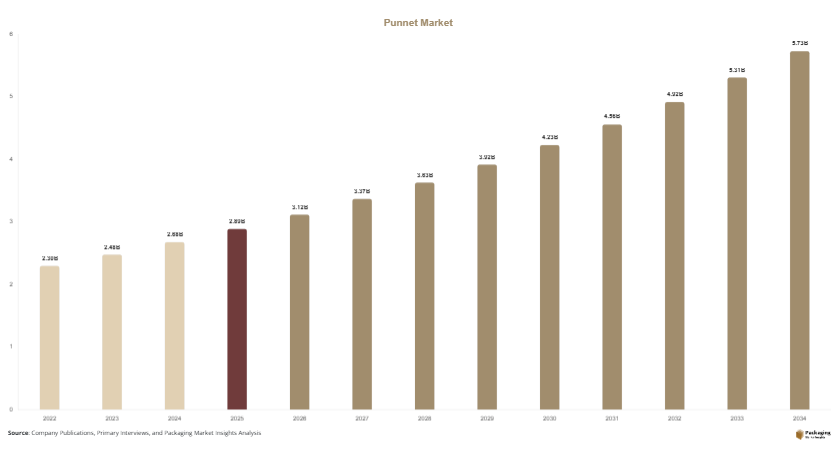
Punnet market size is projected at USD 3.12 billion in 2026 and is expected to hit USD 5.76 billion by 2034 with a CAGR of 7.9%. Growing consumption of fresh produce, increasing retail packaging requirements, and rising adoption of sustainable food packaging solutions continue to drive industry expansion. The report provides comprehensive production analysis, market segmentation, regional evaluation, and competitive landscape for strategic business planning.
The Punnet Market consists of rigid and semi-rigid containers designed for packaging fresh fruits, vegetables, bakery products, and meat products while ensuring product visibility, ventilation, and protection. Global production exceeded 42.8 billion punnet units in 2026, utilizing more than 5.4 million metric tons of packaging materials. Fruits and vegetables accounted for approximately 61% of total consumption, while plastic punnets contributed nearly 54% of production. Sustainable packaging adoption exceeded 48% among organized food retailers, supporting continued expansion of the Punnet Market.
Explore more data points, trends and opportunities Download Free Sample Report
Punnet Market Trends
Rising Adoption of Sustainable Packaging Materials
Manufacturers are increasingly replacing conventional plastic packaging with recyclable paperboard and molded fiber alternatives. More than 16.8 billion eco-friendly punnet units were produced during 2026, while recycled material utilization increased to 46% across newly commissioned production lines. Nearly 63% of supermarket chains have expanded sustainable packaging programs, reinforcing the Punnett market.
Automation and Lightweight Packaging Innovations
High-speed thermoforming and injection molding technologies continue improving manufacturing efficiency and reducing material consumption. Production facilities manufactured over 42.8 billion units, while lightweight packaging designs reduced material usage by approximately 17%. Modified atmosphere packaging compatibility exceeded 58%, supporting fresh food preservation and strengthening the punnet market.
Punnet Market Drivers
Growing Demand for Fresh Produce Packaging
Expansion of organized retail, supermarkets, and fresh food exports continues driving demand for punnets. Global packaged fruit shipments exceeded 165 million metric tons, while fresh vegetable exports increased by 11% during 2026. More than 71% of premium fresh produce is now sold using protective retail packaging, accelerating the punnet market.
Punnet Market Restraints
Fluctuating Raw Material Prices
Volatility in polymer resins, paper pulp, and molded fiber feedstock continues affecting production economics. Raw materials account for approximately 59% of manufacturing costs, while annual price fluctuations remain between 10% and 16%. Smaller manufacturers continue facing profitability challenges across the bonnet market.
Punnet Market Opportunities
Growth of Sustainable Food Packaging Solutions
Demand for recyclable and compostable packaging continues increasing among retailers and food producers. More than 52% of newly introduced food packaging products utilize recyclable materials, while investments in molded fiber production exceeded USD 520 million globally during 2026. These developments create strong opportunities for the parent market.
Challenges in the Punnett Market
Balancing Product Protection with Material Reduction
Manufacturers continue optimizing structural strength while reducing packaging weight. Lightweight packaging initiatives reduced average material usage by 14%, while compression testing now exceeds 2,500 quality cycles per production batch. Maintaining durability without increasing production costs remains a major challenge for the bonnet market.
Report Scope
| Report Metric | Details |
|---|---|
| Market Size in 2025 | USD 2.89 Billion |
| Market Size in 2026 | USD 3.12 Billion |
| Market Size in 2034 | USD 5.76 Billion |
| CAGR | 7.9% (2026-2034) |
| Base Year for Estimation | 2025 |
| Historical Data | 2022-2024 |
| Forecast Period | 2026-2034 |
| Report Coverage | Revenue Forecast, Competitive Landscape, Supply Chain Disruption, Growth Factors, Environment & Regulatory Landscape and Trends |
| Geographies Covered | North America, Europe, APAC, Middle East and Africa, LATAM |
| Countries Covered | U.S., Canada, U.K., Germany, France, Spain, Italy, Russia, Nordic, Benelux, Rest of Europe, China, South Korea, Japan, India, Australia, Singapore, Taiwan, South East Asia, Rest of Asia-Pacific, UAE, Turkey, Saudi Arabia, South Africa, Egypt, Nigeria, Rest of MEA, Brazil, Mexico, Argentina, Chile, Colombia, Rest of LATAM |
Explore more data points, trends and opportunities Download Free Sample Report
Punnet Market Segmentation
The market is segmented by material and application to evaluate manufacturing trends and end-user demand. Plastic punnets account for approximately 54% of production, while fruits and vegetables represent nearly 61% of total consumption. Annual global manufacturing exceeds 42.8 billion punnet units.
By Material
Plastic punnets dominate the market with approximately 54% share. Annual production exceeds 23 billion units, utilizing PET, PP, and RPET materials with excellent transparency, durability, and stackability. These punnets remain widely used for fresh produce packaging.
Paperboard punnets account for approximately 27% of market volume, with annual production exceeding 11.5 billion units. These products offer recyclable packaging solutions, printable surfaces, and growing adoption across premium retail food packaging.
Molded fiber punnets contribute nearly 19% of production, exceeding 8.3 billion units annually. These biodegradable products provide improved sustainability, moisture resistance, and cushioning properties for delicate fruits and vegetables.
By Application
Fruits and vegetables represent the largest application with approximately 61% market share. Annual consumption exceeds 26 billion units, supporting berries, grapes, tomatoes, mushrooms, and fresh-cut produce. Ventilation features and moisture management improve shelf life.
Bakery and confectionery applications account for approximately 21% of demand. Annual utilization exceeds 9 billion units, supporting cakes, pastries, cookies, and premium confectionery products requiring protective retail packaging and product visibility.
Meat and seafood contribute approximately 18% of market demand, with annual consumption exceeding 7.8 billion units. Modified atmosphere packaging compatibility and leak-resistant designs support hygiene, freshness, and regulatory compliance.
Punnet Market Segmentations
Material
- Plastic Punnet
- Paperboard Punnet
- Molded Fiber Punnet
Application
- Fruits & Vegetables
- Bakery & Confectionery
- Meat & Seafood
Punnet Market Regional Outlook
North America
North America accounts for approximately 28% of global demand. Annual production exceeds 11.4 billion punnet units, with the United States contributing nearly 80% of regional consumption. Fresh produce packaging dominates regional demand.
Europe
Europe represents approximately 30% of worldwide consumption. Germany, France, Italy, Spain, and the United Kingdom contribute over 73% of regional production. Annual manufacturing exceeds 12.5 billion units, supported by stringent sustainability regulations.
Asia-Pacific
The Asia-Pacific leads the market with approximately 34% share. China, India, Japan, and Australia account for nearly 78% of regional production. Manufacturing exceeds 14.5 billion units, driven by expanding food retail and agricultural exports.
Latin America
Latin America contributes approximately 5% of global demand. Brazil, Chile, and Mexico account for more than 69% of regional production, supported by fruit exports and supermarket expansion.
Middle East & Africa
The Middle East & Africa account for approximately 3% of worldwide demand. GCC countries and South Africa continue investing in fresh food supply chains, supporting increasing adoption of retail-ready packaging solutions.
Top Players in the Punnett Market
- Pöppelmann GmbH & Co. KG
- INFIA S.r.l.
- Coveris Holdings S.A.
- Smurfit Westrock
- DS Smith Plc
- Amcor plc
- Berry Global Inc.
- Faerch A/S
- Sabert Corporation
- Greiner Packaging International GmbH
- Quinn Packaging Ltd.
- Klöckner Pentaplast
- Silgan Holdings Inc.
- Genpak LLC
- Plastipak Holdings, Inc.
Pöppelmann GmbH & Co. KG
- Estimated market presence: 10–12%
- Leading manufacturer of sustainable horticultural and food packaging solutions.
- Strong production capabilities across Europe with advanced thermoforming technologies.
- Extensive portfolio of recyclable and RPET punnet products serving fresh produce markets.
- Continuous investment in lightweight packaging, recycled material utilization, and automation supports large-scale manufacturing exceeding billions of packaging units annually. The company maintains long-term partnerships with retailers and agricultural producers while strengthening sustainable packaging innovation.
INFIA S.r. l.
- Estimated market presence: 8–10%
- Major supplier of rigid packaging for fresh fruits and vegetables.
- Strong manufacturing presence across Europe with advanced PET and recycled PET processing technologies.
- Focus on lightweight, transparent, and recyclable punnet solutions for premium retail packaging.
- Ongoing investments in circular economy initiatives, production efficiency, and sustainable material development enhance global competitiveness while supporting food safety and extended shelf-life applications.