Food Storage Container Market Size and Growth
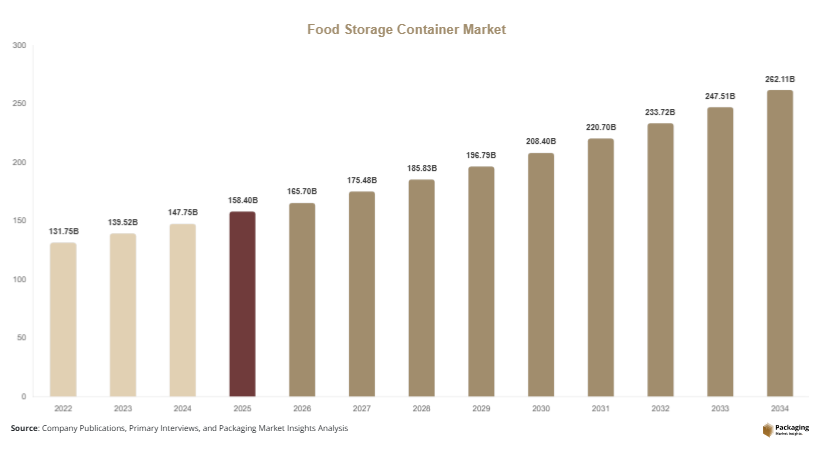
The global food storage container market size is experiencing steady expansion due to evolving consumer lifestyles, increased demand for packaged foods, and growing awareness of food preservation solutions. In 2025, the market size is estimated at USD 158.4 billion and is projected to reach approximately USD 165.7 billion in 2026. Over the forecast period from 2025 to 2034, the market is expected to grow at a compound annual growth rate (CAGR) of 5.9%, reaching nearly USD 278.6 billion by 2034.
Food storage containers play an important role in maintaining food freshness, improving shelf life, and ensuring hygienic food handling in both residential and commercial settings. These containers are widely used for storing leftovers, meal preparation, food transportation, and bulk food preservation. Materials such as plastic, glass, metal, and silicone are commonly used in the manufacturing of storage containers, with manufacturers focusing on durability, lightweight designs, and reusable packaging solutions.
Key Highlights
- Global market size estimated at USD 158.4 billion in 2025
- Expected to reach USD 278.6 billion by 2034
- Projected CAGR of 5.9% (2025–2034)
- Increasing demand for reusable and sustainable food storage products
- Strong adoption across residential and commercial food service sectors
Explore more data points, trends and opportunities Download Free Sample Report
Market Trends
Rising Demand for Sustainable and Eco-Friendly Containers
Sustainability is becoming an important trend shaping the food storage container market. Consumers are increasingly seeking products made from environmentally responsible materials such as recycled plastic, glass, stainless steel, and biodegradable compounds. Concerns regarding plastic waste and environmental pollution have encouraged manufacturers to develop reusable containers designed to reduce single-use packaging. Many brands are launching BPA-free containers and incorporating recycled materials into their product lines to meet sustainability expectations. In addition, retailers are promoting eco-conscious kitchen products, which has increased consumer awareness of reusable food storage solutions. As sustainability remains a key purchasing factor, eco-friendly container innovations are expected to influence product development and marketing strategies across the industry.
Growing Popularity of Smart and Modular Storage Systems
Another noticeable trend in the food storage container market is the emergence of modular and smart storage systems designed for efficient kitchen organization. Consumers are increasingly adopting stackable containers with airtight lids and portion control features that improve convenience and storage efficiency. Manufacturers are also introducing containers with smart labels, freshness indicators, and compatibility with modern kitchen appliances. These solutions allow users to monitor food freshness and organize pantry items more effectively. The growing popularity of meal preparation routines and organized kitchen layouts has encouraged the demand for modular container systems that simplify food storage. As smart kitchen concepts gain traction globally, innovative container designs are likely to gain wider adoption.
Market Drivers
Expansion of Food Delivery and Takeaway Services
The rapid expansion of food delivery and takeaway services has become a significant driver for the food storage container market. Online food ordering platforms and cloud kitchens have increased the need for durable and hygienic food storage and packaging solutions. Restaurants and food service providers rely on reliable containers that can preserve food quality during transportation and storage. These containers help maintain temperature control, prevent leakage, and ensure food safety. As urban populations continue to rely on food delivery services, the demand for reliable storage and packaging products is expected to grow steadily across both commercial and household applications.
Increasing Adoption of Meal Preparation and Home Cooking
The growing popularity of meal preparation practices is another factor supporting the growth of the food storage container market. Consumers are preparing meals in advance to save time and maintain healthier diets, which has increased the need for reliable storage solutions. Food storage containers allow individuals to portion meals and store them safely in refrigerators or freezers. The trend has gained momentum among working professionals and fitness enthusiasts who prefer organized meal planning. As more households adopt structured cooking routines and bulk food purchasing habits, the demand for high-quality containers designed for refrigeration, freezing, and reheating is expected to rise.
Market Restraint
Environmental Concerns Related to Plastic Waste
Environmental concerns regarding plastic waste remain a key restraint affecting the food storage container market. Many storage containers are manufactured using plastic materials that contribute to long-term environmental pollution when disposed of improperly. Governments and environmental organizations have introduced regulations aimed at reducing plastic usage, which has created challenges for manufacturers relying heavily on conventional plastic materials. These regulations often require companies to redesign products or invest in sustainable alternatives, which can increase production costs.
Consumer perceptions regarding plastic safety also influence purchasing decisions. Some consumers prefer glass or stainless steel containers due to concerns about chemical migration from plastic materials during heating or long-term storage. As awareness of environmental sustainability increases, brands that rely heavily on traditional plastic packaging may experience slower demand growth.
Additionally, the recycling infrastructure in several developing economies remains limited, making it difficult to manage plastic waste effectively. This situation creates pressure on manufacturers to adopt environmentally friendly materials and packaging processes. Companies are investing in research to develop biodegradable plastics and recyclable packaging solutions to address environmental concerns. However, the higher cost of sustainable materials continues to pose a challenge for widespread adoption in price-sensitive markets.
Market Opportunities
Growth of Sustainable Packaging Technologies
Advancements in sustainable packaging technologies present a major opportunity for the food storage container market. Manufacturers are increasingly exploring materials such as biodegradable polymers, plant-based plastics, and recycled composites that reduce environmental impact. These innovations enable companies to create reusable containers that align with evolving consumer preferences and regulatory requirements. Sustainable packaging solutions are gaining popularity among environmentally conscious consumers, particularly in developed economies where eco-friendly products command higher demand. Companies investing in sustainable material research are expected to gain a competitive advantage in the coming years.
Expansion of E-commerce Distribution Channels
The expansion of e-commerce platforms provides another promising opportunity for the food storage container market. Online retail channels allow manufacturers to reach a wider consumer base and showcase diverse product categories. Consumers benefit from easy product comparisons, detailed descriptions, and convenient home delivery services. E-commerce platforms also allow smaller brands to enter the market and compete with established manufacturers. As digital retail infrastructure continues to expand across emerging markets, online distribution channels are expected to contribute significantly to market growth.
Report Scope
| Report Metric | Details |
|---|---|
| Market Size in 2025 | USD 158.4 Billion |
| Market Size in 2026 | USD 165.7 Billion |
| Market Size in 2034 | USD 278.6 Billion |
| CAGR | 5.9% (2026-2034) |
| Base Year for Estimation | 2025 |
| Historical Data | 2022-2024 |
| Forecast Period | 2026-2034 |
| Report Coverage | Revenue Forecast, Competitive Landscape, Supply Chain Disruption, Growth Factors, Environment & Regulatory Landscape and Trends |
| Geographies Covered | North America, Europe, APAC, Middle East and Africa, LATAM |
| Countries Covered | U.S., Canada, U.K., Germany, France, Spain, Italy, Russia, Nordic, Benelux, Rest of Europe, China, South Korea, Japan, India, Australia, Singapore, Taiwan, South East Asia, Rest of Asia-Pacific, UAE, Turky, Saudi Arabia, South Africa, Egypt, Nigeria, Rest of MEA, Brazil, Mexico, Argentina, Chile, Colombia, Rest of LATAM |
Explore more data points, trends and opportunities Download Free Sample Report
Segmental Analysis
By Material
Plastic containers dominated the food storage container market in 2024, accounting for approximately 52% of total market share. Plastic remains widely used due to its affordability, lightweight properties, and design flexibility. Manufacturers can easily produce containers in various shapes and sizes, which allows them to meet diverse consumer preferences. In addition, plastic containers are commonly used in both residential and commercial applications because they are resistant to breakage and easy to transport. The availability of BPA-free plastics has also improved consumer confidence in using plastic storage products for food preservation.
Glass containers are expected to represent the fastest-growing material segment, with a projected CAGR of about 6.7% during the forecast period. Consumers increasingly prefer glass containers due to their durability, non-toxic properties, and ability to withstand high temperatures. Glass containers are often used for reheating food in microwaves and ovens, making them suitable for modern cooking practices. The rising demand for sustainable alternatives to plastic packaging is also encouraging the adoption of glass containers across residential and commercial kitchens.
By Product Type
Airtight containers accounted for the largest share of the food storage container market in 2024, contributing nearly 48% of total revenue. These containers are designed to prevent air exposure and maintain food freshness for extended periods. Airtight lids help preserve flavor, prevent contamination, and reduce moisture exposure. Consumers widely use these containers for storing dry foods, leftovers, and pantry items. Their versatility and reliability make them a preferred choice for households and food service businesses.
Stackable containers are projected to be the fastest-growing product segment, expanding at a CAGR of approximately 6.5% during the forecast period. These containers help maximize storage space and improve kitchen organization. Stackable designs allow consumers to store multiple containers efficiently in refrigerators, cabinets, and pantry shelves. As urban living spaces become smaller, consumers increasingly prefer compact storage solutions that optimize available space.
By End Use
The residential segment held the largest share of the food storage container market in 2024, accounting for approximately 63% of overall demand. Households frequently use storage containers for meal preparation, leftover storage, and bulk ingredient preservation. Rising consumer awareness of food waste reduction and organized kitchen practices has strengthened the demand for residential storage solutions. Additionally, social media trends related to kitchen organization have encouraged consumers to invest in aesthetically pleasing and functional storage products.
The commercial segment is expected to grow at the fastest CAGR of around 6.2% during the forecast period. Restaurants, catering businesses, and food processing companies require large quantities of durable storage containers for operational efficiency. Commercial kitchens depend on containers that support food safety standards, temperature control, and efficient ingredient storage. The continued growth of food service industries worldwide is expected to drive demand for commercial-grade storage solutions.
Food Storage Container Market Segmentations
Material
- Plastic
- Glass
- Metal
- Silicone
Product Type
- Airtight Containers
- Stackable Containers
- Vacuum Containers
- Specialty Containers
End Use
- Residential
- Commercial
Distribution Channel
- Supermarkets & Hypermarkets
- Specialty Stores
- Online Retail
- Department Stores
- Others
Regional Analysis
North America
North America accounted for a significant share of the global food storage container market in 2025, representing approximately 31% of total revenue. The region is expected to grow at a CAGR of around 5.2% during the forecast period. Strong consumer demand for reusable kitchen products and organized storage solutions continues to drive market expansion. High household spending on kitchenware and home improvement products has further supported the demand for durable food storage containers across the United States and Canada.
The United States dominates the regional market due to strong retail infrastructure and widespread adoption of meal preparation routines. A key growth factor in the country is the increasing demand for sustainable kitchen products. Consumers are actively choosing reusable and eco-friendly storage containers as part of environmentally responsible lifestyles, which has encouraged manufacturers to introduce innovative container designs.
Europe
Europe held approximately 26% of the global food storage container market share in 2025 and is projected to grow at a CAGR of about 5.4% through 2034. The region benefits from strong environmental awareness and strict regulations aimed at reducing plastic waste. Consumers across European countries are increasingly adopting reusable food storage solutions that support sustainable living practices.
Germany represents one of the leading markets within Europe due to its strong manufacturing sector and consumer interest in eco-friendly household products. A major growth factor in the country is the increasing popularity of zero-waste lifestyles. Consumers are purchasing durable containers that support bulk food storage and reduce reliance on disposable packaging materials.
Asia Pacific
Asia Pacific accounted for nearly 28% of the global food storage container market in 2025 and is expected to record the highest CAGR of around 6.8% during the forecast period. Rapid urbanization, increasing disposable incomes, and changing dietary habits are supporting demand for food storage solutions across the region. Expanding retail networks and rising adoption of organized kitchen products are also contributing to market growth.
China leads the regional market due to its large population and expanding middle class. One key growth factor in the country is the increasing popularity of online retail platforms for household products. Consumers frequently purchase food storage containers through digital marketplaces, which has improved product accessibility and encouraged manufacturers to strengthen their e-commerce presence.
Middle East & Africa
The Middle East & Africa region accounted for approximately 7% of the global food storage container market share in 2025 and is projected to grow at a CAGR of around 4.9% through 2034. Growth in this region is driven by urban development, increasing consumer spending on kitchenware products, and the expansion of modern retail channels such as supermarkets and hypermarkets.
The United Arab Emirates represents a leading market within the region due to its strong retail sector and high consumer purchasing power. A unique growth factor is the rapid expansion of hospitality and food service industries. Restaurants and catering businesses require reliable food storage containers to maintain food safety and operational efficiency.
Latin America
Latin America held nearly 8% of the global food storage container market share in 2025 and is expected to grow at a CAGR of about 5.1% during the forecast period. Rising urban populations and increasing awareness of food storage practices are supporting the demand for kitchen storage products across the region.
Brazil dominates the regional market due to its large consumer base and expanding retail infrastructure. One important growth factor is the rising adoption of organized kitchen solutions among urban households. Consumers are increasingly purchasing stackable and modular containers to improve food storage and reduce food waste in residential kitchens.
Competitive Landscape
The food storage container market is moderately competitive, with several global and regional manufacturers focusing on product innovation, sustainability initiatives, and expanding distribution networks. Companies compete by offering containers made from durable materials, eco-friendly designs, and modular storage solutions that enhance kitchen organization.
One of the leading companies in the market is Tupperware Brands Corporation, which maintains a strong presence through its wide range of reusable storage containers and direct sales model. The company continues to introduce sustainable product designs and improved sealing technologies to meet changing consumer preferences.
Other major participants include Newell Brands, LocknLock Co. Ltd., Sistema Plastics, and Rubbermaid. These companies are focusing on expanding product portfolios, improving material quality, and strengthening their presence in emerging markets. Recent developments in the industry include the launch of eco-friendly container collections and partnerships with e-commerce platforms to improve product accessibility.
Key Players List
- Tupperware Brands Corporation
- Newell Brands Inc.
- LocknLock Co. Ltd.
- Sistema Plastics
- Rubbermaid Commercial Products
- OXO International Ltd.
- Hamilton Housewares Pvt. Ltd.
- Anchor Hocking Company
- World Kitchen LLC
- Plast Team Group
- EMSA GmbH
- Joseph Joseph Ltd.
- Signoraware
- Cello World Ltd.
- Glasslock Co. Ltd.