Pharmaceuticals Pouch Market Size
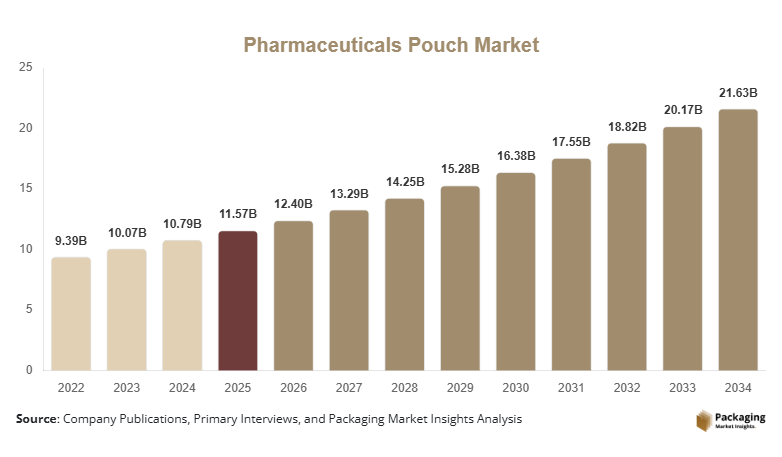
The pharmaceutical pouch market size is projected at USD 12.40 billion in 2026 and is expected to hit USD 21.60 billion by 2034 with a CAGR of 7.2%. The market evaluation includes detailed analysis of pharmaceutical packaging demand, material adoption, manufacturing capacity, regulatory requirements, application performance, and competitive positioning. The study provides segmentation insights, regional analysis, technology assessment, and industry developments influencing future expansion.
Pharmaceutical pouches are flexible packaging solutions designed to protect tablets, capsules, powders, medical devices, and liquid pharmaceutical products from moisture, oxygen, contamination, and external environmental factors. Global pharmaceutical pouch production exceeded 92 billion units in 2025, with oral solid dosage packaging accounting for approximately 54% of consumption. Laminated pouches represented nearly 46% of demand, while aluminum foil pouches contributed around 32% due to superior barrier properties. Increasing adoption of lightweight, sterile, and cost-efficient packaging solutions continues supporting the Pharmaceuticals Pouch Market.
Explore more data points, trends and opportunities Download Free Sample Report
Pharmaceuticals Pouch Market Trends
Increasing Adoption of Sustainable and High-Barrier Flexible Packaging
Pharmaceutical manufacturers are shifting toward recyclable films, mono-material structures, and advanced barrier pouch technologies to improve sustainability. Global production of pharmaceutical flexible pouches exceeded 98 billion units in 2026, while recyclable pouch adoption increased by 29%. Advanced coating technologies improved moisture protection by 21%, and pharmaceutical companies increased flexible packaging usage by 18% to reduce material consumption, strengthening the Pharmaceuticals Pouch Market.
Smart packaging integration, serialization, and tamper-evident technologies are becoming increasingly important in pharmaceutical supply chains. Digital tracking adoption reached approximately 38%, automated pouch inspection systems increased by 24%, and demand from specialty medicines grew by 16%. Healthcare manufacturers are investing in secure and efficient pouch formats for sensitive pharmaceutical products, supporting continuous development in the Pharmaceuticals Pouch Market.
Pharmaceuticals Pouch Market Drivers
Growing Pharmaceutical Production and Demand for Lightweight Packaging
Expansion of pharmaceutical manufacturing and increasing medicine consumption are major drivers of market growth. Global pharmaceutical production increased by 8.1%, healthcare packaging demand exceeded 250 billion units, and flexible pharmaceutical packaging adoption expanded by 19% across major manufacturing facilities. The need for cost-effective, protective, and lightweight packaging solutions continues to accelerate the pharmaceuticals pouch market.
Pharmaceuticals Pouch Market Restraints
Stringent Regulatory Compliance and Material Certification Requirements
Pharmaceutical pouch manufacturers face challenges associated with regulatory approvals, validation processes, and material certification. Compliance costs increased by 14%, testing requirements expanded by 12%, and certification timelines extended by 9% for specialized pharmaceutical packaging solutions. These regulatory complexities create operational challenges for manufacturers within the pharmaceutical pouch market.
Pharmaceuticals Pouch Market Opportunities
Expansion of Biologics, Specialty Drugs, and Home Healthcare Applications
Increasing demand for specialty medicines, biologics, and home-based healthcare products creates new opportunities for pharmaceutical pouch manufacturers. Biologics packaging demand increased by 17%, home healthcare adoption expanded by 22%, and specialty pharmaceutical pouch production exceeded 18 billion units annually. The development of advanced sterile and temperature-resistant pouches is creating new opportunities in the Pharmaceuticals Pouch Market.
Challenges in Pharmaceuticals Pouch Market
Raw Material Price Volatility and Recycling Limitations
The industry faces challenges due to fluctuating polymer prices, aluminum costs, and recycling complexities associated with multi-layer structures. Raw material prices fluctuated by 13%, production expenses increased by 10%, and recycling limitations affected approximately 21% of manufacturers. Improving sustainable material availability remains a significant challenge for the pharmaceutical pouch market.
Report Scope
| Report Metric | Details |
|---|---|
| Market Size in 2025 | USD 11.57 Billion |
| Market Size in 2026 | USD 12.40 Billion |
| Market Size in 2034 | USD 21.60 Billion |
| CAGR | 7.2% (2026-2034) |
| Base Year for Estimation | 2025 |
| Historical Data | 2022-2024 |
| Forecast Period | 2026-2034 |
| Report Coverage | Revenue Forecast, Competitive Landscape, Supply Chain Disruption, Growth Factors, Environment & Regulatory Landscape and Trends |
| Geographies Covered | North America, Europe, APAC, Middle East and Africa, LATAM |
| Countries Covered | U.S., Canada, U.K., Germany, France, Spain, Italy, Russia, Nordic, Benelux, Rest of Europe, China, South Korea, Japan, India, Australia, Singapore, Taiwan, South East Asia, Rest of Asia-Pacific, UAE, Turkey, Saudi Arabia, South Africa, Egypt, Nigeria, Rest of MEA, Brazil, Mexico, Argentina, Chile, Colombia, Rest of LATAM |
Explore more data points, trends and opportunities Download Free Sample Report
Pharmaceuticals Pouch Market Segmentation
The market is segmented by type and application, with laminated pouches accounting for approximately 46% of total demand due to their high barrier performance and compatibility with multiple pharmaceutical products. Prescription medicine packaging dominates application demand with nearly a 48% share, followed by over-the-counter medicines at 34% and medical-supply packaging at 18%.
By Type
Aluminum foil pouches accounted for approximately 32% market share, with annual production exceeding 31 billion units. These pouches provide superior oxygen, moisture, and light protection, making them suitable for sensitive pharmaceutical formulations. Barrier efficiency exceeds 99%, supporting applications requiring extended shelf life.
Plastic pouches represented nearly a 22% share, with production exceeding 21 billion units annually. Materials including polyethylene and polypropylene are widely used due to flexibility, durability, lightweight characteristics, and cost efficiency. These pouches support pharmaceutical powders, medical supplies, and liquid product packaging.
Laminated pouches dominated with approximately 46% share and production exceeding 45 billion units. Multi-layer structures combine polymer films, aluminum layers, and protective coatings to deliver enhanced barrier performance, sealing strength, and contamination protection.
By Application
Prescription medicines accounted for nearly 48% of market demand, with consumption exceeding 47 billion pouch units annually. Pharmaceutical companies use pouches for tablets, capsules, powders, and specialty drugs due to protection against humidity, oxygen exposure, and contamination.
Over-the-counter medicines contributed approximately a 34% share, with production exceeding 33 billion units. These pouches are widely used for pain relief products, supplements, vitamins, and healthcare products due to convenience, portability, and efficient distribution.
Medical supply packaging represented nearly an 18% share, with production exceeding 17 billion units annually. Applications include sterile kits, diagnostic materials, and disposable healthcare products requiring contamination prevention, tamper evidence, and secure transportation.
Pharmaceuticals Pouch Market Segmentations
Type
- Aluminum Foil Pouches
- Plastic Pouches
- Laminated Pouches
Application
- Prescription Medicines
- Over-the-Counter Medicines
- Medical Supplies Packaging
Pharmaceuticals Pouch Market: Regional Outlook
North America
North America accounted for approximately 36% of global market revenue with production exceeding 35 billion pouch units. The United States contributed nearly 84% of regional demand due to advanced pharmaceutical manufacturing, high healthcare expenditure, and strong adoption of flexible packaging solutions.
Europe
Europe represented approximately 29% market share, with production exceeding 28 billion units. Germany, France, Italy, and the United Kingdom contributed more than 72% of regional demand. Strict pharmaceutical regulations and sustainability initiatives support increased pouch adoption.
Asia-Pacific
The Asia-Pacific held approximately a 26% share with production exceeding 25 billion units. China accounted for nearly 44% of regional output, followed by India at 21%, Japan at 12%, and South Korea at 9%. Expanding pharmaceutical manufacturing and healthcare infrastructure drive regional growth.
Latin America
Latin America contributed approximately 6% of global demand. Brazil represented nearly 46% of regional consumption, followed by Mexico at 29%, supported by pharmaceutical production expansion and increasing healthcare access.
Middle East & Africa
The Middle East & Africa accounted for approximately 3% of global demand. Saudi Arabia, the UAE, South Africa, and Egypt are increasing pharmaceutical packaging investments due to healthcare development programs and pharmaceutical manufacturing growth.
Top Players In The Pharmaceuticals Pouch Market
- Amcor plc
- Berry Global Inc.
- Huhtamaki Oyj
- Mondi plc
- Constantia Flexibles Group GmbH
- Sealed Air Corporation
- Sonoco Products Company
- Coveris Management GmbH,
- Winpak Ltd.,
- Glenroy Inc.
Amcor plc holds an estimated 15% market share globally. Maintains a strong position through advanced flexible pharmaceutical packaging solutions, sustainable material development, and extensive manufacturing capabilities. The company provides high-barrier pouches, child-resistant packaging, and specialty healthcare packaging solutions. Continuous investment in recyclable structures, digital technologies, and global production facilities strengthens its competitive positioning in the Pharmaceuticals Pouch Market. Berry Global Inc. Accounts for approximately 11% market share. Strengthens its market position through innovative polymer-based pharmaceutical packaging, advanced manufacturing technologies, and customized healthcare packaging solutions. The company focuses on lightweight materials, sterile packaging systems, and sustainable flexible solutions supporting pharmaceutical manufacturers across global markets.