PET Hinged Containers Market Size
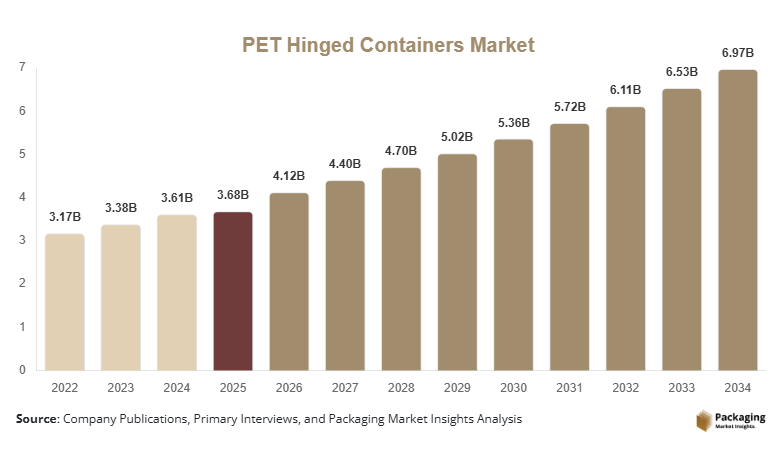
The PET hinged containers market size is projected at USD 4.12 billion in 2026 and is expected to hit USD 6.98 billion by 2034 with a CAGR of 6.8%. Rising demand for transparent food packaging, increasing consumption of ready-to-eat products, and expanding retail packaging applications continue to support industry expansion. The report provides a detailed evaluation of production capacity, technology developments, market segmentation, regional performance, and competitive landscape across key manufacturing regions.
PET hinged containers are rigid thermoformed plastic packaging solutions manufactured from polyethylene terephthalate for fresh produce, bakery products, confectionery, deli items, and healthcare products. Global production exceeded 56.5 billion units during 2025, while food packaging represented approximately 67% of total consumption. Recycled PET content accounted for nearly 31% of production, and organized retail contributed over 58% of global demand, reinforcing the PET-hinged containers market.
Explore more data points, trends and opportunities Download Free Sample Report
PET Hinged Containers Trends
Increasing Adoption of Recycled PET Packaging
Packaging manufacturers continue increasing recycled PET (rPET) content to meet sustainability objectives and regulatory requirements. Production of rPET hinged containers exceeded 17.5 billion units during 2025, while adoption among food retailers increased to approximately 44%. Investments in thermoforming technologies expanded by 13%, supporting sustainable packaging innovation and strengthening the PET-hinged containers market.
Demand for lightweight, tamper-evident, and high-clarity packaging continues expanding across supermarkets and foodservice industries. More than 39 billion food containers were supplied globally during 2025, while automated thermoforming production lines increased output efficiency by 18%. Premium transparent packaging accounted for approximately 49% of retail shelf-ready packaging, supporting the PET hinged container market.
PET Hinged Containers Drivers
Growing Demand for Fresh and Ready-to-eat Food Packaging
Expansion of supermarkets, convenience stores, and food delivery services continues driving demand for PET-hinged containers. Fresh food packaging demand increased by 11% during 2025, while global production exceeded 58 billion containers annually. Nearly 72% of packaged bakery and produce products utilize transparent rigid packaging, supporting the PET hinged container market.
PET Hinged Containers Restraints
Environmental Concerns Regarding Plastic Packaging
Government regulations and consumer preference for alternative materials continue creating challenges for virgin PET packaging. Approximately 37% of packaging companies are increasing investments in fiber-based alternatives, while virgin PET resin prices fluctuated by 10% during 2025. Compliance costs continue influencing the PET-hinged containers market.
PET Hinged Containers Opportunities
Expansion of Recycled PET Manufacturing Capacity
Global recycling infrastructure continues improving, supporting greater availability of food-grade recycled PET. Annual rPET production capacity exceeded 6.8 million metric tons, while recycled content utilization increased by 15% during 2025. Food-grade packaging demand continues creating new opportunities for the PET-hinged containers market.
Challenges in PET-hinged containers
Volatility in Raw Material Prices
PET resin prices remain influenced by crude oil fluctuations and supply chain disruptions. Feedstock costs increased between 8% and 14% during 2025, while transportation expenses rose by approximately 7%. Manufacturers continue optimizing material utilization to address cost pressures affecting the PET-hinged containers market.
Report Scope
| Report Metric | Details |
|---|---|
| Market Size in 2025 | USD 3.68 Billion |
| Market Size in 2026 | USD 4.12 Billion |
| Market Size in 2034 | USD 6.98 Billion |
| CAGR | 6.8% (2026-2034) |
| Base Year for Estimation | 2025 |
| Historical Data | 2022-2024 |
| Forecast Period | 2026-2034 |
| Report Coverage | Revenue Forecast, Competitive Landscape, Supply Chain Disruption, Growth Factors, Environment & Regulatory Landscape and Trends |
| Geographies Covered | North America, Europe, APAC, Middle East and Africa, LATAM |
| Countries Covered | U.S., Canada, U.K., Germany, France, Spain, Italy, Russia, Nordic, Benelux, Rest of Europe, China, South Korea, Japan, India, Australia, Singapore, Taiwan, South East Asia, Rest of Asia-Pacific, UAE, Turkey, Saudi Arabia, South Africa, Egypt, Nigeria, Rest of MEA, Brazil, Mexico, Argentina, Chile, Colombia, Rest of LATAM |
Explore more data points, trends and opportunities Download Free Sample Report
PET Hinged Containers Market Segmentation
The market is segmented by product type and end-use industry. Clear PET hinged containers accounted for approximately 52% of total revenue during 2025, while food & beverage remained the dominant application with nearly 67% market share because of extensive fresh food packaging requirements.
By Product Type
Clear PET containers dominated the market with approximately 52% share. Annual production exceeded 29 billion units, providing superior transparency, high impact resistance, and lightweight construction suitable for fresh produce, bakery, and deli products.
Recycled PET hinged containers represented approximately 31% of market demand. Production exceeded 17.5 billion units, with recycled content reaching up to 100% in selected packaging grades while maintaining food-contact compliance.
Tamper-evident products accounted for nearly 17% of the market. Annual production surpassed 10 billion units, featuring secure locking mechanisms, enhanced product protection, and compatibility with automated filling and sealing systems.
By Application
Food & beverage remained the largest application with nearly 67% market share. More than 39 billion containers were consumed annually for fruits, vegetables, bakery items, salads, desserts, and ready-to-eat meals, with organized retail penetration exceeding 70%.
Retail packaging represented approximately 21% of market demand. Consumer electronics, personal care products, and promotional merchandise increasingly utilize transparent PET hinged containers for improved product visibility and shelf appeal.
Healthcare accounted for nearly 12% of total demand. Medical kits, diagnostic products, and pharmaceutical packaging applications exceeded 6 billion units annually while maintaining stringent hygiene and product protection requirements.
PET Hinged Containers Market Segmentations
Product Type
- Clear PET Hinged Containers
- Recycled PET Hinged Containers
- Tamper-Evident PET Hinged Containers
- Vented PET Hinged Containers
Application
- Food & Beverage
- Retail Packaging
- Healthcare
- Fresh Produce Packaging
- Bakery & Confectionery Packaging
Distribution Channel
- Direct Sales
- Packaging Distributors
- Online Sales
- OEM Suppliers
PET Hinged Containers Regional Outlook
North America
North America accounted for approximately 29% of global revenue during 2025. The United States represented nearly 82% of regional demand, with annual production exceeding 15 billion containers. Fresh produce and bakery packaging remained dominant applications.
Europe
Europe contributed nearly 27% of the global market. Germany, France, Italy, Spain, and the United Kingdom collectively manufactured over 14 billion containers annually. Recycled PET adoption exceeded 46%, supported by stringent sustainability regulations.
Asia-Pacific
Asia-Pacific held approximately 36% market share and remained the fastest-growing region. China, India, Japan, and South Korea produced more than 20 billion containers annually. Food processing and organized retail expansion supported annual demand growth exceeding 9%.
Latin America
Latin America accounted for approximately 5% of global demand. Brazil and Mexico generated over 69% of regional consumption through expanding supermarket chains and food processing industries.
Middle East & Africa
Middle East & Africa represented around 3% of market revenue. Increasing packaged food consumption and retail modernization continued supporting regional demand growth.
Top Players In PET Hinged Containers
- Berry Global Inc.
- Pactiv Evergreen Inc.
- Amcor plc
- Sonoco Products Company
- Sabert Corporation
- Genpak LLC,
- Anchor Packaging LLC
- Dart Container Corporation
- Lacerta Group, LLC,
- Placon Corporation
Berry Global Inc. Estimated market share: 16%–18% Global leader in rigid plastic packaging and thermoformed PET container manufacturing. Strong presence across North America, Europe, and Asia-Pacific. The company focuses on recyclable PET packaging, lightweight container designs, high-speed thermoforming technologies, and food-grade recycled resin integration. Continuous investments in sustainable packaging innovation and global manufacturing capabilities strengthen its competitive position. Pactiv Evergreen Inc. Estimated market share: 11%–13% Leading manufacturer of food packaging and PET hinged container solutions. Extensive product portfolio serving supermarkets, food processors, and foodservice industries. The company emphasizes recyclable packaging, advanced thermoforming technology, tamper-evident designs, and customized packaging solutions while expanding production capacity to support growing demand across international markets.