Thermoformed Containers Market Size
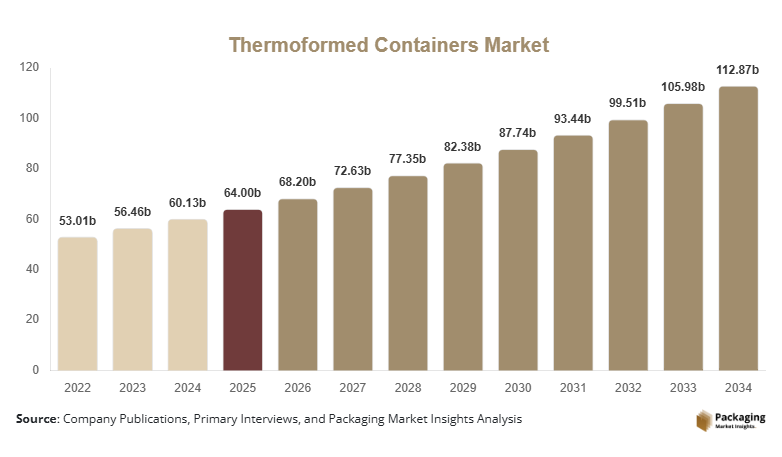
Thermoformed Containers market size is projected at USD 68.2 billion in 2026 and is expected to hit USD 112.6 billion by 2034 with a CAGR of 6.5%.The report evaluates production capacity, material innovations, demand analysis, segmentation, pricing trends, and the competitive landscape across global markets. It provides detailed historical analysis from 2022–2024, establishes 2025 as the base year, and forecasts industry developments through 2034.
Thermoformed containers are rigid or semi-rigid packaging products manufactured by heating plastic or paperboard sheets and forming them into containers for food, healthcare, industrial, and consumer applications. Global production exceeded 245 billion units during 2025, with plastic-based thermoformed containers accounting for nearly 74% of total output. Food & beverage applications contributed approximately 57% of overall consumption, while automated thermoforming systems achieved penetration above 66%, strengthening the Thermoformed Containers Market.
Explore more data points, trends and opportunities Download Free Sample Report
Thermoformed Containers Market Trends
Increasing Adoption of Sustainable Thermoforming Materials
Packaging manufacturers are introducing recyclable PET, recycled PET (rPET), and paper-based thermoformed containers to comply with sustainability regulations. More than 78 billion units of recyclable thermoformed containers were produced during 2025, while recycled content utilization increased by 18% compared with the previous year. These developments continue supporting the Thermoformed Containers Market Trend.
Growing Demand for Convenience Food Packaging
Expanding consumption of ready-to-eat meals, fresh produce, dairy products, and takeaway foods continues driving thermoformed packaging demand. More than 140 billion food containers were manufactured globally during 2025, while convenience food consumption increased by approximately 8% annually. High-speed thermoforming equipment capable of producing over 45,000 containers per hour continues strengthening the Thermoformed Containers Market.
Thermoformed Containers Market Drivers
Expansion of Packaged Food and Retail Distribution Networks
Growing urbanization, retail expansion, and increasing consumption of packaged foods continue driving thermoformed container demand. Global packaged food production exceeded 2.4 billion metric tons during 2025, while organized retail sales increased by nearly 9% worldwide. Food packaging represents over 57% of total demand, supporting Thermoformed Containers Market Growth.
Thermoformed Containers Market Restraints
Environmental Regulations on Conventional Plastic Packaging
Stringent regulations regarding single-use plastics and increasing recycling mandates continue affecting conventional thermoformed container production. Nearly 34% of packaging regulations introduced globally between 2023 and 2025 targeted plastic waste reduction, while virgin resin prices fluctuated by approximately 13%, creating cost pressures across the Thermoformed Containers Market.
Thermoformed Containers Market Opportunities
Growing Investment in Recyclable and Bio-based Packaging Solutions
Packaging manufacturers continue investing in recycled PET, biodegradable polymers, and fiber-based thermoformed containers. Global sustainable packaging investments exceeded USD 23 billion during 2025, while recycled-content thermoformed packaging adoption increased by approximately 21% annually, creating significant opportunities within the Thermoformed Containers Market.
Challenges in Thermoformed Containers Market
Maintaining Cost Efficiency While Improving Sustainability
Manufacturers face challenges balancing lightweight designs, recycled material incorporation, and product durability. Average packaging thickness has declined by approximately 11% during the past five years, while recycled content targets increased beyond 30% across multiple regions. These evolving requirements continue challenging the Thermoformed Containers Market.
Report Scope
| Report Metric | Details |
|---|---|
| Market Size in 2025 | USD 64.0 billion |
| Market Size in 2026 | USD 68.2 billion |
| Market Size in 2034 | USD 112.6 billion |
| CAGR | 6.5% (2026-2034) |
| Base Year for Estimation | 2025 |
| Historical Data | 2022-2024 |
| Forecast Period | 2026-2034 |
| Report Coverage | Revenue Forecast, Competitive Landscape, Supply Chain Disruption, Growth Factors, Environment & Regulatory Landscape and Trends |
| Geographies Covered | North America, Europe, APAC, Middle East and Africa, LATAM |
| Countries Covered | U.S., Canada, U.K., Germany, France, Spain, Italy, Russia, Nordic, Benelux, Rest of Europe, China, South Korea, Japan, India, Australia, Singapore, Taiwan, South East Asia, Rest of Asia-Pacific, UAE, Turky, Saudi Arabia, South Africa, Egypt, Nigeria, Rest of MEA, Brazil, Mexico, Argentina, Chile, Colombia, Rest of LATAM |
Explore more data points, trends and opportunities Download Free Sample Report
Thermoformed Containers Market Segmentation
The market is segmented by material type and end-use industry. Plastic containers accounted for approximately 74% of total revenue during 2025, while food & beverage applications represented nearly 57% of global demand.
By Type
Plastic
Plastic thermoformed containers dominated the market with approximately 74% share. Annual production exceeded 181 billion units, supported by PET, PP, and PS materials offering excellent transparency, durability, and cost efficiency for food packaging applications.
Paperboard
Paperboard accounted for nearly 17% of market demand, with production exceeding 41 billion units annually. Increasing sustainability initiatives and improved barrier coatings continue expanding adoption across retail and food service packaging.
Aluminum
Aluminum thermoformed containers represented approximately 9% of the market. Annual production exceeded 23 billion units, serving premium food packaging, pharmaceutical, and industrial applications requiring high barrier protection and temperature resistance.
By Application
Food & Beverage
Food & beverage accounted for approximately 57% of total market demand. More than 140 billion units were consumed annually for fresh foods, ready meals, bakery products, fruits, dairy products, and beverages.
Healthcare
Healthcare represented nearly 22% of the market. Thermoformed trays, blister packs, diagnostic packaging, and sterile medical containers exceeded 54 billion units in annual production, driven by pharmaceutical expansion.
Consumer Goods
Consumer goods contributed approximately 16% of total demand. Electronics, cosmetics, personal care, and household products increasingly utilize thermoformed containers for protective packaging and retail presentation.
Thermoformed Containers Market Segmentations
Material Type
- Plastic
- Paperboard
- Aluminum
End-use Industry
- Food & Beverage
- Healthcare
- Consumer Goods
Thermoformed Containers Regional Outlook
North America
North America accounted for approximately 29% of global revenue during 2025. The United States contributed over 81% of regional demand through strong packaged food production, healthcare packaging, and advanced thermoforming technologies.
Europe
Europe represented approximately 28% of market share. Germany, France, Italy, and the United Kingdom remain major producers, supported by circular economy initiatives and increasing recycled packaging adoption.
Asia-Pacific
Asia-Pacific dominated the market with nearly 36% of global revenue. China, India, Japan, and South Korea generated over 72% of regional production, driven by expanding food processing industries and consumer packaging demand.
Rest of World
Latin America and Middle East & Africa collectively accounted for approximately 7% of market revenue. Expanding food manufacturing, retail modernization, and pharmaceutical production continue supporting regional growth.
Top players in Thermoformed Containers Market
- Amcor plc
- Sonoco Products Company
- Berry Global Inc.
- Pactiv Evergreen Inc.
- Genpak LLC
- Anchor Packaging LLC
- Placon Corporation
- Sabert Corporation
- DS Smith Plc
- Huhtamaki Oyj
Amcor plc
-
Holds an estimated 13–16% share of the global thermoformed containers market.
-
Operates manufacturing facilities across North America, Europe, Asia-Pacific, and Latin America.
-
Focuses on recyclable PET containers, lightweight packaging, and sustainable thermoforming technologies.
-
Serves food, beverage, healthcare, and consumer goods industries through advanced packaging solutions.
-
Continues expanding investments in circular packaging innovations and recycled material integration.
Berry Global Inc.
-
Accounts for approximately 11–14% of global market revenue.
-
Manufactures high-performance thermoformed containers using PET, PP, and recycled polymers.
-
Maintains strong relationships with multinational food processors, retailers, and healthcare companies.
-
Invests heavily in lightweight packaging, recycled resin technologies, and manufacturing automation.
-
Strengthens global competitiveness through product innovation and sustainable packaging development.