Pesticides Packaging Market Size
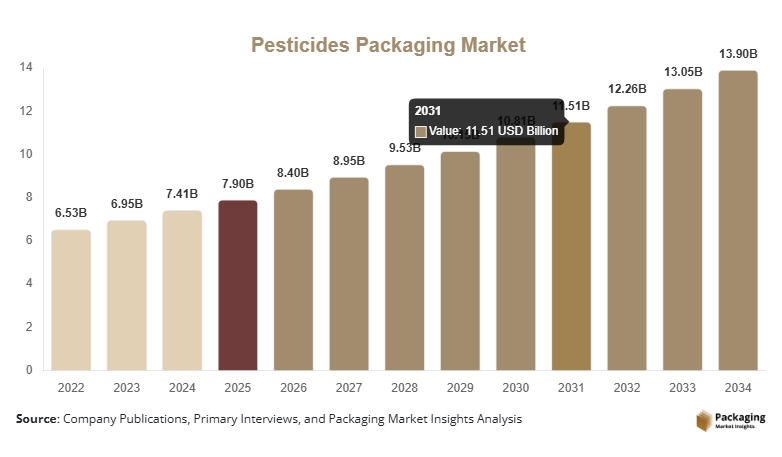
The pesticides packaging market size is projected at USD 8.4 billion in 2026 and is expected to hit USD 13.9 billion by 2034 with a CAGR of 6.5%. Rising agricultural chemical consumption, increasing demand for safe transportation, and continuous packaging innovations are supporting market expansion. The report provides comprehensive segmentation analysis, production statistics, competitive landscape evaluation, and regional performance assessment to assist stakeholders in strategic decision-making.
The pesticides packaging market comprises rigid and flexible packaging solutions specifically designed for insecticides, herbicides, fungicides, and other crop protection chemicals. Global packaging production exceeded 29.6 billion units in 2025, while industrial filling capacity surpassed 620 million containers annually. Plastic packaging accounted for nearly 63.4% of total production, paper-based solutions contributed 22.8%, and metal packaging represented 13.8%. Agricultural chemical packaging penetration exceeded 81% across commercial farming operations, with bottles and containers contributing approximately 52% of total packaging demand, reinforcing the pesticides packaging market.
Explore more data points, trends and opportunities Download Free Sample Report
Pesticides Packaging Market Trends
Growing Adoption of Sustainable and High-Barrier Packaging
Manufacturers are increasingly adopting recyclable polymers, mono-material structures, and lightweight containers to improve sustainability while maintaining chemical resistance. Annual production of recyclable pesticide packaging exceeded 8.7 billion units, representing nearly 34% of total output. High-barrier packaging adoption increased to 41%, while lightweight packaging reduced material consumption by 15%. These developments continue to strengthen the pesticides' packaging market.
Advanced barrier technologies, digital printing, tamper-evident closures, and smart labeling are improving product safety and traceability. Smart label adoption reached 26% among premium pesticide products, while automated filling systems improved packaging efficiency by 18%. Flexible pouch production exceeded 4.2 billion units, supporting convenient storage and transportation across agricultural supply chains. These innovations continue shaping the pesticides' packaging market.
Pesticides Packaging Market Drivers
Increasing Agricultural Chemical Consumption Worldwide
Growing agricultural production and food security requirements are increasing pesticide usage across developed and emerging economies. Global pesticide consumption exceeded 4.5 million metric tons, while packaged agricultural chemicals recorded annual shipment growth of 7.2%. Commercial farming represented approximately 74% of total packaged pesticide demand, supporting investments in durable, leak-proof, and regulation-compliant packaging solutions that continue driving the Pesticides Packaging Market.
Pesticides Packaging Market Restraints
Volatility in Raw Material Prices and Regulatory Compliance
Packaging manufacturers face fluctuations in resin, paperboard, and metal prices, directly impacting production costs. Polymer prices increased by nearly 11%, while aluminum costs rose 9% during recent procurement cycles. Compliance with hazardous chemical packaging regulations increased operational expenses by approximately 8%, creating cost pressures that influence the pesticides packaging market.
Pesticides Packaging Market Opportunities
Expansion of Precision Agriculture and Sustainable Packaging
Precision farming and environmentally responsible packaging are creating new opportunities. Bio-based packaging production increased by 21%, while reusable agricultural containers expanded by 17% year-over-year. Demand for lightweight packaging solutions grew by 19%, encouraging manufacturers to develop innovative materials with enhanced durability and reduced environmental impact, expanding the Pesticides Packaging Market.
Challenges in Pesticides Packaging Market
Complex Transportation and Hazardous Material Handling
Packaging suppliers must meet stringent transportation regulations for hazardous chemicals. Approximately 14% of packaging redesign projects focus on improved leak resistance, while testing costs increased by 12% due to evolving international standards. Maintaining chemical compatibility, impact resistance, and labeling compliance across multiple regions remains a major challenge for the pesticide packaging market.
Report Scope
| Report Metric | Details |
|---|---|
| Market Size in 2025 | USD 7.9 Billion |
| Market Size in 2026 | USD 8.4 Billion |
| Market Size in 2034 | USD 13.9 Billion |
| CAGR | 6.5% (2026-2034) |
| Base Year for Estimation | 2025 |
| Historical Data | 2022-2024 |
| Forecast Period | 2026-2034 |
| Report Coverage | Revenue Forecast, Competitive Landscape, Supply Chain Disruption, Growth Factors, Environment & Regulatory Landscape and Trends |
| Geographies Covered | North America, Europe, APAC, Middle East and Africa, LATAM |
| Countries Covered | U.S., Canada, U.K., Germany, France, Spain, Italy, Russia, Nordic, Benelux, Rest of Europe, China, South Korea, Japan, India, Australia, Singapore, Taiwan, South East Asia, Rest of Asia-Pacific, UAE, Turkey, Saudi Arabia, South Africa, Egypt, Nigeria, Rest of MEA, Brazil, Mexico, Argentina, Chile, Colombia, Rest of LATAM |
Explore more data points, trends and opportunities Download Free Sample Report
Pesticides Packaging Market Segmentation
Plastic packaging dominates the market with nearly 63.4% share, followed by paper & paperboard at 22.8% and metal at 13.8%. Bottles & containers account for approximately 52% of total demand, while bags & sacks and pouches continue expanding with increasing agricultural chemical distribution.
By Material
Plastic remains the leading material owing to excellent chemical resistance, lightweight characteristics, and cost efficiency. It contributes approximately 63.4% market share, with production exceeding 18.7 billion units annually. HDPE, PET, and multilayer plastics are widely utilized for pesticide storage and transportation.
Paper & paperboard packaging accounts for nearly 22.8% of the market. Annual production exceeded 6.8 billion units, primarily serving dry pesticide formulations. Multiwall construction, coated paper structures, and reinforced fiber packaging improve durability and moisture resistance.
Metal packaging contributes approximately 13.8% share, with production exceeding 4.1 billion units. Steel and aluminum containers provide superior barrier protection for specialty agricultural chemicals requiring extended shelf life and enhanced product stability.
By Packaging Type
Bottles & containers dominate with nearly 52% market share and annual production above 15.4 billion units. These packages provide secure dispensing systems, tamper-evident closures, and excellent chemical compatibility for liquid pesticide formulations.
Bags & sacks account for approximately 28% of total demand with production exceeding 8.3 billion units. Multi-layer paper and woven polymer constructions are commonly used for granular and powdered pesticide products, offering high load-bearing capacity.
Pouches contribute around 20% market share, with production surpassing 5.9 billion units. Flexible laminated structures reduce packaging weight by nearly 25% while improving logistics efficiency and storage optimization.
Pesticides Packaging Market Segmentations
Material
- Plastic
- Paper & Paperboard
- Metal
Packaging Type
- Bottles & Containers
- Bags & Sacks
- Pouches
Pesticides Packaging Regional Outlook
North America
North America accounted for approximately 29.4% of global revenue. Annual production exceeded 7.8 billion packaging units, with the United States contributing nearly 84% of regional demand. High adoption of advanced agricultural chemicals and strict packaging regulations continue supporting market expansion.
Europe
Europe represented nearly 24.8% market share, producing over 6.3 billion units annually. Germany, France, Italy, and Spain collectively contributed approximately 69% of regional consumption. Sustainable packaging initiatives continue driving investments across the region.
Asia-Pacific
The Asia-Pacific dominated with nearly a 36.1% share and annual production exceeding 10.9 billion units. China contributed 41% of regional output, followed by India at 24% and Japan at 11%. Expanding agricultural activities and rising pesticide utilization continue accelerating regional demand.
Latin America
Latin America accounted for approximately 6.1% of the market. Brazil represented nearly 54% of regional demand, followed by Argentina and Mexico. Increasing commercial farming continues supporting packaging production across the region.
Middle East & Africa
The Middle East & Africa contributed nearly 3.6% of global revenue. Agricultural modernization and expanding crop protection product usage continue driving packaging demand, with South Africa, Saudi Arabia, and Egypt serving as key regional contributors.
Top Players In The Pesticides Packaging Market
- Amcor plc
- Berry Global Inc.
- Greif Inc.
- Mauser Packaging Solutions
- Schütz GmbH & Co. KGaA
- Mondi plc
- Sonoco Products Company
- DS Smith Plc
- CCL Industries Inc.
- Silgan Holdings Inc.
Amcor plc
- Estimated market presence: 11-13%
- Global leader with an extensive rigid and flexible pesticide packaging portfolio.
- Strong focus on recyclable materials, lightweight designs, and high-barrier packaging technologies.
- Broad manufacturing footprint supports multinational agrochemical companies with regulatory-compliant packaging solutions.
Berry Global Inc.
- Estimated market presence: 9-11%
- Major supplier of HDPE containers, closures, and industrial chemical packaging.
- Extensive investment in sustainable plastics, recycled resin integration, and advanced molding technologies.
- Strong customer relationships across agricultural chemical manufacturers enhance its competitive positioning.