PCR Packaging Market Size and Growth
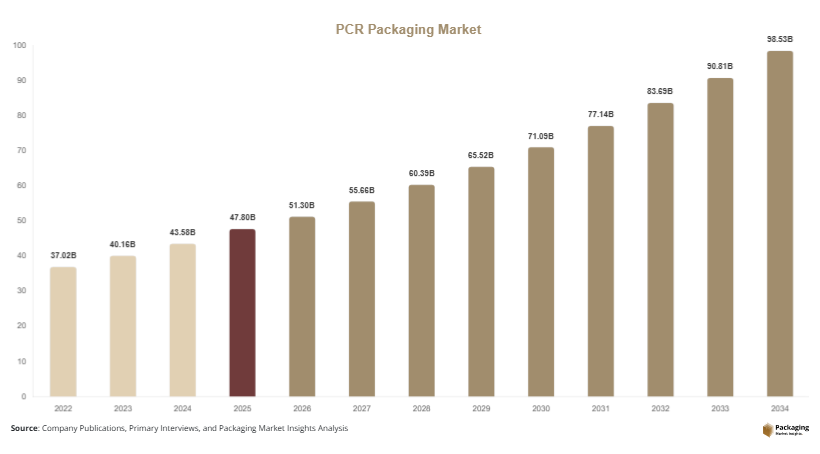
The global PCR packaging market size is estimated at USD 47.8 billion in 2025, increasing to approximately USD 51.3 billion in 2026. By 2034, the market is projected to reach nearly USD 98.6 billion, registering a CAGR of 8.5% during 2025–2034. The PCR Packaging Market is witnessing strong expansion due to increasing demand for sustainable packaging solutions across food & beverage, personal care, healthcare, and industrial sectors. PCR packaging refers to packaging products manufactured using post-consumer recycled materials, primarily recycled plastics, paper, aluminum, and glass collected from consumer waste streams. Companies across multiple industries are adopting PCR packaging to reduce virgin material consumption, lower carbon emissions, and comply with evolving environmental regulations.
One of the major growth factors driving the market is the increasing implementation of sustainability regulations related to plastic waste reduction. Governments across North America and Europe are introducing mandatory recycled-content targets for packaging manufacturers, which is accelerating the adoption of PCR materials. Another important growth factor is the rising consumer preference for environmentally responsible products. Brands in cosmetics, beverages, and household care industries are increasingly using PCR packaging to improve sustainability positioning and strengthen customer engagement. Additionally, technological advancements in recycling infrastructure and polymer processing are improving the quality, durability, and visual appearance of recycled packaging materials.
Key Highlights
- Asia Pacific dominated the market with a 39.8% share in 2025.
- Latin America is projected to grow at the fastest CAGR of 8.9%.
- Bottles and containers led the type segment with a 36.5% share.
- Recycled plastic packaging dominated with a 54.7% share.
- Food & beverage applications led the end-use segment with 42.4% share.
- The US remained the dominant country with a market size of USD 10.8 billion in 2025 and USD 11.6 billion in 2026.
Explore more data points, trends and opportunities Download Free Sample Report
Market Trends
Rising Integration of Recycled Content in Premium Consumer Packaging
Brand owners are increasingly integrating post-consumer recycled materials into premium packaging formats to improve sustainability performance and strengthen environmental branding. Personal care, cosmetics, and beverage companies are launching products packaged in high-PCR-content bottles, jars, and containers to address changing consumer expectations. For example, several multinational beauty brands have introduced shampoo and skincare bottles containing over 70% recycled plastic content. Manufacturers are also investing in improved resin purification technologies to enhance packaging clarity and durability. This trend is expected to accelerate as retailers impose sustainability standards on suppliers and governments introduce stricter packaging waste regulations. Future packaging innovation will likely focus on balancing recycled content, aesthetics, and product protection without compromising shelf appeal or functional performance.
Growth of Advanced Recycling Technologies for Food-Grade Packaging
Advanced recycling technologies such as chemical recycling and depolymerization are becoming increasingly important in the PCR packaging market. These technologies allow manufacturers to convert post-consumer waste into high-quality food-grade materials suitable for sensitive applications. Food and beverage companies are increasingly adopting recycled PET and HDPE packaging to comply with sustainability commitments while maintaining safety standards. For instance, beverage producers in Europe and North America are expanding the use of recycled plastic bottles supported by advanced recycling partnerships. Future investment in automated sorting systems and polymer recovery technologies is expected to improve material availability and quality consistency. This trend will support the expansion of PCR packaging into pharmaceutical, dairy, and ready-to-eat food applications over the forecast period.
Market Drivers
Government Regulations Supporting Circular Packaging Economy
Government regulations aimed at reducing plastic waste and promoting recycling are a major driver for the PCR packaging market. Several countries have introduced mandatory recycled-content requirements for packaging materials, particularly in food, beverage, and consumer goods industries. Regulations related to extended producer responsibility and single-use plastic reduction are encouraging manufacturers to shift toward recycled packaging solutions. For example, packaging producers in the European Union are increasing investment in recycled polymer processing facilities to comply with regional sustainability targets. This regulatory pressure is creating long-term demand for PCR packaging materials and accelerating innovation in recyclable product design. As additional countries strengthen environmental legislation, demand for PCR packaging solutions is expected to increase steadily across industrial and consumer sectors.
Increasing Consumer Demand for Sustainable Packaging Solutions
Consumer awareness regarding environmental sustainability is significantly influencing packaging purchasing decisions. Buyers increasingly prefer products packaged in recyclable and recycled-content materials, encouraging brands to adopt PCR packaging across product lines. Food, beverage, and cosmetics companies are using sustainability-focused packaging strategies to improve brand perception and customer loyalty. For example, several beverage brands in the United States and Europe have expanded the use of recycled PET bottles to reduce virgin plastic consumption. The growth of environmentally conscious retail channels and eco-labeling initiatives is further supporting market demand. As sustainability becomes a key purchasing factor among younger consumers, companies are expected to increase investment in high-PCR-content packaging formats and circular economy partnerships.
Market Restraint
Limited Availability and Quality Variability of Recycled Raw Materials
One of the major restraints affecting the PCR packaging market is the inconsistent availability and quality of recycled raw materials. Post-consumer waste streams often contain contamination, mixed polymers, and impurities that can reduce packaging performance and processing efficiency. Manufacturers may face challenges maintaining consistent product quality, particularly for food-grade and healthcare packaging applications that require strict safety standards. In addition, fluctuations in recycling collection rates and waste management infrastructure can limit the supply of high-quality recycled plastics and paper materials. For example, packaging producers in developing economies frequently encounter shortages of sorted recyclable waste, increasing procurement costs and production delays. Quality inconsistency can also affect packaging appearance, color uniformity, and mechanical properties, limiting adoption in premium consumer products. Furthermore, advanced recycling technologies require substantial capital investment, which may restrict expansion among smaller manufacturers. These challenges collectively create operational complexity and may slow market penetration in regions with underdeveloped recycling systems and limited waste segregation infrastructure.
Market Opportunities
Expansion of Sustainable E-commerce Packaging Solutions
The rapid growth of e-commerce is creating significant opportunities for PCR packaging manufacturers. Online retailers and logistics companies are increasingly adopting recycled-content mailers, corrugated packaging, flexible pouches, and protective packaging materials to reduce environmental impact. Brands are also focusing on lightweight and recyclable packaging formats to improve shipping efficiency and lower carbon emissions. For example, several global e-commerce platforms are introducing PCR-based delivery packaging programs to reduce virgin plastic consumption across fulfillment operations. Future growth in online grocery, apparel, and consumer electronics deliveries is expected to further strengthen demand for sustainable packaging solutions. Companies investing in recyclable flexible packaging and high-durability recycled materials are likely to benefit from long-term expansion in e-commerce logistics applications.
Increasing Adoption in Personal Care and Cosmetic Packaging
The personal care and cosmetics industry presents strong growth opportunities for the PCR packaging market. Beauty and skincare brands are increasingly adopting recycled-content bottles, jars, caps, and dispensers to align with sustainability goals and changing consumer preferences. High-end cosmetic companies are investing in aesthetically appealing recycled packaging with improved transparency and premium finishes. For instance, several skincare manufacturers in South Korea and France are using recycled PET and polypropylene containers for product launches targeting environmentally conscious consumers. Future innovation in decorative recycled materials and refillable packaging systems is expected to expand application scope. Growing demand for sustainable luxury packaging and refill-based beauty products will likely create additional opportunities for PCR packaging suppliers worldwide.
Report Scope
| Report Metric | Details |
|---|---|
| Market Size in 2025 | USD 47.8 Billion |
| Market Size in 2026 | USD 51.3 Billion |
| Market Size in 2034 | USD 98.6 Billion |
| CAGR | 8.5% (2026-2034) |
| Base Year for Estimation | 2025 |
| Historical Data | 2022-2024 |
| Forecast Period | 2026-2034 |
| Report Coverage | Revenue Forecast, Competitive Landscape, Supply Chain Disruption, Growth Factors, Environment & Regulatory Landscape and Trends |
| Geographies Covered | North America, Europe, APAC, Middle East and Africa, LATAM |
| Countries Covered | U.S., Canada, U.K., Germany, France, Spain, Italy, Russia, Nordic, Benelux, Rest of Europe, China, South Korea, Japan, India, Australia, Singapore, Taiwan, South East Asia, Rest of Asia-Pacific, UAE, Turky, Saudi Arabia, South Africa, Egypt, Nigeria, Rest of MEA, Brazil, Mexico, Argentina, Chile, Colombia, Rest of LATAM |
Explore more data points, trends and opportunities Download Free Sample Report
Segmental Analysis
By Type
Bottles and containers dominated the PCR packaging market in 2024, accounting for approximately 36.5% of total revenue. These packaging formats are widely used across beverage, food, personal care, and household product industries due to their durability, convenience, and compatibility with recycled plastics such as PET and HDPE. Beverage manufacturers increasingly use PCR bottles to comply with sustainability regulations and reduce carbon footprints. Personal care brands are also adopting recycled-content jars and containers for shampoos, lotions, and skincare products. The dominance of this segment is further supported by improvements in bottle-to-bottle recycling systems and advanced resin purification technologies that enable production of food-grade recycled packaging with strong visual appeal and mechanical performance.
Flexible pouches are expected to emerge as the fastest-growing type segment, expanding at a CAGR of 9.3% during the forecast period. Growth is driven by rising demand for lightweight, cost-efficient, and recyclable packaging solutions in food, e-commerce, and personal care applications. Flexible PCR packaging reduces transportation costs and material usage while supporting sustainability initiatives. Packaging manufacturers are increasingly developing mono-material recyclable pouches containing high percentages of recycled content. For example, snack food and detergent brands are introducing refill pouches made from recycled polyethylene films to reduce virgin plastic consumption. Future innovation in barrier coatings and recyclable multilayer structures is expected to improve product protection and expand application potential for PCR flexible packaging solutions globally.
By Material
Recycled plastic packaging held the largest market share in 2024, representing approximately 54.7% of global revenue. Materials such as recycled PET, HDPE, and polypropylene are widely used due to their durability, flexibility, and suitability for mass consumer packaging applications. Beverage, household care, and food companies continue to increase PCR plastic usage to meet sustainability goals and regulatory requirements. Recycled plastic packaging also supports lightweight transportation and reduced production costs compared to alternative materials. Advancements in mechanical and chemical recycling technologies are improving resin quality and enabling higher recycled content percentages in food-grade packaging. Strong demand from retail and e-commerce industries further supports the dominance of this segment across global markets.
Recycled paper materials are projected to record the fastest CAGR of 8.8% during the forecast period. The growth is driven by increasing restrictions on single-use plastics and rising consumer preference for biodegradable packaging materials. Recycled paper packaging is gaining popularity in e-commerce, food delivery, and retail applications because of its recyclability and lower environmental impact. Packaging producers are introducing durable corrugated solutions and molded fiber packaging products with improved moisture resistance and printability. For example, online retailers are replacing plastic mailers with recycled paper packaging to strengthen sustainability positioning. Continued innovation in coated paper technologies and compostable packaging materials is expected to expand adoption across multiple industrial sectors.
By End-Use
The food & beverage industry dominated the PCR packaging market in 2024, accounting for approximately 42.4% of total market revenue. Rising demand for sustainable beverage bottles, food trays, takeaway containers, and flexible packaging solutions is supporting segment growth. Food manufacturers are increasingly adopting PCR materials to meet regulatory requirements and improve environmental branding. Beverage companies in Europe and North America are introducing recycled PET bottles with higher recycled content percentages to reduce virgin resin consumption. Growth in packaged food consumption, urbanization, and convenience-based lifestyles are also strengthening demand for sustainable packaging formats. Additionally, advancements in food-grade recycling technologies are enabling broader application of PCR materials in sensitive food-contact packaging products.
Personal care packaging is expected to be the fastest-growing end-use segment, registering a CAGR of 9.1% over the forecast period. Cosmetics, skincare, and haircare brands are rapidly adopting PCR packaging to align with sustainability commitments and changing consumer preferences. Recycled-content jars, bottles, pumps, and dispensers are becoming increasingly common in premium beauty product lines. Companies are investing in aesthetically refined PCR materials with enhanced transparency and decorative capabilities to maintain luxury branding standards. For example, several global beauty companies are introducing refillable PCR packaging systems for skincare and fragrance products. Future growth is expected to be supported by eco-conscious consumers, refill-based product models, and increasing investment in sustainable cosmetic packaging innovation.
PCR Packaging Market Segmentations
By Type
- Bottles & Containers
- Flexible Pouches
- Trays
- Corrugated Packaging
- Films & Wraps
By Material
- Recycled Plastic
- Recycled Paper
- Recycled Glass
- Recycled Metal
By End-User
- Food & Beverage
- Personal Care
- Healthcare
- Household Products
- Industrial Packaging
Regional Analysis
North America
North America accounted for approximately 28.6% of the global PCR packaging market share in 2025 and is projected to grow at a CAGR of 7.6% during the forecast period. The region benefits from strong environmental regulations, established recycling infrastructure, and rising corporate sustainability commitments. Major consumer goods companies in the United States and Canada are increasing the use of recycled-content packaging to reduce dependence on virgin plastics. Demand is also supported by growing awareness regarding plastic waste reduction and circular economy initiatives. Expanding investments in chemical recycling technologies and advanced waste sorting systems are improving the availability of food-grade recycled materials for packaging applications across the region.
The United States dominates the North American PCR packaging market due to large-scale consumer goods production and strong sustainability initiatives among multinational brands. One unique growth driver is the expansion of retailer-led recycled packaging commitments. Several large retail chains are requiring suppliers to increase recycled content in packaging to meet environmental targets. For example, beverage and household product manufacturers are increasingly adopting recycled PET bottles and PCR flexible packaging solutions for retail distribution. Rising demand for sustainable e-commerce packaging and increasing investment in domestic recycling infrastructure are also contributing to long-term market expansion in the country.
Europe
Europe represented nearly 26.1% of the PCR packaging market in 2025 and is expected to expand at a CAGR of 7.8% through 2034. Strict environmental regulations and ambitious circular economy goals are driving adoption of PCR packaging across the region. European governments continue to implement recycled-content mandates and plastic waste reduction policies, encouraging packaging manufacturers to increase PCR usage. Demand is particularly strong in food, beverage, and personal care industries. The region also benefits from advanced recycling infrastructure and growing collaboration between packaging producers and waste management companies. Increasing consumer demand for environmentally responsible packaging is supporting continued market growth across major European economies.
Germany remains the dominant country within the European PCR packaging market due to its advanced recycling ecosystem and strong manufacturing sector. A unique growth factor is the country’s deposit return system for beverage containers, which improves collection rates and recycled material quality. Beverage producers in Germany are increasing use of recycled PET bottles to comply with sustainability commitments and reduce carbon emissions. Additionally, cosmetic and household product companies are expanding PCR packaging adoption across retail product lines. Investments in closed-loop recycling systems and high-efficiency material recovery facilities are expected to further strengthen market development in the country over the forecast period.
Asia Pacific
Asia Pacific dominated the PCR packaging market with a 39.8% share in 2025 and is forecast to register a CAGR of 9.1% during the assessment period. Rapid urbanization, increasing packaging consumption, and growing environmental awareness are major growth contributors across the region. Countries such as China, India, Japan, and South Korea are expanding recycling infrastructure and encouraging sustainable packaging adoption. The region’s strong manufacturing base and expanding e-commerce sector are also increasing demand for PCR packaging materials. In addition, consumer goods and beverage companies are introducing recycled-content packaging solutions to strengthen sustainability positioning and comply with evolving environmental regulations.
China leads the Asia Pacific PCR packaging market due to its large packaging manufacturing industry and growing investment in recycling systems. One unique growth driver is the rapid expansion of domestic e-commerce packaging demand combined with government-led waste reduction initiatives. Packaging manufacturers in China are increasing production of recycled plastic containers, films, and flexible packaging materials for food delivery and retail applications. For example, several consumer goods companies are partnering with recycling firms to establish closed-loop packaging recovery systems. Rising exports of sustainable packaging materials and expansion of local recycling capacity are expected to support continued market growth in the country.
Middle East & Africa
The Middle East & Africa PCR packaging market accounted for approximately 3.9% of global revenue in 2025 and is expected to grow at a CAGR of 8.0% during the forecast period. Growth is supported by increasing investment in waste management infrastructure and rising demand for sustainable packaging solutions across food and beverage industries. Governments in the Gulf region are introducing environmental regulations aimed at reducing landfill waste and promoting recycling initiatives. Packaging manufacturers are gradually incorporating recycled materials into industrial and retail packaging formats. Expansion of organized retail and packaged food consumption is also contributing to market development across urban areas.
The United Arab Emirates dominates the Middle East & Africa PCR packaging market due to strong sustainability initiatives and infrastructure modernization projects. One unique growth driver is the country’s increasing investment in circular economy programs linked to tourism and retail sectors. Food service operators and retail brands are adopting recycled-content packaging to align with environmental targets and improve brand positioning. For example, hospitality businesses are increasingly using PCR-based beverage containers and takeaway packaging products. The expansion of sustainable retail packaging and recycling partnerships is expected to create additional opportunities for market participants operating in the region.
Latin America
Latin America held approximately 1.6% of the global PCR packaging market share in 2025 and is projected to grow at the fastest CAGR of 8.9% through 2034. The region is benefiting from increasing environmental awareness, growth in packaged consumer goods, and rising investment in recycling systems. Countries across Latin America are introducing sustainability regulations encouraging the use of recycled-content packaging in food and beverage industries. The expansion of organized retail and regional manufacturing activities is also supporting market growth. Demand for cost-effective and sustainable packaging materials is increasing among local consumer goods producers and export-oriented businesses.
Brazil remains the dominant country in the Latin American PCR packaging market due to its large beverage and consumer goods sectors. A unique growth factor is the increasing use of recycled packaging materials in agricultural exports and processed food packaging. Packaging manufacturers are adopting recycled plastic films and containers to improve export sustainability credentials and reduce packaging costs. For instance, beverage and personal care companies in Brazil are introducing packaging products with higher recycled content percentages to strengthen environmental marketing strategies. Investments in waste collection infrastructure and recycling partnerships are expected to support long-term regional market expansion.
Competitive Landscape
The global PCR packaging market is moderately competitive, with major companies focusing on sustainability innovation, recycling partnerships, and expansion of recycled material processing capacity. Amcor plc remains a leading company in the market due to its strong global presence, advanced sustainable packaging portfolio, and extensive investment in recyclable and recycled-content packaging solutions. The company recently introduced high-PCR flexible packaging products for food and healthcare applications to support circular economy initiatives.
Other prominent companies include Berry Global Inc., Sealed Air Corporation, Sonoco Products Company, and ALPLA Group. These companies are focusing on strategic collaborations with recycling firms and consumer goods manufacturers to strengthen recycled material supply chains. Berry Global is expanding PCR resin integration across industrial and personal care packaging products, while ALPLA Group continues to invest in bottle-to-bottle recycling infrastructure across Europe and Asia. Sonoco Products Company is increasing production of recycled fiber packaging for e-commerce and food applications. Companies are also investing in chemical recycling technologies and closed-loop recovery systems to improve material quality and secure long-term raw material availability.
Key Players List
- Amcor plc
- Berry Global Inc.
- Sealed Air Corporation
- Sonoco Products Company
- ALPLA Group
- Mondi Group
- DS Smith plc
- Silgan Holdings Inc.
- Huhtamaki Oyj
- WestRock Company
- AptarGroup Inc.
- Gerresheimer AG
- UFlex Limited
- Coveris Holdings S.A.
- Plastipak Holdings Inc.
- Evergreen Packaging LLC