Mono Material Packaging Market Size and Growth
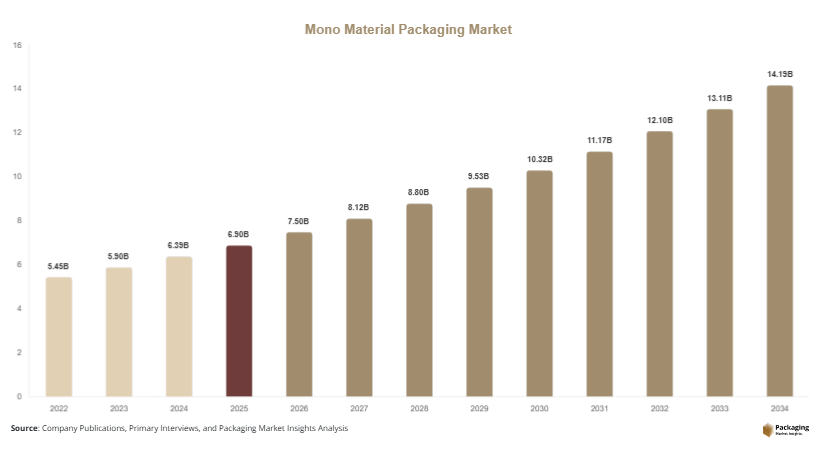
The global market size was valued at approximately USD 6.9 billion in 2025 and is projected to reach USD 7.5 billion in 2026. By 2034, the market is forecasted to reach nearly USD 15.4 billion, expanding at a CAGR of 8.3% during 2025–2034. The mono material packaging market is experiencing steady growth due to increasing demand for recyclable and sustainable packaging solutions across food, beverage, healthcare, personal care, and industrial sectors. Mono material packaging refers to packaging products manufactured using a single type of material, such as polyethylene (PE), polypropylene (PP), paper, or aluminum, which improves recyclability and simplifies waste management processes. The market is gaining traction as governments, brand owners, and consumers increasingly prioritize circular economy practices and reduction of mixed-material plastic waste.
One of the primary growth factors supporting the market is the rising implementation of strict packaging waste regulations worldwide. Governments are encouraging manufacturers to adopt packaging structures that are easier to recycle and compatible with existing recycling systems. Another important growth factor is increasing consumer awareness regarding sustainable packaging. Consumers are increasingly choosing brands that use recyclable and environmentally responsible materials, encouraging companies to redesign packaging structures. Additionally, advancements in barrier coating technologies are enabling mono material packaging to achieve improved moisture resistance, oxygen protection, and shelf-life performance, making it suitable for broader applications.
Key Highlights
- Europe dominated the market with a 35.9% share in 2025.
- Asia Pacific is projected to grow at the fastest CAGR of 8.9%.
- Flexible packaging led the product type segment with a 44.7% share.
- Polyethylene materials dominated the market with a 41.6% share.
- Food & beverage applications accounted for 48.4% market share.
- The US remained the dominant country with a market size of USD 1.7 billion in 2025 and USD 1.9 billion in 2026.
Explore more data points, trends and opportunities Download Free Sample Report
Market Trends
Rising Shift Toward Recyclable Flexible Packaging
The packaging industry is increasingly transitioning toward recyclable flexible packaging structures based on mono materials. Brand owners and retailers are redesigning pouches, wraps, and sachets using single-polymer compositions to improve compatibility with recycling systems. Traditional multilayer packaging often creates recycling challenges because different materials are difficult to separate. Mono material solutions simplify waste processing while helping companies meet sustainability targets and regulatory requirements. Food, beverage, and personal care brands are particularly adopting polyethylene- and polypropylene-based packaging formats that offer recyclability without compromising functionality. Advancements in barrier technologies are also improving oxygen and moisture protection, allowing mono material flexible packaging to expand into applications previously dominated by multilayer laminates.
Growing Investment in Circular Economy Packaging Solutions
Circular economy initiatives are significantly influencing the mono material packaging market. Packaging manufacturers and consumer goods companies are investing in recyclable designs that support closed-loop recycling systems and reduce landfill waste. Retailers are increasingly setting packaging sustainability goals that encourage the use of recyclable mono materials across product categories. Companies are also collaborating with recycling firms and resin producers to improve collection and reprocessing efficiency. In addition, governments are introducing extended producer responsibility regulations that encourage packaging recyclability and recycled content usage. This trend is accelerating innovation in mono material films, recyclable caps, and high-performance barrier coatings designed to improve sustainability performance across industrial and consumer packaging applications.
Market Drivers
Increasing Government Regulations on Packaging Waste
Strict government regulations related to plastic waste reduction are one of the major drivers of the mono material packaging market. Regulatory authorities across Europe, North America, and Asia Pacific are implementing policies that encourage recyclable packaging structures and discourage the use of difficult-to-recycle multilayer materials. Packaging producers and consumer goods companies are therefore redesigning products to comply with sustainability regulations and recycling targets. Mono material packaging offers an effective solution because it simplifies sorting and reprocessing within existing recycling systems. In addition, increasing landfill restrictions and plastic reduction policies are encouraging businesses to invest in recyclable packaging technologies that align with environmental compliance standards.
Rising Consumer Preference for Sustainable Packaging
Growing consumer demand for sustainable packaging solutions is another significant factor driving market expansion. Consumers are increasingly aware of environmental issues related to plastic waste and are favoring products packaged in recyclable materials. Retail brands are responding by adopting mono material packaging formats that improve recyclability while maintaining product protection and shelf appeal. Food and beverage manufacturers, in particular, are using recyclable flexible packaging to strengthen sustainability branding and improve customer perception. The influence of environmentally conscious purchasing behavior is encouraging companies to accelerate transition toward mono material packaging solutions across multiple product categories.
Market Restraint
Performance Limitations Compared to Multilayer Packaging
One of the major restraints affecting the mono material packaging market is the performance limitation associated with certain single-material packaging structures. Traditional multilayer packaging solutions provide strong barrier properties, durability, and product protection by combining different materials with specialized functions. Mono material packaging may face challenges related to oxygen resistance, moisture control, and heat tolerance in some applications. Industries requiring extended shelf life, such as pharmaceuticals and processed foods, may hesitate to replace multilayer laminates until performance standards are fully matched. For example, snack food manufacturers often require advanced barrier protection to preserve freshness during long distribution cycles. Developing mono material alternatives with similar performance can increase production complexity and research costs, limiting adoption in certain high-performance applications.
Market Opportunities
Expansion of Recyclable Food Packaging Solutions
The growing demand for recyclable food packaging presents significant opportunities for the mono material packaging market. Food manufacturers and retailers are increasingly adopting recyclable packaging structures to meet sustainability commitments and reduce environmental impact. Mono material films, pouches, and trays are gaining popularity because they improve recyclability while supporting lightweight packaging requirements. Increasing demand for packaged foods, ready-to-eat meals, and online grocery delivery services is also supporting market growth. In addition, retailers are encouraging suppliers to transition toward recyclable packaging formats that align with corporate sustainability goals and consumer expectations regarding environmentally responsible products.
Advancements in Barrier Coating Technologies
Technological innovation in barrier coatings and material engineering is creating new growth opportunities within the market. Packaging manufacturers are developing advanced coatings that improve oxygen resistance, moisture protection, and sealing performance while maintaining recyclability. These developments are enabling mono material packaging to expand into high-performance applications such as dairy products, pet food, pharmaceuticals, and industrial goods. Companies are investing heavily in research and development activities aimed at improving packaging functionality without compromising recyclability standards. As technological performance improves, adoption of mono material packaging is expected to increase across a wider range of industries and product categories.
Report Scope
| Report Metric | Details |
|---|---|
| Market Size in 2025 | USD 6.9 Billion |
| Market Size in 2026 | USD 7.5 Billion |
| Market Size in 2034 | USD 15.4 Billion |
| CAGR | 8.3% (2026-2034) |
| Base Year for Estimation | 2025 |
| Historical Data | 2022-2024 |
| Forecast Period | 2026-2034 |
| Report Coverage | Revenue Forecast, Competitive Landscape, Supply Chain Disruption, Growth Factors, Environment & Regulatory Landscape and Trends |
| Geographies Covered | North America, Europe, APAC, Middle East and Africa, LATAM |
| Countries Covered | U.S., Canada, U.K., Germany, France, Spain, Italy, Russia, Nordic, Benelux, Rest of Europe, China, South Korea, Japan, India, Australia, Singapore, Taiwan, South East Asia, Rest of Asia-Pacific, UAE, Turky, Saudi Arabia, South Africa, Egypt, Nigeria, Rest of MEA, Brazil, Mexico, Argentina, Chile, Colombia, Rest of LATAM |
Explore more data points, trends and opportunities Download Free Sample Report
Segmental Analysis
By Product Type
Flexible packaging dominated the mono material packaging market in 2024 and accounted for approximately 44.7% of the overall market share. Flexible films, wraps, and sachets are widely used because they offer lightweight performance, lower transportation costs, and compatibility with automated packaging systems. Food, beverage, and personal care manufacturers increasingly prefer mono material flexible packaging because it improves recyclability while maintaining convenience and product visibility. Advances in sealability and barrier coating technologies have also improved the performance of recyclable flexible packaging formats. In addition, retailers are encouraging suppliers to transition toward recyclable mono material flexible packaging to support corporate sustainability goals and improve waste management efficiency across packaging supply chains.
Mono material pouches are expected to register the fastest CAGR of 9.2% during the forecast period. Demand for recyclable pouches is increasing rapidly across packaged food, pet food, and household product categories because they combine convenience with improved recyclability. Brand owners are redesigning stand-up pouches and resealable packaging formats using polyethylene and polypropylene structures to comply with sustainability regulations. E-commerce growth and rising demand for lightweight packaging are also contributing to segment expansion. Furthermore, technological advancements in high-barrier recyclable films are enabling mono material pouches to replace traditional multilayer laminates in broader commercial applications, supporting strong future growth potential.
By Material
Polyethylene materials accounted for the largest market share of 41.6% in 2024 because of their flexibility, recyclability, and wide compatibility with packaging applications. Polyethylene-based mono material packaging is extensively used in pouches, films, bags, and wraps across food, beverage, and consumer goods industries. Manufacturers prefer polyethylene because it provides good sealing properties, lightweight performance, and strong moisture resistance. In addition, polyethylene packaging can be efficiently processed within existing recycling systems, making it attractive for companies seeking sustainable packaging solutions. Increasing adoption of recyclable flexible packaging by major food brands is further supporting growth of polyethylene-based mono material packaging across global markets.
Polypropylene materials are anticipated to witness the fastest CAGR of 8.7% during the forecast period. Polypropylene offers improved heat resistance, clarity, and stiffness compared to some other recyclable materials, making it suitable for high-performance packaging applications. Food packaging manufacturers are increasingly adopting polypropylene mono material structures for products requiring enhanced durability and shelf stability. Growing demand for microwave-safe and heat-resistant recyclable packaging formats is also supporting segment growth. In addition, ongoing research into recyclable barrier coatings and mono polymer film technologies is improving the functionality of polypropylene-based packaging systems across industrial and consumer applications.
By Application
Food & beverage applications dominated the mono material packaging market in 2024 and accounted for approximately 48.4% of the overall market share. Food manufacturers and beverage companies are increasingly transitioning toward recyclable packaging structures to reduce packaging waste and comply with sustainability regulations. Mono material packaging is widely used for snacks, frozen foods, dairy products, beverages, and ready-to-eat meals because it offers lightweight performance and improved recyclability. Retailers are also encouraging suppliers to adopt recyclable food packaging solutions to align with environmental commitments and consumer expectations. In addition, technological improvements in oxygen and moisture barrier protection are supporting broader use of mono material packaging within food preservation applications.
Healthcare packaging is projected to register the fastest CAGR of 8.8% during the forecast period. Pharmaceutical and medical product manufacturers are increasingly exploring recyclable mono material packaging solutions to improve sustainability performance while maintaining safety standards. Demand for lightweight, sterile, and recyclable packaging is increasing across medical devices, over-the-counter medicines, and healthcare consumables. Regulatory pressure regarding sustainable packaging practices within healthcare supply chains is also encouraging innovation in recyclable medical packaging formats. Advancements in high-barrier films and tamper-evident recyclable packaging technologies are expected to further support growth of this segment during the forecast period.
Mono Material Packaging Market Segmentations
By Product Type
- Flexible Packaging
- Mono Material Pouches
- Films & Wraps
- Bottles & Containers
- Bags & Sachets
By Material
- Polyethylene
- Polypropylene
- Paper-Based Materials
- Aluminum
By Application
- Food & Beverage
- Healthcare Packaging
- Personal Care & Cosmetics
- Industrial Packaging
- E-commerce Packaging
Regional Analysis
North America
North America accounted for approximately 27.4% of the global mono material packaging market share in 2025 and is projected to grow at a CAGR of 7.8% during the forecast period. Increasing corporate sustainability initiatives and growing pressure to improve packaging recyclability are supporting market expansion across the region. Consumer goods companies are rapidly transitioning toward recyclable flexible packaging formats to comply with environmental regulations and meet consumer expectations. Investments in recycling infrastructure and sustainable packaging innovation are also strengthening regional growth.
The United States dominates the North American market due to its large packaged food and consumer goods industries. A unique growth factor in the country is the increasing adoption of recyclable flexible pouches among major food and beverage brands. Companies are redesigning packaging portfolios to reduce mixed-material plastic waste and improve compatibility with domestic recycling systems. Growing retailer sustainability commitments are also encouraging broader use of mono material packaging formats.
Europe
Europe held the largest market share of 35.9% in 2025 and is expected to expand at a CAGR of 8.1% through 2034. Strict recycling regulations and strong environmental awareness among consumers are major factors supporting regional market growth. European packaging manufacturers are increasingly developing recyclable mono material solutions to align with circular economy objectives and packaging waste reduction targets. In addition, several governments are implementing policies that encourage use of recyclable and reusable packaging systems.
Germany remains the dominant country in the European mono material packaging market due to its advanced recycling infrastructure and strong packaging manufacturing sector. A unique growth factor is the country’s emphasis on closed-loop recycling systems for flexible packaging. Companies are increasingly investing in recyclable polyethylene and polypropylene packaging structures that can be efficiently processed through existing waste management networks, supporting higher recycling rates and sustainability performance.
Asia Pacific
Asia Pacific represented approximately 25.8% of the global market share in 2025 and is projected to register the fastest CAGR of 8.9% during the forecast period. Rapid urbanization, increasing packaged food consumption, and growing awareness regarding sustainable packaging are supporting regional market growth. Governments across the region are implementing regulations aimed at reducing plastic waste and encouraging recyclable packaging solutions. Expanding manufacturing industries and rising e-commerce activities are also contributing to increasing demand for mono material packaging products.
China dominates the Asia Pacific market due to its large packaging manufacturing base and growing environmental policy initiatives. A unique growth factor in the country is the rapid expansion of recyclable packaging adoption among food delivery and e-commerce companies. Major online retailers and food delivery platforms are increasingly using recyclable mono material pouches and mailers to reduce plastic waste and comply with sustainability regulations in urban areas.
Middle East & Africa
The Middle East & Africa region accounted for around 4.8% of the global market share in 2025 and is expected to grow at a CAGR of 7.2% during the forecast period. Increasing awareness regarding sustainable packaging and gradual implementation of waste reduction regulations are supporting regional market expansion. Food service providers and retail businesses are increasingly adopting recyclable packaging formats to align with sustainability goals. Investment in packaging manufacturing and logistics infrastructure is also contributing to market growth.
The United Arab Emirates leads the regional market because of its strong focus on environmental sustainability and green business initiatives. A unique growth factor is the increasing use of recyclable packaging within the hospitality and retail sectors. Hotels, supermarkets, and food delivery companies are adopting mono material flexible packaging solutions to support national sustainability programs and reduce dependence on mixed-material plastics.
Latin America
Latin America accounted for nearly 6.1% of the global mono material packaging market share in 2025 and is projected to grow at a CAGR of 8.4% through 2034. Rising environmental awareness and increasing government initiatives aimed at reducing plastic waste are supporting market demand across the region. Expansion of packaged food industries and retail modernization are also driving adoption of recyclable packaging solutions. Packaging companies are increasingly investing in recyclable flexible packaging technologies to improve sustainability performance.
Brazil dominates the Latin American market because of its expanding food processing and consumer goods industries. A unique growth factor is the growing use of recyclable mono material packaging in the beverage and snack sectors. Companies are increasingly replacing multilayer laminates with recyclable alternatives to improve environmental compliance and strengthen sustainability-focused product branding across domestic and export markets.
Competitive Landscape
The mono material packaging market is moderately competitive, with major global packaging companies focusing on recyclable material innovation, sustainable product development, and strategic partnerships. Market participants are investing in advanced barrier coatings, recyclable flexible packaging technologies, and circular economy initiatives to strengthen their competitive positions. Collaboration between resin suppliers, converters, and recycling firms is becoming increasingly important for improving recyclability and waste management efficiency.
Amcor plc remains one of the leading companies in the market because of its extensive sustainable packaging portfolio and global manufacturing presence. In 2024, the company introduced a new recyclable mono polyethylene pouch designed for food and personal care applications. Other major players include Mondi Group, Berry Global Inc., Sealed Air Corporation, and Huhtamaki Oyj. These companies are focusing on product innovation, production expansion, and strategic acquisitions to strengthen market reach and meet rising demand for recyclable packaging solutions. Increasing investment in research and development is expected to remain a key competitive strategy across the market.
Key Players List
- Amcor plc
- Mondi Group
- Berry Global Inc.
- Sealed Air Corporation
- Huhtamaki Oyj
- Constantia Flexibles
- Sonoco Products Company
- Coveris Holdings S.A.
- UFlex Ltd.
- ProAmpac LLC
- Clondalkin Group
- Winpak Ltd.
- TC Transcontinental Inc.
- Borealis AG
- Avery Dennison Corporation