PCR Films Market Size
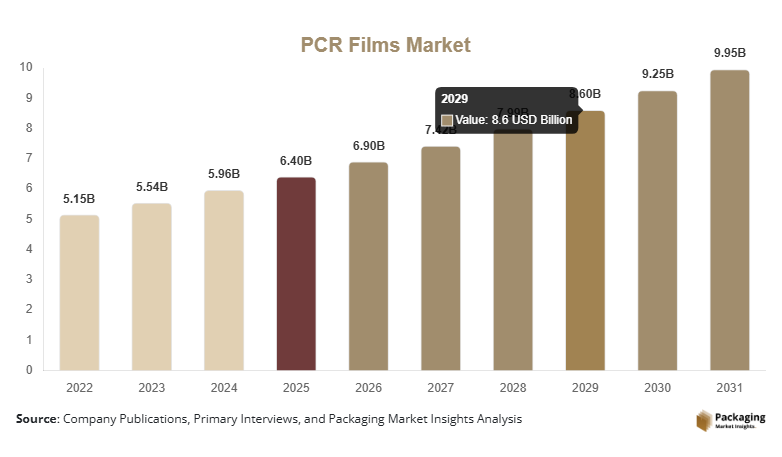
The PCR films market size is projected at USD 6.9 billion in 2026 and is expected to hit USD 12.4 billion by 2034 with a CAGR of 7.6%. Rising demand for recycled packaging materials, stringent sustainability regulations, and increasing investments in circular economy initiatives are accelerating industry expansion. The report provides comprehensive market segmentation, production analysis, competitive benchmarking, and regional assessment for strategic decision-making.
PCR (Post-Consumer Recycled) films are packaging films manufactured using recycled plastic waste collected from post-consumer sources. Global PCR film production exceeded 9.4 million metric tons in 2025, while annual manufacturing capacity surpassed 26.8 billion square meters. Polyethylene-based films contributed approximately 54.8% of production, polypropylene accounted for 28.6%, and PET represented 16.6%. Sustainable packaging adoption exceeded 48% across consumer goods industries, while food packaging represented nearly 44% of total consumption, reinforcing the PCR Films market.
Explore more data points, trends and opportunities Download Free Sample Report
PCR Films Market Trends
Increasing Adoption of Circular Economy Packaging Solutions
Brand owners are increasingly replacing virgin plastics with recycled content to comply with sustainability commitments. PCR film production increased by 12.8% year-over-year, while recycled polymer utilization exceeded 5.8 million metric tons. More than 58% of leading consumer brands have introduced packaging containing post-consumer recycled materials, strengthening the PCR Films market.
Technological advancements in sorting, washing, extrusion, and multilayer film processing continue improving PCR film quality. Advanced recycling facilities processed over 18 million metric tons of plastic waste annually, while high-performance PCR film adoption reached 36% across premium packaging applications. Demand from food, personal care, and industrial sectors continues expanding the PCR films market.
PCR Films Market Drivers
Growing Demand for Sustainable Flexible Packaging
Government regulations and corporate sustainability targets are encouraging the use of recycled packaging materials. Global recycled plastic demand increased by 14%, while flexible packaging production exceeded 31 billion units annually. More than 62% of multinational packaging companies expanded PCR film capacity, supporting continued development of the PCR films market.
PCR Films Market Restraints
Limited Availability of High-Quality Recycled Feedstock
Inconsistent waste collection systems and contamination remain major challenges for PCR film manufacturers. Feedstock recovery efficiency averages 67%, while contamination rates remain between 8% and 15%. Production costs are approximately 11% higher than conventional film manufacturing, limiting broader adoption across certain applications and affecting the PCR Films market.
PCR Films Market Opportunities
Expansion of Food-Grade Recycled Packaging
Food-grade recycled resin technologies are creating significant commercial opportunities. Investment in advanced recycling exceeded USD 2.3 billion, while food-contact PCR resin production increased by 19%. Packaging manufacturers are introducing mono-material recyclable structures that improve recyclability and enhance the PCR films market.
Challenges in PCR Films Market
Maintaining Consistent Film Performance
Manufacturers must achieve uniform mechanical strength, clarity, and barrier performance despite variations in recycled raw materials. Quality inspection costs increased by 13%, while production rejects averaged 4.6%. Maintaining compliance with food-contact regulations and customer specifications remains a major operational challenge for the PCR Films market.
Report Scope
| Report Metric | Details |
|---|---|
| Market Size in 2025 | USD 6.4 Billion |
| Market Size in 2026 | USD 6.9 Billion |
| Market Size in 2034 | USD 12.4 Billion |
| CAGR | 7.6% (2026-2034) |
| Base Year for Estimation | 2025 |
| Historical Data | 2022-2024 |
| Forecast Period | 2026-2034 |
| Report Coverage | Revenue Forecast, Competitive Landscape, Supply Chain Disruption, Growth Factors, Environment & Regulatory Landscape and Trends |
| Geographies Covered | North America, Europe, APAC, Middle East and Africa, LATAM |
| Countries Covered | U.S., Canada, U.K., Germany, France, Spain, Italy, Russia, Nordic, Benelux, Rest of Europe, China, South Korea, Japan, India, Australia, Singapore, Taiwan, South East Asia, Rest of Asia-Pacific, UAE, Turkey, Saudi Arabia, South Africa, Egypt, Nigeria, Rest of MEA, Brazil, Mexico, Argentina, Chile, Colombia, Rest of LATAM |
Explore more data points, trends and opportunities Download Free Sample Report
PCR Films Market Segmentation
Polyethylene dominates with approximately 54.8% market share, followed by polypropylene at 28.6% and PET at 16.6%. Food & beverage remains the leading end-use industry, accounting for nearly 44% of global demand due to increasing sustainable packaging initiatives.
By Material
PE films account for approximately 54.8% of the market with annual production exceeding 5.1 million metric tons. These films provide excellent flexibility, moisture resistance, and processability, making them suitable for pouches, wraps, and flexible packaging applications.
PP contributes nearly 28.6% of total demand, with production surpassing 2.7 million metric tons annually. High stiffness, heat resistance, and lightweight characteristics support broad adoption in food packaging and industrial applications.
PET represents approximately 16.6% market share, producing over 1.6 million metric tons annually. The material offers excellent transparency, dimensional stability, and gas barrier performance for premium packaging solutions.
By End-Use Industry
Food & beverage accounts for approximately 44% of total demand, consuming more than 11.5 billion square meters of PCR films annually. High barrier performance, regulatory compliance, and sustainable branding continue driving adoption across packaged food manufacturers.
Personal care applications represent nearly 31% of market demand. Annual consumption exceeded 8.2 billion square meters, while recycled content adoption surpassed 42% among cosmetic packaging manufacturers focused on environmental commitments.
Industrial packaging contributes approximately 25% of global demand, with production exceeding 6.4 billion square meters. PCR films provide durable wrapping, pallet protection, and transport packaging while reducing virgin plastic consumption.
PCR Films Market Segmentations
Material
- Polyethylene (PE)
- Polypropylene (PP)
- Polyethylene Terephthalate (PET)
End-Use Industry
- Food & Beverage
- Personal Care & Cosmetics
- Industrial Packaging
PCR Films Market Regional Outlook
North America
North America accounted for approximately 30.2% of global revenue. Annual PCR film production exceeded 2.6 million metric tons, with the United States contributing nearly 82% of regional demand. Strong recycling infrastructure and sustainability legislation continue driving growth.
Europe
Europe represented nearly 29.8% of the market, producing more than 2.5 million metric tons annually. Germany, France, Italy, and the United Kingdom collectively contributed over 71% of regional production, supported by strict recycled content regulations.
Asia-Pacific
Asia-Pacific dominated with approximately 33.6% market share and annual production exceeding 3.1 million metric tons. China accounted for 43% of regional production, followed by India at 21% and Japan at 12%, driven by rapid packaging industry expansion.
Latin America
Latin America contributed approximately 4.1% of global demand. Brazil represented nearly 56% of regional consumption, supported by increasing investments in plastic recycling and sustainable packaging.
Middle East & Africa
The Middle East & Africa accounted for approximately 2.3% of the market. Growing investments in waste management infrastructure and recycled packaging production continue supporting regional market development.
Top Players In PCR Films Market
- Berry Global Inc.
- Amcor plc
- Mondi plc
- Sealed Air Corporation
- Coveris Holdings S.A.
- Novolex Holdings, LLC
- Inteplast Group
- Tredegar Corporation
- Trioworld Group
- UFlex Limited
Berry Global Inc. Estimated market share: 10–12%. Global leader in recycled flexible packaging with strong PCR film manufacturing capabilities across North America and Europe. The company continues investing in advanced recycling technologies, lightweight film structures, and circular packaging solutions. Strategic partnerships with consumer goods manufacturers and ongoing capacity expansion strengthen its competitive position within the global PCR films industry. Amcor plc Estimated market share: 9–11%. Amcor maintains a strong position through extensive sustainable packaging innovations and high-quality PCR film solutions for the food, healthcare, and personal care industries. Continuous investments in recyclable mono-material films, advanced barrier technologies, and post-consumer recycled resin integration support its global leadership and long-term market competitiveness.