Biodegradable Plastic Films Market Size and Growth
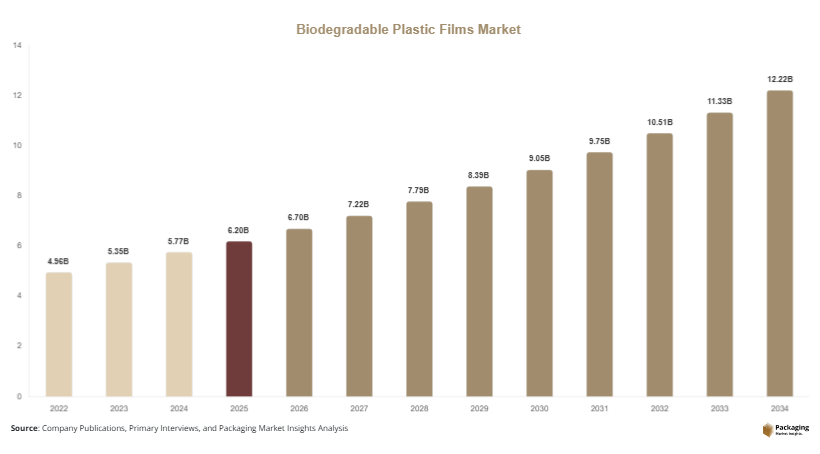
The global biodegradable plastic films market size is estimated at USD 6.2 billion in 2025, and it is projected to reach approximately USD 6.7 billion in 2026. By 2034, the market is expected to grow significantly to around USD 12.4 billion, registering a CAGR of 7.8% during 2025–2034. The Biodegradable Plastic Films Market is witnessing steady expansion driven by increasing environmental concerns, regulatory pressure on conventional plastics, and rising adoption of sustainable packaging materials across multiple industries.
Growth in this market is primarily supported by strict government regulations banning single-use plastics across Europe, North America, and parts of Asia Pacific. These regulations are pushing industries such as food packaging, agriculture, and retail toward biodegradable alternatives. Rising consumer awareness regarding plastic pollution and environmental sustainability is also accelerating market adoption.
Key Highlights:
- Europe dominated the market with a 36.8% share in 2025
- Asia Pacific is projected to grow at the fastest CAGR of 8.6% (2025–2034)
- Food packaging accounted for 48.3% share in 2025
- PLA-based films led the material segment with 42.1% share in 2025
- Agricultural mulch films held 39.5% share in 2025
- The U.S. market reached USD 1.35 billion in 2025 and USD 1.46 billion in 2026
Explore more data points, trends and opportunities Download Free Sample Report
Market Trends
Shift Toward Bio-Based Polymer Innovation
The biodegradable plastic films industry is experiencing a strong shift toward advanced bio-based polymers such as PLA, PHA, and PBAT blends. These materials are being engineered to improve tensile strength, moisture resistance, and thermal stability, making them suitable for broader applications beyond basic packaging. Manufacturers are investing heavily in R&D to enhance biodegradation speed without compromising durability during usage. This trend is particularly strong in Europe and North America, where regulatory frameworks are encouraging rapid transition away from fossil-based plastics. Food packaging companies are increasingly adopting multilayer biodegradable films for extended shelf-life applications. The continuous improvement in material science is expected to significantly expand the application scope of biodegradable films in industrial and commercial sectors.
Expansion of Compostable Packaging in FMCG Sector
Another key trend shaping the market is the increasing adoption of compostable packaging in the FMCG sector. Leading brands in food, beverages, and personal care are shifting toward fully compostable packaging solutions to meet sustainability targets. Retailers are also prioritizing biodegradable film packaging to align with consumer demand for eco-friendly products. This trend is further supported by certification systems for compostable materials, which help standardize quality and environmental compliance. E-commerce growth is also contributing, as companies seek sustainable protective packaging for shipping. The integration of biodegradable films into flexible packaging formats such as pouches, wraps, and liners is expanding rapidly across global supply chains.
Market Drivers
Government Regulations on Single-Use Plastics
One of the strongest drivers of the Biodegradable Plastic Films Market is the increasing implementation of government regulations restricting single-use plastics. Countries across Europe, Asia, and North America have introduced strict bans or taxes on conventional plastic packaging materials. These regulatory frameworks are compelling manufacturers to adopt biodegradable alternatives in order to remain compliant. Policies such as extended producer responsibility (EPR) are further pushing companies to redesign packaging systems with eco-friendly materials. Public procurement programs are also favoring biodegradable solutions, especially in food service and retail sectors. As regulations continue to tighten globally, demand for biodegradable plastic films is expected to grow steadily across both developed and emerging markets.
Rising Consumer Demand for Sustainable Packaging
Increasing environmental awareness among consumers is another key driver supporting market growth. Consumers are actively choosing products packaged in biodegradable or compostable materials, influencing brand packaging strategies. This shift is particularly visible in urban populations with higher sustainability awareness. FMCG companies are responding by introducing biodegradable packaging lines and reducing plastic usage in product portfolios. Social media campaigns and environmental activism are also reinforcing consumer expectations for sustainable packaging solutions. As a result, biodegradable plastic films are becoming a standard requirement in premium product categories, especially in food, personal care, and retail packaging segments.
Market Restraint
High Production Costs and Limited Performance in Extreme Conditions
Despite strong growth potential, the Biodegradable Plastic Films Market faces a key restraint in the form of high production costs and performance limitations. Biodegradable polymers such as PLA and PHA are more expensive to produce compared to conventional plastics due to complex manufacturing processes and limited raw material availability. This cost difference makes it challenging for price-sensitive industries to adopt biodegradable films at scale. Additionally, performance limitations such as lower heat resistance, reduced barrier properties, and shorter shelf life restrict their use in high-demand applications. In sectors like heavy-duty packaging and industrial wrapping, conventional plastics still dominate due to their superior durability. These limitations slow down large-scale substitution, especially in developing economies where cost efficiency remains a primary purchasing factor.
Market Opportunities
Expansion in Agricultural Applications
The agricultural sector presents a significant growth opportunity for biodegradable plastic films, particularly in mulch film applications. These films help improve soil moisture retention, reduce weed growth, and enhance crop yield while naturally degrading after use. This eliminates the need for manual removal and reduces plastic waste accumulation in farmland. Governments promoting sustainable agriculture practices are encouraging farmers to adopt biodegradable mulch films through subsidies and awareness programs. Emerging economies with large agricultural bases are expected to witness strong adoption. The increasing focus on regenerative agriculture and soil health management is further expanding the use of biodegradable films in farming applications.
Growth in E-Commerce and Sustainable Logistics Packaging
The rapid expansion of e-commerce is creating new opportunities for biodegradable plastic films in protective packaging applications. Online retail platforms are under pressure to reduce packaging waste and adopt eco-friendly alternatives. Biodegradable films are being used for mailers, protective wraps, and cushioning layers in shipping materials. Logistics companies are also adopting sustainable packaging solutions to meet corporate ESG targets. The increasing volume of cross-border trade and last-mile delivery services is further boosting demand. Innovation in lightweight, durable biodegradable films is expected to enhance adoption in high-volume logistics operations.
Report Scope
| Report Metric | Details |
|---|---|
| Market Size in 2025 | USD 6.2 Billion |
| Market Size in 2026 | USD 6.7 Billion |
| Market Size in 2034 | USD 12.4 Billion |
| CAGR | 7.8% (2026-2034) |
| Base Year for Estimation | 2025 |
| Historical Data | 2022-2024 |
| Forecast Period | 2026-2034 |
| Report Coverage | Revenue Forecast, Competitive Landscape, Supply Chain Disruption, Growth Factors, Environment & Regulatory Landscape and Trends |
| Geographies Covered | North America, Europe, APAC, Middle East and Africa, LATAM |
| Countries Covered | U.S., Canada, U.K., Germany, France, Spain, Italy, Russia, Nordic, Benelux, Rest of Europe, China, South Korea, Japan, India, Australia, Singapore, Taiwan, South East Asia, Rest of Asia-Pacific, UAE, Turky, Saudi Arabia, South Africa, Egypt, Nigeria, Rest of MEA, Brazil, Mexico, Argentina, Chile, Colombia, Rest of LATAM |
Explore more data points, trends and opportunities Download Free Sample Report
Segmental Analysis
By Material Type
The material type segment includes PLA (Polylactic Acid), PHA (Polyhydroxyalkanoates), starch blends, cellulose-based films, and others. Among these, PLA-based films dominated the market with approximately 42.5% share in 2025, primarily due to their wide availability, cost efficiency, and strong mechanical properties. PLA films are extensively used in food packaging, agricultural mulch films, and disposable consumer products.
PLA remains the preferred material due to its excellent transparency and compatibility with existing packaging machinery. Food & beverage companies rely heavily on PLA films for wrapping fresh produce and ready-to-eat products. Additionally, starch-based films are gaining traction in low-cost packaging applications, especially in emerging markets.
The fastest-growing subsegment is PHA-based biodegradable films, expected to register a CAGR of 11.2% during 2025–2034. Growth is driven by their superior biodegradability in marine environments and higher flexibility compared to PLA. Increasing R&D investment and commercialization of PHA production using bacterial fermentation processes are supporting this segment’s expansion.
By Application
The application segment includes packaging, agriculture, consumer goods, and industrial uses. Packaging dominated the market with 48.7% share in 2025, driven by strong demand from food packaging, retail bags, and e-commerce shipping materials.
Food packaging remains the largest sub-application due to increasing demand for sustainable alternatives in supermarkets, quick-service restaurants, and online grocery delivery platforms. Consumer goods companies are actively replacing traditional plastic wraps with biodegradable films to meet sustainability targets and improve brand image.
The fastest-growing application is agriculture, expected to grow at a CAGR of 10.6% during 2025–2034. Biodegradable mulch films are increasingly used to improve crop yield, conserve water, and reduce labor costs associated with film removal. Governments in Asia Pacific and Latin America are heavily promoting sustainable farming practices, further boosting demand in this segment.
By End-Use Industry
The end-use industry segment includes food & beverage, agriculture, retail & e-commerce, healthcare, and industrial sectors. Food & beverage dominated the market with 44.3% share in 2025, driven by high consumption of packaged food products and increasing sustainability commitments from major FMCG brands.
Retail and e-commerce sectors are also significant users of biodegradable plastic films due to rising demand for sustainable shipping materials. Healthcare applications are growing steadily, particularly for sterile packaging and disposable medical products.
The fastest-growing end-use industry is e-commerce, projected to grow at a CAGR of 10.9% during 2025–2034. The rapid expansion of online retail platforms and increasing environmental awareness among consumers are driving demand for biodegradable mailers, wraps, and protective packaging films. Companies are increasingly adopting sustainable packaging strategies to reduce carbon footprint and meet regulatory requirements.
Biodegradable Plastic Films Market Segmentations
By Material Type
- Polylactic Acid (PLA) Films
- Polyhydroxyalkanoates (PHA) Films
- Starch-Based Films
- Cellulose-Based Films
- Bio-Polymer Blends
By Application
- Packaging (Food & Consumer Goods)
- Agriculture (Mulch Films, Greenhouse Covers)
- Retail & E-commerce Packaging
- Industrial Applications
- Healthcare Packaging
By End-User Industry
- Food & Beverage Industry
- Agriculture Sector
- Retail & E-commerce
- Healthcare & Pharmaceuticals
- Industrial & Manufacturing
Regional Analysis
North America
North America accounts for a significant share of the biodegradable plastic films market, holding approximately 28.4% share in 2025, with a projected CAGR of 8.6% during 2025–2034. The region’s growth is primarily supported by strict environmental regulations, advanced packaging industry infrastructure, and strong corporate sustainability commitments. The United States dominates regional demand due to widespread adoption of eco-friendly packaging solutions across food retail, agriculture, and e-commerce sectors.
The U.S. biodegradable plastic films market is driven by increasing bans on single-use plastics in several states such as California, New York, and Washington. Additionally, major FMCG and food delivery companies are shifting toward compostable packaging solutions to meet ESG targets. Canada is also witnessing steady growth due to government initiatives supporting circular economy models and biodegradable material innovation. A key growth factor in North America is the strong presence of bio-polymer manufacturers and advanced R&D facilities that enable faster commercialization of PLA and PHA-based films.
Europe
Europe holds approximately 31.2% market share in 2025, making it the leading regional market, and is expected to expand at a CAGR of 9.3% through 2034. The region is characterized by some of the world’s most stringent environmental policies, including EU directives aimed at reducing plastic waste and promoting circular economy practices.
Germany, France, Italy, and the UK are major contributors to regional demand. Germany leads due to its strong packaging manufacturing base and early adoption of compostable materials in retail and agriculture sectors. France is focusing heavily on banning non-recyclable plastics, further boosting demand for biodegradable alternatives. A unique growth factor in Europe is the presence of highly advanced waste management and industrial composting infrastructure, which supports large-scale adoption of biodegradable films. Additionally, strong consumer awareness regarding environmental sustainability continues to drive demand across retail packaging.
Asia Pacific
Asia Pacific dominates the global biodegradable plastic films market with a 37.6% share in 2025, and is projected to grow at the fastest CAGR of 10.4% during 2025–2034. The region’s growth is driven by rapid industrialization, expanding agriculture sector, and increasing government initiatives to reduce plastic waste.
China leads the regional market due to its large-scale packaging industry and strong government push toward sustainable materials. India is emerging as a high-growth country due to increasing agricultural applications such as biodegradable mulch films. Japan and South Korea are also investing heavily in bio-based polymer innovation. A key growth driver in Asia Pacific is the rising adoption of sustainable farming practices supported by government subsidies and environmental programs. Additionally, low-cost raw material availability such as corn starch and sugarcane enhances regional competitiveness in biodegradable film production.
Middle East & Africa
Middle East & Africa holds a smaller but steadily growing share of around 6.8% in 2025, with a projected CAGR of 7.9% through 2034. Growth in this region is primarily driven by increasing environmental awareness, tourism packaging demand, and gradual regulatory developments related to plastic waste management.
The UAE and Saudi Arabia are the leading countries adopting biodegradable packaging solutions, especially in food service and retail industries. South Africa is also witnessing growing adoption in agricultural applications. A key growth factor in this region is the increasing government focus on sustainability initiatives under national vision programs such as Saudi Vision 2030 and UAE Green Agenda. Additionally, expansion of retail and hospitality sectors is creating new opportunities for biodegradable packaging film adoption.
Latin America
Latin America accounts for approximately 8.0% market share in 2025, with a CAGR of 8.2% during 2025–2034. The region is gradually shifting toward sustainable packaging due to rising environmental concerns and increasing waste management challenges.
Brazil and Mexico dominate the market due to their strong agricultural sectors and expanding food processing industries. Brazil, in particular, is investing in biodegradable mulch films to support large-scale farming efficiency. A key growth factor in Latin America is the increasing export-oriented agriculture industry, which requires compliance with international sustainability standards. Additionally, rising awareness of plastic pollution in coastal and urban areas is pushing governments toward stricter regulations on conventional plastic usage.
Competitive Landscape
The Biodegradable Plastic Films Market is moderately fragmented, with companies focusing on innovation, capacity expansion, and sustainability-driven product development. Key players are investing in bio-polymer technologies and strategic partnerships to expand global presence.
Amcor plc is a leading player due to its strong sustainable packaging portfolio and global distribution network. Recent developments include expansion of compostable film production lines and investment in advanced bio-based material R&D. Other major players such as Novamont, BASF SE, Taghleef Industries, and Futamura Chemical are actively expanding biodegradable film capabilities and collaborating with FMCG companies for sustainable packaging adoption.
Key Players List
- Amcor plc
- BASF SE
- Novamont S.p.A.
- Taghleef Industries
- Futamura Chemical Co. Ltd.
- NatureWorks LLC
- BioBag International AS
- Mitsubishi Chemical Group
- TIPA Corp
- Danimer Scientific
- FKuR Kunststoff GmbH
- Plastics Engineering Company
- Biome Bioplastics
- Cardia Bioplastics
- Uflex Ltd.