Pallet Shippers Packaging Market Size and Growth
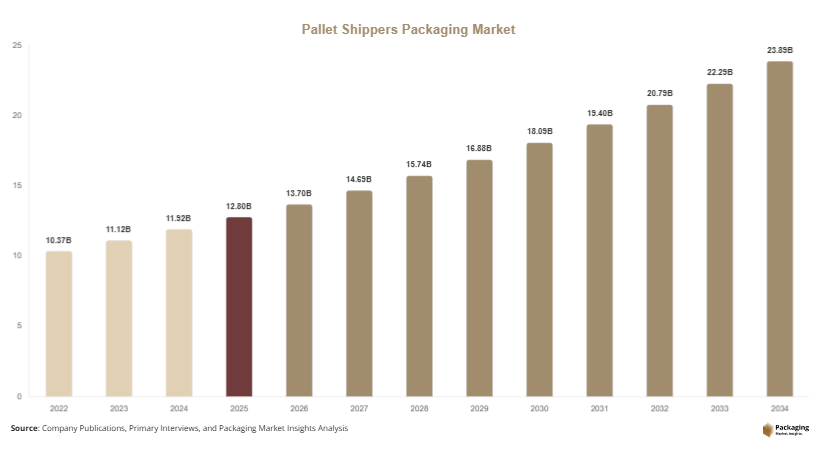
The global pallet shippers packaging market size was valued at USD 12.8 billion in 2025 and is projected to reach USD 13.7 billion in 2026. The market is expected to attain approximately USD 23.9 billion by 2034, expanding at a CAGR of 7.2% during the forecast period (2025–2034). Growth is being supported by increasing demand for protective bulk packaging, expansion of international trade activities, and rising adoption of temperature-sensitive logistics solutions.
The pallet shippers packaging market is an important segment of the industrial and transit packaging industry, providing efficient solutions for the transportation, storage, and protection of bulk goods across supply chains. Pallet shippers are widely used in food and beverage, pharmaceuticals, chemicals, agriculture, industrial manufacturing, and e-commerce logistics. These packaging systems combine pallets with protective outer structures, enabling safer handling, reduced product damage, and improved logistics efficiency. As global trade volumes continue to rise and supply chains become increasingly complex, demand for pallet shipper packaging solutions is growing steadily.
Key Highlights
- North America dominated the market with a 35.4% share in 2025.
- Latin America is projected to grow at the fastest CAGR of 7.8%.
- Corrugated Pallet Shippers led the type segment with a 38.6% share.
- Corrugated Board dominated the material segment with a 42.7% share.
- Food & Beverage applications led the market with a 40.8% share.
- The US remained the dominant country market with a market size of USD 3.2 billion in 2025 and USD 3.4 billion in 2026.
Explore more data points, trends and opportunities Download Free Sample Report
Market Trends
Increasing Adoption of Sustainable and Reusable Shipping Solutions
Sustainability has become a defining trend within the pallet shippers packaging market. Companies across logistics, retail, and manufacturing industries are seeking packaging solutions that reduce waste and support circular economy goals. As a result, reusable pallet shippers, recyclable corrugated structures, and lightweight transport packaging systems are gaining popularity. For example, major food and beverage manufacturers are implementing reusable pallet shipper programs to reduce packaging disposal costs and improve environmental performance. Future developments are expected to focus on materials with higher recycled content, modular designs, and packaging systems optimized for multiple shipping cycles. These innovations will help companies meet sustainability objectives while maintaining supply chain efficiency.
Growth of Temperature-Controlled Pallet Shipping Systems
The expansion of pharmaceutical, biotechnology, and fresh food logistics is driving demand for temperature-controlled pallet shippers. These solutions help maintain product integrity during transportation by providing insulation and thermal protection. For example, vaccine manufacturers and specialty pharmaceutical companies increasingly utilize insulated pallet shippers to ensure compliance with product storage requirements. The trend is also extending to fresh produce, dairy products, and meal-kit deliveries. Looking ahead, improvements in insulation materials, smart monitoring technologies, and reusable thermal packaging systems are expected to strengthen market demand and support broader adoption across temperature-sensitive industries.
Market Drivers
Expansion of Global Logistics and E-Commerce Networks
The rapid growth of e-commerce and international trade continues to drive demand for pallet shipper packaging solutions. As goods move across increasingly complex supply chains, businesses require durable packaging capable of protecting products during transportation and storage. The expansion of fulfillment centers, distribution hubs, and cross-border shipping activities has increased the need for efficient palletized packaging systems. For example, major online retailers rely heavily on pallet shippers for bulk product movement between warehouses and regional distribution facilities. This demand is expected to increase as digital commerce continues expanding across emerging and developed markets.
Rising Demand for Pharmaceutical and Healthcare Logistics
Healthcare and pharmaceutical industries are becoming major contributors to market growth. Increasing production of biologics, vaccines, specialty medicines, and temperature-sensitive healthcare products requires advanced shipping solutions that maintain product quality and regulatory compliance. Pallet shippers provide secure and efficient transport options for these products. For example, pharmaceutical distributors utilize insulated pallet shippers equipped with temperature-control features to ensure safe delivery of medical products. As healthcare infrastructure expands globally and pharmaceutical manufacturing increases, demand for specialized pallet shipping solutions is expected to grow significantly.
Market Restraint
High Initial Costs of Advanced Pallet Shipping Systems
One of the primary restraints affecting the pallet shippers packaging market is the relatively high cost associated with advanced and specialized shipping solutions. Insulated pallet shippers, reusable systems, and smart packaging technologies often require higher upfront investments compared to conventional transport packaging. Small and medium-sized enterprises may face budget limitations when adopting these solutions. Additionally, maintenance, cleaning, and reverse logistics costs associated with reusable pallet systems can affect overall cost efficiency. For example, pharmaceutical companies using temperature-controlled pallet shippers often incur additional expenses related to monitoring and compliance requirements. While long-term savings and sustainability benefits can offset these costs, initial investment barriers remain a challenge for certain market participants.
Market Opportunities
Rising Demand for Cold Chain Logistics Solutions
The growth of cold chain logistics presents significant opportunities for pallet shipper manufacturers. Industries such as pharmaceuticals, biotechnology, dairy, seafood, and fresh produce increasingly require temperature-controlled transportation solutions. Pallet shippers equipped with thermal insulation and monitoring systems are becoming critical components of cold chain operations. Future opportunities are expected to emerge from the increasing global distribution of biologic drugs and specialty healthcare products. Companies investing in innovative cold chain packaging technologies will likely benefit from expanding demand across multiple end-use industries.
Adoption of Smart Packaging and Tracking Technologies
The integration of digital technologies into pallet shipping systems offers substantial growth potential. Smart pallet shippers equipped with RFID tags, GPS tracking devices, and condition-monitoring sensors enable real-time visibility throughout the supply chain. These technologies help improve inventory management, reduce losses, and enhance product security. For example, pharmaceutical companies increasingly deploy sensor-enabled pallet shippers to monitor temperature and location during transportation. As supply chains become more data-driven, demand for intelligent packaging systems is expected to increase, creating new opportunities for manufacturers and logistics providers.
Report Scope
| Report Metric | Details |
|---|---|
| Market Size in 2025 | USD 12.8 Billion |
| Market Size in 2026 | USD 13.7 Billion |
| Market Size in 2034 | USD 23.9 Billion |
| CAGR | 7.2% (2026-2034) |
| Base Year for Estimation | 2025 |
| Historical Data | 2022-2024 |
| Forecast Period | 2026-2034 |
| Report Coverage | Revenue Forecast, Competitive Landscape, Supply Chain Disruption, Growth Factors, Environment & Regulatory Landscape and Trends |
| Geographies Covered | North America, Europe, APAC, Middle East and Africa, LATAM |
| Countries Covered | U.S., Canada, U.K., Germany, France, Spain, Italy, Russia, Nordic, Benelux, Rest of Europe, China, South Korea, Japan, India, Australia, Singapore, Taiwan, South East Asia, Rest of Asia-Pacific, UAE, Turky, Saudi Arabia, South Africa, Egypt, Nigeria, Rest of MEA, Brazil, Mexico, Argentina, Chile, Colombia, Rest of LATAM |
Explore more data points, trends and opportunities Download Free Sample Report
Segmental Analysis
By Type
Corrugated Pallet Shippers dominated the market in 2024, accounting for approximately 38.6% of total market revenue. Their leadership position is attributed to lightweight construction, cost efficiency, recyclability, and widespread use across food, beverage, and consumer goods industries. Corrugated pallet shippers provide effective product protection while minimizing transportation costs. Manufacturers increasingly favor these solutions because they can be customized for various load sizes and supply chain requirements. For example, food processors and retail distributors frequently utilize corrugated pallet shippers to improve handling efficiency and reduce packaging waste. The segment continues to benefit from sustainability initiatives encouraging recyclable transport packaging solutions.
Insulated Pallet Shippers are expected to be the fastest-growing type segment, expanding at a CAGR of 8.4% through 2034. Growth is driven by rising demand for temperature-controlled logistics within pharmaceutical, biotechnology, and fresh food sectors. These solutions provide thermal protection and support compliance with strict transportation requirements. Future innovations in insulation materials and reusable thermal packaging systems are expected to enhance performance and expand application opportunities. As cold chain logistics continue to develop globally, demand for insulated pallet shippers is likely to accelerate.
By Material
Corrugated Board held the largest market share in 2024, representing approximately 42.7% of total revenue. Corrugated board remains the preferred material due to its affordability, recyclability, and versatility. It provides strong structural support while remaining lightweight and easy to customize. Applications include food shipments, consumer goods transportation, and industrial logistics. Many companies prefer corrugated materials because they align with sustainability objectives and established recycling systems. Continuous innovation in corrugated packaging design is further supporting segment growth.
Recyclable Composite Materials are anticipated to register the fastest growth, achieving a CAGR of 8.1% during the forecast period. These materials combine strength, durability, and environmental performance, making them suitable for demanding transportation applications. Increasing emphasis on circular economy practices is encouraging adoption across logistics and industrial sectors. Future developments in material engineering are expected to improve performance characteristics while reducing environmental impact. As sustainability requirements become more stringent, recyclable composite materials are expected to gain market share.
By End-Use
Food & Beverage represented the largest end-use segment in 2024, accounting for approximately 40.8% of total market revenue. The segment benefits from extensive movement of packaged food products through regional and international supply chains. Pallet shipper packaging helps maintain product quality, improve handling efficiency, and reduce transit-related damage. Food manufacturers, distributors, and retailers increasingly rely on palletized transport systems to streamline logistics operations. Rising consumption of packaged foods and beverages continues to support segment dominance.
Pharmaceuticals are projected to be the fastest-growing end-use segment, expanding at a CAGR of 8.7% through 2034. Growing demand for biologics, vaccines, and specialty medicines is creating substantial opportunities for advanced pallet shipping solutions. Temperature-sensitive pharmaceutical products require secure transport systems that maintain product integrity throughout distribution. Innovations in insulated packaging, monitoring technologies, and reusable shipping systems are expected to drive continued growth. Expanding healthcare infrastructure and increasing pharmaceutical exports will further support segment expansion.
Pallet Shippers Packaging Market Segmentations
By Type
- Reusable Pallet Shippers
- Single-Use Pallet Shippers
- Temperature-Controlled Pallet Shippers
- Insulated Pallet Shippers
- Corrugated Pallet Shippers
By Material
- Corrugated Board
- Plastic
- Foam
- Wood
- Composite Materials
By End-User
- Pharmaceuticals
- Food & Beverage
- Chemicals
- Industrial Goods
- E-Commerce & Logistics
Region
- North America
- Europe
- Asia Pacific
- Latin America
- Middle East & Africa
Regional Analysis
North America
North America accounted for approximately 35.4% of the global pallet shippers packaging market share in 2025 and is projected to expand at a CAGR of 6.9% through 2034. The region benefits from advanced logistics infrastructure, extensive warehousing networks, and strong demand from food, beverage, and healthcare industries. Companies continue to invest in transport packaging systems that improve supply chain efficiency and reduce product damage. Growing e-commerce activity and increasing adoption of automated warehouse operations are supporting demand for palletized shipping solutions. Sustainability initiatives encouraging reusable packaging systems are also contributing to market growth.
The United States dominates the North American market. A unique growth driver is the country's large-scale distribution and fulfillment ecosystem. Major retailers and logistics providers continue to expand warehouse capacity and optimize transportation operations using standardized pallet shipping solutions. For example, e-commerce fulfillment centers increasingly utilize reusable pallet shippers to improve operational efficiency and reduce packaging waste. These developments are expected to support continued market expansion.
Europe
Europe represented approximately 28.1% of global market share in 2025 and is forecast to grow at a CAGR of 7.0% through 2034. The region's emphasis on sustainability and efficient supply chain management is driving adoption of advanced pallet shipping systems. Demand remains strong across food exports, pharmaceutical logistics, and industrial manufacturing sectors. Regulatory initiatives promoting reusable and recyclable transport packaging are encouraging investments in innovative pallet shipper designs. Additionally, cross-border trade within the region continues to generate demand for durable transport packaging solutions.
Germany remains the dominant country market in Europe. A unique growth driver is the country's strong industrial manufacturing base and export-oriented economy. Manufacturers rely heavily on pallet shipper packaging to transport machinery components, automotive parts, and consumer goods across international markets. For example, industrial exporters increasingly adopt reusable transport packaging systems to reduce logistics costs and improve sustainability performance. This trend is expected to continue throughout the forecast period.
Asia Pacific
Asia Pacific held approximately 25.6% of global market share in 2025 and is expected to register a CAGR of 7.6% through 2034. Rapid industrialization, expanding manufacturing activities, and growing regional trade volumes are supporting market growth. Food processing, consumer goods production, and pharmaceutical manufacturing industries are increasing their use of palletized shipping systems. Rising investments in logistics infrastructure and warehouse modernization programs further contribute to demand. The region continues to emerge as a major production and export hub for numerous industries.
China dominates the Asia Pacific market. A unique growth factor is the country's extensive manufacturing and export network. Chinese producers rely on pallet shipper packaging to support efficient transportation of goods to domestic and international markets. For example, electronics manufacturers increasingly utilize advanced pallet packaging systems to minimize transit damage and improve shipping efficiency. Continued export growth is expected to support sustained market expansion.
Middle East & Africa
The Middle East & Africa accounted for approximately 4.8% of global market share in 2025 and is projected to grow at a CAGR of 7.3% through 2034. Increasing investments in logistics infrastructure, food imports, and pharmaceutical distribution networks are driving demand for pallet shipping solutions. Governments across the region are investing in supply chain modernization programs aimed at improving trade efficiency and reducing transportation costs. Growing demand for temperature-controlled logistics further supports market growth.
Saudi Arabia remains the leading market within the region. A unique growth driver is the country's expanding logistics and distribution sector supported by economic diversification initiatives. For example, investments in industrial zones and logistics hubs are increasing demand for efficient transport packaging systems. These developments create favorable opportunities for pallet shipper manufacturers serving food, healthcare, and industrial sectors.
Latin America
Latin America represented approximately 6.1% of global market share in 2025 and is expected to record the fastest CAGR of 7.8% through 2034. Growth is supported by increasing agricultural exports, expansion of food processing industries, and improvements in transportation infrastructure. Demand for durable shipping solutions is rising as manufacturers seek to improve product protection during long-distance transportation. Additionally, growing pharmaceutical distribution activities are creating opportunities for insulated pallet shipper solutions.
Brazil dominates the Latin American market. A unique growth driver is the country's strong agricultural export sector. Producers of fresh produce, meat products, and processed foods increasingly utilize pallet shipper packaging to improve logistics performance and product quality. For example, export-oriented agribusiness companies are investing in advanced shipping systems designed to support international distribution. This trend is expected to contribute significantly to market growth.
Competitive Landscape
The pallet shippers packaging market is characterized by the presence of several global and regional packaging manufacturers competing through innovation, product customization, and sustainability initiatives. Sonoco Products Company is recognized as a leading market participant due to its diversified transport packaging portfolio, extensive distribution network, and investments in temperature-controlled packaging solutions. The company continues to expand its offerings to address growing demand from pharmaceutical and food industries.
Other key players include DS Smith plc, Smurfit Westrock plc, International Paper Company, and Packaging Corporation of America. These companies focus on product innovation, capacity expansion, and sustainable packaging development. Recent industry developments include investments in reusable pallet shipper systems, advanced insulation technologies, and smart packaging solutions featuring tracking capabilities. Strategic collaborations with logistics providers and end-use industries continue to strengthen competitive positioning across the market.
Key Players List
- Sonoco Products Company
- DS Smith plc
- Smurfit Westrock plc
- International Paper Company
- Packaging Corporation of America
- Mondi plc
- Orbis Corporation
- Cold Chain Technologies
- Pelican BioThermal
- Snyder Industries, Inc.
- Rehrig Pacific Company
- Schoeller Allibert
- Craemer Group
- Greif, Inc.
- Nefab Group