Modified Atmosphere Packaging Market Size and Growth
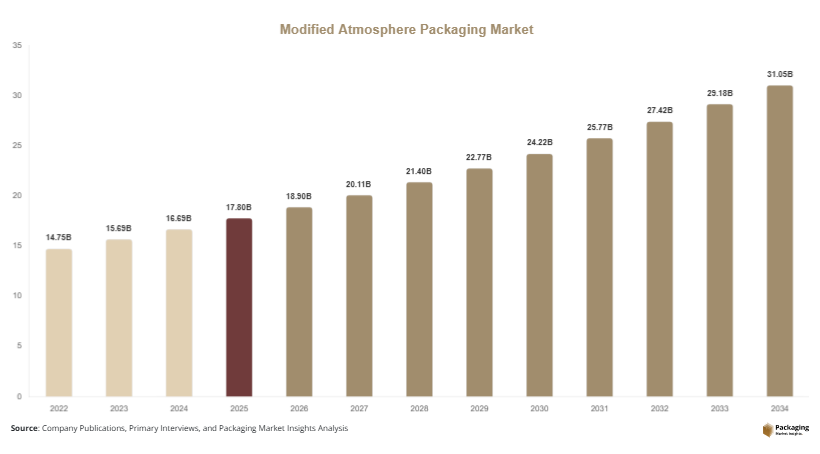
The global modified atmosphere packaging market size was valued at USD 17.8 billion in 2025 and is estimated to reach USD 18.9 billion in 2026. With growing demand for convenience foods and longer product shelf life, the market is projected to expand significantly and reach approximately USD 32.6 billion by 2034, registering a compound annual growth rate (CAGR) of 6.4% from 2025 to 2034. This growth reflects increasing adoption of advanced packaging technologies across the food supply chain.
The modified atmosphere packaging market is experiencing steady expansion as food manufacturers, retailers, and logistics providers seek packaging technologies that extend shelf life while maintaining product freshness. Modified atmosphere packaging (MAP) involves altering the composition of gases within a package, typically using nitrogen, carbon dioxide, and oxygen mixtures, to slow microbial growth and reduce oxidation. This technology is widely used in packaged foods such as meat, seafood, dairy products, fresh produce, and bakery items.
Key Highlights
- Market size estimated at USD 17.8 billion in 2025
- Expected to reach USD 32.6 billion by 2034
- Projected CAGR of 6.4% from 2025 to 2034
- Increasing demand for packaged and convenience foods
- Rising adoption across meat, dairy, and fresh produce industries
Explore more data points, trends and opportunities Download Free Sample Report
Market Trends
Expansion of Sustainable Packaging Materials
Sustainability has become an important trend in the modified atmosphere packaging market Food producers and retailers are increasingly adopting recyclable and biodegradable packaging materials to reduce environmental impact. Traditional MAP packaging often relies on multilayer plastic films that can be difficult to recycle. As a result, packaging manufacturers are investing in mono-material films, recyclable polymers, and bio-based materials that maintain barrier properties while supporting circular economy goals.
The shift toward sustainable packaging is also influenced by regulatory frameworks and consumer expectations. Many governments are implementing regulations to reduce plastic waste, which encourages manufacturers to redesign packaging structures. Companies are developing MAP-compatible films made from recyclable polyethylene or compostable materials while preserving gas barrier performance. This trend is expected to shape product innovation across the industry.
Integration of Smart Packaging Technologies
Another key trend shaping the Modified Atmosphere Packaging Market is the integration of smart and intelligent packaging technologies. Food producers are exploring solutions such as freshness indicators, oxygen sensors, and time-temperature indicators to monitor product quality throughout the supply chain. These technologies help retailers and consumers assess whether packaged food remains safe and fresh.
Smart packaging combined with MAP creates a more transparent food distribution system. For example, oxygen sensors can detect leaks in modified atmosphere packages, while freshness indicators change color when food quality declines. This approach helps reduce food waste and improves inventory management for retailers. As digital technologies and sensor costs decline, smart packaging solutions are expected to gain wider adoption within MAP systems.
Market Drivers
Rising Demand for Fresh and Minimally Processed Foods
One of the major drivers of the Modified Atmosphere Packaging Market is the increasing demand for fresh and minimally processed foods. Consumers are seeking products that maintain natural flavor, texture, and nutritional value without excessive preservatives. MAP technology helps extend shelf life while preserving product quality, making it suitable for fresh meat, poultry, seafood, and fresh-cut fruits.
Retailers benefit from MAP packaging because it allows longer display times and reduces product waste. Food producers also gain advantages through improved distribution efficiency and broader geographic reach. As consumer preference shifts toward healthier and fresher food options, the use of modified atmosphere packaging continues to expand across multiple product categories.
Growth of Organized Retail and E-commerce Food Distribution
The expansion of organized retail chains and online grocery platforms is another major factor driving the modified atmosphere packaging market Supermarkets, hypermarkets, and online food delivery services rely heavily on packaging technologies that maintain food freshness during transportation and storage.
MAP solutions are particularly useful for e-commerce grocery shipments, where products may travel through several logistics stages before reaching consumers. Packaging systems that maintain controlled gas environments help ensure that perishable foods remain fresh during last-mile delivery. As online grocery shopping continues to grow globally, demand for modified atmosphere packaging solutions is expected to increase.
Market Restraint
High Initial Equipment and Packaging Costs
Despite its advantages, the Modified Atmosphere Packaging Market faces certain challenges, particularly the relatively high cost of packaging equipment and materials. MAP systems require specialized machinery such as gas flushing equipment, sealing machines, and high-barrier packaging films. These systems often involve higher capital investment compared with conventional packaging technologies.
Small and medium-sized food manufacturers may find it difficult to adopt MAP solutions due to these upfront costs. In addition, MAP packaging materials such as multilayer barrier films and specialized trays can increase packaging expenses. For businesses operating with narrow profit margins, these costs can limit widespread adoption.
Another challenge is the need for technical expertise and quality control. Improper gas mixtures or packaging leaks can reduce the effectiveness of the modified atmosphere, leading to product spoilage. This requires continuous monitoring and strict process control within manufacturing facilities. As a result, some companies may hesitate to invest in MAP technology without adequate technical resources.
However, as packaging equipment becomes more automated and economies of scale improve production efficiency, the cost barrier is gradually decreasing. Continued innovation in packaging materials and machinery is expected to address these limitations over time.
Market Opportunities
Increasing Adoption in Fresh Produce Packaging
The growing global demand for fresh fruits and vegetables presents a strong opportunity for the modified atmosphere packaging market Fresh produce is highly sensitive to environmental conditions, and spoilage can occur quickly during transportation and storage. MAP technology helps slow respiration rates and microbial growth, which extends shelf life and maintains product quality.
Retailers and exporters are increasingly adopting MAP solutions for fresh-cut salads, berries, mushrooms, and other produce products. The technology helps maintain color, texture, and freshness during long distribution periods. As global trade in fresh produce continues to grow, the demand for advanced packaging solutions is expected to increase significantly.
Expansion of Food Export Markets
Another major opportunity lies in the expansion of international food trade. Many countries export large volumes of meat, seafood, and dairy products to global markets. These products require reliable packaging solutions to maintain freshness during long transportation periods.
Modified atmosphere packaging enables exporters to ship perishable foods across continents while preserving quality and safety. This technology reduces spoilage losses and supports extended distribution networks. As emerging economies expand their food export industries, adoption of MAP packaging is likely to grow steadily in the coming years.
Report Scope
| Report Metric | Details |
|---|---|
| Market Size in 2025 | USD 17.8 Billion |
| Market Size in 2026 | USD 18.9 Billion |
| Market Size in 2034 | USD 32.6 Billion |
| CAGR | 6.4% (2026-2034) |
| Base Year for Estimation | 2025 |
| Historical Data | 2022-2024 |
| Forecast Period | 2026-2034 |
| Report Coverage | Revenue Forecast, Competitive Landscape, Supply Chain Disruption, Growth Factors, Environment & Regulatory Landscape and Trends |
| Geographies Covered | North America, Europe, APAC, Middle East and Africa, LATAM |
| Countries Covered | U.S., Canada, U.K., Germany, France, Spain, Italy, Russia, Nordic, Benelux, Rest of Europe, China, South Korea, Japan, India, Australia, Singapore, Taiwan, South East Asia, Rest of Asia-Pacific, UAE, Turky, Saudi Arabia, South Africa, Egypt, Nigeria, Rest of MEA, Brazil, Mexico, Argentina, Chile, Colombia, Rest of LATAM |
Explore more data points, trends and opportunities Download Free Sample Report
Segmental Analysis
By Packaging Material
Plastic films represent the dominant subsegment in the modified atmosphere packaging market, accounting for approximately 64% of total market share in 2024. These materials are widely used because they offer strong barrier properties that help maintain controlled gas environments within packaged products. High-barrier plastic films such as polyethylene, polypropylene, and multilayer laminates are commonly used in MAP systems for meat, dairy, and bakery products. Their ability to prevent oxygen penetration and retain modified gas mixtures makes them suitable for preserving product freshness. Plastic films are also lightweight, flexible, and compatible with automated packaging machinery, which increases production efficiency for food manufacturers.
Biodegradable and recyclable packaging materials are expected to be the fastest-growing subsegment, with an estimated CAGR of 8.1% during the forecast period. Increasing environmental concerns and regulatory pressure to reduce plastic waste are encouraging companies to develop sustainable alternatives. Manufacturers are introducing mono-material packaging structures that can be recycled more easily while maintaining barrier performance. Bio-based polymers and compostable films are also gaining attention as potential solutions for environmentally friendly MAP systems. As sustainability becomes a priority for food producers and retailers, demand for eco-friendly packaging materials is expected to increase steadily.
By Application
The meat and poultry packaging segment accounted for the largest share of the modified atmosphere packaging market in 2024, representing approximately 38% of total revenue. Meat products are highly susceptible to microbial growth and oxidation, making them ideal candidates for MAP technology. By adjusting oxygen and carbon dioxide levels inside packaging, producers can extend shelf life while preserving color and texture. Supermarkets rely heavily on MAP packaging for fresh meat display because it helps maintain product appearance and reduces spoilage losses. The growing consumption of packaged meat products worldwide continues to support strong demand in this segment.
The fresh produce segment is projected to grow at the fastest CAGR of around 7.9% during the forecast period. Increasing demand for ready-to-eat salads, fresh-cut fruits, and packaged vegetables is driving adoption of MAP solutions in the produce industry. This packaging method helps regulate respiration rates and maintain optimal gas conditions for different types of fruits and vegetables. As global trade in fresh produce expands and consumers seek convenient healthy food options, the use of modified atmosphere packaging for produce is expected to increase significantly.
By End-Use Industry
The food processing industry dominated the modified atmosphere packaging market in 2024, accounting for approximately 69% of total market share. Food processors use MAP technology extensively to package perishable products such as dairy, seafood, and ready-to-eat meals. The ability to extend shelf life while maintaining product quality provides a significant advantage for manufacturers. MAP packaging also helps reduce food waste across distribution networks, which improves operational efficiency for producers and retailers. With increasing demand for packaged food products globally, the food processing industry remains the largest end-use segment.
The food service and retail sector is expected to witness the fastest growth with a CAGR of about 7.2% through 2034. Supermarkets, convenience stores, and restaurant chains are increasingly adopting MAP packaging to improve product presentation and extend storage times. Retailers benefit from reduced product spoilage and improved inventory management. The rise of online grocery platforms and meal kit services is also contributing to demand for packaging solutions that maintain freshness during delivery. These factors are expected to drive strong growth in the retail and food service segment.
Modified Atmosphere Packaging Market Segmentations
Packaging Material
- Plastic Films
- Paper & Paperboard
- Biodegradable Materials
Application
- Meat & Poultry
- Seafood
- Fresh Produce
- Dairy Products
- Bakery & Confectionery
End-Use Industry
- Food Processing Industry
- Retail & Supermarkets
- Food Service Industry
Regional Analysis
North America
North America accounted for approximately 34% of the global modified atmosphere packaging market share in 2025 and continues to represent a significant regional market. The region is expected to grow at a CAGR of around 5.8% through 2034, supported by strong demand from the packaged food industry. High consumer spending on convenience foods and advanced retail infrastructure are key factors supporting market growth across the United States and Canada.
The United States dominates the regional market due to its well-established food processing industry and advanced packaging technologies. One unique growth factor in the country is the widespread adoption of automated food packaging lines in large processing facilities. These systems enable efficient implementation of modified atmosphere packaging at high production volumes, making MAP technology common in meat, poultry, and ready-to-eat food packaging.
Europe
Europe held approximately 28% share of the modified atmosphere packaging market in 2025, with a projected CAGR of 6.1% through 2034. The region benefits from a strong presence of food processing companies and strict food safety regulations. European consumers show a strong preference for fresh and minimally processed foods, which encourages manufacturers to adopt packaging technologies that preserve product quality.
Germany represents the largest national market within Europe. One distinctive growth factor in Germany is the strong focus on sustainable packaging solutions. Packaging companies in the country are developing recyclable and eco-friendly MAP materials to comply with environmental regulations. This emphasis on sustainability is encouraging innovation in packaging film structures and barrier materials.
Asia Pacific
Asia Pacific accounted for roughly 24% of the global modified atmosphere packaging market share in 2025 and is projected to grow at the fastest CAGR of about 7.4% during the forecast period. Rapid urbanization, rising disposable income, and increasing consumption of packaged foods are major factors driving regional demand.
China leads the Asia Pacific market due to its large food processing industry and expanding retail sector. A unique growth factor in the country is the rapid expansion of cold chain logistics networks. Investments in refrigerated transportation and storage facilities are enabling wider adoption of MAP technology for fresh food distribution.
Middle East & Africa
The Middle East & Africa region accounted for approximately 7% of the global modified atmosphere packaging market in 2025 and is expected to grow at a CAGR of 6.0% through 2034. Growth in the region is supported by rising food imports and the expansion of modern retail chains.
Saudi Arabia represents one of the leading markets in the region. A key growth factor in the country is the increasing reliance on imported packaged foods. Modified atmosphere packaging plays an important role in maintaining the freshness of imported meat, dairy products, and produce during transportation from international suppliers.
Latin America
Latin America held around 7% share of the modified atmosphere packaging market in 2025 and is forecast to grow at a CAGR of approximately 6.2% through 2034. The region is witnessing gradual modernization of food processing and packaging infrastructure.
Brazil dominates the regional market due to its large meat and poultry export industry. One unique growth factor is the increasing use of MAP packaging in meat export operations. Exporters use this technology to maintain product quality during long shipping periods, supporting the country's global food trade.
Competitive Landscape
The modified atmosphere packaging market is moderately competitive, with several global packaging companies focusing on product innovation, strategic partnerships, and expansion of manufacturing capacity. Leading companies invest in research and development to improve barrier film technologies, sustainable materials, and automated packaging systems.
One of the leading players in the market is Amcor plc, which offers a broad range of flexible packaging solutions designed for modified atmosphere packaging applications. The company focuses on developing recyclable and high-barrier packaging films that meet food safety and sustainability requirements.
Other major participants include packaging manufacturers that specialize in trays, films, and automated MAP machinery. Companies are increasingly collaborating with food processors to develop customized packaging solutions for specific products such as fresh meat, seafood, and dairy items. Technological innovation remains a key competitive strategy within the industry.
A recent development in the market includes the introduction of advanced recyclable MAP film structures by several packaging companies. These materials maintain barrier performance while supporting recycling initiatives. Such innovations highlight the industry's focus on sustainability and regulatory compliance.
Key Players List
- Amcor plc
- Sealed Air Corporation
- Berry Global Inc.
- Mondi Group
- Sonoco Products Company
- Coveris Holdings S.A.
- Smurfit Kappa Group
- Multivac Group
- Ilapak International SA
- ULMA Packaging
- Winpak Ltd.
- LINPAC Packaging
- ProAmpac LLC
- Klöckner Pentaplast
- Constantia Flexibles