Pre Conditioned Packaging Market Size and Growth
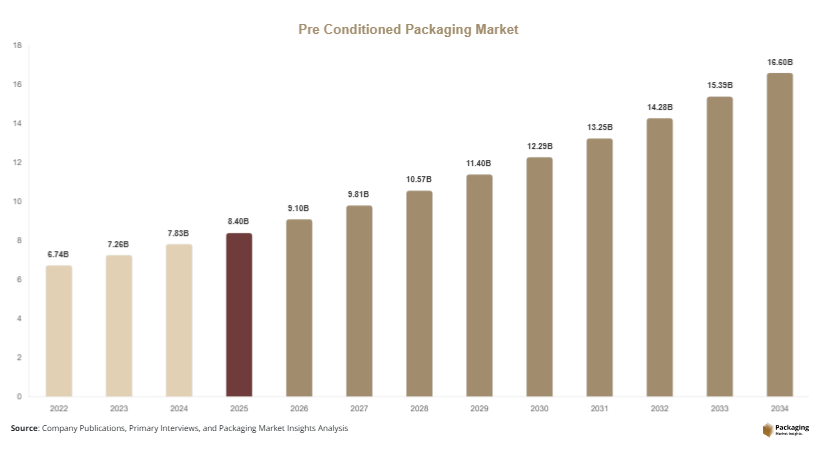
The pre conditioned packaging market is witnessing steady expansion driven by increasing demand for protective packaging solutions across industries such as electronics, pharmaceuticals, and automotive. The market size was estimated at USD 8.4 billion in 2025 and is projected to reach approximately USD 9.1 billion in 2026, reflecting consistent demand across global supply chains. By 2034, the market is forecast to attain a value of nearly USD 16.8 billion, expanding at a compound annual growth rate (CAGR) of 7.8% from 2025 to 2034. This growth trajectory is supported by evolving logistics requirements and the need for reliable packaging solutions that maintain product integrity under varying environmental conditions.
One of the primary growth factors includes the increasing globalization of trade, which necessitates packaging solutions that can withstand long-distance transportation and diverse climatic conditions. Pre conditioned packaging, which is designed to maintain specific temperature and humidity levels, plays a critical role in ensuring product safety during transit. Another factor is the rapid expansion of the pharmaceutical and biotechnology industries, where temperature-sensitive products such as vaccines and biologics require controlled packaging environments. Additionally, the growth of e-commerce and direct-to-consumer delivery models has intensified the demand for packaging solutions that can protect goods from environmental stress while minimizing damage during shipping.
Key Highlights:
- Market size is projected to grow from USD 8.4 billion in 2025 to USD 16.8 billion by 2034, reflecting steady expansion across industries. This growth highlights increasing reliance on advanced packaging solutions for product protection and supply chain efficiency.
- The market is expected to expand at a CAGR of 7.8% during the forecast period from 2025 to 2034. This consistent growth rate indicates rising investments and technological advancements in packaging materials and logistics systems.
- Strong demand from pharmaceuticals and cold chain logistics is a major factor supporting market growth. The need to maintain temperature-sensitive products such as vaccines and biologics is driving adoption of pre conditioned packaging solutions.
- Rising adoption in e-commerce and global trade sectors is further accelerating market expansion. Increased cross-border shipments and direct-to-consumer deliveries are creating demand for reliable and durable packaging systems.
Explore more data points, trends and opportunities Download Free Sample Report
Market Trends
Integration of Smart Packaging Technologies
The integration of smart technologies into pre conditioned packaging is emerging as a significant trend shaping the market. Companies are increasingly incorporating sensors, data loggers, and Internet of Things (IoT) capabilities into packaging solutions to monitor temperature, humidity, and shock levels in real time. These technologies provide enhanced visibility across the supply chain, allowing stakeholders to track product conditions and ensure compliance with quality standards. The ability to capture and analyze data also supports predictive maintenance and reduces the risk of product spoilage. As industries such as pharmaceuticals and food distribution demand higher levels of transparency, the adoption of smart packaging solutions is expected to expand further.
Shift Toward Sustainable and Reusable Packaging Solutions
Sustainability is becoming a central focus within the pre conditioned packaging market, with manufacturers developing eco-friendly and reusable packaging systems. The use of recyclable materials, biodegradable insulation, and returnable packaging containers is gaining traction as companies aim to reduce their environmental footprint. This trend is driven by regulatory pressures as well as growing consumer awareness regarding sustainability. Reusable packaging solutions also offer cost advantages over time, particularly for businesses engaged in frequent shipments. As environmental concerns continue to influence purchasing decisions, sustainable packaging innovations are expected to play a critical role in shaping market dynamics.
Market Drivers
Expansion of Cold Chain Logistics Industry
The rapid expansion of the cold chain logistics industry is a key driver for the pre conditioned packaging market. With increasing demand for temperature-sensitive products such as pharmaceuticals, vaccines, fresh food, and chemicals, the need for reliable packaging solutions has grown significantly. Pre conditioned packaging ensures that products remain within specified temperature ranges during transportation and storage. The rise in global trade of perishable goods has further intensified the need for robust cold chain infrastructure. Additionally, advancements in logistics networks and transportation systems are supporting the adoption of specialized packaging solutions that enhance product safety and reduce spoilage.
Growth of Pharmaceutical and Biotechnology Sectors
The pharmaceutical and biotechnology industries are major contributors to the growth of the pre conditioned packaging market. The increasing production and distribution of biologics, vaccines, and specialty drugs require packaging solutions that maintain strict environmental conditions. Regulatory requirements related to drug safety and efficacy also mandate the use of validated packaging systems. Furthermore, the growing prevalence of chronic diseases and the expansion of healthcare services are driving demand for pharmaceutical products globally. This, in turn, is boosting the adoption of advanced packaging solutions that ensure product integrity throughout the supply chain.
Market Restraint
High Cost of Advanced Packaging Solutions
One of the primary restraints affecting the pre conditioned packaging market is the high cost associated with advanced packaging solutions. Technologies such as insulated containers, phase change materials, and smart monitoring systems involve significant initial investment and operational expenses. Small and medium-sized enterprises may find it challenging to adopt these solutions due to budget constraints. Additionally, the cost of maintaining and validating temperature-controlled packaging systems can add to the overall logistics expenses. This cost factor can limit market penetration, particularly in developing regions where price sensitivity is high. For example, companies operating in emerging markets may opt for conventional packaging methods to reduce costs, even if it compromises product protection. As a result, the high cost of advanced solutions remains a key barrier to widespread adoption.
Market Opportunities
Rising Demand in Emerging Markets
Emerging markets present significant growth opportunities for the pre conditioned packaging market. Rapid industrialization, urbanization, and improvements in healthcare infrastructure are driving demand for temperature-sensitive products in regions such as Asia Pacific and Latin America. As these markets continue to expand, there is a growing need for reliable packaging solutions that can support the distribution of pharmaceuticals, food products, and chemicals. Governments in these regions are also investing in logistics and supply chain infrastructure, creating a favorable environment for market growth. Companies that establish a strong presence in emerging markets can benefit from increasing demand and relatively lower competition.
Technological Innovations in Packaging Materials
Technological advancements in packaging materials are creating new opportunities for market growth. Innovations such as lightweight insulation materials, advanced phase change materials, and biodegradable packaging solutions are enhancing the performance and sustainability of pre conditioned packaging. These innovations not only improve temperature control but also reduce environmental impact and operational costs. Additionally, the development of customizable packaging solutions tailored to specific industry requirements is gaining traction. As companies seek to optimize their supply chains and improve efficiency, the adoption of innovative packaging materials is expected to increase, driving market expansion.
Report Scope
| Report Metric | Details |
|---|---|
| Market Size in 2025 | USD 8.4 Billion |
| Market Size in 2026 | USD 9.1 Billion |
| Market Size in 2034 | USD 16.8 Billion |
| CAGR | 7.8% (2026-2034) |
| Base Year for Estimation | 2025 |
| Historical Data | 2022-2024 |
| Forecast Period | 2026-2034 |
| Report Coverage | Revenue Forecast, Competitive Landscape, Supply Chain Disruption, Growth Factors, Environment & Regulatory Landscape and Trends |
| Geographies Covered | North America, Europe, APAC, Middle East and Africa, LATAM |
| Countries Covered | U.S., Canada, U.K., Germany, France, Spain, Italy, Russia, Nordic, Benelux, Rest of Europe, China, South Korea, Japan, India, Australia, Singapore, Taiwan, South East Asia, Rest of Asia-Pacific, UAE, Turky, Saudi Arabia, South Africa, Egypt, Nigeria, Rest of MEA, Brazil, Mexico, Argentina, Chile, Colombia, Rest of LATAM |
Explore more data points, trends and opportunities Download Free Sample Report
Segmental Analysis
By Type
The insulated containers segment dominated the pre conditioned packaging market in 2024, accounting for approximately 42% of the market share. These containers are widely used across industries such as pharmaceuticals, food and beverage, and chemicals due to their ability to maintain stable temperature conditions. Insulated containers offer durability, reusability, and cost efficiency, making them a preferred choice for long-distance transportation. Additionally, advancements in insulation materials have improved their performance, further driving their adoption across various applications.
Phase change materials represent the fastest-growing subsegment, with a projected CAGR of 9.5% during the forecast period. These materials provide precise temperature control by absorbing and releasing thermal energy, making them ideal for temperature-sensitive products. The increasing demand for efficient cold chain solutions is driving the adoption of phase change materials. Furthermore, their ability to maintain consistent temperatures without external power sources makes them highly suitable for pharmaceutical and healthcare applications.
By Application
The pharmaceuticals segment held the largest share of the pre conditioned packaging market in 2024, accounting for approximately 38% of the total market. The need to maintain strict temperature conditions for drugs, vaccines, and biologics is driving the demand for advanced packaging solutions in this segment. Regulatory requirements and quality standards further emphasize the importance of reliable packaging systems. Additionally, the growth of the pharmaceutical industry is contributing to the expansion of this segment.
The food and beverage segment is expected to be the fastest-growing application, with a CAGR of 8.8% during the forecast period. The increasing demand for fresh and perishable food products is driving the need for temperature-controlled packaging solutions. E-commerce platforms and online grocery services are also contributing to the growth of this segment. As consumer preferences shift toward convenience and quality, the adoption of pre conditioned packaging in the food and beverage industry is expected to increase.
By End-Use
The healthcare sector dominated the pre conditioned packaging market in 2024, accounting for approximately 45% of the market share. The increasing demand for temperature-sensitive medical products and the expansion of healthcare services are key factors driving this segment. Pre conditioned packaging plays a critical role in ensuring the safety and efficacy of medical products during transportation and storage. Additionally, advancements in packaging technologies are enhancing the reliability of these solutions.
The e-commerce sector is projected to be the fastest-growing end-use segment, with a CAGR of 10.1% during the forecast period. The rapid growth of online retail and direct-to-consumer delivery models is driving the demand for protective packaging solutions. Pre conditioned packaging ensures that products are delivered in optimal condition, even under varying environmental conditions. As e-commerce continues to expand globally, the demand for advanced packaging solutions is expected to increase significantly.
Pre Conditioned Packaging Market Segmentations
By Type
- Insulated Containers
- Phase Change Materials
- Insulated Shippers
By Application
- Pharmaceuticals
- Food & Beverage
- Chemicals
By End-Use
- Healthcare
- E-commerce
- Industrial
Regional Analysis
North America
North America held a significant share of the pre conditioned packaging market in 2025, accounting for approximately 32% of the global market. The region is expected to maintain steady growth with a CAGR of around 6.9% during the forecast period. The presence of well-established pharmaceutical and biotechnology industries, along with advanced logistics infrastructure, supports market growth. Additionally, stringent regulatory requirements related to product safety and quality are driving the adoption of advanced packaging solutions across various industries.
The United States dominates the North American market due to its strong pharmaceutical sector and extensive cold chain logistics network. A unique growth factor in the region is the increasing adoption of smart packaging technologies, which enable real-time monitoring of product conditions. This technological advancement enhances supply chain visibility and ensures compliance with regulatory standards, further boosting market demand.
Europe
Europe accounted for approximately 27% of the global market share in 2025 and is projected to grow at a CAGR of 6.5% through 2034. The region’s growth is driven by the presence of leading pharmaceutical companies and a strong focus on sustainability. Regulatory frameworks promoting eco-friendly packaging solutions are also contributing to market expansion. Additionally, the increasing demand for temperature-controlled packaging in food and beverage industries supports growth.
Germany is a key contributor to the European market, driven by its advanced manufacturing sector and strong logistics infrastructure. A unique growth factor in the region is the emphasis on sustainable packaging practices, including the use of recyclable and reusable materials. This focus on sustainability is encouraging companies to adopt innovative packaging solutions that align with environmental regulations.
Asia Pacific
Asia Pacific is the fastest-growing region in the pre conditioned packaging market, with a CAGR of approximately 9.2% during the forecast period. The region accounted for around 24% of the global market share in 2025. Rapid industrialization, increasing healthcare expenditure, and expanding e-commerce activities are key factors driving market growth. Additionally, the development of logistics infrastructure is supporting the adoption of advanced packaging solutions.
China dominates the Asia Pacific market due to its large manufacturing base and growing pharmaceutical industry. A unique growth factor in the region is the increasing demand for temperature-sensitive products, including vaccines and biologics. This demand is driving the adoption of pre conditioned packaging solutions that ensure product safety during transportation and storage.
Middle East & Africa
The Middle East & Africa region held a smaller share of approximately 9% in 2025 but is expected to grow at a CAGR of 7.1% during the forecast period. The market is driven by increasing investments in healthcare infrastructure and the expansion of pharmaceutical distribution networks. Additionally, the growth of the food and beverage industry is contributing to the demand for temperature-controlled packaging solutions.
Saudi Arabia is a leading market within the region, supported by government initiatives to enhance healthcare services and logistics infrastructure. A unique growth factor is the increasing focus on improving cold chain capabilities, particularly for pharmaceutical products. This focus is driving the adoption of advanced packaging solutions that ensure product quality and safety.
Latin America
Latin America accounted for approximately 8% of the global market share in 2025 and is projected to grow at a CAGR of 7.4% during the forecast period. The region’s growth is driven by expanding pharmaceutical and food industries, along with improvements in logistics infrastructure. Increasing trade activities are also contributing to the demand for reliable packaging solutions.
Brazil dominates the Latin American market due to its large consumer base and growing healthcare sector. A unique growth factor in the region is the rising demand for export-oriented agricultural products, which require temperature-controlled packaging. This demand is encouraging the adoption of pre conditioned packaging solutions that ensure product quality during transportation.
Competitive Landscape
The pre conditioned packaging market is characterized by the presence of several established players focusing on innovation, product development, and strategic partnerships. Leading companies are investing in advanced technologies to enhance the performance and sustainability of their packaging solutions. The market is moderately competitive, with key players striving to expand their global footprint and strengthen their market position.
One of the leading companies in the market is Sonoco Products Company, which has a strong presence in the packaging industry and offers a wide range of temperature-controlled solutions. The company has recently focused on expanding its sustainable packaging portfolio to meet evolving customer demands. Other major players are also investing in research and development to introduce innovative solutions that address industry challenges. Strategic collaborations and acquisitions are common strategies adopted by companies to enhance their capabilities and market reach.
Key Players List
- Sonoco Products Company
- Cold Chain Technologies
- Pelican BioThermal
- Softbox Systems
- Tempack Packaging Solutions
- Va-Q-tec AG
- Cryopak Industries
- Intelsius
- Sofrigam
- Inmark Packaging
- Snyder Industries
- American Aerogel Corporation
- EcoCool GmbH
- Insulated Products Corporation
- Emball’iso