Minimalist Packaging Market Size and Growth
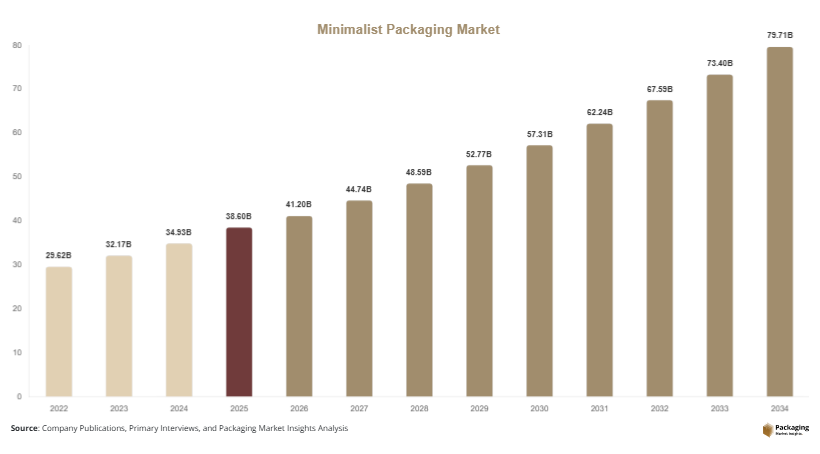
The global minimalist packaging market size is estimated at USD 38.6 billion in 2025, rising to approximately USD 41.2 billion in 2026. By 2034, the market is projected to reach nearly USD 79.5 billion, expanding at a CAGR of 8.6% during 2025–2034. The Minimalist Packaging Market is witnessing consistent growth as brands increasingly focus on sustainability, material reduction, and clean product presentation. Minimalist packaging refers to packaging designs that use fewer materials, simplified graphics, lightweight structures, and environmentally conscious formats while maintaining product protection and brand communication. The market is gaining momentum across food & beverage, cosmetics, healthcare, personal care, and e-commerce sectors due to changing consumer preferences toward sustainable and aesthetically simple packaging solutions.
One of the major growth factors supporting market expansion is the increasing consumer demand for eco-friendly and recyclable packaging solutions. Consumers are increasingly preferring products packaged with reduced plastic use, recyclable paper materials, and simplified branding elements. Another important factor is the rapid growth of premium personal care and cosmetic brands adopting minimalist packaging aesthetics to communicate transparency, authenticity, and sustainability values. In addition, rising e-commerce activities are encouraging manufacturers to reduce packaging weight and optimize shipping efficiency through compact and lightweight packaging designs.
Key Highlights
- Asia Pacific dominated the market with a 39.8% share in 2025.
- Latin America is projected to grow at the fastest CAGR of 9.2%.
- Flexible minimalist packaging led the type segment with a 36.7% share.
- Paper & paperboard materials dominated with a 44.3% share.
- Food & beverage applications led the end-use segment with 40.9% share.
- The US remained the dominant country with a market size of USD 8.9 billion in 2025 and USD 9.5 billion in 2026.
Explore more data points, trends and opportunities Download Free Sample Report
Market Trends
Increasing Adoption of Sustainable and Mono-Material Packaging Designs
The transition toward sustainable and mono-material packaging structures is emerging as a significant trend in the minimalist packaging market. Brands are increasingly reducing packaging complexity by eliminating unnecessary layers, coatings, and mixed-material formats that complicate recycling processes. Companies are focusing on recyclable paper-based pouches, lightweight cartons, and mono-polymer flexible packaging to support circular economy goals. For example, cosmetic and skincare brands are introducing simplified packaging designs with limited ink usage and recyclable refill containers to reduce environmental impact. Future packaging development is expected to prioritize resource efficiency and lower carbon emissions while maintaining shelf visibility and durability. This trend is likely to strengthen demand for minimalist packaging solutions across retail, e-commerce, and food distribution channels.
Rising Consumer Preference for Clean Label and Minimal Branding Aesthetics
Consumers are increasingly associating minimalist packaging with product transparency, premium quality, and environmental responsibility. This trend is driving brands to adopt clean label packaging with neutral color palettes, simple typography, and reduced graphic elements. Food, beverage, and personal care companies are simplifying product presentation to create authentic and modern brand identities. For instance, organic food manufacturers are using kraft paper packaging with limited printing and concise ingredient information to communicate sustainability values. The future impact of this trend is expected to influence packaging design strategies across luxury retail and health-focused product categories. Growing demand for visually simple and functional packaging formats will continue encouraging investment in digital printing and lightweight packaging technologies.
Market Drivers
Growing Environmental Regulations on Packaging Waste Reduction
The increasing implementation of environmental regulations targeting packaging waste reduction is significantly driving the minimalist packaging market. Governments across North America, Europe, and Asia Pacific are introducing policies aimed at reducing single-use plastics, improving recyclability, and lowering packaging material consumption. These regulations are encouraging manufacturers to redesign packaging structures using fewer materials and recyclable components. For example, food and beverage companies are reducing secondary packaging layers and replacing plastic trays with lightweight paper alternatives to meet sustainability standards. This regulatory pressure is accelerating innovation in compact packaging formats, recyclable labels, and refill-based systems. As environmental compliance requirements continue evolving, demand for minimalist packaging solutions is expected to strengthen across multiple industrial sectors.
Expansion of E-commerce and Cost-Efficient Packaging Demand
Rapid growth in e-commerce and direct-to-consumer retail channels is another major factor driving market expansion. Online retailers and logistics providers are increasingly seeking lightweight and compact packaging solutions that reduce shipping costs and improve storage efficiency. Minimalist packaging designs use fewer raw materials while maintaining product protection during transportation, making them highly suitable for e-commerce applications. For example, apparel and consumer electronics brands are introducing slim recyclable mailers and compact corrugated packaging formats to optimize logistics operations. The increasing focus on packaging efficiency, transportation cost reduction, and warehouse optimization is supporting demand for minimalist packaging across global online retail networks. This trend is expected to continue as e-commerce penetration expands in emerging economies.
Market Restraint
Limited Branding Space and Product Differentiation Challenges
One of the major restraints affecting the minimalist packaging market is the limited space available for branding, product information, and visual differentiation. Minimalist packaging designs prioritize simplicity and material reduction, which may restrict opportunities for extensive graphics, promotional messaging, and branding elements. This creates challenges for companies operating in highly competitive retail environments where shelf visibility plays a critical role in purchasing decisions. For example, small consumer goods brands may struggle to communicate product features and marketing messages effectively through simplified packaging formats. In addition, minimalist packaging sometimes faces consumer perception issues in premium product categories where elaborate packaging is associated with luxury and exclusivity. Certain industries such as pharmaceuticals and food products also require detailed regulatory labeling, making minimalist designs difficult to implement without compromising compliance standards. The use of thinner materials and reduced structural components may also raise concerns regarding product durability and protection during transportation. These limitations can slow adoption among brands that prioritize high-impact visual merchandising and extensive product communication strategies.
Market Opportunities
Expansion of Refillable and Reusable Packaging Systems
The increasing popularity of refillable and reusable packaging systems presents significant opportunities for the minimalist packaging market. Consumer brands are increasingly introducing refill stations, reusable containers, and subscription-based refill packaging models to reduce packaging waste and improve sustainability performance. Personal care, household cleaning, and food product manufacturers are adopting durable minimalist packaging designs that support repeated use and lower material consumption. For example, skincare brands are offering refill cartridges packaged in lightweight recyclable pouches that fit into reusable containers. Future growth opportunities are expected to emerge from retail partnerships promoting refill infrastructure and zero-waste shopping experiences. Continued investment in reusable packaging logistics and reverse supply chain systems is likely to strengthen market expansion globally.
Rising Demand for Minimalist Premium Packaging in Luxury Retail
Luxury retail and premium consumer goods sectors are increasingly adopting minimalist packaging strategies to communicate sophistication and sustainability. Premium cosmetic, jewelry, and electronics brands are shifting toward simple packaging structures with elegant typography, monochromatic designs, and sustainable materials. This trend creates opportunities for packaging manufacturers specializing in lightweight premium packaging solutions with enhanced visual appeal. For instance, luxury skincare companies are replacing glossy plastic containers with matte recyclable paperboard packaging and refillable glass jars. Future opportunities are expected to expand as environmentally conscious luxury consumers seek packaging that reflects sustainability without compromising aesthetics. Advancements in textured paper materials, digital finishing technologies, and sustainable inks will further support innovation in minimalist premium packaging applications.
Report Scope
| Report Metric | Details |
|---|---|
| Market Size in 2025 | USD 38.6 Billion |
| Market Size in 2026 | USD 41.2 Billion |
| Market Size in 2034 | USD 79.5 Billion |
| CAGR | 8.6% (2026-2034) |
| Base Year for Estimation | 2025 |
| Historical Data | 2022-2024 |
| Forecast Period | 2026-2034 |
| Report Coverage | Revenue Forecast, Competitive Landscape, Supply Chain Disruption, Growth Factors, Environment & Regulatory Landscape and Trends |
| Geographies Covered | North America, Europe, APAC, Middle East and Africa, LATAM |
| Countries Covered | U.S., Canada, U.K., Germany, France, Spain, Italy, Russia, Nordic, Benelux, Rest of Europe, China, South Korea, Japan, India, Australia, Singapore, Taiwan, South East Asia, Rest of Asia-Pacific, UAE, Turky, Saudi Arabia, South Africa, Egypt, Nigeria, Rest of MEA, Brazil, Mexico, Argentina, Chile, Colombia, Rest of LATAM |
Explore more data points, trends and opportunities Download Free Sample Report
Segmental Analysis
By Type
Flexible minimalist packaging dominated the market in 2024, accounting for approximately 36.7% of total revenue. This segment includes lightweight pouches, wraps, sachets, and flexible mailers designed with reduced material consumption and simplified structures. Flexible packaging remains highly preferred due to its lower transportation costs, compact storage capabilities, and compatibility with recyclable and mono-material designs. Food manufacturers and e-commerce companies are increasingly adopting minimalist flexible packaging to reduce waste generation while improving shipping efficiency. For example, snack food and beverage brands are using lightweight recyclable pouches with minimal printing elements to support sustainability goals. The ability of flexible packaging to combine cost efficiency with simplified aesthetics continues to support its strong market position globally.
Reusable minimalist packaging is projected to be the fastest-growing type segment, registering a CAGR of 9.5% during the forecast period. The growing shift toward refillable packaging systems and circular economy business models is supporting segment growth across retail and personal care sectors. Brands are increasingly introducing reusable containers paired with refill pouches or compact packaging inserts to minimize waste generation. For example, household cleaning product manufacturers are launching reusable bottles with concentrated refill packaging to reduce plastic consumption. Future growth is expected to be supported by government incentives promoting reusable packaging adoption and increasing consumer demand for waste-free shopping experiences. Advancements in durable lightweight materials and reusable logistics systems are likely to expand commercial applications significantly.
By Material
Paper & paperboard materials held the largest market share in 2024, representing approximately 44.3% of global minimalist packaging revenue. These materials are widely used due to their recyclability, lightweight characteristics, and strong consumer perception regarding environmental sustainability. Retailers, food service providers, and cosmetic brands are increasingly replacing plastic packaging with paper-based cartons, kraft wraps, and recyclable corrugated packaging. Paper-based minimalist packaging also supports clean printing aesthetics and reduced ink usage, aligning with minimalist branding trends. For example, organic food brands are using uncoated kraft paper packaging with simple typography to communicate transparency and sustainability. Increasing investment in water-resistant paper coatings and recyclable barrier technologies is expected to maintain strong segment growth globally.
Biodegradable materials are expected to emerge as the fastest-growing material segment, expanding at a CAGR of 9.8% during the forecast period. Consumer demand for environmentally friendly packaging alternatives and regulatory restrictions on plastic packaging are accelerating adoption of biodegradable films, starch-based polymers, and compostable containers. Food service companies and premium consumer brands are increasingly integrating biodegradable minimalist packaging into product portfolios to strengthen sustainability positioning. For instance, takeaway food providers are replacing conventional plastic packaging with compostable fiber containers featuring simple branding designs. Continued advancements in biodegradable barrier materials and industrial composting infrastructure are expected to create additional growth opportunities. Strategic collaboration between packaging producers and material innovators will likely accelerate product commercialization across multiple industries.
By End-Use
The food & beverage industry dominated the minimalist packaging market in 2024, accounting for approximately 40.9% of global revenue. Rising demand for sustainable food packaging, increasing packaged food consumption, and expansion of online grocery retail are supporting segment growth. Food manufacturers are reducing packaging layers, eliminating unnecessary plastic components, and adopting recyclable flexible packaging formats to lower environmental impact. Beverage brands are also simplifying label designs and lightweighting bottle structures to improve sustainability performance. For example, premium beverage companies are introducing minimalist aluminum cans and recyclable paper cartons with limited graphics to reduce material usage. Growing regulatory pressure regarding food packaging waste reduction is expected to continue driving adoption of minimalist packaging solutions within the industry.
Personal care packaging is projected to register the fastest CAGR of 9.4% during the forecast period. Cosmetic and skincare brands are increasingly using minimalist packaging aesthetics to communicate premium quality, transparency, and environmental responsibility. Companies are adopting refillable containers, recyclable glass jars, and simplified secondary packaging to align with consumer sustainability expectations. For example, clean beauty brands are introducing monochromatic paperboard packaging with reduced ink coverage and reusable dispensing systems. Rising demand for eco-conscious personal care products and direct-to-consumer beauty retail models is expected to support future market expansion. Ongoing innovation in refillable packaging formats and biodegradable cosmetic packaging materials will likely create additional opportunities across global beauty and wellness industries.
Minimalist Packaging Market Segmentations
By Type
- Flexible Minimalist Packaging
- Rigid Minimalist Packaging
- Reusable Minimalist Packaging
- Refillable Packaging
- Lightweight Corrugated Packaging
By Material
- Paper & Paperboard
- Plastic
- Biodegradable Materials
- Glass
- Metal
By End-User
- Food & Beverage
- Personal Care
- Healthcare
- Consumer Electronics
- Household Products
Regional Analysis
North America
North America accounted for approximately 28.7% of the global minimalist packaging market share in 2025 and is expected to expand at a CAGR of 7.9% during the forecast period. The region benefits from strong consumer awareness regarding sustainability, increasing e-commerce activity, and rising adoption of recyclable packaging materials. Major consumer goods companies are redesigning packaging structures to reduce waste generation and improve transportation efficiency. The food & beverage and personal care industries remain major adopters of minimalist packaging formats across the United States and Canada. In addition, retailers are promoting eco-friendly packaging initiatives and reducing unnecessary secondary packaging to support environmental targets and improve operational efficiency.
The United States dominates the North American market due to high demand for sustainable retail packaging and advanced packaging design capabilities. One unique growth driver is the increasing adoption of subscription-based consumer product delivery services that require lightweight and compact packaging solutions. Brands offering cosmetics, apparel, and household products are introducing recyclable minimalist mailers and simplified corrugated packaging systems to optimize shipping costs. For example, direct-to-consumer skincare brands are replacing multilayer plastic packaging with recyclable paper cartons and refillable containers. Increasing investment in sustainable packaging innovation and digital printing technologies is expected to support continued market growth across the country.
Europe
Europe represented approximately 25.1% of the minimalist packaging market in 2025 and is projected to grow at a CAGR of 8.1% through 2034. The market is strongly influenced by strict environmental regulations encouraging recyclable, reusable, and reduced-material packaging solutions. European packaging manufacturers are focusing on lightweight paper-based packaging, compostable materials, and mono-material flexible structures to comply with sustainability targets. Food retailers and consumer goods companies are also reducing unnecessary plastic packaging across supply chains. The region benefits from advanced recycling infrastructure and increasing consumer demand for environmentally responsible products, particularly in countries emphasizing circular economy initiatives and waste reduction policies.
Germany remains the dominant country within the European minimalist packaging market due to its advanced manufacturing sector and strong environmental policies. One unique growth factor is the widespread implementation of zero-waste retail concepts and refill-based shopping models. German supermarkets and personal care brands are increasingly introducing reusable containers and simplified packaging systems to reduce plastic waste. For example, grocery retailers are expanding private-label products using recyclable kraft paper packaging with limited printing elements. Growing investment in sustainable packaging research and automated lightweight packaging production technologies is expected to further strengthen market development in Germany over the forecast period.
Asia Pacific
Asia Pacific dominated the minimalist packaging market with a 39.8% share in 2025 and is expected to register a CAGR of 9.0% during the assessment period. Rapid urbanization, growing middle-class populations, and expanding e-commerce sectors are major factors driving regional market growth. Consumer goods manufacturers in China, Japan, India, and South Korea are increasingly adopting lightweight and recyclable packaging solutions to improve operational efficiency and comply with sustainability goals. The food delivery and online retail industries are also encouraging adoption of compact and cost-efficient packaging formats. In addition, rising awareness regarding plastic pollution is supporting investment in paper-based and biodegradable minimalist packaging alternatives across the region.
China leads the Asia Pacific market due to its large-scale packaging manufacturing capacity and expanding digital retail ecosystem. One unique growth driver is the rapid growth of e-commerce packaging optimization programs introduced by major online retailers. Packaging manufacturers are developing lightweight corrugated boxes, recyclable flexible packaging, and simplified shipping materials to reduce transportation costs and material usage. For example, Chinese retail platforms are encouraging suppliers to adopt minimalist packaging standards that reduce excess packaging waste in online deliveries. Government initiatives promoting recyclable packaging materials and sustainable logistics practices are expected to continue supporting market growth throughout the country.
Middle East & Africa
The Middle East & Africa minimalist packaging market accounted for approximately 3.9% of global revenue in 2025 and is forecast to grow at a CAGR of 8.4% during the forecast period. Increasing urbanization, retail modernization, and rising packaged food demand are contributing to market expansion in the region. Governments and retailers are gradually introducing sustainability-focused packaging strategies to reduce environmental impact and improve waste management systems. Food service operators and consumer goods brands are adopting lightweight packaging designs to reduce logistics costs and improve supply chain efficiency. In addition, rising tourism and hospitality activities are creating demand for visually clean and sustainable packaging solutions across premium product categories.
The United Arab Emirates dominates the regional market due to its advanced retail infrastructure and increasing sustainability investments. One unique growth driver is the growing adoption of premium minimalist packaging in luxury retail and hospitality sectors. Cosmetic brands, gourmet food producers, and specialty retailers are increasingly using recyclable rigid boxes, paper-based packaging, and simplified branding aesthetics to attract environmentally conscious consumers. For instance, several premium retail brands in Dubai are introducing reusable shopping packaging and eco-friendly takeaway containers. Increasing government support for sustainable business practices and packaging waste reduction initiatives is expected to create additional opportunities for minimalist packaging manufacturers in the country.
Latin America
Latin America held approximately 2.5% of the global minimalist packaging market share in 2025 and is projected to expand at the fastest CAGR of 9.2% through 2034. Growth in organized retail, rising consumer awareness regarding sustainable packaging, and increasing food delivery activities are supporting market expansion across the region. Local packaging manufacturers are increasingly introducing lightweight flexible packaging and recyclable paper packaging solutions for food, beverage, and personal care applications. E-commerce growth is also encouraging adoption of compact shipping materials and reduced-material packaging formats. Governments and retailers are gradually implementing initiatives aimed at reducing plastic waste and encouraging recyclable packaging adoption.
Brazil remains the dominant country in the Latin American market due to its expanding food processing and retail industries. One unique growth factor is the increasing use of minimalist packaging in agricultural exports and beverage packaging operations. Food producers and exporters are introducing lightweight recyclable packaging materials to reduce shipping costs and improve sustainability performance. For example, beverage companies in Brazil are adopting simplified labeling and recyclable paperboard packaging for premium organic beverage products. Increasing investment in sustainable packaging technologies and growing consumer preference for environmentally responsible products are expected to strengthen future market growth across the country.
Competitive Landscape
The global minimalist packaging market is moderately fragmented, with leading companies focusing on lightweight materials, recyclable packaging innovation, and sustainable design strategies. Amcor plc remains one of the leading players due to its strong sustainable packaging portfolio and extensive global manufacturing network. The company recently expanded its recyclable flexible packaging solutions designed for food and personal care applications with reduced material usage and simplified structures.
Other major companies operating in the market include Mondi Group, DS Smith plc, WestRock Company, and Smurfit Kappa Group. These companies are investing in recyclable paper packaging, lightweight corrugated solutions, and refillable packaging systems to strengthen market presence. Mondi Group is focusing on mono-material packaging innovation, while DS Smith is developing circular packaging systems for e-commerce applications. WestRock continues expanding paper-based minimalist packaging formats for retail products, and Smurfit Kappa is investing in recyclable shipping packaging with reduced environmental impact. Strategic partnerships with consumer goods companies and sustainability-focused packaging development remain important competitive strategies across the industry.
Key Players List
- Amcor plc
- Mondi Group
- DS Smith plc
- WestRock Company
- Smurfit Kappa Group
- Berry Global Inc.
- Sonoco Products Company
- Sealed Air Corporation
- Huhtamaki Oyj
- International Paper Company
- Graphic Packaging International
- UFlex Limited
- Stora Enso Oyj
- Coveris Holdings S.A.
- Tetra Pak International S.A.
- Constantia Flexibles