Carbon Negative Packaging Market Size and Growth
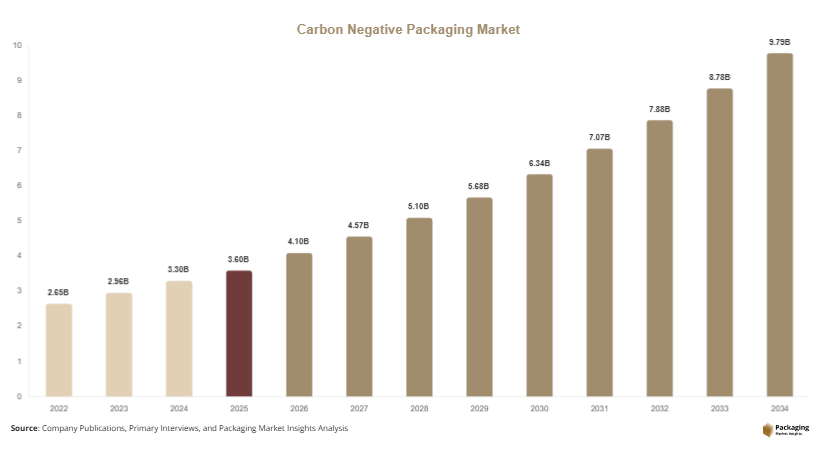
In 2025, the global carbon negative packaging market size is estimated at USD 3.6 billion, increasing to approximately USD 4.1 billion in 2026. The market is projected to reach USD 10.8 billion by 2034, expanding at a CAGR of 11.5% during the forecast period (2025–2034). This growth reflects a structural shift in packaging strategies, where companies are moving beyond carbon neutrality to adopt carbon negative materials and processes.
One of the key growth factors is the rising global focus on carbon reduction targets and net-zero commitments. Governments and corporations are actively seeking solutions that not only reduce emissions but also contribute to carbon sequestration. Carbon negative packaging, made from materials such as biochar composites, agricultural waste, and regenerative fibers, aligns with these goals. Secondly, increasing consumer awareness about climate change is encouraging brands to adopt packaging solutions that demonstrate measurable environmental impact. This shift is influencing purchasing decisions and brand loyalty across sectors such as food, cosmetics, and consumer goods. Thirdly, advancements in material science and life cycle assessment technologies are enabling the development of packaging materials with verified carbon-negative footprints, enhancing market credibility and adoption.
Key Highlights:
- Market size estimated at USD 3.6 billion in 2025, reflecting early-stage adoption across industries focused on sustainability. Growth is supported by increasing investments in low-carbon and carbon-negative material innovations.
- Expected to reach USD 10.8 billion by 2034, driven by expanding adoption across packaging-intensive sectors. Companies are integrating carbon-negative solutions to align with long-term climate commitments.
- CAGR of 11.5% from 2025 to 2034 indicates strong growth momentum in the market. This expansion is fueled by regulatory support and increasing corporate focus on reducing environmental impact.
- Increasing adoption driven by net-zero and carbon reduction goals is shaping market demand. Businesses are prioritizing packaging solutions that contribute to measurable carbon offset and sustainability targets.
- Rising demand for climate-positive packaging solutions is influencing product development and innovation. Companies are focusing on materials and processes that not only reduce emissions but also create a positive environmental impact.
Explore more data points, trends and opportunities Download Free Sample Report
Market Trends
Adoption of Carbon Accounting and Lifecycle Transparency
The carbon negative packaging market is witnessing a growing emphasis on carbon accounting and lifecycle transparency. Companies are increasingly using advanced tools to measure the environmental impact of their packaging solutions across the entire lifecycle, from raw material sourcing to disposal. This trend is driven by the need for accurate reporting and compliance with evolving environmental regulations. Businesses are integrating carbon tracking systems into their operations to validate their sustainability claims and build consumer trust. Additionally, lifecycle transparency enables companies to identify areas for improvement and optimize their packaging strategies. As stakeholders demand greater accountability, the adoption of carbon accounting practices is expected to become a standard in the industry.
Development of Bio-Based and Regenerative Materials
Another significant trend in the market is the development of bio-based and regenerative materials for packaging applications. These materials are derived from renewable sources such as agricultural waste, algae, and forestry byproducts, which can absorb carbon during their growth cycle. Innovations in material science are enabling the production of packaging materials that not only reduce emissions but also contribute to carbon sequestration. This trend is gaining traction among companies aiming to achieve carbon negative status. Additionally, the use of regenerative materials supports circular economy principles by promoting resource efficiency and waste reduction. As research and development efforts continue, the availability and performance of these materials are expected to improve.
Market Drivers
Increasing Corporate Net-Zero Commitments
The growing number of corporate net-zero commitments is a major driver for the carbon negative packaging market. Companies across industries are setting ambitious targets to reduce their carbon footprint and achieve carbon neutrality or negativity. Packaging is a significant contributor to emissions, making it a key focus area for sustainability initiatives. By adopting carbon negative packaging, companies can offset emissions and demonstrate progress toward their climate goals. This trend is particularly prominent in sectors such as food and beverage, cosmetics, and consumer goods, where packaging plays a critical role. As more companies commit to sustainability targets, the demand for carbon negative packaging solutions is expected to increase.
Consumer Preference for Climate-Positive Products
Consumer behavior is evolving, with increasing preference for products that have a positive environmental impact. Shoppers are becoming more aware of climate change and are actively seeking brands that align with their values. Carbon negative packaging provides a unique value proposition by offering measurable environmental benefits. Companies are leveraging this trend to differentiate their products and enhance brand reputation. Additionally, the availability of eco-labels and certifications is helping consumers make informed purchasing decisions. This shift in consumer preferences is driving the adoption of carbon negative packaging across various industries.
Market Restraint
High Cost and Limited Scalability of Carbon Negative Materials
A major restraint in the carbon negative packaging market is the high cost and limited scalability of carbon negative materials. The production of such materials often involves advanced technologies and specialized processes, which can increase manufacturing costs. Additionally, the availability of raw materials such as biochar and regenerative fibers may be limited, affecting supply chain stability.
For example, a packaging company aiming to adopt carbon negative materials may face challenges in sourcing sufficient quantities of sustainable raw materials at competitive prices. This can result in higher product costs, which may be passed on to consumers. While large corporations may have the resources to invest in these solutions, small and medium-sized enterprises may find it difficult to adopt carbon negative packaging due to cost constraints. As a result, scalability remains a key challenge for market growth.
Market Opportunities
Integration with Circular Economy Models
The integration of carbon negative packaging with circular economy models presents a significant growth opportunity. Circular economy practices focus on reducing waste and maximizing resource efficiency through recycling and reuse. Carbon negative packaging aligns with these principles by using renewable materials and promoting sustainable production processes. Companies are exploring ways to incorporate carbon negative materials into closed-loop systems, where packaging can be recycled or composted after use. This approach not only reduces environmental impact but also enhances brand value. As circular economy initiatives gain momentum, the demand for carbon negative packaging solutions is expected to increase.
Expansion in Premium and Niche Product Segments
Premium and niche product segments offer promising opportunities for the carbon negative packaging market. Brands in sectors such as luxury goods, organic food, and high-end cosmetics are increasingly adopting sustainable packaging to differentiate their products. Carbon negative packaging provides a unique selling point by offering environmental benefits that go beyond traditional sustainability claims. These segments are less price-sensitive, allowing companies to invest in advanced packaging solutions. Additionally, the growing demand for eco-friendly premium products is driving innovation in packaging design and materials. As consumer preferences evolve, the adoption of carbon negative packaging in premium segments is expected to grow.
Report Scope
| Report Metric | Details |
|---|---|
| Market Size in 2025 | USD 3.6 Billion |
| Market Size in 2026 | USD 4.1 Billion |
| Market Size in 2034 | USD 10.8 Billion |
| CAGR | 11.5% (2026-2034) |
| Base Year for Estimation | 2025 |
| Historical Data | 2022-2024 |
| Forecast Period | 2026-2034 |
| Report Coverage | Revenue Forecast, Competitive Landscape, Supply Chain Disruption, Growth Factors, Environment & Regulatory Landscape and Trends |
| Geographies Covered | North America, Europe, APAC, Middle East and Africa, LATAM |
| Countries Covered | U.S., Canada, U.K., Germany, France, Spain, Italy, Russia, Nordic, Benelux, Rest of Europe, China, South Korea, Japan, India, Australia, Singapore, Taiwan, South East Asia, Rest of Asia-Pacific, UAE, Turky, Saudi Arabia, South Africa, Egypt, Nigeria, Rest of MEA, Brazil, Mexico, Argentina, Chile, Colombia, Rest of LATAM |
Explore more data points, trends and opportunities Download Free Sample Report
Segmental Analysis
By Type
Biochar-based packaging dominated the carbon negative packaging market in 2024, accounting for approximately 44% of the total share. This segment is widely used due to its ability to sequester carbon and provide durable packaging solutions. Biochar is produced from organic waste materials, making it a sustainable and cost-effective option. The segment’s dominance is supported by increasing adoption across industries seeking carbon negative solutions.
Algae-based packaging is the fastest-growing segment, expected to expand at a CAGR of 12.9%. This growth is driven by the material’s renewable nature and ability to absorb carbon during production. Algae-based packaging is gaining popularity in food and consumer goods sectors.
By Application
Food and beverage packaging was the dominant application segment in 2024, holding a market share of approximately 48%. The increasing demand for sustainable packaging in the food industry is driving this segment. Carbon negative packaging provides an effective solution for reducing environmental impact.
Cosmetics and personal care packaging is the fastest-growing application segment, projected to grow at a CAGR of 13.2%. The demand for eco-friendly packaging in the beauty industry is driving this growth.
By End-Use Industry
The consumer goods industry dominated the market in 2024, accounting for around 46% of the total share. The increasing focus on sustainability and brand differentiation is driving this segment.
The food and beverage industry is the fastest-growing segment, expected to grow at a CAGR of 13.5%. The demand for sustainable packaging solutions is driving growth in this segment.
Carbon Negative Packaging Market Segmentations
By Type
- Biochar-Based Packaging
- Algae-Based Packaging
- Plant Fiber-Based Packaging
By Application
- Food & Beverage Packaging
- Cosmetics & Personal Care Packaging
- Industrial Packaging
By End-Use Industry
- Consumer Goods
- Food & Beverage
- Healthcare
- Industrial
Regional Analysis
North America
North America accounted for approximately 30% of the carbon negative packaging market share in 2025 and is expected to grow at a CAGR of 10.8% during the forecast period. The region’s growth is driven by strong corporate sustainability initiatives and increasing regulatory pressure to reduce carbon emissions. Companies are actively investing in innovative packaging solutions to meet environmental targets.
The United States dominates the North American market due to its advanced technology infrastructure and high adoption of sustainable practices. A unique growth factor is the increasing integration of carbon accounting tools in packaging supply chains, enabling companies to track and reduce emissions effectively.
Europe
Europe held a market share of around 27% in 2025 and is projected to grow at a CAGR of 10.5% through 2034. The region is characterized by stringent environmental regulations and strong government support for sustainability initiatives. Consumers in Europe are highly conscious of environmental issues, driving demand for carbon negative packaging.
Germany leads the European market due to its focus on innovation and sustainability. A unique growth factor is the widespread adoption of carbon labeling practices, which provide transparency and encourage the use of environmentally friendly packaging solutions.
Asia Pacific
Asia Pacific is the fastest-growing region, accounting for approximately 28% of the market share in 2025 and expected to expand at a CAGR of 12.6%. Rapid industrialization and increasing environmental awareness are driving demand for sustainable packaging solutions.
China dominates the Asia Pacific market due to its large manufacturing base and growing focus on sustainability. A key growth factor is government initiatives aimed at reducing carbon emissions and promoting green technologies in packaging.
Middle East & Africa
The Middle East & Africa region accounted for around 7% of the market share in 2025 and is expected to grow at a CAGR of 9.6%. The market is gradually expanding due to increasing awareness of climate change and sustainability.
South Africa is a leading market in the region, supported by growing environmental initiatives. A unique growth factor is the adoption of sustainable packaging solutions in the retail sector to align with global trends.
Latin America
Latin America held approximately 8% of the market share in 2025 and is projected to grow at a CAGR of 10.2%. The region’s growth is driven by increasing demand for eco-friendly packaging and government support for sustainability initiatives.
Brazil dominates the Latin American market due to its large consumer base and growing focus on environmental sustainability. A key growth factor is the increasing use of renewable materials in packaging applications.
Competitive Landscape
The carbon negative packaging market is emerging and moderately fragmented, with several companies focusing on innovation and sustainability. Key players are investing in research and development to create advanced materials and improve scalability. Strategic collaborations and partnerships are common strategies to enhance market presence.
Tetra Pak is a leading player in the market, known for its commitment to sustainability and innovation. The company has recently introduced carbon negative packaging solutions as part of its environmental initiatives. Other companies are also focusing on developing new materials and technologies to gain a competitive edge.
Key Players List
- Tetra Pak
- Amcor Plc
- Smurfit Kappa Group
- DS Smith Plc
- Mondi Group
- WestRock Company
- Stora Enso Oyj
- International Paper Company
- Ball Corporation
- Crown Holdings, Inc.
- Sealed Air Corporation
- UPM-Kymmene Corporation
- Klabin S.A.
- Rengo Co., Ltd.
- Packaging Corporation of America