Laminated Labels Market Size and Growth
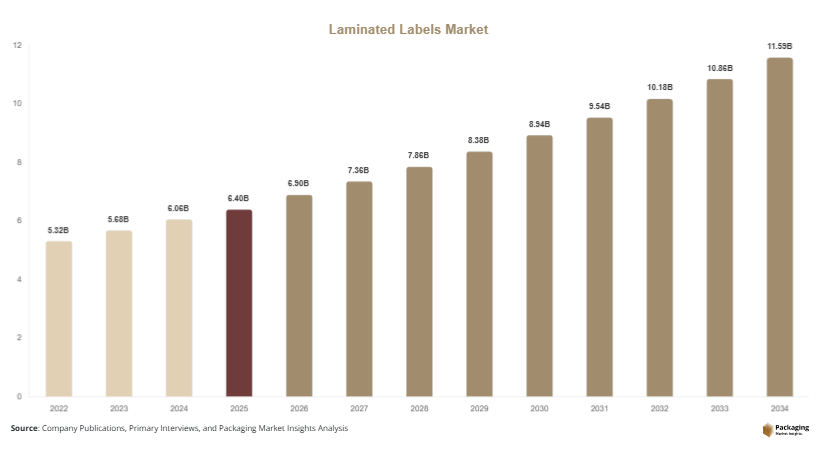
The global laminated labels market size is estimated at USD 6.4 billion in 2025, and it is projected to reach USD 6.9 billion in 2026. By 2034, the market is expected to attain approximately USD 11.8 billion, registering a CAGR of 6.7% during 2025–2034. Growth is supported by advancements in printing technologies, rising branding requirements, and the expansion of packaged consumer goods. The laminated labels market is experiencing steady expansion driven by increasing demand for durable, high-quality, and visually appealing labeling solutions across packaging-intensive industries such as food & beverages, pharmaceuticals, personal care, and industrial goods.
One of the primary growth factors is the increasing adoption of premium packaging formats. Laminated labels provide resistance against moisture, chemicals, and abrasion, making them suitable for products exposed to harsh environments. Another factor is the rapid expansion of retail and e-commerce sectors, where strong shelf appeal and product differentiation are critical. Additionally, regulatory labeling requirements in pharmaceuticals and food industries are encouraging manufacturers to adopt high-performance laminated labeling solutions that ensure compliance and traceability.
Key Highlights:
- Asia Pacific dominated the market with a 37.4% share in 2025.
- Latin America is projected to grow at the fastest CAGR of 6.2%.
- Pressure-sensitive laminated labels led the type segment with a 31.2% share.
- Plastic-based laminated labels dominated with a 54.1% share.
- Food & beverage applications led with 44.5% share.
- The US remained the dominant country with a market size of USD 1.6 billion in 2025 and USD 1.7 billion in 2026.
Explore more data points, trends and opportunities Download Free Sample Report
Market Trends
Growth of Premium and Decorative Labeling
The laminated labels market is witnessing strong adoption of premium and decorative labeling solutions, particularly in beverages, cosmetics, and specialty foods. Brands are increasingly using high-gloss, matte, and textured laminated finishes to enhance shelf appeal and consumer engagement. This trend is driven by intense retail competition, where packaging plays a key role in influencing purchase decisions. For example, craft beverage companies are adopting metallic laminated labels to differentiate product lines. In the future, demand for tactile and multi-layered label designs is expected to rise further as brands focus on experiential packaging strategies.
Shift Toward Sustainable Laminated Materials
Sustainability is becoming a central trend in laminated labels, with manufacturers shifting toward recyclable films, water-based adhesives, and bio-laminates. Regulatory pressure in Europe and increasing consumer awareness are pushing companies to reduce plastic usage in packaging components. For instance, FMCG brands are introducing paper-based laminated labels that maintain durability while reducing environmental impact. This trend is expected to accelerate as circular economy models gain traction, encouraging innovation in compostable and mono-material label structures.
Market Drivers
Expansion of Packaged Consumer Goods Industry
The rapid growth of packaged consumer goods is a major driver for laminated labels. Increasing urbanization, rising disposable incomes, and changing consumption patterns are boosting demand for packaged food, beverages, and personal care products. Laminated labels offer durability and aesthetic enhancement, making them suitable for mass-market and premium products. For example, multinational beverage companies use laminated labels to maintain brand visibility in refrigerated and moisture-prone environments. This expanding FMCG ecosystem continues to strengthen label demand globally.
Growth in Pharmaceutical and Compliance Labeling
The pharmaceutical sector is another strong driver due to strict regulatory requirements for product identification, safety, and traceability. Laminated labels provide resistance against sterilization processes and chemical exposure, ensuring legibility throughout the product lifecycle. With increasing demand for vaccines, biologics, and specialty drugs, pharmaceutical companies are investing in high-performance labeling systems. Serialized labeling and anti-counterfeit requirements further enhance adoption of laminated label technologies in this sector.
Market Restraint
High Cost of Advanced Lamination Technologies
One of the key restraints in the laminated labels market is the relatively high cost of advanced materials and production processes. Multi-layer films, specialty coatings, and digital printing systems increase overall manufacturing expenses. Small and medium enterprises often face challenges in adopting premium laminated labels due to budget limitations. For example, regional food brands in developing markets may opt for simpler label alternatives instead of high-cost laminated solutions. This cost sensitivity can limit market penetration in price-competitive industries.
Market Opportunities
Expansion of Smart and Functional Labels
The integration of smart features such as QR codes, RFID tags, and temperature indicators into laminated labels presents significant growth opportunities. These smart labels enhance traceability, consumer engagement, and supply chain transparency. In pharmaceuticals, temperature-sensitive laminated labels help monitor cold chain compliance. Similarly, in food delivery services, QR-enabled laminated labels provide product origin and freshness details. This convergence of packaging and digital technology is expected to open new revenue streams for manufacturers.
Growth in Emerging Markets
Emerging economies in Asia Pacific, Latin America, and Africa are witnessing rapid growth in packaged goods consumption, creating strong demand for laminated labels. Expanding retail networks, rising e-commerce penetration, and increasing industrial production are supporting market expansion. For instance, India and Brazil are experiencing strong growth in FMCG and pharmaceutical packaging, where laminated labels are becoming essential for branding and compliance. This regional expansion offers long-term growth potential for global label manufacturers.
Report Scope
| Report Metric | Details |
|---|---|
| Market Size in 2025 | USD 6.4 Billion |
| Market Size in 2026 | USD 6.9 Billion |
| Market Size in 2034 | USD 11.8 Billion |
| CAGR | 6.7% (2026-2034) |
| Base Year for Estimation | 2025 |
| Historical Data | 2022-2024 |
| Forecast Period | 2026-2034 |
| Report Coverage | Revenue Forecast, Competitive Landscape, Supply Chain Disruption, Growth Factors, Environment & Regulatory Landscape and Trends |
| Geographies Covered | North America, Europe, APAC, Middle East and Africa, LATAM |
| Countries Covered | U.S., Canada, U.K., Germany, France, Spain, Italy, Russia, Nordic, Benelux, Rest of Europe, China, South Korea, Japan, India, Australia, Singapore, Taiwan, South East Asia, Rest of Asia-Pacific, UAE, Turky, Saudi Arabia, South Africa, Egypt, Nigeria, Rest of MEA, Brazil, Mexico, Argentina, Chile, Colombia, Rest of LATAM |
Explore more data points, trends and opportunities Download Free Sample Report
Segmental Analysis
By Type
Pressure-sensitive laminated labels dominated the market with a 2024 share of 33.1%. These labels are widely used due to their ease of application, strong adhesion, and compatibility with automated labeling systems. Industries such as beverages, cosmetics, and pharmaceuticals rely heavily on pressure-sensitive formats for high-speed packaging lines. Their ability to support high-quality printing and resistance to environmental conditions makes them highly suitable for diverse applications. For example, bottled beverage companies use these labels to maintain durability in refrigerated environments while preserving branding quality.
Shrink sleeve laminated labels are the fastest-growing segment with a CAGR of 7.0%. These labels offer 360-degree branding coverage and enhanced tamper-evidence features. Rising demand in beverage and personal care industries is driving adoption. Their ability to conform to irregular container shapes is further boosting usage in premium packaging formats.
By Material
Plastic-based laminated labels dominated with a 55.2% share in 2024 due to their durability, flexibility, and moisture resistance. They are widely used in food and beverage packaging where long shelf life and visual appeal are important. PET and polypropylene films are commonly used materials supporting high-resolution printing and strong adhesive bonding. For example, bottled water and soft drink companies extensively use plastic laminated labels for durability in cold storage conditions.
Biodegradable materials are the fastest-growing subsegment with a CAGR of 6.9%, driven by sustainability initiatives. Companies are shifting toward compostable films and paper-based laminates to reduce environmental impact and comply with regulations.
By End-Use
Food & beverage dominated with a 46.3% share in 2024 due to high consumption of packaged goods. Laminated labels ensure moisture resistance and branding consistency in refrigerated and frozen products. Beverage companies rely heavily on laminated formats for long-lasting shelf appeal.
Healthcare is the fastest-growing segment with a CAGR of 7.2%, driven by rising pharmaceutical production and regulatory labeling requirements. Laminated labels ensure durability during sterilization and transport processes.
Laminated Labels Market Segmentations
By Type
- Pressure-Sensitive Labels
- Shrink Sleeve Labels
- Wet Glue Labels
By Material
- Plastic
- Paper
- Biodegradable Films
By End-Use
- Food & Beverage
- Pharmaceuticals
- Personal Care
- Industrial
Regional Analysis
North America
North America accounted for approximately 28.6% of the global laminated labels market share in 2025 and is projected to expand at a CAGR of 6.1% during the forecast period. The region benefits from a mature packaging industry, high demand for premium consumer goods, and strong adoption of advanced labeling technologies. Food and beverage manufacturers in the United States and Canada increasingly use laminated labels to improve durability, moisture resistance, and shelf visibility. Growth in e-commerce packaging and pharmaceutical labeling is also supporting regional demand. In addition, rising investments in sustainable packaging materials are encouraging the transition toward recyclable laminated labels across multiple end-use sectors.
The United States dominates the North American laminated labels market due to its large packaged food, healthcare, and personal care industries. One unique growth driver is the rapid expansion of cold-chain logistics and frozen food distribution. Laminated labels are widely used on refrigerated and frozen products because they maintain adhesion and print quality under low-temperature conditions. Beverage companies are also adopting pressure-sensitive laminated labels with high-gloss finishes to strengthen brand positioning. Furthermore, the growing use of smart labels with QR codes in retail and healthcare packaging is creating additional opportunities for manufacturers operating in the U.S. market.
Europe
Europe held around 25.4% of the global laminated labels market share in 2025 and is forecast to grow at a CAGR of 6.0% between 2025 and 2034. The region is characterized by strict environmental regulations, strong sustainability initiatives, and high demand for premium packaging solutions. European packaging manufacturers are increasingly investing in recyclable laminates and water-based adhesive technologies to comply with circular economy targets. Demand for laminated labels remains high in food processing, cosmetics, and pharmaceutical industries, particularly in countries with advanced manufacturing sectors. Retail growth and the expansion of private-label products are also contributing to steady market development across the region.
Germany is the dominant country within the European laminated labels market due to its strong industrial base and advanced printing technologies. A unique growth factor in Germany is the increasing use of eco-friendly mono-material packaging systems that support easier recycling processes. Many consumer goods companies are replacing traditional multi-layer laminates with recyclable alternatives to meet EU sustainability regulations. The cosmetics industry in Germany is also driving demand for decorative laminated labels with matte and metallic finishes. In addition, pharmaceutical manufacturers continue to adopt durable labeling solutions for compliance and traceability purposes, supporting long-term market growth.
Asia Pacific
Asia Pacific dominated the laminated labels market with a 37.4% share in 2025 and is projected to register the highest regional CAGR of 7.3% during the forecast period. Rapid industrialization, urbanization, and rising packaged goods consumption are key factors driving market expansion across the region. Countries such as China, India, Japan, and South Korea are experiencing strong demand for high-quality labeling solutions in food, beverage, pharmaceutical, and consumer electronics packaging. The rapid growth of organized retail and e-commerce platforms is further increasing the requirement for visually appealing and durable labels. Additionally, expanding manufacturing activities and export-oriented packaging industries continue to strengthen regional market demand.
China remains the leading country in the Asia Pacific laminated labels market due to its extensive manufacturing ecosystem and large consumer base. One unique growth factor is the increasing export of packaged consumer goods and electronics products requiring durable labels for long-distance transportation. Chinese packaging manufacturers are also investing heavily in digital printing and automated labeling technologies to improve production efficiency. The growth of beverage packaging, especially bottled water, dairy drinks, and energy beverages, is accelerating demand for shrink sleeve laminated labels. Furthermore, rising middle-class spending and increased preference for premium packaging designs are expected to sustain long-term market growth in China.
Middle East & Africa
The Middle East & Africa region accounted for approximately 4.8% of the global laminated labels market in 2025 and is expected to grow at a CAGR of 6.4% through 2034. Market growth is being supported by increasing urbanization, expanding retail infrastructure, and rising imports of packaged consumer goods. Food packaging applications are driving significant demand for laminated labels due to the need for moisture-resistant and durable labeling materials in hot climatic conditions. Governments in Gulf countries are also investing in healthcare infrastructure, which is increasing the use of pharmaceutical labeling solutions. In addition, the development of logistics and warehousing sectors is supporting regional packaging demand.
The United Arab Emirates dominates the regional market because of its strong trade and logistics network. A unique growth driver in the UAE is the rapid expansion of luxury retail and premium cosmetics packaging. International beauty and skincare brands entering the Gulf market are increasingly using decorative laminated labels with metallic and textured finishes to enhance shelf appeal. The hospitality and tourism industries are also contributing to increased demand for packaged beverages and personal care products. Moreover, rising investments in sustainable packaging technologies across the UAE are encouraging manufacturers to introduce recyclable laminated label materials for regional applications.
Latin America
Latin America represented around 3.8% of the laminated labels market share in 2025 and is forecast to expand at a CAGR of 6.6% during the forecast period. The market is benefiting from growing food processing industries, increasing pharmaceutical production, and rising demand for packaged consumer products. Countries across the region are witnessing greater penetration of organized retail chains and e-commerce platforms, which is increasing the need for durable and attractive labeling solutions. Flexible packaging manufacturers are also expanding their laminated label offerings to meet growing demand from beverage and household product companies. Improvements in regional printing and packaging capabilities are further supporting market expansion.
Brazil is the dominant country in the Latin American laminated labels market due to its large consumer goods and agricultural processing industries. One unique growth factor is the increasing export of packaged food and beverage products requiring long-lasting labels for transportation and storage. Beverage manufacturers in Brazil are widely adopting shrink sleeve laminated labels for improved product branding and tamper resistance. The pharmaceutical sector is also contributing to market demand through rising use of compliance labeling and serialized packaging solutions. Additionally, investments in local packaging production facilities are expected to strengthen Brazil’s role in the regional laminated labels industry over the coming years.
Competitive Landscape
The laminated labels market is moderately competitive, with key players focusing on innovation, sustainability, and digital printing capabilities. Major companies include Avery Dennison Corporation, which leads the market through its extensive global distribution network and continuous product innovation. The company recently expanded its sustainable label portfolio using recyclable adhesive technologies.
Other prominent players include CCL Industries, 3M Company, UPM Raflatac, and Constantia Flexibles. These companies are investing in advanced printing technologies, smart labeling solutions, and eco-friendly materials. Strategic partnerships with FMCG and pharmaceutical companies are strengthening their market positions.
Key Players List
- Avery Dennison Corporation
- CCL Industries Inc.
- 3M Company
- UPM Raflatac
- Constantia Flexibles
- Fuji Seal International
- MCC Label
- Sato Holdings Corporation
- Brady Corporation
- HERMA GmbH
- Coveris Holdings
- Lintec Corporation
- Resource Label Group
- Fuji Seal Packaging
- Huhtamaki Group