Hazardous Waste Bag Market Size and Growth
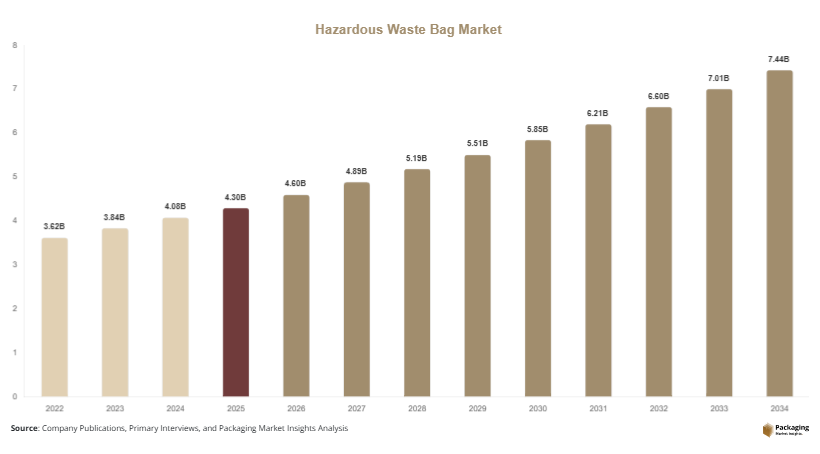
The global hazardous waste bag market size is estimated at USD 4.3 billion in 2025 and is expected to reach USD 4.6 billion in 2026. By 2034, the market is projected to expand to USD 7.9 billion, registering a CAGR of 6.2% during the forecast period (2025–2034). This growth is primarily driven by increasing hazardous waste generation across healthcare, pharmaceutical, and industrial sectors, along with tightening regulatory frameworks that mandate proper waste management. The hazardous waste bag market is experiencing consistent growth as industries and healthcare systems increase their focus on safe waste disposal practices.
Rising healthcare activities worldwide have significantly increased the volume of infectious and biohazardous waste. Hospitals, diagnostic laboratories, and clinics require reliable containment solutions, which is accelerating demand for high-performance hazardous waste bags. At the same time, industrial sectors such as chemicals and manufacturing are generating complex waste streams that must be handled with strict safety protocols, further supporting market expansion.
Key Highlights:
- Asia Pacific dominated the market with a 38.1% share in 2025, while Latin America is projected to grow at the fastest CAGR of 6.8%.
- High-density polyethylene (HDPE) bags led the type segment with a 33.4% share, while biodegradable bags are expected to grow at a CAGR of 7.1%.
- Industrial applications dominated with a 49.6% share, while healthcare applications are forecasted to grow at a CAGR of 6.9%.
- Hospitals led the end-use segment with 41.3% share, while research laboratories are expected to grow at a CAGR of 6.7%.
- The United States remained the dominant country with a market size of USD 1.1 billion in 2025 and USD 1.2 billion in 2026.
Explore more data points, trends and opportunities Download Free Sample Report
Market Trends
Growing shift toward eco-friendly hazardous waste bags
Sustainability is emerging as a defining direction within the hazardous waste bag market, as organizations aim to reduce environmental impact while maintaining compliance with safety standards. Manufacturers are investing in biodegradable and recyclable materials to replace conventional plastic-based products. This shift is supported by regulatory pressure, particularly in developed regions where environmental policies are becoming stricter. Healthcare providers and industrial facilities are increasingly adopting eco-friendly waste bags as part of their sustainability commitments. Innovations in bio-based polymers have enabled the production of bags that retain durability and resistance properties. This transition is influencing procurement strategies and encouraging companies to differentiate their offerings through sustainable product portfolios.
Integration of digital tracking and smart labeling technologies
Digitalization is transforming hazardous waste management practices, with smart labeling and tracking systems gaining widespread adoption. Hazardous waste bags are increasingly embedded with QR codes, RFID tags, and barcodes that allow real-time monitoring throughout the waste disposal chain. This enhances traceability and ensures compliance with regulatory standards. Healthcare facilities and industrial operators are leveraging these technologies to reduce risks associated with mismanagement and improper disposal. The ability to track waste from generation to final treatment improves accountability and operational efficiency. As industries continue to adopt digital solutions, smart hazardous waste bags are expected to play a critical role in modern waste management systems.
Market Drivers
Rising volume of healthcare and biohazardous waste
The expansion of global healthcare infrastructure has significantly increased the generation of hazardous waste. Hospitals, clinics, and laboratories produce large volumes of infectious materials, including sharps, contaminated equipment, and biological waste. The need for safe containment and disposal has become essential to prevent cross-contamination and environmental hazards. This has led to increased demand for high-quality hazardous waste bags that meet strict safety standards. Emerging economies are also investing in healthcare development, further boosting waste generation. Additionally, growing awareness regarding infection control and hygiene practices is encouraging healthcare providers to adopt reliable disposal solutions, supporting consistent market growth.
Increasing enforcement of regulatory compliance
Stringent regulatory frameworks are playing a crucial role in driving the hazardous waste bag market. Governments and environmental agencies have established strict guidelines for the handling, transportation, and disposal of hazardous waste. Compliance with these regulations requires the use of certified and high-performance waste bags. Industries such as pharmaceuticals, chemicals, and manufacturing are particularly impacted, as they generate complex and potentially harmful waste streams. Non-compliance can result in penalties and environmental damage, prompting organizations to invest in compliant solutions. This regulatory pressure continues to create sustained demand across multiple sectors.
Market Restraint
High cost associated with advanced waste bag materials
The adoption of advanced hazardous waste bags is often limited by their relatively high cost compared to conventional alternatives. Multi-layered, puncture-resistant, and biodegradable bags require specialized manufacturing processes and high-quality raw materials, which increase production expenses. This cost factor can be a barrier for small and medium-sized enterprises, particularly in developing regions where budget constraints are more pronounced. Healthcare facilities with limited funding may opt for lower-cost solutions that do not fully meet advanced safety standards. This creates a gap between regulatory requirements and practical implementation. The cost challenge may slow market penetration in price-sensitive regions and impact overall adoption rates.
Market Opportunities
Expansion of healthcare and industrial sectors in emerging economies
Emerging markets present strong growth potential for the hazardous waste bag market due to rapid industrialization and expanding healthcare infrastructure. Countries in Asia Pacific, Latin America, and Africa are witnessing increased investments in hospitals, laboratories, and manufacturing facilities. This growth is leading to higher volumes of hazardous waste, creating demand for efficient disposal solutions. Governments in these regions are also strengthening regulatory frameworks to improve waste management practices. Companies that offer cost-effective and compliant products can benefit from these developments. Establishing local manufacturing and distribution networks can further enhance market penetration and growth opportunities.
Advancements in biodegradable and sustainable materials
Innovation in biodegradable materials is creating new opportunities for market expansion. Environmental concerns and regulatory pressure are encouraging the development of sustainable hazardous waste bags that reduce ecological impact. Advances in polymer science have enabled the production of materials that combine durability with biodegradability. These products are particularly attractive to healthcare institutions and industries aiming to meet sustainability goals. Manufacturers investing in research and development can create differentiated products that cater to evolving customer preferences. The growing adoption of eco-friendly solutions is expected to drive long-term growth and innovation in the market.
Report Scope
| Report Metric | Details |
|---|---|
| Market Size in 2025 | USD 4.3 Billion |
| Market Size in 2026 | USD 4.6 Billion |
| Market Size in 2034 | USD 7.9 Billion |
| CAGR | 6.2% (2026-2034) |
| Base Year for Estimation | 2025 |
| Historical Data | 2022-2024 |
| Forecast Period | 2026-2034 |
| Report Coverage | Revenue Forecast, Competitive Landscape, Supply Chain Disruption, Growth Factors, Environment & Regulatory Landscape and Trends |
| Geographies Covered | North America, Europe, APAC, Middle East and Africa, LATAM |
| Countries Covered | U.S., Canada, U.K., Germany, France, Spain, Italy, Russia, Nordic, Benelux, Rest of Europe, China, South Korea, Japan, India, Australia, Singapore, Taiwan, South East Asia, Rest of Asia-Pacific, UAE, Turky, Saudi Arabia, South Africa, Egypt, Nigeria, Rest of MEA, Brazil, Mexico, Argentina, Chile, Colombia, Rest of LATAM |
Explore more data points, trends and opportunities Download Free Sample Report
Segmental Analysis
By Type
High-density polyethylene bags accounted for the largest share of 33.4% in 2024, driven by their durability, flexibility, and resistance to punctures and leaks. These bags are widely used across healthcare and industrial applications due to their ability to safely contain hazardous materials. Their cost-effectiveness and compliance with regulatory standards make them a preferred choice for organizations. In addition, HDPE bags offer ease of handling and storage, which enhances operational efficiency. The widespread availability of these bags and their compatibility with existing waste management systems further contribute to their dominance in the market.
Biodegradable bags are expected to witness the fastest growth, registering a CAGR of 7.1% during the forecast period. The increasing emphasis on sustainability and environmental protection is driving demand for eco-friendly alternatives. Advances in material science have enabled the development of biodegradable bags that maintain strength and durability. These bags are gaining popularity among healthcare institutions and industries seeking to reduce their environmental footprint. Regulatory support for sustainable products is also contributing to the growth of this segment, making it a key area of innovation.
By Application
Industrial applications held the largest share of 49.6% in 2024, reflecting the significant volume of hazardous waste generated by manufacturing, chemical, and pharmaceutical industries. These sectors require reliable waste containment solutions to ensure safe handling and transportation. Hazardous waste bags play a critical role in preventing contamination and ensuring compliance with safety regulations. The continued expansion of industrial activities worldwide is expected to sustain demand in this segment. Additionally, increasing awareness of environmental safety is encouraging industries to adopt high-quality disposal solutions.
Healthcare applications are projected to grow at the fastest CAGR of 6.9% during the forecast period. The rising number of medical procedures and the expansion of healthcare facilities are driving the generation of hazardous waste. Hospitals and clinics require specialized waste bags to manage infectious materials safely. The focus on infection control and hygiene standards is further supporting growth in this segment. Increased investment in healthcare infrastructure, particularly in emerging economies, is expected to create significant opportunities for market expansion.
By End-Use
Hospitals accounted for the largest share of 41.3% in 2024, driven by the high volume of hazardous waste generated in medical settings. These facilities require reliable and compliant waste disposal solutions to ensure patient and staff safety. Hazardous waste bags are essential for managing biological and chemical waste, making them a critical component of hospital operations. The expansion of healthcare infrastructure and the increasing number of patients are expected to sustain demand in this segment.
Research laboratories are expected to grow at the fastest CAGR of 6.7% during the forecast period. Laboratories generate specialized hazardous waste that requires careful handling and disposal. The growth of research activities in pharmaceuticals and biotechnology is driving demand for high-quality waste bags. Increased funding for research and development and the expansion of laboratory facilities are further supporting growth in this segment. The need for compliance with safety standards is also encouraging adoption.
Hazardous Waste Bag Market Segmentations
By Type
- High-Density Polyethylene (HDPE)
- Low-Density Polyethylene (LDPE)
- Biodegradable Bags
- Others
By Application
- Industrial
- Healthcare
- Commercial
By End-Use
- Hospitals
- Laboratories
- Pharmaceutical Companies
- Others
Regional Analysis
North America
North America accounted for approximately 29.5% of the hazardous waste bag market share in 2025 and is expected to grow at a CAGR of 5.8% during the forecast period. The region benefits from well-established healthcare systems and strict environmental regulations that mandate proper waste disposal practices. High awareness regarding occupational safety and environmental protection further supports market growth. The adoption of advanced technologies and smart waste management systems is also contributing to increased demand for high-quality hazardous waste bags.
The United States leads the regional market due to its strong regulatory framework and extensive healthcare infrastructure. A key growth factor is the increasing use of digital tracking technologies in waste management processes. Hospitals and industrial facilities are adopting advanced solutions to enhance efficiency and ensure compliance, which is driving demand for innovative hazardous waste bags.
Europe
Europe held a market share of around 24.3% in 2025 and is projected to grow at a CAGR of 5.6% during the forecast period. The region is characterized by strong environmental policies and a focus on sustainability. Governments are promoting the use of eco-friendly materials and encouraging responsible waste management practices. The presence of advanced healthcare systems and established industrial sectors further contributes to market demand.
Germany remains the dominant country in Europe, supported by its robust industrial base and strict regulatory standards. A unique growth factor is the emphasis on circular economy principles, which encourages recycling and the use of sustainable materials. This focus is driving innovation in biodegradable hazardous waste bags and supporting market expansion.
Asia Pacific
Asia Pacific led the global market with a share of 38.1% in 2025 and is expected to grow at a CAGR of 6.7% during the forecast period. Rapid urbanization, industrialization, and healthcare expansion are key factors driving growth in the region. Governments are implementing policies to improve waste management practices, while increasing awareness regarding environmental safety is encouraging adoption of standardized solutions.
China dominates the regional market due to its large population and extensive industrial activities. A significant growth factor is the rapid expansion of healthcare facilities, which is increasing the volume of medical waste. Government initiatives to strengthen waste management regulations are further supporting demand for hazardous waste bags.
Middle East & Africa
The Middle East & Africa region accounted for approximately 4.8% of the market share in 2025 and is projected to grow at a CAGR of 5.9%. Growth in this region is driven by increasing investments in healthcare infrastructure and rising awareness of environmental issues. Governments are gradually implementing regulations to improve waste management practices, creating new opportunities for market players.
Saudi Arabia is a leading country in the region, supported by ongoing healthcare modernization efforts. A key growth factor is the expansion of hospital infrastructure and medical services. This is increasing the demand for hazardous waste bags as healthcare facilities adopt standardized waste disposal practices.
Latin America
Latin America held a market share of 3.3% in 2025 and is expected to grow at the fastest CAGR of 6.8% during the forecast period. The region is experiencing growth due to improving healthcare infrastructure and increasing industrial activities. Governments are focusing on strengthening waste management regulations to address environmental concerns and improve public health.
Brazil dominates the regional market due to its large healthcare system and industrial base. A unique growth factor is the rising awareness of proper waste disposal practices among organizations. This is encouraging the adoption of compliant hazardous waste bags across healthcare and industrial sectors.
Competitive Landscape
The hazardous waste bag market is moderately fragmented, with a mix of global and regional players competing on product quality, innovation, and regulatory compliance. Companies are focusing on expanding their product portfolios and investing in advanced materials to meet evolving industry requirements. Sustainability and digital integration are emerging as key competitive factors.
Berry Global Group, Inc. is recognized as a leading player due to its extensive product range and strong global presence. The company has recently introduced recyclable hazardous waste bags to strengthen its sustainability offerings. Other companies are also focusing on innovation, strategic partnerships, and capacity expansion to enhance their market position and address growing demand.
Key Players List
- Berry Global Group, Inc.
- Stericycle, Inc.
- Veolia Environment S.A.
- Daniels Health
- Clean Harbors, Inc.
- Thermo Fisher Scientific Inc.
- Inteplast Group
- Novolex Holdings, Inc.
- Sharps Compliance, Inc.
- Medline Industries, LP
- SUEZ Group
- Republic Services, Inc.
- Waste Management, Inc.
- BioMedical Waste Solutions, LLC
- Plasti Surge Industries Pvt. Ltd.