Cement Packaging Market Size and Growth
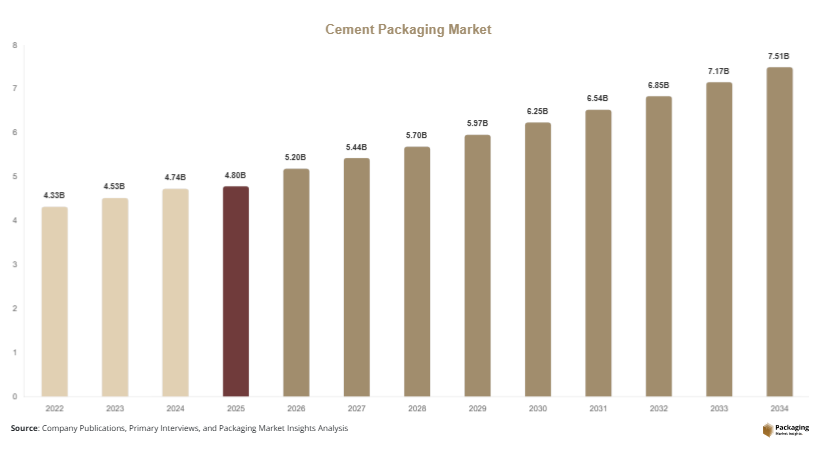
The global cement packaging market size was valued at approximately USD 4.8 billion in 2025 and is projected to reach USD 5.2 billion in 2026. Over the forecast period, the market is expected to grow to nearly USD 7.8 billion by 2034, registering a compound annual growth rate (CAGR) of 4.7% from 2025 to 2034. The steady rise reflects increasing cement consumption across residential, commercial, and infrastructure projects worldwide. The cement packaging market is witnessing steady and consistent growth, supported by expanding construction activities and improvements in industrial packaging technologies.
Growth in the cement packaging market is largely driven by rapid urbanization and population expansion, particularly in emerging economies. Governments are investing in large-scale infrastructure projects such as highways, railways, bridges, and urban housing, which directly increases cement demand and packaging requirements. Another significant growth factor is the transition toward environmentally sustainable packaging materials. Paper-based sacks are gaining traction due to regulatory pressure and corporate sustainability goals, as they are recyclable and reduce environmental impact. Additionally, advancements in packaging technology, including multi-layer paper sacks and moisture-resistant coatings, are improving durability and minimizing product loss during transportation.
Key Highlights:
- Asia Pacific dominated the market with a 38.7% share in 2025, while Latin America is projected to grow at the fastest CAGR of 5.9%.
- Valve sacks led the type segment with a 47.9% share, while jumbo bags are expected to grow at a CAGR of 5.4%.
- Paper packaging dominated with a 55.1% share, while plastic packaging is forecasted to grow at a CAGR of 4.8%.
- Residential construction applications led the segment with 42.3% share, while infrastructure projects are expected to grow at a CAGR of 5.2%.
- China remained the dominant country with a market size of USD 1.25 billion in 2025 and USD 1.33 billion in 2026.
Explore more data points, trends and opportunities Download Free Sample Report
Market Trends
Rising Shift Toward Sustainable Packaging Materials
The cement packaging market is increasingly influenced by sustainability concerns, leading to a notable shift toward eco-friendly packaging materials. Multi-layer kraft paper sacks are widely adopted due to their recyclability and lower environmental impact compared to plastic alternatives. Regulatory frameworks in regions such as Europe and Asia Pacific are pushing manufacturers to reduce plastic usage, encouraging the adoption of biodegradable and recyclable materials. Companies are also aligning their packaging strategies with corporate sustainability goals to meet stakeholder expectations. Technological advancements, including water-resistant coatings and enhanced fiber strength, are improving the durability of paper-based packaging, making it suitable for various environmental conditions.
Integration of Automation and Smart Packaging Systems
Automation is transforming packaging processes within the cement industry, leading to improved operational efficiency and cost optimization. Advanced packaging systems equipped with high-speed filling machines and robotic palletizers are reducing manual intervention and minimizing errors. Smart packaging solutions, including QR codes and RFID tagging, are enabling real-time tracking and better inventory management. These technologies enhance supply chain transparency and help manufacturers monitor product movement effectively. The integration of Industry 4.0 technologies is further improving predictive maintenance and operational performance, making automated packaging systems a key trend in the cement packaging market.
Market Drivers
Expansion of Global Construction Activities
The growth of construction activities worldwide is a major factor driving the cement packaging market. Rapid urbanization and population growth are increasing demand for residential and commercial infrastructure. Governments are investing in large-scale infrastructure projects, including transportation networks and industrial facilities, which require significant quantities of cement. This surge in demand directly increases the need for efficient packaging solutions that ensure safe handling and transportation. The growing adoption of prefabricated construction techniques is also contributing to the demand for bulk packaging formats such as jumbo bags and valve sacks.
Advancements in Packaging Materials and Technologies
Technological progress in packaging materials is playing a crucial role in market expansion. Manufacturers are developing high-performance packaging solutions that offer enhanced strength, moisture resistance, and durability. Multi-layer packaging designs and advanced sealing technologies are improving product safety and reducing wastage during transportation. Lightweight materials are also helping reduce logistics costs, making packaging solutions more efficient. These innovations are enabling cement manufacturers to improve supply chain efficiency and maintain product quality, thereby supporting overall market growth.
Market Restraint
Fluctuations in Raw Material Costs and Regulatory Pressures
The cement packaging market faces challenges due to volatility in raw material prices, particularly paper pulp and plastic resins. These fluctuations can significantly impact production costs and reduce profit margins for packaging manufacturers. Additionally, stringent environmental regulations related to plastic usage are limiting the adoption of certain packaging materials. For instance, restrictions on single-use plastics in several regions are compelling manufacturers to shift toward alternative materials, which may involve higher costs and technical complexities. These challenges can hinder market growth, especially in cost-sensitive regions where price fluctuations directly affect purchasing decisions and operational planning.
Market Opportunities
Expansion Across Emerging Economies
Emerging economies present strong growth potential for the cement packaging market due to rapid urbanization and industrial development. Countries in Asia, Africa, and Latin America are experiencing increased demand for housing and infrastructure projects. Government initiatives focused on economic development and urban expansion are driving cement consumption, creating opportunities for packaging manufacturers. Establishing local production facilities and strengthening distribution networks can help companies capitalize on these opportunities while reducing logistics costs and improving market reach.
Development of Innovative and Sustainable Packaging Solutions
The growing emphasis on sustainability is creating opportunities for innovation in cement packaging. Manufacturers are investing in research and development to produce biodegradable, recyclable, and reusable packaging materials. Hybrid packaging solutions and compostable bags are gaining attention as environmentally friendly alternatives. These innovations not only address environmental concerns but also enhance brand value and customer satisfaction. Companies that prioritize sustainable packaging solutions are likely to gain a competitive edge and strengthen their market position in the long term.
Report Scope
| Report Metric | Details |
|---|---|
| Market Size in 2025 | USD 4.8 Billion |
| Market Size in 2026 | USD 5.2 Billion |
| Market Size in 2034 | USD 7.8 Billion |
| CAGR | 4.7% (2026-2034) |
| Base Year for Estimation | 2025 |
| Historical Data | 2022-2024 |
| Forecast Period | 2026-2034 |
| Report Coverage | Revenue Forecast, Competitive Landscape, Supply Chain Disruption, Growth Factors, Environment & Regulatory Landscape and Trends |
| Geographies Covered | North America, Europe, APAC, Middle East and Africa, LATAM |
| Countries Covered | U.S., Canada, U.K., Germany, France, Spain, Italy, Russia, Nordic, Benelux, Rest of Europe, China, South Korea, Japan, India, Australia, Singapore, Taiwan, South East Asia, Rest of Asia-Pacific, UAE, Turky, Saudi Arabia, South Africa, Egypt, Nigeria, Rest of MEA, Brazil, Mexico, Argentina, Chile, Colombia, Rest of LATAM |
Explore more data points, trends and opportunities Download Free Sample Report
Segmental Analysis
By Material Type
Paper-based packaging dominated the cement packaging market in 2024, accounting for approximately 55.1% of the total share. Multi-layer kraft paper sacks are widely used due to their strength, flexibility, and eco-friendly properties. These sacks provide effective protection against moisture and contamination while being recyclable, making them suitable for sustainable packaging strategies. The increasing focus on reducing environmental impact is encouraging manufacturers to adopt paper-based solutions. Additionally, advancements in paper processing technologies have improved the durability and performance of these materials, enabling them to withstand various environmental conditions and handling processes during transportation and storage.
Plastic packaging is expected to witness the fastest growth, registering a CAGR of 4.8% during the forecast period. Plastic materials offer superior moisture resistance and durability, making them suitable for harsh environmental conditions and long-distance transportation. Innovations in biodegradable plastics and recyclable polymers are addressing environmental concerns associated with plastic usage. The demand for lightweight and cost-efficient packaging solutions is also contributing to segment growth, as these materials help reduce logistics costs and improve handling efficiency across supply chains.
By Packaging Type
Valve sacks emerged as the dominant packaging type in 2024, holding a market share of 47.9%. These sacks are widely used in the cement industry due to their efficient filling and sealing capabilities, which minimize spillage and product loss. They are designed for high-speed filling operations, making them suitable for large-scale production facilities. Valve sacks also offer durability and ease of handling, ensuring safe transportation and storage of cement products across various distribution channels.
Jumbo bags are projected to be the fastest-growing packaging type, with a CAGR of 5.4% during the forecast period. These bags are ideal for bulk transportation of cement and are increasingly used in large infrastructure and industrial projects. Their high load capacity, reusability, and cost-effectiveness make them an attractive option for manufacturers. The growing trend of bulk handling and transportation is driving demand for jumbo bags, as they improve logistics efficiency and reduce packaging waste.
By Application
Residential construction dominated the application segment in 2024, accounting for 42.3% of the cement packaging market share. The increasing demand for housing, particularly in urban areas, is driving cement consumption and packaging requirements. Government initiatives aimed at providing affordable housing are further supporting this segment’s growth. Cement packaging solutions play a crucial role in ensuring efficient distribution and storage, helping maintain product quality and reduce losses during transportation.
Infrastructure projects are expected to be the fastest-growing application segment, with a CAGR of 5.2% during the forecast period. The expansion of transportation networks, including roads, bridges, and railways, is driving cement demand on a large scale. Bulk packaging solutions are increasingly used in these projects to handle high volumes efficiently. The growing focus on sustainable infrastructure development is also influencing the adoption of eco-friendly packaging materials, creating new opportunities within this segment.
Cement Packaging Market Segmentations
By Material Type
- Paper
- Plastic
By Packaging Type
- Valve Sacks
- Open Mouth Bags
- Jumbo Bags
By Application
- Residential Construction
- Commercial Construction
- Infrastructure Projects
Regional Analysis
North America
North America accounted for approximately 22.1% of the cement packaging market share in 2025 and is projected to grow at a CAGR of 3.8% during the forecast period. The region benefits from stable construction activities and ongoing infrastructure modernization initiatives. Demand for advanced packaging solutions is supported by strict quality standards and well-developed logistics networks. The presence of established packaging manufacturers also contributes to consistent market growth across the region.
The United States dominates the North American market due to its strong construction sector and continuous infrastructure investments. A unique growth factor in this region is the increasing adoption of sustainable construction practices, which is driving demand for eco-friendly cement packaging solutions. Companies are focusing on reducing environmental impact, leading to greater use of recyclable and biodegradable packaging materials.
Europe
Europe held a market share of around 18.9% in 2025 and is expected to grow at a CAGR of 4.0% during the forecast period. The region is characterized by stringent environmental regulations and a strong emphasis on sustainability. These factors are encouraging the adoption of paper-based packaging solutions and innovative materials. Additionally, the region’s advanced logistics infrastructure supports efficient distribution of cement products.
Germany is the leading country in the European market, supported by its robust construction industry and manufacturing capabilities. A key growth factor in Europe is the focus on circular economy practices, which promote recycling and reuse of packaging materials. This trend is driving innovation in sustainable cement packaging solutions across the region.
Asia Pacific
Asia Pacific dominated the cement packaging market with a 38.7% share in 2025 and is projected to grow at a CAGR of 5.3%. The region’s growth is driven by rapid urbanization, population expansion, and large-scale infrastructure projects. Countries such as China and India are major contributors to cement consumption, creating strong demand for packaging solutions.
China remains the dominant country in this region due to its extensive construction activities and industrial development. A unique growth factor is the government’s focus on smart city initiatives and transportation infrastructure, which is increasing cement demand. This, in turn, is driving the need for durable and efficient packaging solutions.
Middle East & Africa
The Middle East & Africa region accounted for 10.6% of the cement packaging market share in 2025 and is projected to grow at a CAGR of 4.7%. Growth in this region is supported by increasing investments in construction and infrastructure projects, particularly in Gulf countries. The demand for cement packaging is rising due to large-scale development initiatives.
Saudi Arabia leads the market in this region, driven by major infrastructure and economic diversification projects. A unique growth factor is the development of mega projects and tourism infrastructure, which require significant cement consumption. This is boosting demand for reliable and durable packaging solutions.
Latin America
Latin America held a market share of 9.7% in 2025 and is projected to grow at the fastest CAGR of 5.9%. The region is experiencing growth due to increasing construction activities and government investments in infrastructure development. Demand for cost-effective packaging solutions is rising across the region.
Brazil dominates the Latin American market due to its large construction industry and expanding urban population. A key growth factor is the growth of affordable housing projects, which is driving cement consumption. This is increasing the demand for efficient and durable packaging solutions.
Competitive Landscape
The cement packaging market is moderately fragmented, with several global and regional players competing based on product innovation, pricing strategies, and sustainability initiatives. Companies are focusing on developing advanced packaging solutions that offer durability, efficiency, and environmental benefits. Strategic collaborations, mergers, and expansions are commonly adopted to strengthen market presence and enhance production capabilities.
Mondi Group is a leading player in the market, recognized for its focus on sustainable packaging innovations. The company recently introduced recyclable paper-based cement sacks with improved strength and moisture resistance. Other major players, including Smurfit Kappa Group, Berry Global Inc., Amcor plc, and WestRock Company, are investing in research and development to enhance product performance and expand their global footprint. These companies are also emphasizing sustainable materials and advanced manufacturing processes to meet evolving industry requirements.
Key Players List
- Mondi Group
- Smurfit Kappa Group
- Berry Global Inc.
- Amcor plc
- WestRock Company
- Billerud AB
- Segezha Group
- Sonoco Products Company
- ProAmpac LLC
- Coveris Holdings S.A.
- LC Packaging International BV
- NNZ Group
- Uflex Ltd.
- Hood Packaging Corporation
- Global-Pak Inc.