Glass Bottles Market Size
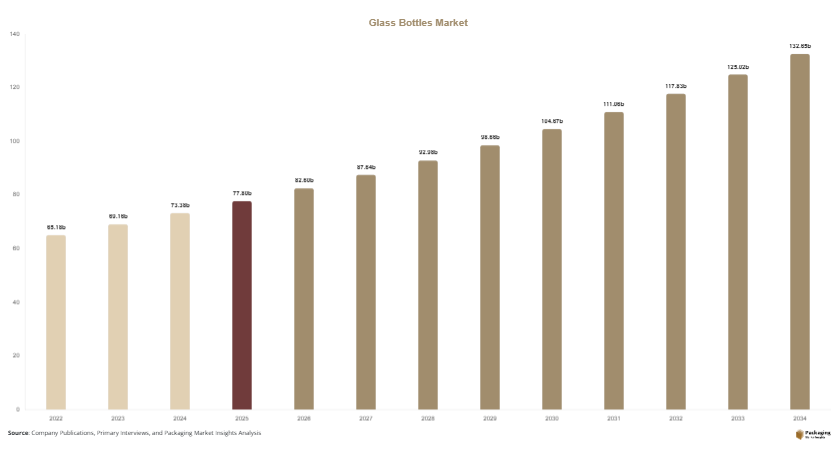
Glass Bottles market size is projected at USD 82.6 billion in 2026 and is expected to hit USD 132.4 billion by 2034 with a CAGR of 6.1%. Increasing preference for recyclable packaging, premium product presentation, and stringent sustainability regulations continue driving market expansion. The report provides detailed analysis of production volumes, consumption patterns, segmentation, competitive landscape, pricing trends, and regional developments to support strategic business decisions.
Glass bottles are rigid packaging containers manufactured primarily from silica, soda ash, and limestone, offering high chemical stability and complete recyclability. Global production exceeded 760 billion glass bottles during 2025, with the food and beverage sector accounting for approximately 68% of total consumption, pharmaceuticals representing 18%, and personal care products contributing nearly 14%. More than 74% of premium beverage brands utilize glass packaging due to its superior barrier properties, reinforcing the Glass Bottles Market.
Explore more data points, trends and opportunities Download Free Sample Report
Glass Bottles Market Trends
Growing Demand for Sustainable and Recyclable Packaging
Governments and brand owners continue emphasizing circular economy initiatives and environmentally responsible packaging. Recycled glass (cullet) utilization surpassed 37% of total raw material consumption in 2025, while global recycling rates exceeded 55% across developed markets. More than 280 billion recycled glass bottles entered manufacturing processes, strengthening the Glass Bottles Market.
Packaging manufacturers are investing in lightweight bottle technologies, energy-efficient furnaces, and carbon emission reduction strategies. Lightweight bottle production increased by 19%, while furnace efficiency improved by nearly 14% across major production facilities. Sustainability initiatives continue supporting long-term Glass Bottles Market development.
Premium Beverage Packaging Continues to Expand
Premium alcoholic beverages, functional drinks, juices, and specialty food products continue increasing demand for decorative glass bottles. More than 340 billion beverage bottles were produced annually, while premium packaging adoption increased by 16% during 2025. Advanced embossing, UV coatings, and customized bottle designs continue strengthening the Glass Bottles Market.
Glass Bottles Market Drivers
Rising Consumption of Premium Food and Beverage Products
Growing consumer preference for premium beverages and packaged food continues supporting glass bottle demand. Food and beverage applications account for approximately 68% of total consumption, while premium beverage sales increased by 11% annually. More than 515 billion glass bottles are supplied to beverage manufacturers each year, accelerating the Glass Bottles Market.
Glass Bottles Market Restraints
High Energy Consumption During Manufacturing
Glass manufacturing requires temperatures exceeding 1,500°C, resulting in significant energy costs. Fuel prices increased by approximately 13%, while electricity costs rose by nearly 10% across major manufacturing regions. Higher operational expenses continue affecting production economics and restraining the Glass Bottles Market.
Glass Bottles Market Opportunities
Expansion of Pharmaceutical and Cosmetic Packaging
Demand for chemically stable and contamination-resistant packaging continues increasing across pharmaceutical and cosmetic industries. Pharmaceutical packaging demand increased by approximately 9%, while cosmetic packaging production expanded by 12% during 2025. Investments in premium packaging create strong opportunities within the Glass Bottles Market.
Challenges in Glass Bottles Market
Transportation Costs and Product Fragility
Glass bottles remain heavier than plastic alternatives, increasing logistics expenses and breakage risks. Transportation costs account for approximately 18% of total supply chain expenses, while breakage rates range between 1% and 3% depending on shipping conditions. Manufacturers continue investing in lightweight designs and protective packaging to improve the Glass Bottles Market.
Report Scope
| Report Metric | Details |
|---|---|
| Market Size in 2025 | USD 77.8 billion |
| Market Size in 2026 | USD 82.6 billion |
| Market Size in 2034 | USD 132.4 billion |
| CAGR | 6.1% (2026-2034) |
| Base Year for Estimation | 2025 |
| Historical Data | 2022-2024 |
| Forecast Period | 2026-2034 |
| Report Coverage | Revenue Forecast, Competitive Landscape, Supply Chain Disruption, Growth Factors, Environment & Regulatory Landscape and Trends |
| Geographies Covered | North America, Europe, APAC, Middle East and Africa, LATAM |
| Countries Covered | U.S., Canada, U.K., Germany, France, Spain, Italy, Russia, Nordic, Benelux, Rest of Europe, China, South Korea, Japan, India, Australia, Singapore, Taiwan, South East Asia, Rest of Asia-Pacific, UAE, Turky, Saudi Arabia, South Africa, Egypt, Nigeria, Rest of MEA, Brazil, Mexico, Argentina, Chile, Colombia, Rest of LATAM |
Explore more data points, trends and opportunities Download Free Sample Report
Glass Bottles Market Segmentation
The Glass Bottles Market is segmented by product type and end-use industry. Clear glass bottles account for approximately 54% of total market revenue, while food and beverage applications contribute nearly 68% of overall demand due to high consumption volumes worldwide.
By Product Type
Clear Glass Bottles
Clear glass bottles dominate with approximately 54% market share and annual production exceeding 410 billion units. They offer excellent transparency, premium appearance, recyclability, and compatibility with food, beverages, and cosmetics.
Amber Glass Bottles
Amber glass bottles represent nearly 28% of industry demand, with annual production exceeding 210 billion units. These bottles provide superior UV protection, preserving pharmaceutical formulations, essential oils, and specialty beverages.
Green Glass Bottles
Green glass bottles contribute approximately 18% of market revenue. Production exceeds 140 billion units annually and supports wine, mineral water, sparkling beverages, and premium food packaging applications.
By End-Use Industry
Food & Beverage
Food and beverage dominate the market with approximately 68% share, consuming more than 515 billion glass bottles annually. Carbonated beverages, alcoholic drinks, juices, sauces, and dairy products represent the largest application segment.
Pharmaceuticals
Pharmaceutical applications account for approximately 18% of global demand. More than 135 billion pharmaceutical glass bottles are manufactured annually, providing chemical stability, contamination protection, and regulatory compliance.
Personal Care & Cosmetics
Personal care and cosmetics contribute nearly 14% of market consumption. Perfumes, skincare formulations, lotions, and premium beauty products increasingly utilize decorative glass bottles for brand differentiation and product preservation.
Glass Bottles Market Segmentations
Product Type
- Clear Glass Bottles
- Amber Glass Bottles
- Green Glass Bottles
Application
- Food & Beverage
- Pharmaceuticals
- Personal Care & Cosmetics
Distribution Channel
- Direct Sales
- Distributors & Wholesalers
- Online Sales
- Specialty Packaging Suppliers
- Retail Packaging Suppliers
Glass Bottles Regional Outlook
North America
North America accounts for approximately 27% of global market revenue. The United States contributes nearly 81% of regional demand, supported by premium beverages, pharmaceuticals, and well-established recycling infrastructure.
Europe
Europe represents approximately 31% of the global market. Germany, France, Italy, Spain, and the United Kingdom collectively contribute over 75% of regional production, supported by advanced glass manufacturing capabilities and strong recycling regulations.
Asia-Pacific
Asia-Pacific accounts for nearly 34% of worldwide demand and remains the fastest-growing region. China, India, Japan, and South Korea collectively manufacture more than 310 billion glass bottles annually, driven by expanding food, beverage, and pharmaceutical industries.
Latin America
Latin America contributes approximately 5% of global demand. Brazil and Mexico account for nearly 69% of regional consumption due to growing beverage production and packaging investments.
Middle East & Africa
The Middle East & Africa represent approximately 3% of market revenue. Saudi Arabia, the UAE, and South Africa continue investing in beverage manufacturing and pharmaceutical packaging infrastructure.
Top players in Glass Bottles Market
- Owens-Illinois, Inc. (O-I Glass)
- Ardagh Group S.A.
- Verallia SA
- Vetropack Holding AG
- BA Glass Group
- Vidrala S.A.
- Piramal Glass Limited
- Stoelzle Glass Group
- Gerresheimer AG
- AGI Greenpac Limited
- Saverglass SAS
- HEINZ-GLAS GmbH & Co. KGaA
Owens-Illinois, Inc. (O-I Glass)
-
Estimated market share of approximately 16%, supported by one of the world's largest glass container manufacturing networks.
-
The company operates numerous manufacturing facilities across North America, Europe, Asia-Pacific, and Latin America. Continuous investments in lightweight glass technology, recycled glass utilization, energy-efficient furnaces, and sustainable production processes strengthen its competitive position across food, beverage, and pharmaceutical packaging applications.
Ardagh Group S.A.
-
Estimated market share of approximately 12%, with a strong presence across beverage and food packaging industries.
-
Ardagh focuses on premium glass packaging, advanced manufacturing automation, sustainable production technologies, and global customer partnerships. Its diversified product portfolio and investments in recyclable packaging continue strengthening its leadership position within the Glass Bottles Market.