Foodservice Paper Bags Market Size
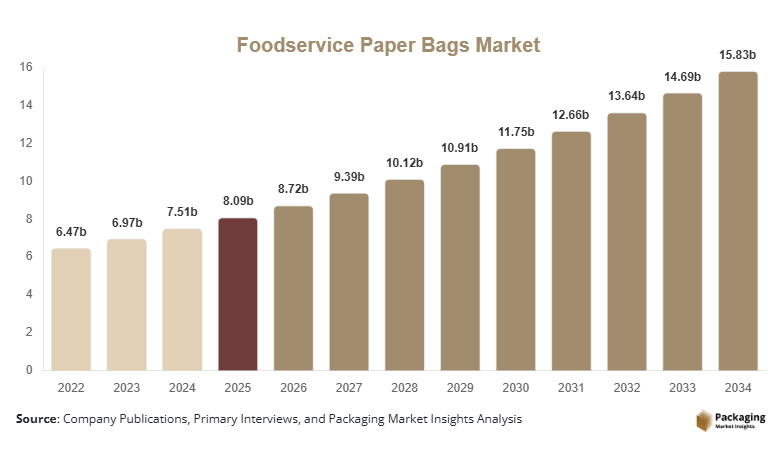
Foodservice Paper Bags market size is projected at USD 8.72 billion in 2026 and is expected to hit USD 15.84 billion by 2034 with a CAGR of 7.74%. Rising restrictions on single-use plastics, increasing demand for sustainable food packaging, and the rapid expansion of food delivery services continue to drive market expansion. The report provides comprehensive analysis of production capacity, end-use demand, market segmentation, technological developments, and the competitive landscape across the forecast period.
The foodservice paper bags market comprises paper-based carrying and takeaway bags used by restaurants, cafés, bakeries, food delivery companies, supermarkets, and convenience stores. Global production exceeded 186 billion units during 2025, with quick service restaurants accounting for nearly 46% of total consumption. Recycled kraft paper represented approximately 61% of raw material usage, while adoption of recyclable paper packaging surpassed 74% among organized foodservice chains. Growing environmental regulations continue strengthening the foodservice paper bags market.
Explore more data points, trends and opportunities Download Free Sample Report
Foodservice Paper Bags Market Trends
Growing Adoption of Sustainable Food Packaging
Foodservice operators are rapidly replacing plastic carry bags with recyclable paper alternatives to comply with environmental regulations. More than 122 billion paper bags were consumed by restaurants and takeaway businesses in 2025, while recycled fiber utilization increased by 21% year-over-year. Water-based inks, biodegradable coatings, and automated converting technologies have improved production efficiency by approximately 18%, supporting continued expansion of the foodservice paper bags market.
The adoption of FSC-certified paper and lightweight kraft materials continues to reshape packaging innovation. Sustainable paper bag production exceeded 186 billion units, while over 68% of newly established foodservice outlets adopted paper packaging for takeaway operations. Digital printing, reinforced handles, and grease-resistant coatings further improve product functionality, supporting long-term development across the foodservice paper bags market.
Foodservice Paper Bags Drivers
Expansion of Food Delivery and Takeaway Services
The rapid growth of online food ordering platforms and takeaway restaurants has significantly increased demand for paper packaging. Global food delivery orders increased by approximately 14% during 2025, while more than 95 billion takeaway bags were utilized worldwide. Improved bag strength, moisture resistance, and printability support broader adoption across restaurants, reinforcing foodservice paper bags market growth.
Foodservice Paper Bags Restraints
Volatility in Kraft Paper and Pulp Prices
Fluctuations in wood pulp prices and energy costs continue affecting manufacturing profitability. Virgin kraft paper prices increased by nearly 16%, while transportation costs rose approximately 11% across several producing regions. Small manufacturers face margin pressures despite growing demand, creating challenges for the foodservice paper bags market.
Foodservice Paper Bags Opportunities
Rising Investments in Eco-Friendly Packaging Solutions
Governments and foodservice brands continue investing in recyclable and compostable packaging materials. Sustainable paper packaging investments increased by approximately 28% during 2025, while recycled fiber content exceeded 65% in newly launched foodservice bags. Premium branding, customized printing, and biodegradable barrier coatings create significant opportunities across the foodservice paper bags market.
Challenges in Foodservice Paper Bags
Balancing Durability with Sustainability
Manufacturers must produce lightweight bags capable of carrying heavier food items while maintaining recyclability. High-strength kraft grades improve load capacity by nearly 20%, but advanced coatings increase manufacturing costs by approximately 12%. Meeting food safety regulations and moisture resistance requirements remains a key operational challenge for the foodservice paper bags market.
Report Scope
| Report Metric | Details |
|---|---|
| Market Size in 2025 | USD 8.09 billion |
| Market Size in 2026 | USD 8.72 billion |
| Market Size in 2034 | USD 15.84 billion |
| CAGR | 7.74% (2026-2034) |
| Base Year for Estimation | 2025 |
| Historical Data | 2022-2024 |
| Forecast Period | 2026-2034 |
| Report Coverage | Revenue Forecast, Competitive Landscape, Supply Chain Disruption, Growth Factors, Environment & Regulatory Landscape and Trends |
| Geographies Covered | North America, Europe, APAC, Middle East and Africa, LATAM |
| Countries Covered | U.S., Canada, U.K., Germany, France, Spain, Italy, Russia, Nordic, Benelux, Rest of Europe, China, South Korea, Japan, India, Australia, Singapore, Taiwan, South East Asia, Rest of Asia-Pacific, UAE, Turky, Saudi Arabia, South Africa, Egypt, Nigeria, Rest of MEA, Brazil, Mexico, Argentina, Chile, Colombia, Rest of LATAM |
Explore more data points, trends and opportunities Download Free Sample Report
Foodservice Paper Bags Market Segmentation
The market is segmented by type and application, with SOS paper bags accounting for nearly 41% of global demand owing to their widespread use in takeaway and quick service restaurants. Quick service restaurants contribute approximately 46% of overall consumption due to high transaction volumes.
By Type
Flat Paper Bags
Flat paper bags account for approximately 28% of market volume, with annual production exceeding 52 billion units. These bags are commonly used for bakery products, sandwiches, confectionery, and lightweight takeaway items. They feature grease-resistant coatings and high-quality printing surfaces.
Gusseted Paper Bags
Gusseted paper bags represent nearly 31% of market demand with production exceeding 58 billion units annually. Side gussets increase storage capacity by approximately 35%, making them suitable for grocery items, meal packs, and packaged food products.
SOS Paper Bags
SOS paper bags dominate the market with approximately 41% share and production exceeding 76 billion units annually. Their flat-bottom construction improves stability, carrying capacity, and ease of packing, making them the preferred solution for restaurants and food delivery businesses.
By Application
Quick Service Restaurants
Quick service restaurants account for approximately 46% of market demand and consume more than 85 billion units annually. Paper bags are widely used for burgers, fries, beverages, and meal combinations while supporting sustainable brand positioning.
Cafés & Bakeries
Cafés and bakeries contribute nearly 29% of market consumption with annual usage exceeding 54 billion units. Flat and gusseted paper bags provide suitable packaging for bread, pastries, cakes, and coffee takeaway products while enhancing product presentation.
Food Delivery & Takeaway
Food delivery and takeaway applications represent approximately 25% of total demand with production exceeding 47 billion units annually. Reinforced handles, moisture-resistant coatings, and durable kraft paper improve transportation efficiency and customer convenience.
Foodservice Paper Bags Market Segmentations
Type
- Flat Paper Bags
- Gusseted Paper Bags
- SOS Paper Bags
Application
- Quick Service Restaurants
- Cafés & Bakeries
- Food Delivery & Takeaway
Foodservice Paper Bags Regional Outlook
North America
North America accounted for approximately 29% of global demand during 2025. The United States contributed nearly 81% of regional production, supported by widespread sustainability initiatives and expanding quick service restaurant networks producing over 54 billion units annually.
Europe
Europe represented approximately 30% of total market demand. Germany, France, Italy, and the United Kingdom collectively produced over 57 billion units, while strict environmental regulations accelerated the adoption of recyclable paper packaging across foodservice businesses.
Asia-Pacific
Asia-Pacific held nearly 33% of the global market and remained the fastest-growing region. China, India, Japan, and South Korea accounted for more than 63 billion units of annual production, driven by urbanization, food delivery expansion, and rising organized retail.
Latin America, Middle East & Africa
These regions collectively represented approximately 8% of global demand. Brazil, Mexico, UAE, Saudi Arabia, and South Africa experienced growing adoption of sustainable food packaging, with annual production exceeding 15 billion units.
Top players in Foodservice Paper Bags Market
- Novolex Holdings, LLC
- Mondi plc
- Smurfit Westrock
- International Paper Company
- Georgia-Pacific LLC
- Huhtamaki Oyj
- Stora Enso Oyj
- Billerud AB
- Ronpak Inc.
- Welton Bibby & Baron Ltd.
- Detmold Group
- Paper Bag Co.
- Langston Companies Inc.
- Yorkshire Packaging Systems Ltd.
- ProAmpac LLC
Novolex Holdings, LLC
-
Estimated global market share of approximately 13%.
-
Strong presence in sustainable foodservice packaging and paper bag manufacturing.
-
Extensive manufacturing network across North America with advanced converting facilities.
-
Continuous investment in recyclable packaging technologies, automated production, lightweight kraft materials, and customized printing solutions strengthens its leadership position across restaurant, grocery, and food delivery applications while expanding its global customer base.
Mondi plc
-
Estimated global market share of approximately 11%.
-
Integrated operations spanning paper production, converting, and sustainable packaging.
-
Strong portfolio of FSC-certified paper bags for foodservice applications.
-
Ongoing investments in recyclable barrier coatings, lightweight kraft paper, production automation, and circular packaging initiatives continue enhancing competitiveness across international foodservice markets.