Fast Food Bag Market Size
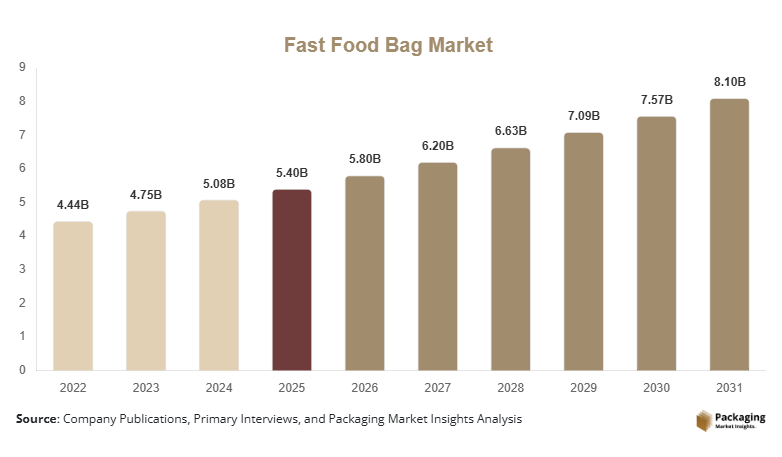
The fast food bag market size is projected at USD 5.8 billion in 2026 and is expected to hit USD 9.9 billion by 2034 with a CAGR of 6.9%. The report provides detailed evaluation of production capacity, consumption trends, competitive benchmarking, pricing analysis, and end-user demand across global markets. It also assesses regional performance, product segmentation, technological developments, and manufacturer strategies supporting long-term industry expansion.
The fast food bag market comprises paper, plastic, and biodegradable bags used for packaging takeaway meals, beverages, snacks, and food delivery orders. Global production exceeded 98.5 billion bags in 2025, with annual output expected to surpass 148 billion bags by 2034. Quick service restaurants accounted for approximately 58% of total consumption, while food delivery services represented 28%, and cafés & bakeries contributed 14%. Sustainable bag adoption exceeded 39%, while recycled fiber utilization reached 35%, reinforcing the fast food bag market.
Explore more data points, trends and opportunities Download Free Sample Report
Fast Food Bag Market Trends
Rising Preference for Sustainable Food Packaging
The transition toward environmentally responsible packaging continues to reshape manufacturing strategies. Production of paper and biodegradable fast food bags is expected to increase from 61 billion units in 2026 to over 101 billion units by 2034. More than 54% of restaurant chains have adopted recyclable packaging, while biodegradable material usage increased by 17% over the previous year. Automation has improved production efficiency by 19%, strengthening the fast food bag market.
Digital food ordering platforms continue to increase demand for durable takeaway packaging. Food delivery volumes exceeded 43 billion orders globally during 2025, while insulated bag usage expanded by 14% annually. Approximately 46% of manufacturers introduced water-based inks and food-safe coatings, and smart inventory management reduced production waste by 11%, supporting continued expansion of the fast food bag market.
Fast Food Bag Market Drivers
Rapid Expansion of Quick Service Restaurants and Food Delivery
The growth of quick-service restaurant chains and online food delivery platforms has significantly increased packaging demand. Global QSR outlets surpassed 1.8 million locations, while online food delivery orders expanded by 13% annually. More than 56 billion takeaway bags were supplied to restaurant chains during 2025, with sustainable packaging demand increasing by 15%, accelerating the fast food bag market.
Fast Food Bag Market Restraints
Volatility in Raw Material Prices
Price fluctuations in kraft paper, polyethylene, and bio-based materials continue affecting production costs. Raw material prices increased between 9% and 18%, while transportation expenses rose by approximately 10% across major exporting countries. Production costs increased by 7%, creating pricing pressure for manufacturers operating in the fast food bag market.
Fast Food Bag Market Opportunities
Growing Demand for Eco-Friendly Packaging Solutions
Government regulations encouraging recyclable and compostable packaging continue creating growth opportunities. Biodegradable bag production exceeded 18 billion units in 2025, while sustainable packaging investments surpassed USD 2.6 billion globally. Nearly 48% of multinational restaurant brands announced packaging sustainability targets through 2030, supporting future expansion of the fast food bag market.
Challenges in Fast Food Bag Market
Balancing Cost Efficiency with Sustainability
Manufacturers continue facing challenges in maintaining competitive pricing while adopting sustainable materials. Compostable materials remain 20% to 35% more expensive than conventional alternatives, while manufacturing conversion costs increased by 12%. Supply chain disruptions also extended lead times by nearly 9 days, affecting production planning throughout the fast food bag market.
Report Scope
| Report Metric | Details |
|---|---|
| Market Size in 2025 | USD 5.4 Billion |
| Market Size in 2026 | USD 5.8 Billion |
| Market Size in 2034 | USD 9.9 Billion |
| CAGR | 6.9% (2026-2034) |
| Base Year for Estimation | 2025 |
| Historical Data | 2022-2024 |
| Forecast Period | 2026-2034 |
| Report Coverage | Revenue Forecast, Competitive Landscape, Supply Chain Disruption, Growth Factors, Environment & Regulatory Landscape and Trends |
| Geographies Covered | North America, Europe, APAC, Middle East and Africa, LATAM |
| Countries Covered | U.S., Canada, U.K., Germany, France, Spain, Italy, Russia, Nordic, Benelux, Rest of Europe, China, South Korea, Japan, India, Australia, Singapore, Taiwan, South East Asia, Rest of Asia-Pacific, UAE, Turkey, Saudi Arabia, South Africa, Egypt, Nigeria, Rest of MEA, Brazil, Mexico, Argentina, Chile, Colombia, Rest of LATAM |
Explore more data points, trends and opportunities Download Free Sample Report
Fast Food Bag Market Segmentation
The market is segmented according to material type and end-use applications. Paper bags accounted for approximately 52% of total production, and plastic bags represented 29%, while biodegradable bags contributed 19% of global demand.
By Type
Paper Bags: Representing nearly 52% of total demand, paper bags exceeded 51 billion units in annual production. Typical basis weights range from 40 GSM to 90 GSM, providing high printability, recyclability, and durability for takeaway food packaging.
Plastic Bags: Accounting for approximately 29% of production, plastic bags surpassed 29 billion units annually. These products offer moisture resistance, lightweight construction, and high tensile strength suitable for beverages and prepared meals.
Biodegradable Bags: Holding around 19% market share, biodegradable bags exceeded 18 billion units annually. Manufactured using compostable polymers and renewable materials, these bags support environmental compliance while maintaining food safety standards.
By Application
Quick Service Restaurants: Dominating with approximately 58% share, this segment consumed more than 57 billion bags annually. Burgers, sandwiches, fries, and beverages require durable packaging capable of handling high-volume takeaway operations.
Food Delivery Services: Accounting for around 28% of market demand, food delivery services utilized more than 27 billion bags annually. These bags support order consolidation, thermal protection, and branding for digital food delivery platforms.
Cafes & Bakeries: Representing approximately 14% of demand, cafés and bakeries consumed nearly 14 billion bags annually. Packaging solutions focus on bakery products, pastries, coffee, and confectionery while maintaining product freshness and convenience.
Fast Food Bag Market Segmentations
Type
- Paper Bags
- Plastic Bags
- Biodegradable Bags
Application
- Quick Service Restaurants
- Food Delivery Services
- Cafes & Bakeries
Distribution Channel
- Direct Sales
- Packaging Distributors
- Online Sales
- Foodservice Wholesalers
- Retail Packaging Suppliers
Fast Food Bag Regional Outlook
North America
North America accounted for approximately 34% of global demand, producing over 33 billion bags annually. The United States contributed nearly 81% of regional consumption, supported by high penetration of quick-service restaurants and food delivery platforms.
Europe
Europe represented approximately 27% of the market with production exceeding 26 billion bags annually. Germany, France, Italy, and the United Kingdom together accounted for over 72% of regional demand, driven by sustainability regulations.
Asia-Pacific
The Asia-Pacific held nearly a 31% market share while annual production exceeded 30 billion bags. China, India, Japan, and South Korea dominated regional manufacturing, supported by expanding urban populations and rapid food delivery adoption.
Latin America
Latin America accounted for approximately 5% of global demand. Brazil and Mexico together represented nearly 68% of regional consumption, supported by increasing restaurant chains and takeaway food services.
Middle East & Africa
The Middle East & Africa contributed approximately 3% of the global market. GCC countries and South Africa remained key regional consumers due to growing tourism, restaurant expansion, and food delivery investments.
Top Players In The Fast Food Bag Market
- Mondi plc
- Smurfit Westrock
- Novolex Holdings LLC
- Huhtamaki Oyj
- International Paper Company
- Detmold Group
- Billerud AB
- Coveris Holdings S.A.
- ProAmpac LLC
- Genpak LLC
- Dart Container Corporation
- Georgia-Pacific LLC
Mondi plc Estimated market share: 11%–13% Strong global presence in paper-based food packaging solutions. Extensive manufacturing network serving restaurant chains and foodservice operators. Continuous investment in recyclable and fiber-based packaging technologies. Focused on lightweight, high-strength bag solutions supporting sustainability initiatives and operational efficiency across global food packaging markets. Smurfit Westrock Estimated market share: 9%–11% Leading supplier of paper packaging products for foodservice applications. Strong portfolio of recyclable takeaway packaging and customized printing solutions. Significant investments in renewable fiber sourcing and automated production facilities. Well-established customer relationships with multinational quick-service restaurant brands and food retailers.