Food Delivery Boxes Market Size and Growth
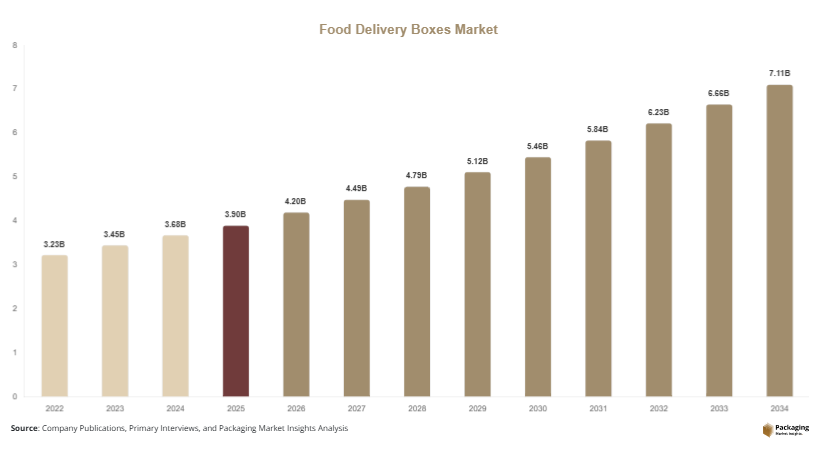
The global food delivery boxes market size is estimated at USD 3.9 billion in 2025, and it is projected to reach approximately USD 4.2 billion in 2026. By 2034, the market is expected to attain nearly USD 7.6 billion, registering a CAGR of 6.8% during 2025–2034. The global food delivery boxes market is experiencing significant growth due to the rapid expansion of online food ordering platforms, changing consumer eating habits, and increasing demand for safe and convenient food packaging solutions. Food delivery boxes are widely used for transporting prepared meals, groceries, bakery products, and beverages while maintaining freshness, temperature, and product integrity.
One of the primary growth factors driving the market is the continued expansion of food delivery applications and cloud kitchen operations worldwide. Restaurants and food service providers increasingly rely on durable and insulated delivery boxes to maintain food quality during transportation. Another important growth factor is the rising consumer preference for takeaway meals and ready-to-eat products, particularly in urban areas with busy lifestyles. Additionally, sustainability concerns are encouraging food packaging manufacturers to develop recyclable, biodegradable, and compostable delivery box solutions.
Key Highlights:
- Asia Pacific dominated the market with a 38.1% share in 2025.
- Latin America is projected to grow at the fastest CAGR of 7.0%.
- Corrugated food delivery boxes led the type segment with a 36.8% share.
- Paper and paperboard materials dominated with a 54.6% share.
- Restaurant and takeaway applications led the market with 48.3% share.
- The US remained the dominant country with a market size of USD 980 million in 2025 and USD 1.05 billion in 2026.
Explore more data points, trends and opportunities Download Free Sample Report
Market Trends
Growing Adoption of Sustainable Food Delivery Packaging
Sustainability has become a major trend in the food delivery boxes market as restaurants, delivery platforms, and consumers increasingly prefer environmentally responsible packaging solutions. Manufacturers are developing recyclable paperboard boxes, molded fiber containers, and compostable packaging materials to reduce plastic waste. Major food delivery companies are partnering with packaging suppliers to replace foam and single-use plastic containers with biodegradable alternatives. For example, several international quick-service restaurant chains are introducing fiber-based delivery boxes with water-resistant coatings. This trend is expected to accelerate as governments implement stricter regulations on plastic packaging waste and consumers continue demanding eco-friendly food delivery solutions across urban markets.
Integration of Smart and Temperature-Control Packaging
The market is also witnessing rising adoption of smart and temperature-controlled food delivery boxes designed to maintain product quality during transit. Insulated delivery boxes equipped with thermal liners, moisture barriers, and tamper-evident seals are becoming increasingly common in premium food delivery services. Some packaging manufacturers are introducing QR-enabled packaging that provides tracking and freshness information to consumers. For example, meal subscription companies are using insulated corrugated boxes with gel packs to preserve perishable food items during long-distance deliveries. In the future, smart packaging technologies integrated with temperature monitoring systems are expected to improve food safety and customer satisfaction in the global delivery ecosystem.
Market Drivers
Rapid Expansion of Online Food Delivery Platforms
The rapid growth of online food delivery platforms is a major driver supporting the food delivery boxes market. Mobile applications and digital payment systems have significantly increased consumer access to restaurant meals and grocery delivery services. As delivery volumes rise, restaurants and cloud kitchens require reliable packaging solutions that can preserve food quality during transportation. For example, international food delivery platforms are increasingly adopting customized corrugated delivery boxes that support branding and operational efficiency. This expansion of app-based food ordering services directly increases demand for durable, leak-resistant, and cost-effective food delivery packaging products across urban markets worldwide.
Rising Consumer Preference for Convenience Foods
Changing consumer lifestyles and increasing urbanization are driving strong demand for ready-to-eat meals, takeaway foods, and home-delivered groceries. Consumers increasingly prefer convenient dining options that save time and provide flexible meal choices. This shift has encouraged restaurants and food service providers to invest in advanced delivery packaging that maintains temperature and prevents product contamination. For instance, premium burger chains and pizza delivery companies are using ventilated boxes designed to preserve freshness and texture during transit. As disposable incomes rise and digital food ordering becomes more common, demand for innovative food delivery boxes is expected to continue growing steadily.
Market Restraint
Volatility in Raw Material Costs and Packaging Waste Concerns
One of the key restraints affecting the food delivery boxes market is the fluctuation in raw material prices, particularly paper pulp, corrugated board, plastic resins, and biodegradable fibers. Sudden increases in material costs can significantly impact profit margins for packaging manufacturers and food delivery companies. Additionally, growing concerns regarding packaging waste generation are creating operational and regulatory challenges. Municipal authorities in several countries are implementing strict waste reduction policies, requiring food service providers to adopt recyclable or compostable materials. For example, small restaurant operators may struggle to transition from low-cost plastic containers to premium sustainable delivery boxes due to higher expenses. These factors can limit market growth, especially among cost-sensitive businesses operating in developing economies where sustainable packaging infrastructure remains limited.
Market Opportunities
Expansion of Grocery and Meal Kit Delivery Services
The rapid expansion of online grocery delivery and meal kit subscription services presents significant growth opportunities for the food delivery boxes market. Consumers increasingly prefer home delivery of fresh produce, frozen foods, and pre-portioned meal ingredients, creating demand for insulated and durable packaging solutions. Meal kit companies require advanced delivery boxes capable of maintaining product freshness during transportation. For example, several grocery delivery providers are adopting recyclable insulated boxes with cooling inserts for temperature-sensitive food items. As urban consumers continue prioritizing convenience and home-based meal preparation, demand for specialized food delivery boxes is expected to increase substantially over the coming years.
Growth of Reusable and Circular Packaging Systems
The development of reusable and returnable packaging systems is creating new opportunities for packaging manufacturers and food delivery platforms. Restaurants and delivery companies are increasingly exploring circular packaging models that reduce single-use waste and improve sustainability performance. Reusable food delivery boxes made from durable polymers or reinforced fiber materials can be collected, sanitized, and reused multiple times. For example, some urban food delivery services in Europe are piloting deposit-based reusable container systems for takeaway meals. In the future, advancements in reusable packaging logistics and consumer awareness are expected to strengthen adoption of circular food delivery packaging solutions globally.
Report Scope
| Report Metric | Details |
|---|---|
| Market Size in 2025 | USD 3.9 Billion |
| Market Size in 2026 | USD 4.2 Billion |
| Market Size in 2034 | USD 7.6 Billion |
| CAGR | 6.8% (2026-2034) |
| Base Year for Estimation | 2025 |
| Historical Data | 2022-2024 |
| Forecast Period | 2026-2034 |
| Report Coverage | Revenue Forecast, Competitive Landscape, Supply Chain Disruption, Growth Factors, Environment & Regulatory Landscape and Trends |
| Geographies Covered | North America, Europe, APAC, Middle East and Africa, LATAM |
| Countries Covered | U.S., Canada, U.K., Germany, France, Spain, Italy, Russia, Nordic, Benelux, Rest of Europe, China, South Korea, Japan, India, Australia, Singapore, Taiwan, South East Asia, Rest of Asia-Pacific, UAE, Turky, Saudi Arabia, South Africa, Egypt, Nigeria, Rest of MEA, Brazil, Mexico, Argentina, Chile, Colombia, Rest of LATAM |
Explore more data points, trends and opportunities Download Free Sample Report
Segmental Analysis
By Type
Corrugated food delivery boxes dominated the global food delivery boxes market in 2024, accounting for approximately 36.8% of the total market share. These boxes are widely preferred because of their durability, lightweight structure, cost efficiency, and ability to protect food products during transportation. Restaurants, cloud kitchens, and grocery delivery platforms extensively use corrugated boxes for pizza, burgers, meal trays, bakery products, and takeaway packaging. Their strong stacking capability and compatibility with customized printing solutions also make them suitable for branding and promotional purposes. Major international quick-service restaurant chains increasingly use corrugated packaging with grease-resistant coatings to improve product presentation and reduce leakage during transit. In addition, corrugated delivery boxes support sustainability goals since they are recyclable and widely accepted in paper recovery systems. Growing demand for eco-friendly takeaway packaging and rising online food ordering volumes continue to strengthen the dominance of this segment across both developed and emerging economies.
Insulated food delivery boxes are projected to be the fastest-growing type segment, expanding at a CAGR of 7.4% during the forecast period. These boxes are designed to maintain temperature stability for hot meals, frozen foods, beverages, and meal kit deliveries during transportation. Increasing consumer expectations regarding food freshness and quality are driving restaurants and food delivery providers to adopt insulated packaging solutions. For example, grocery delivery companies increasingly use thermal-lined boxes and insulated paperboard containers to transport temperature-sensitive products such as dairy items, frozen meals, and seafood. Premium restaurant chains are also adopting multi-layer insulated delivery boxes with tamper-evident features to improve customer satisfaction and food safety. Future growth is expected to be supported by the expansion of long-distance meal delivery services, subscription-based food businesses, and advancements in sustainable insulation materials including recyclable thermal liners and molded fiber insulation systems.
By Material
Paper and paperboard materials dominated the food delivery boxes market in 2024 with a market share of approximately 54.6%. These materials are widely used because of their recyclability, affordability, printability, and compatibility with food-grade packaging requirements. Restaurants and food service providers increasingly prefer paperboard delivery boxes to comply with sustainability regulations and reduce reliance on single-use plastics. Corrugated paperboard boxes are particularly popular in pizza delivery, bakery packaging, and takeaway meal applications due to their strength and ventilation properties. Several international food delivery companies are replacing foam-based packaging with paper-based alternatives to align with environmental commitments. In addition, paperboard packaging supports high-quality branding and customized printing, helping restaurants improve customer engagement. Rising government restrictions on plastic packaging waste and increasing consumer awareness regarding sustainable packaging solutions continue to support the dominance of paper and paperboard materials across the global food delivery packaging industry.
Biodegradable fiber materials are expected to witness the fastest growth, registering a CAGR of 7.1% during the forecast period. These materials include molded pulp, bagasse, bamboo fiber, and compostable agricultural waste-based packaging products. Food service providers are increasingly adopting biodegradable fiber delivery boxes to reduce environmental impact and comply with sustainability regulations. For example, several meal delivery startups are using sugarcane bagasse containers and molded fiber meal trays for takeaway and catering applications. The hospitality industry is also transitioning toward compostable fiber packaging to strengthen sustainable branding strategies. Advancements in coating technologies are improving the moisture resistance and thermal insulation properties of biodegradable fiber materials, making them more suitable for hot and greasy foods. In the future, rising investments in circular packaging infrastructure and growing consumer preference for environmentally responsible packaging are expected to drive substantial adoption of biodegradable delivery boxes worldwide.
By End-Use
Restaurant and takeaway applications dominated the food delivery boxes market in 2024, accounting for approximately 48.3% of the total market share. The segment benefits from rapid growth in online food ordering, expansion of quick-service restaurant chains, and increasing popularity of takeaway dining services. Restaurants require durable and leak-resistant delivery boxes capable of preserving food quality during transportation. Corrugated pizza boxes, compartment meal trays, and vented burger containers are widely used across the food service industry. Several international fast-food brands are also investing in custom-designed packaging that enhances product visibility and supports branding objectives. In addition, rising consumer demand for premium takeaway meals and specialty cuisine delivery services is encouraging restaurants to adopt insulated and tamper-evident packaging formats. Urbanization, busy lifestyles, and digital food ordering trends continue to strengthen the demand for food delivery boxes within the restaurant and takeaway sector globally.
Grocery delivery services are projected to register the fastest CAGR of 7.3% during the forecast period. Online grocery platforms increasingly require durable and temperature-controlled packaging solutions for transporting fresh produce, frozen products, dairy items, and ready-to-cook meal kits. The rapid expansion of same-day grocery delivery services is encouraging retailers to adopt insulated corrugated boxes and reusable delivery packaging systems. For instance, supermarkets and online grocery companies are investing in recyclable thermal packaging designed to maintain freshness during last-mile delivery operations. Demand for compartmentalized food delivery boxes is also increasing to support mixed-product transportation without contamination. Future growth is expected to be supported by increasing urban grocery delivery penetration, rising adoption of subscription-based meal kits, and technological advancements in reusable insulated packaging systems designed for cold chain food distribution.
Food Delivery Boxes Market Segmentations
By Type
- Corrugated Food Delivery Boxes
- Insulated Food Delivery Boxes
- Foldable Food Delivery Boxes
- Compartment Food Delivery Boxes
- Clamshell Food Delivery Boxes
By Material
- Paper & Paperboard
- Plastic Materials
- Biodegradable Fiber Materials
- Molded Pulp Materials
By End-User
- Restaurants & Takeaway
- Grocery Delivery Services
- Cloud Kitchens
- Catering Services
- Bakery & Confectionery Delivery
Regional Analysis
North America
North America accounted for approximately 30.2% of the global food delivery boxes market share in 2025 and is expected to grow at a CAGR of 6.3% during the forecast period. The region benefits from a highly developed online food delivery ecosystem, strong restaurant chains, and widespread adoption of convenience-based dining services. Consumers in the United States and Canada increasingly rely on mobile food ordering applications for restaurant meals, groceries, and meal kits. This growth has increased demand for insulated, leak-resistant, and branded food delivery boxes. In addition, sustainability initiatives across major cities are encouraging restaurants and packaging companies to adopt recyclable and compostable food packaging materials for delivery operations.
The United States dominates the North American food delivery boxes market due to its large quick-service restaurant industry and advanced food delivery infrastructure. One unique growth driver is the rapid expansion of cloud kitchens and virtual restaurant brands operating exclusively through online delivery platforms. These businesses require customized packaging solutions optimized for transportation efficiency and food presentation. Several major restaurant chains in the country are also investing in tamper-evident and temperature-controlled delivery boxes to improve customer trust and food safety. Furthermore, increasing adoption of subscription-based meal delivery services continues to strengthen packaging demand across the United States.
Europe
Europe held approximately 24.7% of the global food delivery boxes market share in 2025 and is projected to expand at a CAGR of 6.1% during the forecast period. The market is driven by increasing environmental awareness, strict packaging waste regulations, and growing demand for takeaway meals. European countries are actively promoting sustainable food packaging solutions, encouraging restaurants and food delivery platforms to shift toward paper-based and biodegradable delivery boxes. Demand for premium food packaging is also rising in urban markets where consumers prioritize food safety and eco-friendly packaging. Growth in online grocery delivery services and meal subscriptions is further contributing to regional market expansion.
Germany remains the leading country in the European food delivery boxes market due to its strong food service sector and advanced packaging industry. A unique growth factor in Germany is the increasing adoption of reusable takeaway packaging systems supported by environmental regulations. Several restaurant chains and food delivery startups are implementing reusable box programs where consumers return packaging for cleaning and reuse. In addition, demand for insulated corrugated boxes is increasing in the country’s expanding frozen food and meal kit delivery sectors. Germany’s focus on circular packaging innovation continues to support long-term market growth.
Asia Pacific
Asia Pacific dominated the global food delivery boxes market with a 38.1% share in 2025 and is projected to register the highest CAGR of 7.4% during the forecast period. Rapid urbanization, rising smartphone penetration, and growing middle-class populations are driving strong demand for food delivery services across the region. Countries such as China, India, Japan, and South Korea are witnessing substantial growth in restaurant delivery applications and cloud kitchen operations. The expansion of online grocery delivery and convenience food consumption is also supporting demand for durable and cost-efficient food delivery boxes. Additionally, increasing investments in sustainable packaging production are strengthening regional market development.
China dominates the Asia Pacific food delivery boxes market because of its large online food delivery ecosystem and high consumer adoption of digital payment platforms. One unique growth driver is the widespread use of super-app ecosystems integrating food ordering, grocery delivery, and logistics services. Food delivery companies in China are increasingly using lightweight corrugated and insulated packaging solutions designed for rapid urban delivery operations. In addition, rising demand for premium beverage delivery and specialty meal services is encouraging development of customized packaging formats. Government support for sustainable packaging innovation is further supporting long-term market growth in China.
Middle East & Africa
The Middle East & Africa region accounted for approximately 3.9% of the global food delivery boxes market in 2025 and is expected to grow at a CAGR of 6.5% during the forecast period. The market is benefiting from increasing urbanization, expanding restaurant chains, and rising smartphone-based food ordering services. Gulf countries are witnessing strong growth in premium food delivery applications, particularly in major metropolitan areas. Demand for insulated and durable packaging is increasing as restaurants focus on maintaining food quality during transportation in hot climatic conditions. Furthermore, tourism growth and rising investments in hospitality infrastructure are contributing to expanding takeaway and food delivery activities across the region.
The United Arab Emirates dominates the Middle East & Africa food delivery boxes market because of its advanced digital commerce ecosystem and strong hospitality sector. One unique growth factor is the rapid expansion of premium food delivery and gourmet meal subscription services. Restaurants and luxury dining brands are increasingly investing in customized packaging with thermal insulation and high-end branding elements. In addition, delivery aggregators operating in the UAE are adopting sustainable paper-based boxes to align with government sustainability initiatives. Growing tourism and high consumer spending on convenience dining continue to support packaging demand in the country.
Latin America
Latin America represented approximately 3.1% of the global food delivery boxes market share in 2025 and is forecast to expand at a CAGR of 7.0% during the forecast period. Rising internet penetration, growing urban populations, and expanding food delivery platforms are supporting regional market growth. Countries across Latin America are experiencing increasing demand for takeaway meals, online grocery delivery, and packaged convenience foods. Restaurants are investing in affordable and durable delivery boxes to improve transportation efficiency and customer experience. The growth of local food delivery startups and digital payment adoption is also contributing to rising demand for food delivery packaging solutions.
Brazil dominates the Latin American food delivery boxes market due to its large restaurant industry and rapidly growing online food delivery sector. One unique growth factor is the increasing popularity of independent cloud kitchens and regional meal delivery brands operating through mobile applications. These businesses require cost-efficient corrugated delivery boxes capable of supporting high delivery volumes. Beverage delivery services and bakery chains are also expanding their use of customized paperboard packaging to improve product presentation. Additionally, rising investments in local packaging manufacturing infrastructure are expected to strengthen Brazil’s long-term market position.
Competitive Landscape
The global food delivery boxes market is moderately competitive, with packaging manufacturers focusing on sustainability, customization, and temperature-control innovations to strengthen their market positions. Companies are increasingly investing in recyclable paperboard materials, compostable packaging solutions, and insulated delivery box technologies to meet evolving consumer and regulatory requirements. The leading player in the market, WestRock Company, maintains a strong position due to its extensive paper packaging portfolio, advanced corrugated packaging capabilities, and global supply network. The company recently expanded its sustainable food packaging solutions designed specifically for online meal delivery and takeaway applications.
Other major companies operating in the market include International Paper Company, Smurfit Kappa Group, DS Smith Plc, and Huhtamaki Oyj. These firms are emphasizing strategic partnerships with restaurant chains, grocery delivery providers, and food service companies to expand their customer base. Several manufacturers are also investing in digital printing technologies that enable customized branding and promotional packaging for restaurants and cloud kitchens. In addition, companies are increasing production of biodegradable molded fiber packaging products to address growing environmental concerns and plastic reduction regulations. Expansion of regional manufacturing facilities in Asia Pacific and Latin America continues to strengthen competition within the global food delivery boxes market.
Key Players List
- WestRock Company
- International Paper Company
- Smurfit Kappa Group
- DS Smith Plc
- Huhtamaki Oyj
- Graphic Packaging International
- Mondi Group
- Stora Enso Oyj
- Sonoco Products Company
- Georgia-Pacific LLC
- Vegware Ltd.
- Dart Container Corporation
- Pactiv Evergreen Inc.
- Reynolds Consumer Products
- Novolex Holdings LLC