Electronics Packaging Market Size and Growth
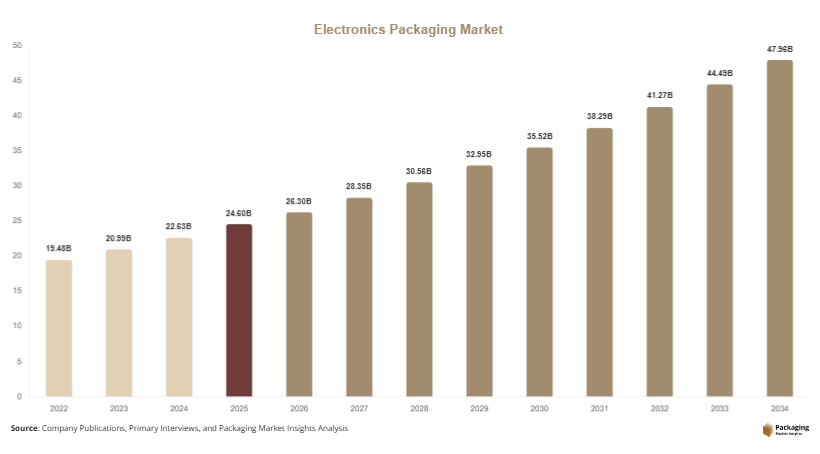
The global electronics packaging market size is estimated at USD 24.6 billion in 2025, and it is projected to reach USD 26.3 billion in 2026. By 2034, the market is expected to reach USD 48.9 billion, expanding at a CAGR of 7.8% during 2025–2034. The electronics packaging market is experiencing steady expansion driven by rapid growth in consumer electronics, semiconductor manufacturing, electric vehicles, and advanced industrial automation systems. Electronics packaging refers to protective, thermal, and structural packaging solutions used to safeguard electronic components, devices, and semiconductor chips during storage, transportation, and assembly.
One of the primary growth factors is the increasing complexity of semiconductor devices and miniaturized electronic components. As chips become smaller and more sensitive, demand for high-performance packaging solutions such as anti-static trays, conductive foams, moisture barrier bags, and vacuum-sealed packaging continues to grow. Another key driver is the expansion of the global electric vehicle (EV) industry, which requires specialized packaging for batteries, sensors, and power electronics. Additionally, the rapid rise of consumer electronics production—smartphones, wearables, laptops, and IoT devices—is significantly boosting demand for safe and efficient packaging solutions.
Key Highlights:
- Asia Pacific dominated the market with a 37.4% share in 2025.
- Latin America is projected to grow at the fastest CAGR of 6.2%.
- Anti-static packaging led the type segment with a 29.6% share.
- Plastic-based packaging dominated with a 52.3% share.
- Consumer electronics led the segment with a 43.1% share.
- The US remained the dominant country with a market size of USD 4.2 billion in 2025 and USD 4.5 billion in 2026.
Explore more data points, trends and opportunities Download Free Sample Report
Market Trends
Adoption of ESD-Safe and Smart Protective Packaging Solutions
A major trend in the electronics packaging market is the rising adoption of electrostatic discharge (ESD)-safe packaging combined with smart tracking technologies. Electronic components are highly sensitive to static electricity, requiring specialized packaging such as conductive trays, shielding bags, and anti-static foam. Companies are now integrating RFID and sensor-based tracking into ESD packaging to monitor environmental conditions during transit. For example, semiconductor manufacturers use smart trays that record humidity and temperature exposure. This ensures product integrity and reduces failure rates in high-value chips. The trend is expected to evolve further with AI-driven logistics monitoring systems.
Shift Toward Sustainable and Recyclable Electronics Packaging
Another key trend is the transition toward sustainable electronics packaging materials. Manufacturers are replacing traditional plastic-based protective materials with recyclable molded pulp, bio-based foams, and reusable transport trays. For instance, electronics companies are adopting paper-based cushioning solutions for packaging laptops and smartphones. This shift is driven by corporate ESG commitments and global recycling regulations. In the future, closed-loop recycling systems for electronics packaging are expected to become standard across semiconductor and consumer electronics supply chains.
Market Drivers
Rapid Growth of Semiconductor and Chip Manufacturing
The expansion of semiconductor manufacturing is a major driver of the electronics packaging market. Advanced chips require highly controlled packaging environments to prevent contamination and damage. As global demand for AI chips, GPUs, and microcontrollers increases, semiconductor fabs require specialized packaging such as vacuum-sealed moisture barrier bags and wafer carriers. For example, foundries in Taiwan and South Korea rely heavily on high-precision packaging systems to ensure yield quality. This demand directly fuels market expansion.
Rising Demand from Consumer Electronics and EV Industry
The growing production of smartphones, laptops, wearables, and electric vehicles is another key driver. These products contain sensitive electronic components that require protective packaging during transportation and assembly. EV manufacturers, for instance, use specialized packaging for battery modules and electronic control units. The surge in global EV adoption is significantly increasing demand for shock-resistant and thermally stable packaging solutions, accelerating market growth.
Market Restraints
High Cost of Advanced Protective Packaging Materials
One of the main restraints in the electronics packaging market is the high cost associated with advanced protective materials such as anti-static polymers, moisture barrier films, and smart packaging systems. These materials require specialized manufacturing processes, increasing production costs. Small and medium electronics manufacturers, especially in emerging markets, often struggle to adopt high-end packaging solutions due to budget constraints. Additionally, fluctuations in raw material prices for plastics and conductive materials further impact profitability. For example, small consumer electronics assemblers in Southeast Asia often rely on low-cost packaging alternatives, which may not provide adequate protection for high-value components. This cost barrier limits widespread adoption of advanced packaging technologies.
Market Opportunities
Expansion of Smart Packaging with IoT Integration
The integration of IoT technology into electronics packaging presents a major growth opportunity. Smart packaging systems equipped with sensors can monitor temperature, humidity, vibration, and handling conditions in real time. This is especially useful for semiconductor and aerospace electronics transportation. For example, logistics providers are beginning to deploy sensor-enabled packaging for tracking high-value chips across global supply chains. As Industry 4.0 adoption increases, demand for intelligent packaging systems is expected to grow significantly.
Growth in Electric Vehicle Electronics Packaging
The expansion of the electric vehicle industry offers strong opportunities for specialized electronics packaging solutions. EVs rely on complex electronic systems, including battery management units, sensors, and control modules, all of which require protective packaging during manufacturing and shipping. For example, EV manufacturers in Europe and China are investing in shockproof and thermally insulated packaging for battery electronics. As EV adoption increases globally, demand for durable, heat-resistant, and vibration-proof electronics packaging will continue to expand.
Report Scope
| Report Metric | Details |
|---|---|
| Market Size in 2025 | USD 24.6 Billion |
| Market Size in 2026 | USD 26.3 Billion |
| Market Size in 2034 | USD 48.9 Billion |
| CAGR | 7.8% (2026-2034) |
| Base Year for Estimation | 2025 |
| Historical Data | 2022-2024 |
| Forecast Period | 2026-2034 |
| Report Coverage | Revenue Forecast, Competitive Landscape, Supply Chain Disruption, Growth Factors, Environment & Regulatory Landscape and Trends |
| Geographies Covered | North America, Europe, APAC, Middle East and Africa, LATAM |
| Countries Covered | U.S., Canada, U.K., Germany, France, Spain, Italy, Russia, Nordic, Benelux, Rest of Europe, China, South Korea, Japan, India, Australia, Singapore, Taiwan, South East Asia, Rest of Asia-Pacific, UAE, Turky, Saudi Arabia, South Africa, Egypt, Nigeria, Rest of MEA, Brazil, Mexico, Argentina, Chile, Colombia, Rest of LATAM |
Explore more data points, trends and opportunities Download Free Sample Report
Segmental Analysis
By Type
Anti-static packaging dominated the market in 2024 with a 34.6% share, as it is essential for protecting sensitive semiconductor and electronic components. Products such as anti-static bags, conductive trays, and shielding films are widely used across manufacturing and logistics. For example, semiconductor fabs rely heavily on anti-static trays to prevent chip damage during handling. Their ability to minimize electrostatic discharge makes them critical in electronics supply chains.
Moisture barrier packaging is the fastest-growing segment with a CAGR of 8.4%, driven by increasing demand for humidity-sensitive semiconductor devices. These packaging solutions prevent corrosion and ensure product integrity during long-distance shipping.
By Material
Plastic-based packaging dominated with a 53.7% share in 2024, due to its durability, flexibility, and cost efficiency. It is widely used in trays, clamshells, and protective casings.
Recycled and biodegradable materials are the fastest-growing segment with a CAGR of 7.9%, driven by sustainability goals and corporate environmental policies.
By End-Use
Consumer electronics led with a 44.2% share in 2024, driven by smartphones, laptops, and wearable devices. These products require extensive protective packaging during distribution.
Automotive electronics is the fastest-growing segment with a CAGR of 8.2%, driven by rising EV production and advanced vehicle electronics systems.
Electronics Packaging Market Segmentations
By Product Type
- Anti-static Packaging
- Moisture Barrier Packaging
- Cushioning Packaging
- Conductive Packaging Solutions
By Material
- Plastic
- Paper & Paperboard
- Foam
- Hybrid Materials
By End-User
- Consumer Electronics
- Automotive Electronics
- Industrial Electronics
- Aerospace & Defense Electronics
By Distribution Channel
- Direct Sales (B2B)
- Distributors & Wholesalers
- Online Industrial Platforms
- OEM Supply Contracts
Regional Analysis
North America
North America accounted for approximately 28.5% share in 2025, with a projected CAGR of 7.2% during 2025–2034. The region is driven by strong semiconductor manufacturing, aerospace electronics demand, and advanced consumer electronics production. Companies are increasingly adopting ESD-safe and smart packaging systems to ensure product integrity during transportation.
The United States dominates the regional market due to its strong semiconductor ecosystem. A key growth driver is the expansion of AI chip manufacturing and EV electronics production. For example, U.S.-based semiconductor firms are investing heavily in advanced packaging solutions to support next-generation processors.
Europe
Europe held a 25.1% share in 2025, with a projected CAGR of 7.0%. The region is driven by automotive electronics, industrial automation, and renewable energy systems. Demand for protective packaging is rising due to increasing complexity of electronic components used in electric vehicles and smart factories.
Germany leads the regional market due to its strong automotive industry. A key driver is the adoption of electronics packaging in EV battery and sensor supply chains, where precision protection is critical.
Asia Pacific
Asia Pacific dominated the market with a 37.4% share in 2025, and is projected to grow at a CAGR of 8.6%. The region benefits from large-scale electronics manufacturing in China, Japan, South Korea, and Taiwan. Rising exports of consumer electronics and semiconductors drive strong demand for packaging solutions.
China remains the dominant country due to its massive electronics manufacturing base. A key driver is the expansion of semiconductor fabrication plants requiring advanced protective packaging systems.
Middle East & Africa
The region accounted for a 5.2% share in 2025, with a projected CAGR of 6.8%. Growth is driven by increasing electronics imports and rising adoption of smart devices. Infrastructure development is also supporting demand for industrial electronics packaging.
The UAE leads the region due to growing electronics distribution hubs. A key driver is the expansion of re-export logistics centers for high-value electronic goods.
Latin America
Latin America held a 3.8% share in 2025, with the fastest projected CAGR of 8.1%. Growth is supported by increasing consumer electronics demand and gradual industrial modernization in Brazil and Mexico.
Brazil dominates the region due to rising electronics assembly operations. A key driver is increasing smartphone and consumer electronics imports requiring protective packaging solutions.
Competitive Landscape
The electronics packaging market is moderately fragmented, with key players focusing on innovation in ESD protection, sustainability, and smart packaging solutions. Major companies include Sealed Air Corporation, Smurfit Kappa Group, DS Smith Plc, Sonoco Products Company, and UFP Technologies Inc. Among these, Sealed Air Corporation is a leading player due to its strong portfolio of protective packaging solutions and global distribution network.
Companies are investing in recyclable materials, smart packaging integration, and advanced cushioning technologies. Smurfit Kappa is expanding its paper-based electronics packaging solutions, while DS Smith is focusing on circular economy packaging models. Strategic collaborations with semiconductor and EV manufacturers are increasing to develop customized packaging solutions. Recent developments include expansion of manufacturing capacity, introduction of bio-based protective packaging, and integration of smart tracking systems.
Key Players List
- Sealed Air Corporation
- Smurfit Kappa Group
- DS Smith Plc
- Sonoco Products Company
- UFP Technologies Inc.
- Pregis LLC
- 3M Company
- Nefab Group
- AEP Industries
- Multisorb Technologies
- Tekni-Plex Inc.
- Clondalkin Group
- Huhtamaki Oyj
- Mondi Group
- Pro-Pac Packaging