Dropper Caps Market Size
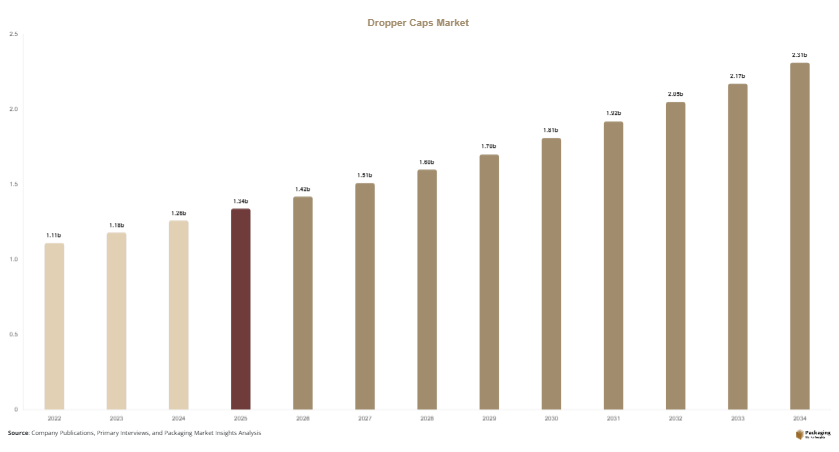
Dropper Caps market size is projected at USD 1.42 billion in 2026 and is expected to hit USD 2.31 billion by 2034 with a CAGR of 6.27%. The report provides extensive quantitative analysis covering production, consumption, pricing trends, supply chain assessment, competitive benchmarking, and regional performance. It further evaluates demand distribution across key end-use industries, technological developments, and strategic manufacturer positioning to support informed business decisions.
The Dropper Caps Market consists of dispensing closures designed to deliver controlled liquid doses across pharmaceutical, cosmetic, nutraceutical, laboratory, and food applications. Global production exceeded 9.8 billion units in 2025, while pharmaceutical applications accounted for approximately 46% of total consumption and cosmetic applications contributed nearly 31%. Plastic variants represented around 58% of overall production compared with 29% for glass and 13% for child-resistant designs. Increasing precision dispensing requirements, regulatory compliance, and premium packaging adoption continue strengthening the Dropper Caps Market.
Explore more data points, trends and opportunities Download Free Sample Report
Dropper Caps Market Trends
Increasing Demand for Precision Dispensing Systems
Manufacturers are introducing precision-molded dispensing closures capable of delivering drop accuracy within ±5%, improving dosage consistency across pharmaceutical and cosmetic products. Automated production facilities now manufacture more than 10 billion dispensing components annually, while automation adoption has surpassed 64% among leading packaging producers. High-performance polymer materials and silicone bulb innovations continue improving durability, leak resistance, and product compatibility, reinforcing the Dropper Caps Market.
Growing pharmaceutical production and premium skincare consumption are encouraging manufacturers to expand capacity. Over 72% of premium essential oil brands and nearly 68% of prescription liquid formulations utilize controlled dispensing closures. Recyclable polymers, lightweight glass, and tamper-evident technologies are increasingly integrated into new product launches, while digital quality inspection systems improve manufacturing efficiency by nearly 22%, supporting the Dropper Caps Market.
Dropper Caps Market Drivers
Rising Pharmaceutical Packaging Requirements
Expanding pharmaceutical manufacturing and increasing demand for liquid medications are major growth drivers. Global pharmaceutical liquid packaging surpassed 4.3 billion units during 2025, while prescription liquid formulations increased by approximately 7.1% year-over-year. Child-resistant packaging regulations cover more than 75% of developed healthcare markets, encouraging higher adoption of advanced dispensing closures. Investments exceeding USD 600 million in packaging automation continue strengthening the Dropper Caps Market.
Dropper Caps Market Restraints
Volatility in Raw Material Costs
Fluctuating prices of polypropylene, polyethylene, rubber bulbs, and specialty glass affect manufacturing profitability. Resin costs experienced annual fluctuations of nearly 14%, while specialty glass prices increased approximately 9% during recent years. Transportation expenses account for almost 12% of finished product costs, creating pricing pressure for manufacturers operating under long-term supply contracts, thereby limiting the Dropper Caps Market.
Dropper Caps Market Opportunities
Expansion of Sustainable Packaging Solutions
Demand for recyclable dispensing closures continues expanding as sustainability regulations become stricter. More than 48% of packaging companies are investing in recycled polymers and bio-based materials, while lightweight component adoption has reduced material consumption by nearly 16%. Production of recyclable dispensing closures is projected to exceed 5.5 billion units annually before 2030, creating significant opportunities for the Dropper Caps Market.
Challenges in Dropper Caps Market
Maintaining Regulatory Compliance Across Global Markets
Manufacturers must comply with pharmaceutical, cosmetic, and food-contact regulations across multiple regions. More than 60% of exporters require multiple certifications, while quality validation may increase production costs by 8–12%. Dimensional precision below 0.1 mm is often required for pharmaceutical dispensing systems, making quality assurance increasingly complex and influencing the Dropper Caps Market.
Report Scope
| Report Metric | Details |
|---|---|
| Market Size in 2025 | USD 1.34 billion |
| Market Size in 2026 | USD 1.42 billion |
| Market Size in 2034 | USD 2.31 billion |
| CAGR | 6.27% (2026-2034) |
| Base Year for Estimation | 2025 |
| Historical Data | 2022-2024 |
| Forecast Period | 2026-2034 |
| Report Coverage | Revenue Forecast, Competitive Landscape, Supply Chain Disruption, Growth Factors, Environment & Regulatory Landscape and Trends |
| Geographies Covered | North America, Europe, APAC, Middle East and Africa, LATAM |
| Countries Covered | U.S., Canada, U.K., Germany, France, Spain, Italy, Russia, Nordic, Benelux, Rest of Europe, China, South Korea, Japan, India, Australia, Singapore, Taiwan, South East Asia, Rest of Asia-Pacific, UAE, Turky, Saudi Arabia, South Africa, Egypt, Nigeria, Rest of MEA, Brazil, Mexico, Argentina, Chile, Colombia, Rest of LATAM |
Explore more data points, trends and opportunities Download Free Sample Report
Dropper Caps Market Segmentation
The market is segmented by type and application, with pharmaceutical packaging accounting for nearly 46% of global revenue and plastic products representing approximately 58% of total production. Advanced dispensing technologies continue increasing penetration across healthcare and premium consumer products.
By Type
Glass Dropper Caps
Glass dropper caps account for approximately 29% of total demand and are widely used in premium pharmaceuticals and skincare formulations. Annual production exceeds 2.8 billion units, offering high chemical resistance, excellent transparency, and superior product preservation.
Plastic Dropper Caps
Plastic dropper caps dominate with nearly 58% market share and annual production exceeding 5.6 billion units. These closures provide lightweight construction, reduced transportation costs, improved molding flexibility, and compatibility with automated filling systems.
Child-Resistant Dropper Caps
Child-resistant variants contribute nearly 13% of global consumption. Production surpassed 1.2 billion units in 2025 due to expanding pharmaceutical safety regulations. These closures incorporate locking mechanisms that improve consumer safety while maintaining dispensing accuracy.
By Application
Pharmaceuticals
Pharmaceutical applications represent roughly 46% of total consumption. More than 4.5 billion units are utilized annually for prescription medicines, ophthalmic products, and oral liquid formulations. High regulatory compliance and dosage precision requirements drive consistent demand.
Personal Care & Cosmetics
Personal care applications account for nearly 34% of market demand. Annual consumption exceeds 3.3 billion units, supported by facial serums, essential oils, beard oils, and premium skincare products requiring controlled dispensing.
Food & Beverages
Food and beverage applications contribute approximately 20% of total demand. Over 2 billion units are consumed annually for flavor concentrates, nutritional supplements, edible oils, and specialty liquid ingredients requiring contamination-free dispensing.
Dropper Caps Market Segmentations
Type
- Glass Dropper Caps
- Plastic Dropper Caps
- Child-Resistant Dropper Caps
Application
- Pharmaceuticals
- Personal Care & Cosmetics
- Food & Beverages
Dropper Caps Regional Outlook
North America
North America accounts for approximately 34% of global demand, supported by advanced pharmaceutical manufacturing and premium cosmetic production. The United States contributes nearly 82% of regional consumption, while Canada accounts for approximately 12%. Annual production exceeds 3.1 billion units, supported by high regulatory standards.
Europe
Europe represents nearly 28% of the global market. Germany, France, Italy, and the United Kingdom collectively contribute more than 70% of regional production. Pharmaceutical packaging remains the largest application with nearly 49% regional demand, while sustainable packaging adoption continues accelerating.
Asia-Pacific
Asia-Pacific holds approximately 30% of global demand and remains the fastest-expanding manufacturing hub. China contributes about 45% of regional production, followed by India at 21%, Japan at 14%, and South Korea at 7%. Annual manufacturing exceeds 3 billion units, supported by expanding pharmaceutical exports.
Latin America
Latin America contributes nearly 5% of global consumption. Brazil represents approximately 42% of regional demand, while Mexico contributes nearly 26%. Rising healthcare investments and cosmetic manufacturing continue supporting production growth.
Middle East & Africa
The Middle East & Africa account for approximately 3% of the market. GCC countries and South Africa lead regional demand through expanding pharmaceutical distribution and healthcare infrastructure investments.
Top players in Dropper Caps Market
- AptarGroup, Inc.
- Silgan Holdings Inc.
- Berry Global Inc.
- DWK Life Sciences
- Comar LLC
- Berlin Packaging
- Gerresheimer AG
- SGD Pharma
- Pacific Vial Manufacturing Inc.
- Origin Pharma Packaging
- Virospack S.L.
- O.Berk Company
AptarGroup, Inc.
-
Holds an estimated 12–14% global market share.
-
Strong leadership in pharmaceutical dispensing technologies.
-
Operates advanced manufacturing facilities across North America, Europe, and Asia.
-
Invests significantly in sustainable dispensing systems, digital quality inspection, and precision molding technologies. Its diversified packaging portfolio and long-term pharmaceutical partnerships strengthen its competitive position across regulated healthcare and premium cosmetic packaging markets.
Berry Global Inc.
-
Accounts for approximately 9–11% market share.
-
Major supplier of plastic dispensing closures for healthcare and personal care industries.
-
Extensive global manufacturing network supports high-volume production exceeding several billion closure units annually.
-
Focuses on recyclable polymers, lightweight packaging innovations, and automation investments that improve production efficiency while expanding its presence across pharmaceutical, food, and cosmetic packaging sectors.