Cryo Box Market Size
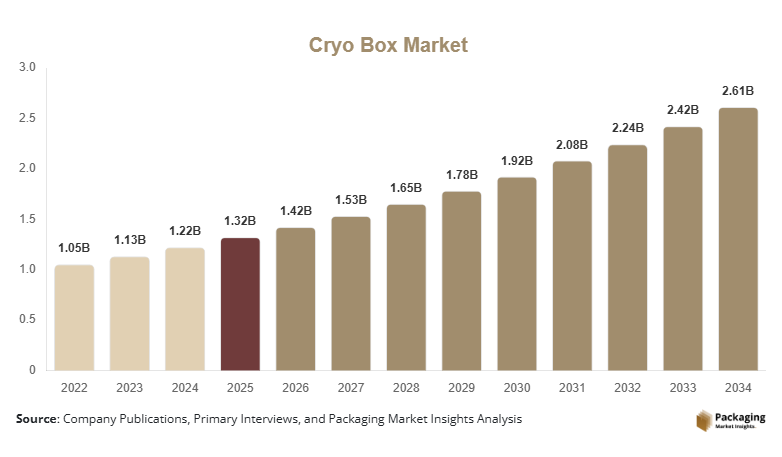
The Cryo Box market size is projected at USD 1.42 billion in 2026 and is expected to hit USD 2.63 billion by 2034 with a CAGR of 7.9%.
The Cryo Box market analysis provides a detailed evaluation of market dynamics, segmentation patterns, regional performance, technological developments, and the competitive landscape. Increasing requirements for secure storage of biological samples, vaccines, genetic materials, and laboratory specimens are driving investments across healthcare and life science industries. The report evaluates market opportunities through quantitative insights covering production capacity, adoption rates, industry demand, and competitive positioning.
The cryo box market includes specialized containers designed for ultra-low temperature storage applications, commonly operating between -80°C and -196°C. These boxes support sample organization, contamination prevention, and efficient handling of millions of biological specimens across research facilities, pharmaceutical companies, and biotechnology laboratories.
The global cryo box market production volume exceeded 420 million units in 2025, with polypropylene-based products accounting for nearly a 46% share due to their durability, chemical resistance, and compatibility with automated laboratory systems. Biotechnology applications contributed approximately 38% of total demand, followed by pharmaceutical storage applications at 34%, reinforcing the importance of cryobox market solutions.
Explore more data points, trends and opportunities Download Free Sample Report
Cryo Box Market Trends
Increasing Adoption of Automated Cryogenic Storage Solutions
The cryo box market trend is influenced by rapid automation in laboratories and biobanking facilities. Automated sample management systems are increasing demand for standardized cryogenic storage boxes capable of handling millions of samples annually. In 2025, more than 55% of newly installed laboratory automation platforms incorporated compatible cryo storage accessories, supporting production volumes exceeding 400 million cryo boxes globally. Advanced barcode integration, RFID tracking, and robotic handling technologies are improving sample accuracy by nearly 35% and reducing manual errors in high-volume laboratories, strengthening the cryo box market trend adoption.
Growing Demand for Sustainable Cryogenic Packaging Materials
Sustainability initiatives are transforming cryo box market trend developments as manufacturers focus on recyclable polymers and reusable storage solutions. Approximately 30% of newly developed cryogenic boxes launched between 2024 and 2026 incorporated environmentally improved materials. Pharmaceutical and biotechnology companies generating more than 2 billion stored biological samples annually are increasingly selecting lightweight and reusable cryogenic storage formats. These technology shifts are supporting long-term demand for efficient and sustainable cryobox market products.
Cryo Box Market Drivers
Expansion of Biotechnology and Pharmaceutical Research Activities
The Cryo Box market growth is accelerated by increasing biotechnology investments, vaccine research programs, and genomic studies. Global pharmaceutical R&D spending surpassed USD 250 billion in 2025, creating significant demand for reliable cryogenic storage systems. Biotechnology laboratories representing over 45% of advanced sample storage users require temperature-resistant boxes capable of preserving biological materials at -80°C and below. Increasing clinical trials, biobanking activities, and personalized medicine adoption with growth rates above 8% annually are supporting the expansion of the cryo box market.
Cryo Box Market Restraints
High Costs Associated With Advanced Cryogenic Storage Systems
The Cryo Box Market faces limitations due to the high investment required for advanced cryogenic infrastructure. Premium cryo boxes with specialized materials can cost 20%–40% more than conventional laboratory storage containers. Small research facilities operating with annual budgets below USD 1 million often experience procurement challenges. Additionally, fluctuations in raw material prices, particularly polypropylene and specialty polymers, affecting nearly 25% of manufacturing costs, create pricing pressure for Cryo Box Market suppliers.
Cryo Box Market Opportunities
Increasing Adoption of Biobanking and Personalized Medicine
The cryo box market opportunities are expanding due to rising global biobanking activities and personalized healthcare initiatives. More than 500 million biological samples are stored worldwide in research repositories, creating strong demand for organized cryogenic storage solutions. Emerging markets investing over USD 15 billion annually in healthcare infrastructure are creating new opportunities for manufacturers. The adoption of precision medicine, genomic sequencing, and cell-based therapies is expected to increase cryogenic storage demand by more than 40% through 2034.
Challenges in Cryo Box Market
Complex Regulatory Requirements for Biological Sample Storage
The cryo box market faces challenges from strict regulatory standards governing biological specimen handling. Approximately 60% of pharmaceutical and biotechnology organizations operate under multiple compliance frameworks requiring validated storage systems. Differences in international regulations, quality certification requirements, and temperature monitoring standards increase operational complexity. Manufacturers must invest 5%–10% of annual revenue into compliance testing and product validation, creating challenges for smaller cryo box market participants.
Report Scope
| Report Metric | Details |
|---|---|
| Market Size in 2025 | USD 1.32 Billion |
| Market Size in 2026 | USD 1.42 Billion |
| Market Size in 2034 | USD 2.63 Billion |
| CAGR | 7.9% (2026-2034) |
| Base Year for Estimation | 2025 |
| Historical Data | 2022-2024 |
| Forecast Period | 2026-2034 |
| Report Coverage | Revenue Forecast, Competitive Landscape, Supply Chain Disruption, Growth Factors, Environment & Regulatory Landscape and Trends |
| Geographies Covered | North America, Europe, APAC, Middle East and Africa, LATAM |
| Countries Covered | U.S., Canada, U.K., Germany, France, Spain, Italy, Russia, Nordic, Benelux, Rest of Europe, China, South Korea, Japan, India, Australia, Singapore, Taiwan, South East Asia, Rest of Asia-Pacific, UAE, Turkey, Saudi Arabia, South Africa, Egypt, Nigeria, Rest of MEA, Brazil, Mexico, Argentina, Chile, Colombia, Rest of LATAM |
Explore more data points, trends and opportunities Download Free Sample Report
Cryo Box Market Segmentation
The cryo box market segmentation is categorized by material type and application. Polypropylene cryo boxes dominate the market with approximately 46% share due to superior temperature resistance, while biotechnology applications represent nearly 38% of total consumption. The segmentation reflects growing demand across laboratories, pharmaceutical companies, hospitals, and research institutions requiring secure ultra-low temperature storage.
By Material Type
Polypropylene cryo boxes represent the leading segment with approximately 46% market share in 2026. More than 190 million polypropylene cryo boxes are produced annually due to their durability, chemical resistance, and ability to withstand temperatures ranging from -80°C to -196°C. These boxes are widely used in biotechnology laboratories and pharmaceutical facilities because they provide lightweight construction, moisture resistance, and compatibility with automated storage systems.
Fiberboard cryo boxes account for nearly a 32% share, supported by their cost-effectiveness and high adoption in academic and research laboratories. Annual production exceeds 130 million units globally. These boxes typically feature coated surfaces, reinforced structures, and compartment designs accommodating 25, 81, or 100 sample tubes. Their affordability makes them suitable for institutions managing large sample volumes.
Polycarbonate cryo boxes contribute approximately 22% market share with production volumes exceeding 90 million units annually. These products provide high impact resistance, transparent construction, and extended lifecycle performance. Pharmaceutical manufacturers and advanced research centers prefer polycarbonate solutions for repeated freezing and thawing operations.
By Application
Biotechnology applications dominate with around a 38% share of cryo box market demand. More than 160 million units are utilized annually for storing DNA samples, cell cultures, proteins, and biological materials. Increasing genomic research programs and cell therapy developments are driving adoption rates above 8% annually.
Pharmaceutical applications represent approximately a 34% share, supported by vaccine manufacturing, clinical research, and drug discovery activities. Over 140 million cryo boxes are consumed annually by pharmaceutical companies requiring reliable storage conditions. These solutions support temperature-controlled preservation of active biological compounds.
Research laboratories contribute nearly a 28% share, with demand exceeding 110 million units annually. Universities, government research centers, and medical institutes use cryo boxes for sample organization and long-term preservation. Increasing laboratory infrastructure investments are improving penetration rates across emerging economies.
Cryo Box Market Segmentations
Material Type
- Polypropylene Cryo Boxes
- Fiberboard Cryo Boxes
- Polycarbonate Cryo Boxes
Application
- Biotechnology
- Pharmaceuticals
- Research Laboratories
End User
- Biotechnology Companies
- Pharmaceutical Companies
- Academic & Research Institutes
- Hospitals & Diagnostic Laboratories
Cryo Box Market Regional Outlook
North America
North America holds approximately 39% share of the cryo box market due to advanced biotechnology infrastructure and high pharmaceutical research spending. The United States contributes nearly 32% of global demand with more than 130 million units consumed annually. Canada supports market expansion through growing biobanking programs and research investments.
Europe
Europe accounts for around 29% market share, supported by strong healthcare systems and genomic research initiatives. Germany, the United Kingdom, and France collectively contribute more than 75 million units annually. Pharmaceutical manufacturing represents nearly 45% of regional demand.
Asia Pacific
The Asia Pacific is the fastest-growing region, with approximately 23% share and annual consumption exceeding 95 million units. China, Japan, and India are increasing investments in biotechnology and healthcare infrastructure. China contributes nearly 50 million units annually due to expanding pharmaceutical production capacity.
Latin America and Middle East & Africa
These regions collectively represent approximately a 9% share of the Cryo Box market. Growing healthcare modernization programs and increasing research collaborations are supporting demand growth. Brazil, the UAE, and South Africa are emerging contributors with rising laboratory investments.
Top Players In The Cryo Box Market
- Thermo Fisher Scientific Inc.
- Avantor Inc.
- Eppendorf SE,
- Simport Scientific Inc.
- Corning Incorporated
- Greiner Bio-One International GmbH
- Azenta Life Sciences
- Sarstedt AG & Co. KG
- BioCision LLC
- Heathrow Scientific LLC
- Bel-Art Products
- SP Industries Inc.
Thermo Fisher Scientific Inc. Thermo Fisher Scientific maintains a leading position in the cryo box market through its extensive laboratory product portfolio and global distribution network. The company accounts for an estimated 15%–18% market presence across cryogenic storage solutions. Its products serve pharmaceutical, biotechnology, and academic research sectors with millions of units supplied annually. Strong investments in laboratory automation, temperature-controlled storage, and life science technologies strengthen its competitive positioning. Eppendorf SE holds a significant position with approximately 8%–10% share in the cryobox market. The company focuses on high-quality laboratory consumables designed for molecular biology and clinical research applications. Its cryogenic storage products support automated workflows and precision sample management. Continuous innovation in ergonomic designs and sustainable materials improves its market competitiveness.