Continuous Ambulatory Peritoneal Dialysis Bags Market Size
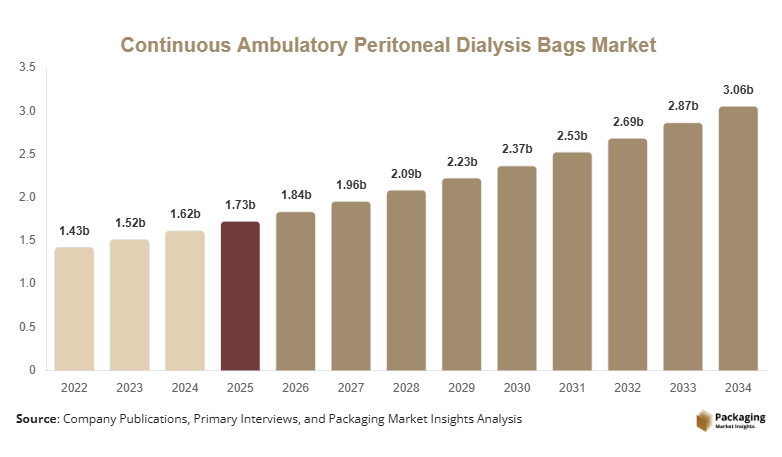
Continuous Ambulatory Peritoneal Dialysis Bags market size is projected at USD 1.84 billion in 2026 and is expected to hit USD 3.06 billion by 2034 with a CAGR of 6.56%. Rising chronic kidney disease prevalence, increasing home-based dialysis adoption, and improvements in sterile medical packaging are supporting market expansion. The report provides detailed analysis of production volumes, market segmentation, technological advancements, and the competitive landscape across key regions.
Continuous Ambulatory Peritoneal Dialysis (CAPD) bags are sterile medical fluid bags used for home-based peritoneal dialysis treatment in patients with end-stage renal disease. Global production exceeded 1.35 billion dialysis bags in 2025, while non-PVC materials represented approximately 44% of total production due to increasing preference for DEHP-free solutions. Double-chamber bags accounted for nearly 49% of market demand, while home healthcare applications represented more than 72% of total usage. Growing renal care infrastructure continues strengthening the continuous ambulatory peritoneal dialysis bags market.
Explore more data points, trends and opportunities Download Free Sample Report
Continuous Ambulatory Peritoneal Dialysis Bags Trends
Growing Adoption of Non-PVC and Advanced Sterile Packaging
Healthcare manufacturers are increasingly introducing non-PVC dialysis bags with enhanced biocompatibility and lower environmental impact. More than 580 million non-PVC dialysis bags were produced during 2025, while adoption increased by over 21%. Multi-layer medical films improve oxygen and moisture barrier performance by approximately 35%, reinforcing the continuous ambulatory peritoneal dialysis bags market.
Automation, cleanroom manufacturing, and digital quality inspection technologies are improving production efficiency. Nearly 63% of global manufacturing facilities operate fully automated filling and sealing systems capable of producing over 160 bags per minute. Rising home dialysis adoption and telehealth integration continue supporting the continuous ambulatory peritoneal dialysis bags market.
Continuous Ambulatory Peritoneal Dialysis Bags Drivers
Rising Incidence of Chronic Kidney Disease
Increasing chronic kidney disease cases and expanding home dialysis programs are major market drivers. More than 4 million patients globally receive dialysis treatment, while peritoneal dialysis accounts for nearly 11% of all dialysis therapies. Home-based treatment adoption has increased by approximately 15% in recent years, supporting continuous ambulatory peritoneal dialysis bags market growth.
Continuous Ambulatory Peritoneal Dialysis Bags Restraints
High Manufacturing and Regulatory Compliance Costs
Strict healthcare regulations, sterile manufacturing requirements, and specialized raw materials increase production costs. Medical-grade polymer prices have fluctuated by 10–18%, while compliance and validation expenses have increased by approximately 14% across regulated markets. These factors continue restraining the continuous ambulatory peritoneal dialysis bags market.
Continuous Ambulatory Peritoneal Dialysis Bags Opportunities
Expansion of Home Healthcare Services
Healthcare providers are increasingly promoting home-based renal therapies to reduce hospital burden and improve patient convenience. Home dialysis utilization has expanded by more than 18%, while investments in renal care infrastructure exceeded USD 4 billion globally. These developments create significant opportunities for the continuous ambulatory peritoneal dialysis bags market.
Challenges in Continuous Ambulatory Peritoneal Dialysis Bags
Maintaining Sterility Throughout the Supply Chain
Ensuring sterile integrity during production, transportation, and storage remains challenging. More than 99.9% sterility assurance levels are required, while packaging defects must remain below 0.05% under regulatory standards. Balancing product safety, material sustainability, and cost efficiency continues challenging the continuous ambulatory peritoneal dialysis bags market.
Report Scope
| Report Metric | Details |
|---|---|
| Market Size in 2025 | USD 1.73 billion |
| Market Size in 2026 | USD 1.84 billion |
| Market Size in 2034 | USD 3.06 billion |
| CAGR | 6.56% (2026-2034) |
| Base Year for Estimation | 2025 |
| Historical Data | 2022-2024 |
| Forecast Period | 2026-2034 |
| Report Coverage | Revenue Forecast, Competitive Landscape, Supply Chain Disruption, Growth Factors, Environment & Regulatory Landscape and Trends |
| Geographies Covered | North America, Europe, APAC, Middle East and Africa, LATAM |
| Countries Covered | U.S., Canada, U.K., Germany, France, Spain, Italy, Russia, Nordic, Benelux, Rest of Europe, China, South Korea, Japan, India, Australia, Singapore, Taiwan, South East Asia, Rest of Asia-Pacific, UAE, Turky, Saudi Arabia, South Africa, Egypt, Nigeria, Rest of MEA, Brazil, Mexico, Argentina, Chile, Colombia, Rest of LATAM |
Explore more data points, trends and opportunities Download Free Sample Report
Continuous Ambulatory Peritoneal Dialysis Bags Market Segmentation
Non-PVC materials dominate nearly 44% of market demand owing to superior patient safety and increasing regulatory preference. Double-chamber bags account for approximately 49% of total consumption because of improved solution stability and ease of administration.
By Material
PVC accounts for approximately 38% of market revenue with annual production exceeding 510 million bags. The material provides flexibility, transparency, and cost-effective manufacturing for dialysis applications.
Non-PVC materials hold nearly 44% market share with production exceeding 580 million units annually. These bags eliminate DEHP exposure while offering enhanced chemical compatibility and environmental benefits.
Polypropylene contributes approximately 18% of demand. These dialysis bags provide improved thermal resistance, excellent mechanical strength, and compatibility with advanced sterilization processes.
By Product Type
Single-chamber bags account for approximately 28% of the market and are widely used for standard dialysis fluid delivery in routine renal therapy.
Double-chamber bags dominate with nearly 49% market share. Production exceeds 660 million units annually and enables on-demand mixing of dialysis solutions while extending shelf life.
Multi-chamber bags represent approximately 23% of total demand and support customized dialysis formulations for complex patient requirements.
Continuous Ambulatory Peritoneal Dialysis Bags Market Segmentations
Material
- PVC
- Non-PVC
- Polypropylene
Product Type
- Single-Chamber Bags
- Double-Chamber Bags
- Multi-Chamber Bags
End User
- Hospitals
- Dialysis Centers
- Home Healthcare
- Specialty Clinics
Continuous Ambulatory Peritoneal Dialysis Bags Regional Outlook
North America
North America accounts for approximately 36% of global revenue. The United States leads regional demand due to advanced renal care infrastructure, rising home dialysis adoption, and healthcare expenditure exceeding USD 4 trillion annually.
Europe
Europe represents nearly 29% of the market. Germany, France, Italy, and the United Kingdom maintain strong demand through established nephrology care systems and increasing adoption of non-PVC dialysis bags.
Asia-Pacific
Asia-Pacific holds approximately 28% market share and records the fastest growth. China, Japan, India, South Korea, and Australia continue expanding renal treatment facilities, producing over 410 million dialysis bags annually.
Latin America
Latin America contributes approximately 4% of the market. Brazil and Mexico lead regional demand through increasing chronic kidney disease diagnosis and improved healthcare accessibility.
Middle East & Africa
The Middle East & Africa account for around 3% of the market. Growth is supported by investments in dialysis centers, expanding healthcare infrastructure, and improved access to renal replacement therapies.
Top players in Continuous Ambulatory Peritoneal Dialysis Bags Market
- Baxter International Inc.
- Fresenius Medical Care AG
- B. Braun SE
- Nipro Corporation
- Baxter Healthcare Corporation
- Terumo Corporation
- JMS Co., Ltd.
- Kawasumi Laboratories, Inc.
- WEGO Group
- Medica S.p.A.
- Renax Biomedical Technology Co., Ltd.
- Farmasol
- Poly Medicure Limited
- Angiplast Pvt. Ltd.
- Baxter India Pvt. Ltd.
Baxter International Inc.
-
Holds an estimated 28–30% share of the global market.
-
Maintains a leading position in peritoneal dialysis systems, CAPD solutions, and home dialysis technologies.
-
Operates advanced sterile manufacturing facilities across multiple regions while continuously investing in digital renal care, connected dialysis systems, and environmentally sustainable dialysis bag production.
Fresenius Medical Care AG
-
Commands approximately 20–22% market share globally.
-
Operates one of the world's largest renal care networks with integrated dialysis products and services.
-
Focuses on high-quality dialysis consumables, non-PVC medical bags, and home dialysis innovations supported by strong research, manufacturing capabilities, and global distribution infrastructure.