Cold Chain Biologic Temperature Monitoring Labels Market Size
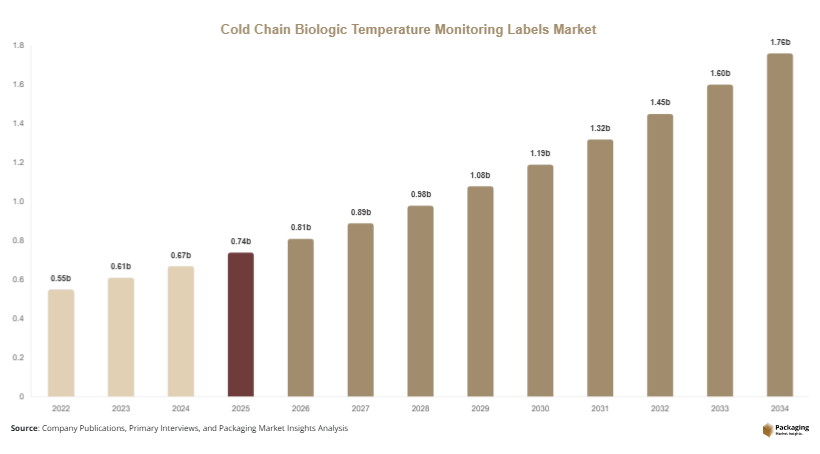
Cold Chain Biologic Temperature Monitoring Labels market size is projected at USD 0.81 billion in 2026 and is expected to hit USD 1.76 billion by 2034 with a CAGR of 10.2%. Rising investments in biologics transportation, pharmaceutical cold chain expansion, and stricter regulatory compliance continue to accelerate market expansion. The report evaluates market segmentation across product types, applications, regional performance, and competitive landscape while analyzing production capacity, technology adoption, pricing trends, and strategic developments shaping long-term industry performance.
The Cold Chain Biologic Temperature Monitoring Labels market consists of specialized temperature-sensitive indicators and smart monitoring labels designed to verify temperature exposure during transportation and storage of biologics, vaccines, blood products, cell therapies, and temperature-sensitive pharmaceuticals. Global production exceeded 1.18 billion labels in 2025, while adoption across pharmaceutical cold chain shipments surpassed 68%, compared with 61% in 2023. Pharmaceutical logistics represented approximately 54% of total consumption, vaccine distribution contributed 29%, and clinical research accounted for nearly 17%. Increasing regulatory compliance, product traceability, and biologic manufacturing continue supporting the Cold Chain Biologic Temperature Monitoring Labels market.
Explore more data points, trends and opportunities Download Free Sample Report
Cold Chain Biologic Temperature Monitoring Labels Market Trends
Expansion of Smart Temperature Indicator Technologies
Manufacturers are increasingly integrating RFID, NFC, printed electronics, and color-changing chemical indicators into monitoring labels to improve shipment visibility. More than 420 million smart monitoring labels were produced globally during 2025, representing annual production growth of nearly 18%. Digital monitoring label adoption exceeded 36%, while pharmaceutical manufacturers increased deployment across high-value biologics by over 24%. Continuous innovation reinforces the Cold Chain Biologic Temperature Monitoring Labels market.
Growing biologic exports, specialty medicines, and personalized therapies continue driving demand for intelligent monitoring solutions. Nearly 81% of newly approved biologic shipments now require continuous temperature verification, while automated logistics systems achieved deployment across approximately 47% of major pharmaceutical distribution centers worldwide. These developments continue strengthening the Cold Chain Biologic Temperature Monitoring Labels market.
Increasing Vaccine Cold Chain Investments
Global immunization initiatives and biologic manufacturing expansion have significantly increased investments in cold chain monitoring infrastructure. Vaccine shipments requiring validated temperature labels surpassed 520 million packages during 2025, while compliance monitoring increased by 22% year-over-year. Advanced irreversible indicators remained widely adopted due to cost efficiency and regulatory acceptance.
Healthcare providers, logistics companies, and contract manufacturing organizations continue expanding validated packaging systems. More than 73% of international biologic shipments now include temperature monitoring labels, while smart packaging penetration reached approximately 41% across premium pharmaceutical logistics operations. These investments continue supporting the Cold Chain Biologic Temperature Monitoring Labels market.
Cold Chain Biologic Temperature Monitoring Labels Drivers
Expansion of Global Biologic and Vaccine Distribution
Rapid expansion of biologics manufacturing, advanced therapies, and temperature-sensitive pharmaceuticals continues driving demand for monitoring labels. Global biologics production exceeded USD 620 billion, while cold chain pharmaceutical shipments increased by approximately 14% during 2025. Regulatory compliance rates surpassed 89%, with validated monitoring labels reducing product loss by nearly 27%, supporting Cold Chain Biologic Temperature Monitoring Labels market.
Cold Chain Biologic Temperature Monitoring Labels Restraints
High Cost of Advanced Smart Monitoring Solutions
Digital monitoring labels incorporating RFID, NFC, and electronic sensors remain substantially more expensive than conventional chemical indicators. Smart label prices remain 2.5–5 times higher than irreversible labels, while implementation costs increased by nearly 18% for smaller logistics providers. Limited infrastructure across developing economies continues restraining the Cold Chain Biologic Temperature Monitoring Labels market.
Cold Chain Biologic Temperature Monitoring Labels Opportunities
Expansion of Personalized Medicine and Cell Therapy Logistics
Cell therapies, gene therapies, and precision biologics require highly accurate temperature validation throughout transportation. Cell therapy shipments increased by approximately 31% during 2025, while advanced therapy clinical trials exceeded 2,400 worldwide. Growing investments in specialty pharmaceutical logistics create substantial opportunities for the Cold Chain Biologic Temperature Monitoring Labels market.
Challenges in Cold Chain Biologic Temperature Monitoring Labels
Maintaining Standardization Across Global Supply Chains
Differences in regulatory standards, transportation environments, and validation protocols continue creating operational challenges. More than 16% of cross-border pharmaceutical shipments require additional verification procedures, while logistics providers report compliance costs increasing by nearly 12% annually. Harmonization remains a key challenge for the Cold Chain Biologic Temperature Monitoring Labels market.
Report Scope
| Report Metric | Details |
|---|---|
| Market Size in 2025 | USD 0.74 billion |
| Market Size in 2026 | USD 0.81 billion |
| Market Size in 2034 | USD 1.76 billion |
| CAGR | 10.2% (2026-2034) |
| Base Year for Estimation | 2025 |
| Historical Data | 2022-2024 |
| Forecast Period | 2026-2034 |
| Report Coverage | Revenue Forecast, Competitive Landscape, Supply Chain Disruption, Growth Factors, Environment & Regulatory Landscape and Trends |
| Geographies Covered | North America, Europe, APAC, Middle East and Africa, LATAM |
| Countries Covered | U.S., Canada, U.K., Germany, France, Spain, Italy, Russia, Nordic, Benelux, Rest of Europe, China, South Korea, Japan, India, Australia, Singapore, Taiwan, South East Asia, Rest of Asia-Pacific, UAE, Turky, Saudi Arabia, South Africa, Egypt, Nigeria, Rest of MEA, Brazil, Mexico, Argentina, Chile, Colombia, Rest of LATAM |
Explore more data points, trends and opportunities Download Free Sample Report
Cold Chain Biologic Temperature Monitoring Labels Market Segmentation
Product innovation and application diversity continue driving market segmentation. Irreversible labels account for nearly 46% of global demand, followed by digital labels at 33% and reversible labels at 21%. Pharmaceutical logistics represents approximately 54% of market utilization.
By Type
Irreversible Temperature Monitoring Labels
Irreversible indicators remain the dominant product category with nearly 46% market share. Annual production exceeded 540 million units, operating across activation thresholds from 2°C to 8°C and -20°C. These labels permanently indicate temperature excursions, making them highly suitable for vaccine logistics and pharmaceutical exports.
Reversible Temperature Monitoring Labels
Reversible labels contribute approximately 21% of global demand with annual production approaching 250 million units. These products support repeated monitoring during storage and warehousing while maintaining visual indication accuracy across controlled environments.
Digital Temperature Monitoring Labels
Digital monitoring labels account for nearly 33% of market demand. Production surpassed 390 million units, integrating RFID, NFC, QR codes, and printed electronics. These labels provide continuous monitoring, cloud connectivity, and improved traceability for high-value biologic products.
By Application
Pharmaceutical & Biopharmaceutical Logistics
This application represents nearly 54% of total market consumption. More than 640 million labels are utilized annually across biologic transportation, specialty medicines, monoclonal antibodies, and insulin distribution. Adoption exceeds 72% among regulated pharmaceutical exporters.
Vaccine Distribution
Vaccine distribution contributes approximately 29% of market demand. More than 340 million monitoring labels support routine immunization programs, pandemic preparedness, and international vaccine transportation while ensuring compliance with validated cold chain protocols.
Clinical Trials & Research
Clinical research accounts for nearly 17% of market utilization. Around 200 million labels support investigational biologics, biospecimens, and temperature-sensitive research materials with adoption exceeding 58% across multinational clinical trial logistics.
Cold Chain Biologic Temperature Monitoring Labels Market Segmentations
Type
- Irreversible Temperature Monitoring Labels
- Reversible Temperature Monitoring Labels
- Digital Temperature Monitoring Labels
Application
- Pharmaceutical & Biopharmaceutical Logistics
- Vaccine Distribution
- Clinical Trials & Research
Cold Chain Biologic Temperature Monitoring Labels Regional Outlook
North America
North America accounts for approximately 38% of global revenue, supported by strong biologics manufacturing and advanced pharmaceutical logistics. The United States contributes nearly 82% of regional demand, while Canada continues expanding vaccine manufacturing and specialty pharmaceutical exports.
Production exceeds 430 million monitoring labels annually across the region, with digital monitoring adoption surpassing 48% among pharmaceutical manufacturers.
Europe
Europe represents approximately 30% of global demand. Germany, France, the United Kingdom, Switzerland, and Italy remain major contributors through biologic production and vaccine exports. Pharmaceutical logistics contributes nearly 61% of regional consumption, supported by expanding GDP-compliant supply chains.
Asia-Pacific
Asia-Pacific holds nearly 24% market share and records the fastest expansion. China, India, Japan, South Korea, and Singapore continue investing in biologics manufacturing and cold chain infrastructure. Regional production exceeded 310 million labels, while pharmaceutical exports increased by approximately 16% during 2025.
Latin America
Latin America contributes approximately 5% of global demand. Brazil and Mexico dominate regional consumption through expanding vaccine manufacturing, biologics imports, and government immunization initiatives. Healthcare logistics modernization continues supporting market expansion.
Middle East & Africa
The Middle East & Africa account for approximately 3% of the market. Saudi Arabia, the UAE, and South Africa continue investing in pharmaceutical warehousing, vaccine storage, and temperature-controlled logistics, improving long-term adoption of monitoring labels.
Top players in Cold Chain Biologic Temperature Monitoring Labels
- SpotSee
- Temptime Corporation
- 3M
- CCL Industries
- Avery Dennison Corporation
- Insignia Technologies
- DeltaTrak
- Berlinger & Co. AG
- American Thermal Instruments
- Cryolog
- Zebra Technologies
- Sensitech
- Thin Film Electronics
- Timestrip UK Ltd.
- Smartrac
SpotSee
-
Estimated market share: 12–15%
-
Strong presence across pharmaceutical logistics and vaccine transportation.
-
Extensive portfolio of irreversible, digital, and smart monitoring indicators.
-
Broad global distribution network serving pharmaceutical manufacturers, logistics providers, and healthcare organizations with continuous investment in smart monitoring technologies.
Temptime Corporation
-
Estimated market share: 10–13%
-
Leading supplier of vaccine temperature monitoring solutions.
-
Strong regulatory acceptance across healthcare and biologic logistics.
-
Focuses on irreversible temperature indicators, validated cold chain solutions, and strategic partnerships with pharmaceutical companies and international healthcare organizations to strengthen global market presence.