Centerfold Laminated Bag Market Size and Growth
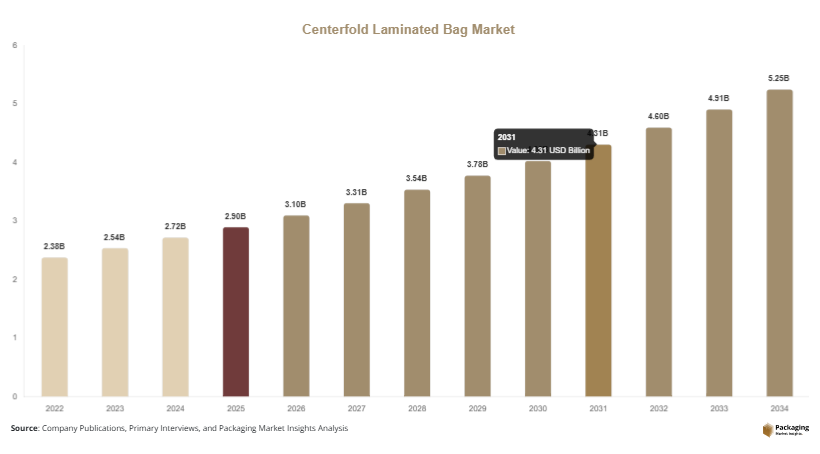
The global centerfold laminated bag market size is estimated at USD 2.9 billion in 2025 and is projected to reach USD 3.1 billion in 2026. By 2034, the market is expected to grow to USD 5.6 billion, registering a CAGR of 6.8% during the forecast period (2025–2034). The consistent growth reflects rising demand for flexible packaging formats that improve product shelf life and branding. The centerfold laminated bag market is experiencing steady expansion as industries increasingly adopt flexible packaging solutions that combine durability, visual appeal, and cost efficiency. Centerfold laminated bags are widely used in food packaging, retail, and industrial applications due to their enhanced barrier properties, lightweight structure, and ability to support high-quality printing.
One of the key growth factors is the increasing demand for packaged food products, driven by changing consumer lifestyles and urbanization. Centerfold laminated bags offer excellent moisture resistance and sealing properties, making them suitable for snacks, bakery items, and processed foods. Another major factor is the growth of retail and e-commerce sectors, where packaging plays a critical role in product protection and presentation. These bags provide a balance between functionality and aesthetics, supporting brand visibility.
Key Highlights:
- Asia Pacific dominated the market with a 40.6% share in 2025, while Latin America is projected to grow at the fastest CAGR of 7.1%.
- Polyethylene-based laminated bags led the type segment with a 35.2% share, while biodegradable laminated bags are expected to grow at a CAGR of 7.5%.
- Flexible plastic packaging dominated with a 58.4% share, while paper-laminated packaging is forecasted to grow at a CAGR of 6.6%.
- Food & beverage applications led the segment with 47.8% share, while pharmaceutical packaging is expected to grow at a CAGR of 7.0%.
- China remained the dominant country with a market size of USD 0.9 billion in 2025 and USD 1.0 billion in 2026.
Explore more data points, trends and opportunities Download Free Sample Report
Market Trends
Increasing shift toward sustainable laminated packaging solutions
Sustainability is becoming a significant direction in the centerfold laminated bag market, as manufacturers and end users seek environmentally responsible packaging alternatives. Companies are focusing on reducing plastic usage by incorporating recyclable and biodegradable materials into laminated structures. The development of mono-material laminates is gaining attention, as these materials simplify recycling processes while maintaining barrier properties. Additionally, regulatory pressure in various regions is encouraging companies to adopt eco-friendly solutions. Brands are also responding to consumer demand for sustainable packaging by investing in green innovations. This trend is expected to influence product development and drive long-term market transformation.
Growing use of high-quality printing and branding features
Advancements in printing technologies are enhancing the visual appeal of centerfold laminated bags. Digital printing and flexographic techniques enable high-resolution graphics, vibrant colors, and detailed designs. This allows brands to create packaging that attracts consumer attention and communicates product information effectively. Customization is becoming increasingly important, as companies aim to differentiate their products in competitive markets. The integration of branding elements such as logos, promotional messages, and interactive features is improving consumer engagement. As retail competition intensifies, visually appealing packaging is expected to play a crucial role in influencing purchasing decisions.
Market Drivers
Rising demand for flexible and lightweight packaging
The growing preference for flexible packaging solutions is a major factor driving the centerfold laminated bag market. These bags are lightweight, easy to handle, and cost-effective compared to rigid packaging alternatives. They offer excellent barrier properties, protecting products from moisture, oxygen, and contaminants. This makes them suitable for a wide range of applications, including food, pharmaceuticals, and personal care products. The increasing demand for convenience and portability among consumers is further supporting the adoption of flexible packaging. Manufacturers are continuously improving product designs to enhance functionality and efficiency.
Expansion of food processing and retail industries
The growth of the food processing and retail sectors is significantly contributing to market expansion. The increasing consumption of packaged and processed foods is driving demand for reliable packaging solutions. Centerfold laminated bags provide extended shelf life and maintain product freshness, making them ideal for food applications. The expansion of supermarkets, hypermarkets, and online retail platforms is also boosting demand. Retailers require packaging that enhances product visibility and facilitates efficient storage and transportation. This trend is expected to sustain market growth during the forecast period.
Market Restraint
Challenges related to recycling and environmental impact
Despite advancements in sustainable materials, recycling laminated bags remains a challenge due to their multi-layered structure. The combination of different materials, such as plastics and aluminum, complicates the recycling process. This can lead to environmental concerns and regulatory restrictions in certain regions. Manufacturers face pressure to develop solutions that balance performance and sustainability. For example, traditional laminated bags may not be easily recyclable, leading to increased waste. This challenge can limit market growth and require significant investment in research and development to create more sustainable alternatives.
Market Opportunities
Development of recyclable and mono-material laminates
The development of recyclable and mono-material laminates presents a significant opportunity for market growth. These materials simplify the recycling process and reduce environmental impact. Companies are investing in research and development to create innovative solutions that maintain barrier properties while improving recyclability. This trend is gaining traction in regions with strict environmental regulations. Brands that adopt sustainable packaging solutions can enhance their market position and meet consumer expectations. The growing demand for eco-friendly products is expected to drive innovation and create new opportunities in the market.
Increasing demand from emerging markets
Emerging economies are creating new growth opportunities for the centerfold laminated bag market. Rapid urbanization, rising disposable incomes, and expanding retail sectors are driving demand for packaged products. Countries in Asia Pacific, Latin America, and Africa are witnessing increased consumption of food, personal care, and pharmaceutical products. This is leading to higher demand for flexible packaging solutions. Companies that establish a strong presence in these markets can benefit from growing demand and favorable economic conditions. The expansion of distribution networks and local manufacturing facilities can further support market growth.
Report Scope
| Report Metric | Details |
|---|---|
| Market Size in 2025 | USD 2.9 Billion |
| Market Size in 2026 | USD 3.1 Billion |
| Market Size in 2034 | USD 5.6 Billion |
| CAGR | 6.8% (2026-2034) |
| Base Year for Estimation | 2025 |
| Historical Data | 2022-2024 |
| Forecast Period | 2026-2034 |
| Report Coverage | Revenue Forecast, Competitive Landscape, Supply Chain Disruption, Growth Factors, Environment & Regulatory Landscape and Trends |
| Geographies Covered | North America, Europe, APAC, Middle East and Africa, LATAM |
| Countries Covered | U.S., Canada, U.K., Germany, France, Spain, Italy, Russia, Nordic, Benelux, Rest of Europe, China, South Korea, Japan, India, Australia, Singapore, Taiwan, South East Asia, Rest of Asia-Pacific, UAE, Turky, Saudi Arabia, South Africa, Egypt, Nigeria, Rest of MEA, Brazil, Mexico, Argentina, Chile, Colombia, Rest of LATAM |
Explore more data points, trends and opportunities Download Free Sample Report
Segmental Analysis
By Type
Polyethylene-based laminated bags accounted for the largest share of 35.2% in 2024. These bags are widely used due to their flexibility, durability, and cost-effectiveness. They provide excellent barrier properties, making them suitable for food and industrial applications. The availability of raw materials and ease of processing further contribute to their dominance. Manufacturers are continuously improving product quality to meet evolving industry requirements.
Biodegradable laminated bags are expected to grow at the fastest CAGR of 7.5% during the forecast period. The increasing focus on sustainability is driving demand for eco-friendly alternatives. Advances in material science are enabling the development of biodegradable laminates that maintain performance standards. This segment is gaining traction among environmentally conscious consumers and businesses.
By Application
Food and beverage applications held the largest share of 47.8% in 2024. The demand for laminated bags in this segment is driven by the need for extended shelf life and product protection. These bags are widely used for packaging snacks, bakery products, and processed foods. The growth of the food industry is supporting demand.
Pharmaceutical applications are projected to grow at the fastest CAGR of 7.0% during the forecast period. The need for safe and secure packaging is driving demand in this segment. Laminated bags provide protection against contamination and maintain product integrity. The expansion of the pharmaceutical industry is further supporting growth.
By End-Use
Retail sector accounted for the largest share of 43.6% in 2024. The demand for laminated bags in this segment is driven by the need for attractive and functional packaging. Retailers rely on packaging to enhance product visibility and improve sales. The growth of organized retail is supporting demand.
Industrial sector is expected to grow at the fastest CAGR of 6.7%. The increasing use of laminated bags in industrial applications is driving demand. These bags are used for packaging various products, including chemicals and raw materials. The growth of industrial activities is supporting market expansion.
Centerfold Laminated Bag Market Segmentations
By Type
- Polyethylene-Based Laminated Bags
- Polypropylene-Based Laminated Bags
- Biodegradable Laminated Bags
- Others
By Application
- Food & Beverage
- Pharmaceuticals
- Personal Care
- Others
By End-Use
- Retail
- Industrial
- Healthcare
- Others
Regional Analysis
North America
North America accounted for approximately 26.4% of the centerfold laminated bag market share in 2025 and is expected to grow at a CAGR of 6.1% during the forecast period. The region benefits from a well-established packaging industry and high demand for processed food products. The presence of advanced manufacturing technologies and strong retail infrastructure further supports market growth. Increasing awareness of sustainable packaging is also influencing product development.
The United States dominates the regional market due to its large consumer base and developed retail sector. A key growth factor is the increasing adoption of eco-friendly packaging solutions. Companies are focusing on reducing environmental impact by introducing recyclable laminated bags, which is driving demand.
Europe
Europe held a market share of around 22.8% in 2025 and is projected to grow at a CAGR of 6.0% during the forecast period. The region is characterized by strict environmental regulations and a strong focus on sustainability. The adoption of recyclable materials is driving demand for innovative packaging solutions. Established food and retail industries further contribute to market growth.
Germany is the dominant country in the European market, supported by its advanced manufacturing capabilities. A unique growth factor is the emphasis on circular economy practices, which encourages the use of sustainable materials. This trend is fostering innovation in laminated packaging.
Asia Pacific
Asia Pacific led the global market with a share of 40.6% in 2025 and is expected to grow at a CAGR of 7.0% during the forecast period. Rapid urbanization and increasing consumer spending are key drivers of growth. The expansion of food processing and retail industries is also contributing to demand.
China dominates the regional market due to its large population and strong manufacturing base. A significant growth factor is the rapid expansion of e-commerce platforms, which is increasing demand for flexible packaging solutions. Government initiatives supporting sustainable practices are further boosting market growth.
Middle East & Africa
The Middle East & Africa region accounted for approximately 4.5% of the market share in 2025 and is projected to grow at a CAGR of 6.3%. Growth in this region is driven by increasing investments in retail infrastructure and rising consumer awareness. The adoption of modern packaging solutions is gradually increasing.
Saudi Arabia is a leading country in the region, supported by economic diversification efforts. A key growth factor is the expansion of the food and beverage industry, which is driving demand for laminated bags. Companies are focusing on improving product quality and presentation.
Latin America
Latin America held a market share of 5.7% in 2025 and is expected to grow at the fastest CAGR of 7.1% during the forecast period. The region is experiencing growth due to improving economic conditions and increasing consumer demand for packaged goods. Governments are promoting sustainable practices.
Brazil dominates the regional market due to its large consumer base. A unique growth factor is the growth of the retail sector, which is increasing demand for packaging solutions. Companies are investing in innovative products to meet market needs.
Competitive Landscape
The centerfold laminated bag market is moderately fragmented, with several global and regional players competing on innovation, cost efficiency, and sustainability. Companies are focusing on developing advanced materials and improving product quality to meet evolving customer requirements. Strategic partnerships and investments in research and development are common strategies among market participants.
Amcor plc is a leading player in the market, known for its strong global presence and innovative packaging solutions. The company recently introduced recyclable laminated packaging products to enhance sustainability. Other major players are also investing in eco-friendly materials and advanced manufacturing technologies to strengthen their market position.
Key Players List
- Amcor plc
- Mondi Group
- Berry Global Group, Inc.
- Sealed Air Corporation
- Huhtamaki Oyj
- Sonoco Products Company
- Constantia Flexibles
- ProAmpac LLC
- Coveris Holdings S.A.
- Uflex Ltd.
- Clondalkin Group
- Winpak Ltd.
- Glenroy, Inc.
- Printpack Inc.
- Transcontinental Inc.