Blood Temperature Indicator Market Size
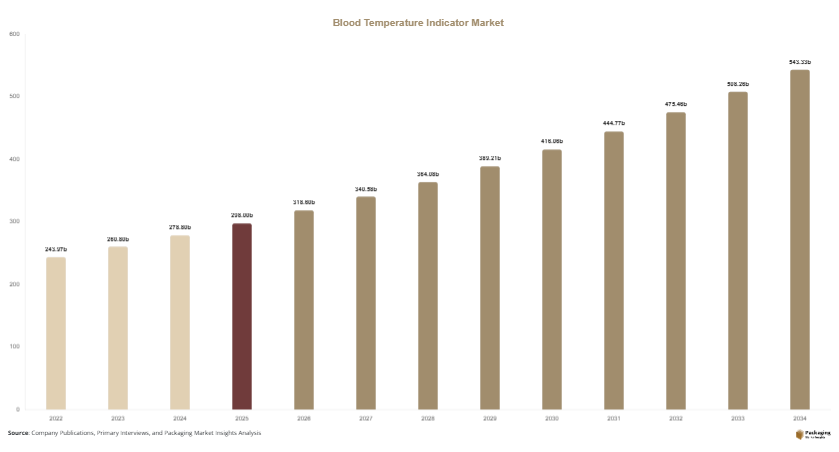
Blood Temperature Indicator market size is projected at USD 318.6 million in 2026 and is expected to hit USD 542.8 million by 2034 with a CAGR of 6.9%. The market expansion is supported by increasing investments in blood storage infrastructure, rising demand for temperature-sensitive blood transportation, and stronger compliance with healthcare quality regulations. The report provides detailed quantitative assessment across product categories, application areas, competitive benchmarking, pricing analysis, technological developments, and regional performance to support strategic decision-making across the Blood Temperature Indicator Market.
Blood temperature indicators are specialized monitoring devices designed to verify that blood and blood components remain within prescribed storage and transportation temperatures, generally between 2°C and 6°C for red blood cells. More than 130 million blood units are collected globally every year, while over 95% of blood banks utilize temperature-monitoring solutions during storage and logistics. Hospitals account for nearly 58% of product utilization, followed by blood banks with approximately 27%, reflecting growing regulatory compliance and patient safety requirements across the Blood Temperature Indicator Market.
Explore more data points, trends and opportunities Download Free Sample Report
Blood Temperature Indicator Market Trends
Increasing Adoption of Digital Temperature Monitoring Technologies
Healthcare providers are rapidly replacing conventional visual indicators with digital and electronic monitoring solutions capable of recording continuous temperature history. Digital products represented nearly 46% of new installations during 2025, while wireless monitoring adoption increased by approximately 19% year-over-year. More than 28 million blood bags are now monitored using digital temperature indicators annually, improving traceability and inventory management across the Blood Temperature Indicator Market.
The integration of RFID, Bluetooth connectivity, cloud-based monitoring, and automated alert systems continues to improve operational efficiency. Approximately 61% of newly established blood storage facilities now incorporate smart monitoring platforms, reducing blood wastage by nearly 18% and enhancing compliance with international quality standards. Growing investments in digital healthcare infrastructure continue strengthening the Blood Temperature Indicator Market.
Expansion of Blood Collection and Cold Chain Infrastructure
Governments and healthcare organizations continue expanding blood donation networks and refrigerated logistics systems. Global cold-chain healthcare investments exceeded USD 20 billion, while refrigerated medical transport capacity increased by nearly 11% during the past two years. More than 450,000 healthcare facilities worldwide require routine blood temperature verification equipment.
The growing incidence of trauma cases, surgical procedures, cancer therapies, and chronic diseases continues increasing blood transfusion demand. Blood utilization has expanded by approximately 7% in developing healthcare systems, while blood bank modernization projects have accelerated across Asia-Pacific, Latin America, and the Middle East. These investments continue supporting long-term Blood Temperature Indicator Market growth.
Blood Temperature Indicator Market Drivers
Growing Blood Transfusion Procedures and Regulatory Compliance
More than 118 million blood donations occur annually worldwide, with transfusion procedures increasing by approximately 5% every year. Regulatory authorities require continuous temperature validation during storage and transportation, encouraging healthcare providers to replace outdated monitoring systems. Nearly 82% of accredited blood banks now employ validated temperature indicators, while compliance audits have increased by 21%, strengthening the Blood Temperature Indicator Market.
Blood Temperature Indicator Market Restraints
High Cost of Advanced Monitoring Systems
Although digital monitoring technologies provide superior accuracy, installation and maintenance costs remain relatively high for smaller healthcare facilities. Electronic monitoring systems may cost 35–60% more than conventional disposable indicators, while calibration expenses increase operational costs by nearly 12% annually. Budget limitations across developing healthcare systems continue restricting adoption, limiting Blood Temperature Indicator Market expansion.
Blood Temperature Indicator Market Opportunities
Expansion of Healthcare Infrastructure in Emerging Economies
Healthcare expenditure across emerging economies continues increasing above 8% annually, while investments in blood banking infrastructure have expanded by nearly 15%. More than 3,000 new diagnostic centers and blood storage facilities are expected to become operational during the forecast period. Rising government initiatives to improve blood safety create substantial opportunities for manufacturers operating within the Blood Temperature Indicator Market.
Challenges in Blood Temperature Indicator Market
Maintaining Accuracy Throughout Complex Distribution Networks
Long-distance transportation, inconsistent refrigeration, and varying environmental conditions create operational challenges for blood temperature monitoring. Approximately 9% of blood products experience temperature excursions during logistics, while logistics providers report equipment calibration issues in nearly 14% of monitoring systems. Manufacturers continue investing in more durable and accurate technologies to improve Blood Temperature Indicator Market performance.
Report Scope
| Report Metric | Details |
|---|---|
| Market Size in 2025 | USD 298.0 billion |
| Market Size in 2026 | USD 318.6 billion |
| Market Size in 2034 | USD 542.8 billion |
| CAGR | 6.9% (2026-2034) |
| Base Year for Estimation | 2025 |
| Historical Data | 2022-2024 |
| Forecast Period | 2026-2034 |
| Report Coverage | Revenue Forecast, Competitive Landscape, Supply Chain Disruption, Growth Factors, Environment & Regulatory Landscape and Trends |
| Geographies Covered | North America, Europe, APAC, Middle East and Africa, LATAM |
| Countries Covered | U.S., Canada, U.K., Germany, France, Spain, Italy, Russia, Nordic, Benelux, Rest of Europe, China, South Korea, Japan, India, Australia, Singapore, Taiwan, South East Asia, Rest of Asia-Pacific, UAE, Turky, Saudi Arabia, South Africa, Egypt, Nigeria, Rest of MEA, Brazil, Mexico, Argentina, Chile, Colombia, Rest of LATAM |
Explore more data points, trends and opportunities Download Free Sample Report
Blood Temperature Indicator Market Segmentation
The Blood Temperature Indicator Market is segmented according to product type and application. Disposable products account for nearly 49% of total industry revenue, while hospitals contribute approximately 58% of total product consumption due to high transfusion volumes and stringent regulatory compliance.
By Type
Disposable Blood Temperature Indicators
Disposable indicators account for nearly 49% of the market, with annual production exceeding 42 million units. These products provide single-use verification, eliminate contamination risks, offer irreversible color-change technology, and remain widely utilized in blood transportation.
Reusable Blood Temperature Indicators
Reusable products represent approximately 29% of market demand, delivering long operating life exceeding 5 years, improved cost efficiency, electronic calibration capability, and multiple monitoring cycles for centralized healthcare facilities.
Digital Blood Temperature Indicators
Digital indicators contribute roughly 22% of industry revenue and support continuous electronic monitoring, real-time alarms, wireless communication, and temperature accuracy within ±0.5°C, making them increasingly preferred in advanced blood banks.
By Application
Hospitals
Hospitals dominate with nearly 58% market share, utilizing more than 24 million monitoring units annually. Continuous blood storage verification, surgical support, emergency transfusion services, and regulatory compliance remain primary demand drivers.
Diagnostic Laboratories
Diagnostic laboratories account for approximately 17% of market demand, supporting blood sample integrity, laboratory testing accuracy, refrigerated specimen storage, and quality assurance across high-volume testing environments.
Blood Banks
Blood banks contribute nearly 25% of industry consumption, processing millions of donated blood units each year. Temperature indicators improve inventory management, transportation validation, storage compliance, and product traceability throughout the blood supply chain.
Blood Temperature Indicator Market Segmentations
Product Type
- Disposable Blood Temperature Indicators
- Reusable Blood Temperature Indicators
- Digital Blood Temperature Indicators
Application
- Hospitals
- Diagnostic Laboratories
- Blood Banks
Distribution Channel
- Direct Sales
- Medical Device Distributors
- Online Sales
- Hospital Procurement Contracts
- Specialty Healthcare Suppliers
Blood Temperature Indicator Regional Outlook
North America
North America accounts for approximately 38% of global revenue, supported by more than 2,800 licensed blood centers and extensive healthcare infrastructure. The United States contributes nearly 82% of regional demand, while Canada continues expanding digital blood monitoring adoption.
Europe
Europe represents nearly 29% of market revenue. Germany, France, the United Kingdom, Italy, and Spain collectively account for over 73% of regional consumption, supported by advanced blood transfusion services and strict medical device regulations.
Asia-Pacific
Asia-Pacific contributes approximately 24% of global demand and records the fastest expansion. China, Japan, India, South Korea, and Australia continue investing in blood bank modernization, with blood collection volumes increasing by approximately 8% annually.
Latin America
Latin America represents around 5% of the market. Brazil and Mexico account for more than 64% of regional demand, supported by improving healthcare access and expanding blood donation programs.
Middle East & Africa
The Middle East & Africa contribute approximately 4% of industry revenue. Saudi Arabia, the UAE, and South Africa continue investing in hospital expansion and national blood safety initiatives, improving adoption of temperature monitoring technologies.
Top players in Blood Temperature Indicator Market
- 3M Company
- Temptime Corporation
- DeltaTrak Inc.
- SpotSee
- ELPRO-BUCHS AG
- Berlinger & Co. AG
- Thermo Fisher Scientific Inc.
- Dickson Company
- Control Company
- Testo SE & Co. KGaA
- Sensitech Inc.
- LogTag Recorders Ltd.
3M Company
-
Estimated market presence of approximately 15% supported by extensive healthcare monitoring solutions and global distribution capabilities.
-
Strong portfolio of temperature monitoring technologies, broad hospital customer base, continuous product innovation, and established regulatory compliance position the company among the leading participants in the global market.
Temptime Corporation
-
Estimated market share of approximately 12%, with specialization in irreversible temperature indicators for blood products and vaccines.
-
The company focuses on blood safety applications, high manufacturing quality, global healthcare partnerships, and continuous innovation in temperature-sensitive monitoring solutions, strengthening its competitive positioning.