Agriculture Chemical Packaging Market Size and Growth
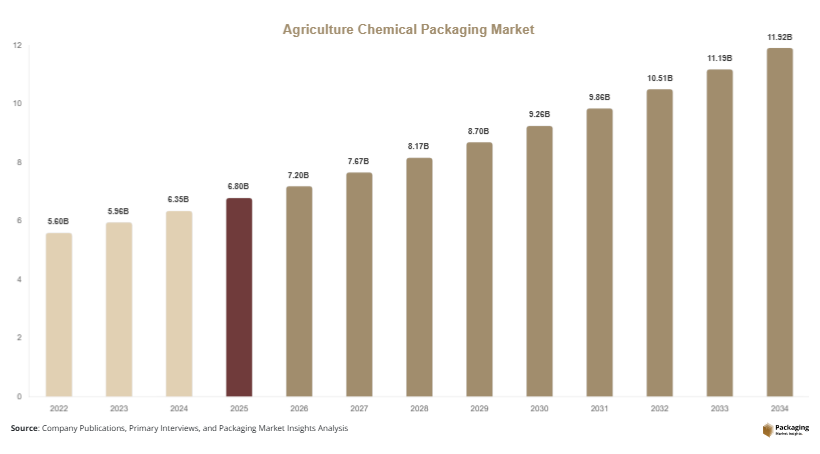
The global agriculture chemical packaging market size was valued at approximately USD 6.8 billion in 2025 and is projected to reach USD 7.2 billion in 2026. By 2034, the market is expected to expand to nearly USD 11.9 billion, registering a CAGR of 6.5% during 2025–2034. The agriculture chemical packaging market is witnessing stable growth due to increasing demand for safe storage and transportation solutions for pesticides, fertilizers, herbicides, fungicides, and other agrochemical products. Packaging plays a critical role in preserving chemical stability, preventing leakage, maintaining regulatory compliance, and ensuring user safety throughout the agricultural supply chain.
The growth of the agriculture chemical packaging market is being driven by several important factors. One of the major growth drivers is the increasing use of crop protection chemicals to improve agricultural productivity and food security. Rising global population levels are creating higher demand for agricultural output, encouraging farmers to adopt advanced agrochemicals that require durable and contamination-resistant packaging solutions. Another key factor is the growing focus on safe handling and transportation of hazardous chemicals. Governments and regulatory agencies across various countries are implementing strict labeling, storage, and packaging regulations for agrochemicals, driving demand for high-performance packaging products.
Key Highlights
- Asia Pacific dominated the market with a 41.3% share in 2025.
- Latin America is projected to grow at the fastest CAGR of 6.9%.
- Bottles and containers led the packaging type segment with a 36.8% share.
- Plastic materials dominated with a 58.7% share.
- Pesticide applications led the segment with 39.5% share.
- The US remained the dominant country with a market size of USD 1.5 billion in 2025 and USD 1.6 billion in 2026.
Explore more data points, trends and opportunities Download Free Sample Report
Market Trends
Rising Adoption of Sustainable and Recyclable Packaging
Sustainability has become an important trend in the agriculture chemical packaging market as manufacturers and agricultural companies aim to reduce environmental impact. Packaging producers are increasingly introducing recyclable containers, reusable drums, and biodegradable flexible packaging solutions for agrochemical products. Governments are implementing stricter environmental policies regarding plastic waste management, encouraging companies to adopt eco-friendly packaging alternatives. Agricultural chemical manufacturers are also focusing on reducing packaging weight to lower transportation costs and carbon emissions. This trend is particularly visible in developed markets where agricultural producers are under pressure to comply with sustainability standards. The transition toward environmentally responsible packaging is expected to support long-term market growth and product innovation.
Growth of Smart Labeling and Tamper-Evident Packaging
The use of smart labeling technologies and tamper-evident packaging systems is increasing across the agriculture chemical packaging market. Packaging manufacturers are integrating QR codes, RFID tracking systems, and digital authentication labels to improve traceability and product safety. These technologies help distributors and farmers verify product authenticity and reduce the risk of counterfeit agrochemicals entering the market. Tamper-evident closures and leak-proof sealing systems are also gaining importance because they improve transportation safety and reduce contamination risks. In addition, digital labeling solutions provide farmers with detailed product information, dosage instructions, and safety guidelines. The adoption of smart packaging technologies is expected to increase as agricultural supply chains become more technology-driven and compliance-focused.
Market Drivers
Increasing Demand for Crop Protection Chemicals
The growing use of pesticides, herbicides, fungicides, and fertilizers is a major driver of the agriculture chemical packaging market. Rising global food demand and declining arable land availability are encouraging farmers to improve crop productivity through advanced agricultural chemicals. These products require durable and secure packaging solutions to maintain chemical stability and prevent leakage during transportation and storage. Commercial farming operations are increasingly using bulk chemical packaging systems to support large-scale agricultural activities. In addition, regulatory standards related to hazardous chemical handling are encouraging manufacturers to develop high-quality packaging with improved barrier properties. The continuous expansion of modern farming practices is expected to sustain demand for agriculture chemical packaging products throughout the forecast period.
Expansion of Agricultural Exports and Global Trade
International agricultural trade activities are significantly contributing to the growth of the agriculture chemical packaging market. Agrochemical manufacturers are exporting products across different regions, creating demand for robust packaging formats capable of withstanding long-distance transportation and varying climatic conditions. Packaging solutions such as HDPE containers, multilayer pouches, and industrial drums help protect chemical products from moisture, contamination, and physical damage during shipping. Developing economies are also increasing investments in agricultural exports, leading to higher consumption of crop protection products. Furthermore, growing cross-border distribution networks are encouraging packaging companies to introduce standardized and regulation-compliant packaging solutions suitable for international trade operations.
Market Restraint
Stringent Environmental Regulations on Plastic Packaging Waste
One of the major restraints affecting the agriculture chemical packaging market is the increasing enforcement of environmental regulations related to plastic packaging waste. Many agrochemical packaging products rely heavily on plastic materials such as HDPE and PET due to their durability and chemical resistance. However, governments and environmental organizations are imposing stricter restrictions on single-use plastics and non-recyclable packaging materials. Compliance with these regulations can increase production costs for packaging manufacturers because they must invest in sustainable materials, recycling systems, and alternative packaging technologies. Smaller companies may face challenges adapting to these changes due to limited financial resources and technical expertise. For example, agricultural packaging producers in several European countries are required to meet extended producer responsibility standards and recycling targets, increasing operational complexity. In addition, improper disposal of chemical containers can create environmental contamination risks, negatively affecting public perception and regulatory acceptance of conventional plastic packaging solutions in the agricultural sector.
Market Opportunities
Development of Bio-Based and Eco-Friendly Packaging
The growing emphasis on environmental sustainability is creating significant opportunities for bio-based and eco-friendly packaging solutions in the agriculture chemical packaging market. Manufacturers are investing in biodegradable polymers, recyclable materials, and renewable fiber-based packaging to reduce plastic waste and improve environmental compliance. Agricultural chemical companies are also seeking sustainable packaging options to strengthen brand reputation and meet evolving customer expectations. Bio-based packaging materials can help reduce carbon emissions while supporting circular economy initiatives. Technological advancements in biodegradable barrier coatings and compostable packaging structures are further improving the performance of sustainable agrochemical packaging products. This opportunity is expected to support innovation and long-term market expansion.
Expansion of Precision Farming and Commercial Agriculture
The increasing adoption of precision farming and large-scale commercial agriculture operations is generating new growth opportunities for the agriculture chemical packaging market. Modern farming systems require efficient storage, transportation, and dispensing solutions for fertilizers and crop protection chemicals. Packaging manufacturers are developing bulk containers, intermediate bulk containers, and easy-dispensing pouch systems to improve operational efficiency for commercial farms. Precision farming technologies also require accurate labeling and dosage information, encouraging demand for advanced packaging with digital tracking features. Emerging economies are investing heavily in agricultural modernization programs, which is expected to increase demand for innovative agrochemical packaging solutions over the forecast period.
Report Scope
| Report Metric | Details |
|---|---|
| Market Size in 2025 | USD 6.8 Billion |
| Market Size in 2026 | USD 7.2 Billion |
| Market Size in 2034 | USD 11.9 Billion |
| CAGR | 6.5% (2026-2034) |
| Base Year for Estimation | 2025 |
| Historical Data | 2022-2024 |
| Forecast Period | 2026-2034 |
| Report Coverage | Revenue Forecast, Competitive Landscape, Supply Chain Disruption, Growth Factors, Environment & Regulatory Landscape and Trends |
| Geographies Covered | North America, Europe, APAC, Middle East and Africa, LATAM |
| Countries Covered | U.S., Canada, U.K., Germany, France, Spain, Italy, Russia, Nordic, Benelux, Rest of Europe, China, South Korea, Japan, India, Australia, Singapore, Taiwan, South East Asia, Rest of Asia-Pacific, UAE, Turky, Saudi Arabia, South Africa, Egypt, Nigeria, Rest of MEA, Brazil, Mexico, Argentina, Chile, Colombia, Rest of LATAM |
Explore more data points, trends and opportunities Download Free Sample Report
Segmental Analysis
By Packaging Type
Bottles and containers dominated the agriculture chemical packaging market in 2024, accounting for approximately 36.8% of total market revenue. These packaging formats are widely used for pesticides, herbicides, and liquid fertilizers because they provide strong chemical resistance and secure storage performance. High-density polyethylene containers are particularly preferred due to their durability, lightweight structure, and leak-resistant properties. Manufacturers are increasingly introducing tamper-evident caps and ergonomic dispensing systems to improve user safety and convenience. Bottles and containers are also suitable for retail distribution because they support detailed labeling and branding requirements. The expansion of commercial farming and agricultural retail networks continues to support strong demand for rigid agrochemical packaging products globally.
Flexible pouches are projected to be the fastest-growing subsegment, expanding at a CAGR of 7.2% during the forecast period. These packaging formats offer advantages such as lower material consumption, reduced transportation costs, and improved storage efficiency. Flexible pouches are increasingly used for powdered fertilizers, seed treatment chemicals, and specialty agrochemical products. Manufacturers are developing multilayer barrier structures that improve moisture resistance and product stability. The growing emphasis on lightweight and sustainable packaging solutions is also encouraging adoption of flexible pouches across agricultural supply chains. In addition, easy-pour spouts and resealable features are improving product handling convenience for farmers and distributors.
By Material
Plastic materials held the dominant share of the agriculture chemical packaging market in 2024, accounting for nearly 58.7% of total revenue. Plastic packaging materials such as HDPE, PET, and polypropylene are widely used because they provide excellent chemical resistance, durability, and lightweight performance. These materials help protect agrochemical products from contamination, leakage, and environmental exposure during storage and transportation. Plastic containers are also cost-effective and compatible with various packaging formats including bottles, drums, and pouches. Manufacturers continue to invest in recyclable plastic technologies and improved barrier properties to meet sustainability and safety requirements across the agricultural sector.
Biodegradable materials are expected to witness the fastest growth, registering a CAGR of 7.4% through 2034. Increasing environmental concerns and stricter plastic waste regulations are encouraging manufacturers to adopt sustainable material alternatives. Bio-based polymers and compostable packaging structures are gaining popularity due to their lower environmental impact and improved regulatory acceptance. Agricultural producers are increasingly seeking eco-friendly packaging solutions to strengthen sustainability initiatives and improve corporate environmental performance. Technological advancements in biodegradable barrier coatings and renewable material processing are also enhancing the durability and chemical compatibility of sustainable packaging products for agrochemical applications.
By Application
Pesticides dominated the agriculture chemical packaging market in 2024 with a revenue share of approximately 39.5%. Pesticides require secure and contamination-resistant packaging solutions because they contain hazardous chemical compounds that must be handled safely during transportation and storage. Packaging manufacturers are developing leak-proof containers, child-resistant closures, and tamper-evident systems to improve product safety and regulatory compliance. Rising global demand for crop protection chemicals and increasing agricultural productivity requirements are supporting strong growth in pesticide packaging demand. Bulk pesticide packaging formats are also becoming increasingly important for commercial farming operations and agricultural distributors.
Bio-based agrochemicals are anticipated to grow at the fastest CAGR of 7.1% during the forecast period. Growing environmental awareness and regulatory restrictions on synthetic chemicals are encouraging farmers to adopt biological crop protection products and organic farming inputs. These products require specialized packaging solutions that maintain biological stability and protect against environmental contamination. Packaging companies are developing sustainable and moisture-resistant packaging materials specifically designed for bio-based agricultural chemicals. Increasing government support for sustainable agriculture and organic farming practices is expected to further accelerate demand for innovative packaging solutions within this rapidly growing application segment.
Agriculture Chemical Packaging Market Segmentations
By Packaging Type
- Bottles & Containers
- Flexible Pouches
- Drums
- Intermediate Bulk Containers
By Material
- Plastic
- Metal
- Paperboard
- Biodegradable Materials
By Application
- Pesticides
- Fertilizers
- Herbicides
- Fungicides
- Bio-Based Agrochemicals
By Distribution Channel
- Direct Industrial Supply
- Agricultural Cooperatives
- Online Agrochemical Suppliers
- Retail Agricultural Stores
Regional Analysis
North America
North America accounted for approximately 27.8% of the global agriculture chemical packaging market share in 2025 and is expected to grow at a CAGR of 5.9% during the forecast period. The region benefits from large-scale commercial farming activities and advanced agricultural infrastructure. High adoption of crop protection chemicals and strict regulations regarding hazardous chemical transportation are supporting demand for durable packaging solutions. Packaging manufacturers are also investing in recyclable materials and smart labeling technologies to meet sustainability and compliance requirements.
The United States dominates the North American market due to its extensive agricultural production and agrochemical manufacturing industries. One unique growth factor is the increasing adoption of precision agriculture technologies that require specialized packaging systems with advanced labeling and dispensing features. The expansion of sustainable farming practices is also encouraging demand for recyclable and reusable agrochemical packaging solutions across the country.
Europe
Europe held around 22.4% of the agriculture chemical packaging market share in 2025 and is projected to grow at a CAGR of 5.7% through 2034. The market is driven by stringent environmental regulations and increasing demand for sustainable agricultural packaging solutions. European agricultural producers are increasingly adopting recyclable and biodegradable packaging formats to reduce environmental impact. The region also benefits from strong investments in agrochemical research and advanced farming technologies.
Germany remains the dominant country in the European market due to its strong chemical manufacturing sector and agricultural exports. A unique growth factor is the growing adoption of eco-friendly packaging regulations that encourage the use of recyclable agrochemical containers. German manufacturers are also focusing on advanced barrier packaging technologies that improve chemical stability and transportation safety for agricultural products.
Asia Pacific
Asia Pacific dominated the agriculture chemical packaging market with a 41.3% share in 2025 and is expected to grow at a CAGR of 7.2% during the forecast period. Rising food demand, increasing agricultural production, and rapid adoption of crop protection chemicals are major growth drivers in the region. Expanding farming activities and government support for agricultural modernization are also contributing to market expansion. Packaging companies are increasing production capacities to meet rising regional demand.
China is the leading country in the Asia Pacific market due to its extensive agricultural industry and growing agrochemical production capacity. One unique growth factor is the rapid expansion of commercial farming operations that require bulk agrochemical packaging solutions. Increasing agricultural exports and improvements in rural distribution networks are also supporting demand for advanced chemical packaging products throughout the country.
Middle East & Africa
The Middle East & Africa region accounted for approximately 4.9% of the global market share in 2025 and is projected to grow at a CAGR of 6.1% over the forecast period. The region is experiencing rising demand for agrochemicals due to increasing food security concerns and agricultural development projects. Governments are investing in irrigation systems and modern farming techniques, supporting demand for chemical packaging products. Agricultural imports are also contributing to market growth.
Saudi Arabia dominates the regional market because of its investments in controlled-environment agriculture and food production initiatives. One unique growth factor is the increasing use of advanced irrigation farming methods that require specialized fertilizers and crop protection chemicals. This trend is encouraging higher adoption of durable and leak-resistant agrochemical packaging solutions across commercial farming operations.
Latin America
Latin America represented nearly 3.6% of the agriculture chemical packaging market share in 2025 and is projected to grow at the fastest CAGR of 6.9% during the forecast period. The region benefits from strong agricultural exports and increasing cultivation of crops such as soybeans, coffee, and sugarcane. Rising use of fertilizers and pesticides is creating higher demand for protective packaging formats. Investments in agricultural infrastructure are also supporting market expansion.
Brazil leads the Latin American market because of its large agricultural production base and strong agrochemical consumption levels. One unique growth factor is the rapid expansion of export-oriented farming activities that require high-performance packaging for long-distance transportation. Packaging manufacturers are also developing moisture-resistant and UV-protective packaging solutions to support tropical agricultural conditions.
Competitive Landscape
The agriculture chemical packaging market is moderately competitive, with major global and regional companies focusing on sustainability, product safety, and packaging innovation. Leading manufacturers are investing in recyclable materials, advanced barrier technologies, and tamper-evident packaging systems to strengthen market presence. Strategic collaborations with agrochemical companies and expansion of manufacturing capacities are also common competitive strategies across the industry.
Berry Global Inc. remains one of the leading companies in the market due to its broad portfolio of industrial and agricultural packaging products. In 2024, the company introduced a new range of recyclable HDPE containers designed specifically for agrochemical transportation and storage applications. Other key players include Greif Inc., Mauser Packaging Solutions, Schütz GmbH & Co. KGaA, and Amcor plc. These companies are increasingly focusing on lightweight packaging, sustainable material innovations, and smart labeling technologies to meet changing regulatory and customer requirements.
Key Players List
- Berry Global Inc.
- Greif Inc.
- Mauser Packaging Solutions
- Schütz GmbH & Co. KGaA
- Amcor plc
- Sonoco Products Company
- Mondi Group
- DS Smith Plc
- LC Packaging International BV
- RPC Group Plc
- Time Technoplast Ltd.
- Balmer Lawrie & Co. Ltd.
- Nampak Ltd.
- UFlex Limited
- Plastipak Holdings, Inc.