Market Overview
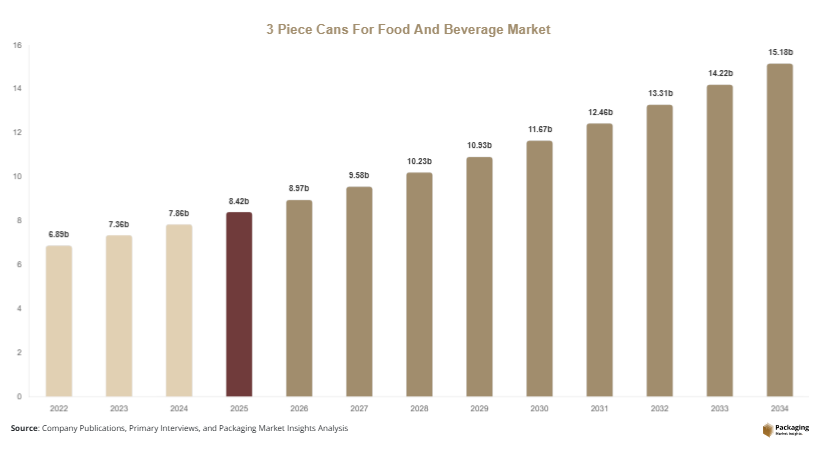
The 3 Piece Cans For Food And Beverage Market is witnessing steady expansion driven by increasing demand for durable, cost-efficient, and sustainable metal packaging solutions across global food and beverage industries. In 2025, the global market size is estimated at USD 8.42 billion, and it is projected to reach USD 8.97 billion in 2026. By 2034, the market is forecasted to attain USD 15.36 billion, registering a CAGR of 6.8% during the forecast period (2025–2034). This growth trajectory reflects rising consumption of canned foods, beverages, and ready-to-eat products, along with advancements in can manufacturing technologies.
Key growth factors include increasing urbanization and changing dietary patterns, which are accelerating demand for packaged food products with longer shelf life. Additionally, the rising focus on recyclable and circular packaging materials is supporting the adoption of 3 piece metal cans. Expansion of processed food industries in emerging economies and improvements in metal coating technologies are also strengthening market demand.
Key Highlights:
- North America dominated the 3 Piece Cans For Food And Beverage Market with the largest share of 38.25% in 2025.
- The Asia Pacific is expected to be the fastest-growing region in the 3 Piece Cans For Food And Beverage Market during the forecast period at a CAGR of 8.12%.
- Based on material type, the tinplate steel segment dominated the market with a share of 46.40% in 2025.
- Based on application, the food packaging segment dominated the market with a share of 52.18% in 2025.
- Based on end-use, the beverages segment dominated the market with a share of 44.73% in 2025.
- Based on distribution channel, direct sales dominated the market with a share of 57.10% in 2025.
- The US 3 Piece Cans For Food And Beverage Market size was valued at USD 2.84 billion in 2025 and is projected to reach USD 3.12 billion in 2026.
Explore more data points, trends and opportunities Download Free Sample Report
Market Trends
Shift Toward Sustainable and Recyclable Metal Packaging
One of the most prominent trends in the 3 Piece Cans For Food And Beverage Market is the growing emphasis on sustainability and recyclability. Manufacturers are increasingly adopting eco-friendly materials such as tin-free steel coatings and low-carbon aluminum alloys to reduce environmental impact. Regulatory bodies across Europe and North America are tightening packaging waste regulations, which is pushing companies to adopt circular economy practices. Food and beverage brands are also responding to consumer demand for sustainable packaging, leading to higher adoption of recyclable 3 piece cans. Additionally, innovations in coating technologies are improving corrosion resistance without compromising recyclability, making these cans more suitable for acidic food products and carbonated beverages. This trend is expected to reshape production strategies and supply chain investments over the forecast period.
Automation and Digitalization in Can Manufacturing
Another key trend shaping the market is the integration of automation, robotics, and digital monitoring systems in can manufacturing facilities. Producers are adopting smart production lines equipped with AI-based defect detection and predictive maintenance systems. This helps reduce production downtime and improve quality consistency in 3 piece cans used for food and beverage packaging. The shift toward Industry 4.0 manufacturing practices is also enhancing production efficiency and reducing material wastage. Furthermore, digital traceability systems are being introduced to track raw material sourcing and ensure compliance with food safety standards. This technological transformation is particularly strong in developed markets where manufacturers aim to optimize cost structures and improve operational scalability.
Market Drivers
Rising Demand for Processed and Packaged Foods
The increasing global consumption of processed and packaged food products is a major driver of the 3 Piece Cans For Food And Beverage Market. Urbanization, busy lifestyles, and changing dietary habits are leading consumers to prefer ready-to-eat meals, canned vegetables, soups, seafood, and beverages. These products require durable and long shelf-life packaging solutions, which makes 3 piece cans highly suitable. Additionally, the food industry is expanding its distribution networks across supermarkets, convenience stores, and online retail platforms, further boosting demand for metal cans. Food manufacturers prefer 3 piece cans due to their ability to preserve flavor, nutritional value, and product integrity over long durations.
Growth in Beverage Industry and Carbonated Drinks Consumption
The expanding global beverage industry is another significant growth driver. Carbonated soft drinks, beer, energy drinks, and ready-to-drink beverages rely heavily on 3 piece cans due to their strength and pressure resistance. Increasing disposable incomes and changing lifestyle patterns are driving beverage consumption, particularly in emerging economies. Beverage brands are also shifting toward premium canned packaging formats for branding and convenience. Additionally, the lightweight nature and stackability of 3 piece cans support efficient transportation and logistics, reducing overall supply chain costs. These advantages are encouraging beverage manufacturers to expand production volumes using metal can packaging solutions.
Market Restraint
Volatility in Raw Material Prices and Supply Chain Challenges
A key restraint affecting the 3 Piece Cans For Food And Beverage Market is the volatility in raw material prices, particularly steel and aluminum. Fluctuations in global metal prices directly impact manufacturing costs, making it difficult for producers to maintain stable pricing strategies. In addition, supply chain disruptions caused by geopolitical tensions, trade restrictions, and transportation bottlenecks can affect the availability of raw materials. This creates uncertainty for manufacturers and increases operational risks. Smaller packaging companies are especially vulnerable, as they have limited capacity to absorb cost fluctuations compared to large multinational players. Moreover, energy-intensive production processes further add to cost pressures, particularly in regions with high electricity and fuel prices. These challenges can slow down investment in capacity expansion and limit profitability margins across the industry.
Market Opportunities
Expansion in Emerging Economies
Emerging economies in Asia Pacific, Latin America, and parts of Africa present significant growth opportunities for the 3 Piece Cans For Food And Beverage Market. Rapid urbanization, increasing population, and rising middle-class income levels are driving demand for packaged food and beverages. Countries such as India, Vietnam, Indonesia, and Brazil are witnessing strong growth in processed food consumption, creating favorable conditions for metal packaging manufacturers. Additionally, government initiatives supporting food preservation and export-oriented food industries are further strengthening market potential. Local manufacturers are investing in modern can production facilities to meet rising demand and reduce dependency on imports. This regional expansion is expected to significantly contribute to global market growth.
Innovation in Lightweight and High-Barrier Coatings
Technological advancements in lightweight can design and high-barrier coating materials are creating new opportunities. Manufacturers are focusing on reducing material usage while maintaining structural strength and product safety. Innovations in polymer coatings and nano-layer technologies are improving resistance to corrosion, oxygen, and moisture. This allows 3 piece cans to be used for a wider range of food and beverage applications, including acidic and high-carbonation products. These innovations also help reduce shipping costs and carbon emissions, aligning with sustainability goals. Companies investing in advanced material science are expected to gain competitive advantages in the global market.
Report Scope
| Report Metric | Details |
|---|---|
| Market Size in 2025 | USD 8.42 billion |
| Market Size in 2026 | USD 8.97 billion |
| Market Size in 2034 | USD 15.36 billion |
| CAGR | 6.8% (2026-2034) |
| Base Year for Estimation | 2025 |
| Historical Data | 2022-2024 |
| Forecast Period | 2026-2034 |
| Report Coverage | Revenue Forecast, Competitive Landscape, Supply Chain Disruption, Growth Factors, Environment & Regulatory Landscape and Trends |
| Geographies Covered | North America, Europe, APAC, Middle East and Africa, LATAM |
| Countries Covered | U.S., Canada, U.K., Germany, France, Spain, Italy, Russia, Nordic, Benelux, Rest of Europe, China, South Korea, Japan, India, Australia, Singapore, Taiwan, South East Asia, Rest of Asia-Pacific, UAE, Turky, Saudi Arabia, South Africa, Egypt, Nigeria, Rest of MEA, Brazil, Mexico, Argentina, Chile, Colombia, Rest of LATAM |
Explore more data points, trends and opportunities Download Free Sample Report
Segmental Analysis
By Material Type
The tinplate steel segment dominated the market with 46.40% share in 2025 due to its durability, cost efficiency, and wide availability. It is extensively used in food and beverage packaging due to strong barrier properties and recyclability.
The aluminum segment is expected to grow at the fastest CAGR of 7.9%, driven by lightweight properties and increasing demand for premium beverage packaging. Its corrosion resistance and branding flexibility are further supporting adoption.
By Application
Food packaging dominated with a 52.18% share in 2025, driven by rising demand for canned vegetables, soups, and ready meals. Long shelf life and preservation benefits are key advantages.
The beverage application segment is expected to grow at a CAGR of 8.3%, driven by increasing consumption of carbonated drinks and energy beverages in developing markets.
By End Use
The beverages segment dominated with a 44.73% share in 2025, supported by strong global consumption of beer and soft drinks packaged in metal cans.
The industrial food processing segment is expected to grow at a CAGR of 7.5%, driven by expansion of large-scale food manufacturing facilities and export-oriented production.
3 Piece Cans For Food And Beverage Market Segmentations
By Material Type
- Tinplate Steel
- Aluminum
- Other Alloys
By Application
- Food Packaging
- Beverage Packaging
- Industrial Food Processing
By End Use
- Household Consumption
- Commercial Food Industry
- Beverage Industry
Regional Analysis
North America
North America accounted for 38.25% market share in 2025, with a projected CAGR of 6.4% through 2034. The region maintains strong demand due to high consumption of packaged foods and beverages. Established retail infrastructure and advanced manufacturing capabilities further support market growth.
The United States dominates the regional market due to its large food processing industry and strong beverage consumption patterns. A key growth factor is the increasing adoption of sustainable metal packaging driven by environmental regulations and corporate sustainability commitments.
Europe
Europe held a market share of 27.60% in 2025, with an expected CAGR of 6.1% during the forecast period. The region benefits from strict recycling regulations and a strong circular economy framework supporting metal packaging demand.
Germany leads the European market due to its advanced packaging industry and strong industrial base. A major growth factor is the widespread adoption of eco-friendly packaging regulations across EU member states.
Asia Pacific
Asia Pacific accounted for 21.45% share in 2025 and is expected to grow at a CAGR of 8.12%, making it the fastest-growing region. Rapid industrialization and population growth are key drivers.
China dominates the regional market due to its massive food processing sector. Rising urban food consumption patterns are significantly boosting demand for canned products.
Middle East & Africa
The Middle East & Africa region held 7.10% share in 2025, with a CAGR of 6.9%. Growth is supported by increasing food imports and expanding retail networks.
Saudi Arabia leads the region, driven by strong demand for packaged food imports and growing hospitality sectors.
Latin America
Latin America accounted for 5.60% share in 2025, with a CAGR of 6.7%. Expanding beverage consumption and processed food industries are driving demand.
Brazil dominates the region due to its strong agricultural processing industry and rising urbanization trends supporting packaged food adoption.
Competitive Landscape
The 3 Piece Cans For Food And Beverage Market is moderately consolidated with the presence of several global and regional manufacturers. Key players include Crown Holdings, Ardagh Group, Ball Corporation, Toyo Seikan Group, and Silgan Holdings. These companies focus on capacity expansion, material innovation, and sustainability-driven packaging solutions.
Crown Holdings remains a leading player due to its extensive global manufacturing network and diversified product portfolio. Recently, the company expanded its European production facility to increase sustainable can output and improve supply chain efficiency. Strategic partnerships and acquisitions are also shaping competitive dynamics across the industry.
Key Players List
- Crown Holdings
- Ardagh Group
- Ball Corporation
- Toyo Seikan Group
- Silgan Holdings
- Can-Pack S.A.
- Orora Packaging
- Mauser Packaging Solutions
- Envases Group
- CPMC Holdings
- Nampak Ltd.
- Allstate Can Corporation
- Jamestrong Packaging
- CCL Container
- Independent Can Company