Yogurt Packaging Market Size
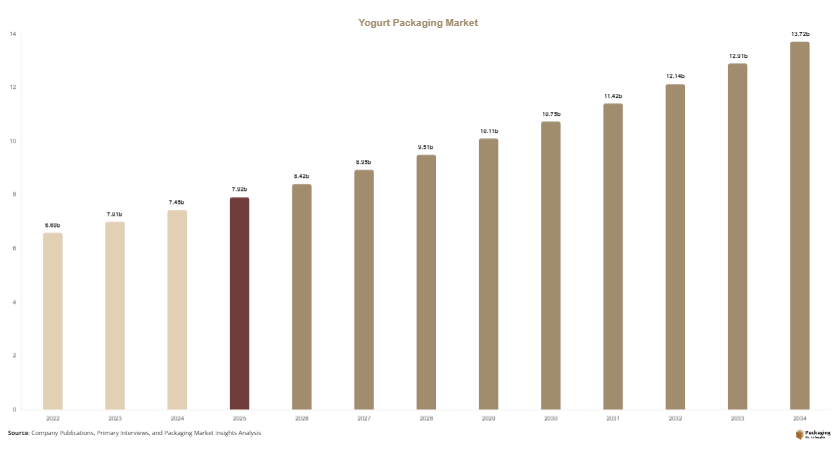
Yogurt Packaging market size is projected at USD 8.42 billion in 2026 and is expected to hit USD 13.71 billion by 2034 with a CAGR of 6.29%. The report provides comprehensive analysis of packaging formats, material innovations, production capacity, consumer preferences, sustainability trends, and competitive strategies. It evaluates market segmentation, regional performance, supply chain developments, and manufacturer positioning to provide detailed insights into the competitive landscape.
The Yogurt Packaging Market includes cups, tubs, bottles, pouches, and specialty containers designed for preserving yogurt quality, freshness, and shelf life. Global production exceeded 92 billion yogurt packaging units in 2025, with cups and tubs accounting for approximately 61% of total demand, bottles contributing 23%, and pouches representing nearly 16%. Dairy yogurt applications dominated with around 72% market contribution, followed by plant-based yogurt at 18% and functional yogurt at 10%, strengthening the Yogurt Packaging Market.
Explore more data points, trends and opportunities Download Free Sample Report
Yogurt Packaging Market Trends
Increasing Shift Toward Sustainable and Convenient Packaging Formats
Yogurt manufacturers are increasingly adopting lightweight, recyclable, and convenient packaging solutions to meet changing consumer preferences. Global yogurt packaging production exceeded 95 billion units annually, while recyclable packaging adoption increased by approximately 36% among dairy product manufacturers. Advanced barrier coatings and lightweight designs have reduced packaging material usage by nearly 18%, supporting the Yogurt Packaging Market.
The demand for portion-controlled and on-the-go yogurt products continues influencing packaging innovation. More than 65% of consumers prefer single-serving yogurt formats, while flexible pouch packaging adoption increased by approximately 22% between 2024 and 2025. Investments exceeding USD 850 million in sustainable dairy packaging technologies are supporting new product developments within the Yogurt Packaging Market.
Yogurt Packaging Market Drivers
Rising Global Consumption of Yogurt Products
Increasing yogurt consumption across developed and emerging economies is driving packaging demand. Global yogurt production exceeded 110 million metric tons annually, while packaged yogurt consumption increased by approximately 7.8% in 2025. More than 74% of dairy manufacturers are expanding packaged yogurt production capacities, creating strong demand for cups, tubs, and bottles within the Yogurt Packaging Market.
Yogurt Packaging Market Restraints
Environmental Concerns Related to Plastic Packaging
Plastic waste concerns and regulatory restrictions on conventional packaging materials are limiting market expansion. Plastic packaging accounts for nearly 68% of yogurt packaging usage, while sustainability compliance costs have increased by approximately 12% for manufacturers. More than 48% of packaging companies are investing in alternative materials, creating cost challenges across the Yogurt Packaging Market.
Yogurt Packaging Market Opportunities
Expansion of Plant-Based and Functional Yogurt Categories
The rapid growth of plant-based and functional yogurt products creates significant opportunities for packaging manufacturers. Plant-based yogurt consumption increased by approximately 15%, while functional yogurt demand expanded by nearly 13% in 2025. Production of specialized yogurt packaging solutions is expected to exceed 120 billion units before 2030, creating new opportunities in the Yogurt Packaging Market.
Challenges in Yogurt Packaging Market
Balancing Sustainability With Product Protection Requirements
Manufacturers face challenges in developing environmentally friendly packaging while maintaining product freshness and protection. More than 59% of companies are investing in recyclable barrier materials, while achieving required oxygen and moisture protection increases production costs by approximately 14%. Maintaining shelf-life performance remains a critical challenge for the Yogurt Packaging Market.
Report Scope
| Report Metric | Details |
|---|---|
| Market Size in 2025 | USD 7.92 billion |
| Market Size in 2026 | USD 8.42 billion |
| Market Size in 2034 | USD 13.71 billion |
| CAGR | 6.29% (2026-2034) |
| Base Year for Estimation | 2025 |
| Historical Data | 2022-2024 |
| Forecast Period | 2026-2034 |
| Report Coverage | Revenue Forecast, Competitive Landscape, Supply Chain Disruption, Growth Factors, Environment & Regulatory Landscape and Trends |
| Geographies Covered | North America, Europe, APAC, Middle East and Africa, LATAM |
| Countries Covered | U.S., Canada, U.K., Germany, France, Spain, Italy, Russia, Nordic, Benelux, Rest of Europe, China, South Korea, Japan, India, Australia, Singapore, Taiwan, South East Asia, Rest of Asia-Pacific, UAE, Turky, Saudi Arabia, South Africa, Egypt, Nigeria, Rest of MEA, Brazil, Mexico, Argentina, Chile, Colombia, Rest of LATAM |
Explore more data points, trends and opportunities Download Free Sample Report
Yogurt Packaging Market Segmentation
The market is segmented by type and application, with cups and tubs dominating approximately 61% of total revenue due to their widespread adoption in dairy products. Dairy yogurt applications account for nearly 72% of demand, supported by high global consumption and retail penetration.
By Type
Cups & Tubs
Cups and tubs account for approximately 61% of global demand, with annual production exceeding 56 billion units. These formats provide excellent stacking efficiency, product visibility, sealing performance, and compatibility with automated filling systems. They are widely used for traditional yogurt, Greek yogurt, and flavored yogurt products.
Bottles
Bottles contribute nearly 23% of market demand with production exceeding 21 billion units annually. These packaging formats provide portability, resealability, and convenience for drinkable yogurt products. Lightweight PET and HDPE bottles are increasingly adopted due to durability and recyclability advantages.
Pouches
Pouches represent approximately 16% of global consumption, with annual production exceeding 14 billion units. Flexible pouches offer reduced material usage, easy transportation, and convenient consumption options, particularly for children’s yogurt products and premium dairy segments.
By Application
Dairy Yogurt
Dairy yogurt dominates the market with approximately 72% share and consumption exceeding 66 billion packaging units annually. Packaging solutions support freshness retention, cold-chain compatibility, and extended shelf life for traditional, Greek, and flavored yogurt products.
Plant-Based Yogurt
Plant-based yogurt contributes around 18% of demand, with production exceeding 16 billion packaging units annually. Growing consumer preference for vegan and lactose-free products is increasing demand for sustainable and premium packaging solutions.
Functional Yogurt
Functional yogurt accounts for approximately 10% of market demand, with more than 9 billion packaging units consumed annually. Packaging requirements include improved barrier properties, premium designs, and protection for probiotic and fortified formulations.
Yogurt Packaging Market Segmentations
By Type
- Cups & Tubs
- Bottles
- Pouches
- Flexible Packaging
By Application
- Dairy Yogurt
- Plant-Based Yogurt
- Functional Yogurt
- Flavored Yogurt
By Material
- Plastic
- Paper & Paperboard
- Glass
- Aluminum & Metal Packaging
Yogurt Packaging Market Regional Outlook
North America
North America accounts for approximately 31% of global demand. The United States contributes nearly 79% of regional consumption due to high yogurt penetration and strong dairy processing infrastructure. Annual production exceeds 28 billion yogurt packaging units, with cups and tubs representing nearly 63% of regional demand.
Europe
Europe represents approximately 34% of the global market. Germany, France, the United Kingdom, and Italy contribute over 72% of regional demand. Sustainable packaging adoption exceeds 61% among major dairy producers, supporting recyclable cups and lightweight container growth.
Asia-Pacific
Asia-Pacific holds approximately 27% of worldwide demand and remains the fastest-growing region. China contributes nearly 41% of regional consumption, followed by India at 23%, Japan at 14%, and South Korea at 8%. Annual regional production exceeds 25 billion packaging units, supported by expanding dairy consumption.
Latin America
Latin America contributes approximately 5% of global demand. Brazil represents nearly 48% of regional consumption, while Mexico contributes around 26%, driven by increasing packaged dairy product adoption.
Middle East & Africa
The Middle East & Africa account for approximately 3% of global demand. Growing urbanization, expanding dairy industries, and increased retail penetration continue supporting yogurt packaging adoption.
Top players in Yogurt Packaging Market
- Amcor plc
- Berry Global Inc.
- Tetra Pak International S.A.
- Huhtamaki Oyj
- Sonoco Products Company
- Constantia Flexibles
- Sealed Air Corporation
- Greif Inc.
- Silgan Holdings Inc.
- Coveris Holdings S.A.
- DS Smith Plc
- Mondi plc
Amcor plc
-
Holds an estimated 14–16% global market share.
-
Maintains a leading position in dairy and food packaging solutions.
-
Provides cups, flexible packaging, and recyclable material solutions for yogurt manufacturers.
-
The company focuses on lightweight packaging, sustainable polymers, and high-barrier technologies to support dairy product freshness and shelf-life requirements. Continuous investments in recyclable packaging innovations strengthen its competitive position across global yogurt packaging applications.
Tetra Pak International S.A.
-
Accounts for approximately 12–14% global market share.
-
Recognized for advanced food and dairy packaging technologies.
-
Provides integrated packaging systems for yogurt and liquid dairy products.
-
The company continues developing sustainable carton-based solutions, efficient filling technologies, and improved material recovery systems to support increasing demand for environmentally responsible yogurt packaging solutions worldwide.