Wooden Pallet And Container Market Size and Growth
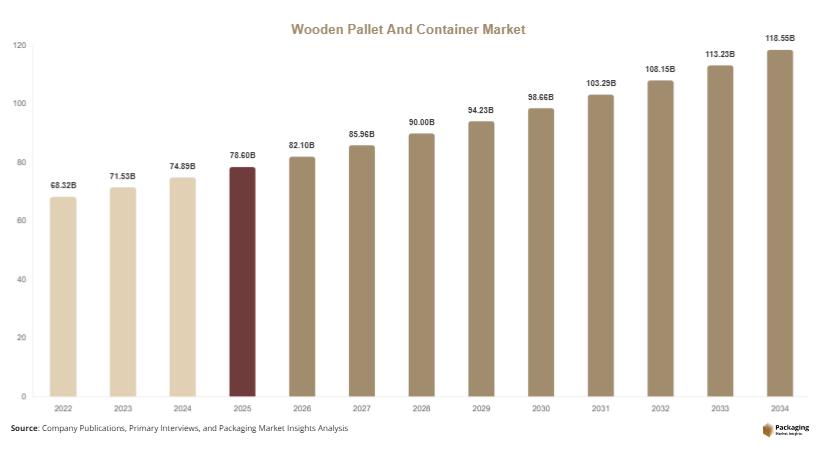
The global wooden pallet and container market size was valued at approximately USD 78.6 billion in 2025 and is projected to reach USD 82.1 billion in 2026. Over the forecast period, the market is expected to grow steadily and reach nearly USD 118.4 billion by 2034, expanding at a CAGR of 4.7% from 2025 to 2034. This growth reflects the increasing demand for reliable material handling solutions in supply chains that are becoming more complex and interconnected. The wooden pallet and container market continues to play a vital role in global logistics, warehousing, and transportation systems due to its durability, cost efficiency, and widespread acceptance across industries.
A major growth factor is the rapid expansion of global trade and e-commerce, which has significantly increased the demand for efficient transportation and storage systems. Wooden pallets and containers are widely used for handling bulk goods due to their strength and compatibility with forklifts and automated systems. Another key factor is the cost advantage of wood compared to alternative materials such as plastic and metal. Wood is readily available, easy to repair, and recyclable, making it an economically viable option for businesses. Additionally, the growing focus on sustainable packaging solutions is supporting the use of wooden pallets, as they are biodegradable and can be sourced from renewable forests.
Key Highlights
- Asia Pacific dominated the market with a 41.3% share in 2025, while Latin America is projected to grow at the fastest CAGR of 5.9%.
- Stringer pallets led the type segment with a 33.7% share, while block pallets are expected to grow at a CAGR of 5.3%.
- Transportation and logistics applications dominated with a 52.8% share, while e-commerce distribution is forecasted to grow at a CAGR of 5.8%.
- Food & beverage end-use led the segment with 38.9% share, while pharmaceutical usage is expected to grow at a CAGR of 5.6%.
- China remained the dominant country with a market size of USD 18.6 billion in 2025 and USD 19.5 billion in 2026.
Explore more data points, trends and opportunities Download Free Sample Report
Market Trends
Increasing Adoption of Sustainable and Recyclable Wooden Packaging
Sustainability is becoming a central theme in the packaging industry, and wooden pallets are gaining attention due to their renewable and biodegradable nature. Companies are increasingly focusing on sourcing wood from certified forests to ensure environmental compliance and reduce carbon footprint. The reuse and recycling of pallets are also becoming more common, as businesses aim to adopt circular economy practices. Repairing and refurbishing used pallets extends their lifecycle, reducing the need for new materials. This trend is particularly strong in regions with strict environmental regulations, where companies are required to minimize waste and promote sustainable practices. As sustainability continues to influence purchasing decisions, the demand for wooden pallets and containers is expected to remain strong.
Integration of Automation and Smart Tracking Systems
The growing use of automation in warehouses and distribution centers is influencing the design and functionality of wooden pallets. Standardized pallet sizes and improved structural designs are being developed to ensure compatibility with automated handling systems. Additionally, the integration of tracking technologies such as RFID tags and barcodes is enhancing supply chain visibility. These features allow companies to monitor the movement of pallets and optimize inventory management. The adoption of smart logistics solutions is improving operational efficiency and reducing losses associated with damaged or misplaced pallets. This trend is expected to drive innovation in pallet design and support market growth.
Market Drivers
Expansion of Global Trade and Logistics Networks
The continuous growth of global trade and logistics networks is a major factor driving the demand for wooden pallets and containers. As international trade volumes increase, there is a growing need for reliable packaging solutions that can handle large quantities of goods. Wooden pallets are widely used in shipping due to their strength and compatibility with various transportation methods. The expansion of e-commerce is also contributing to this trend, as companies require efficient packaging solutions to handle high volumes of orders. The development of logistics infrastructure, including warehouses and distribution centers, is further supporting market growth.
Cost Efficiency and Versatility of Wooden Materials
Wooden pallets offer significant cost advantages compared to alternative materials such as plastic and metal. The availability of raw materials and the relatively low manufacturing costs make wooden pallets an economical choice for businesses. Additionally, wood is easy to repair and recycle, which reduces overall lifecycle costs. The versatility of wooden pallets allows them to be used in a wide range of applications, from transporting heavy industrial goods to storing agricultural products. This adaptability is a key factor driving their widespread adoption across industries.
Market Restraint
Competition from Alternative Materials and Durability Concerns
One of the key challenges facing the wooden pallet and container market is the increasing competition from alternative materials such as plastic and metal. These materials offer advantages such as higher durability, resistance to moisture, and longer lifespan, which can make them more suitable for certain applications. Additionally, wooden pallets are susceptible to damage from moisture, pests, and heavy loads, which can limit their usability in some environments. For example, industries that require strict hygiene standards, such as pharmaceuticals and food processing, may prefer plastic pallets due to their ease of cleaning. These factors can restrict the growth of the wooden pallet market, particularly in regions with advanced industrial requirements.
Market Opportunities
Growth in Emerging Economies and Industrial Expansion
Emerging economies present significant growth opportunities for the wooden pallet and container market. Rapid industrialization and infrastructure development are increasing the demand for efficient material handling solutions. Countries in Asia Pacific, Latin America, and Africa are witnessing growth in manufacturing and logistics sectors, which is driving the need for pallets and containers. The expansion of export-oriented industries is also contributing to market growth, as wooden pallets are widely used for shipping goods internationally. Companies can capitalize on these opportunities by expanding their presence in these regions and investing in local production facilities.
Advancements in Pallet Design and Treatment Technologies
Technological advancements in pallet design and treatment processes are creating new opportunities for market growth. Heat-treated pallets are being developed to meet international shipping standards, ensuring compliance with phytosanitary regulations. Additionally, innovations in pallet design are improving load-bearing capacity and durability. The use of advanced manufacturing techniques is enabling the production of lightweight and high-strength pallets. These developments are enhancing the performance of wooden pallets and expanding their applications across industries.
Report Scope
| Report Metric | Details |
|---|---|
| Market Size in 2025 | USD 78.6 Billion |
| Market Size in 2026 | USD 82.1 Billion |
| Market Size in 2034 | USD 118.4 Billion |
| CAGR | 4.7% (2026-2034) |
| Base Year for Estimation | 2025 |
| Historical Data | 2022-2024 |
| Forecast Period | 2026-2034 |
| Report Coverage | Revenue Forecast, Competitive Landscape, Supply Chain Disruption, Growth Factors, Environment & Regulatory Landscape and Trends |
| Geographies Covered | North America, Europe, APAC, Middle East and Africa, LATAM |
| Countries Covered | U.S., Canada, U.K., Germany, France, Spain, Italy, Russia, Nordic, Benelux, Rest of Europe, China, South Korea, Japan, India, Australia, Singapore, Taiwan, South East Asia, Rest of Asia-Pacific, UAE, Turky, Saudi Arabia, South Africa, Egypt, Nigeria, Rest of MEA, Brazil, Mexico, Argentina, Chile, Colombia, Rest of LATAM |
Explore more data points, trends and opportunities Download Free Sample Report
Segmental Analysis
By Type
Stringer pallets accounted for the largest share in 2024, contributing 33.7% to the overall market. These pallets are widely used due to their simple design and cost efficiency. They are suitable for a wide range of applications, including storage and transportation of goods. The ease of manufacturing and repair makes stringer pallets a preferred choice for many industries.
Block pallets are expected to grow at the fastest CAGR of 5.3%. These pallets offer higher strength and durability compared to stringer pallets, making them suitable for heavy-duty applications. The increasing demand for robust and long-lasting packaging solutions is driving the adoption of block pallets.
By Application
Transportation and logistics applications dominated the market in 2024, accounting for 52.8% of the total share. Wooden pallets are widely used in this segment due to their ability to handle large volumes of goods. They provide stability and support during transportation, reducing the risk of damage.
E-commerce distribution is projected to grow at the fastest CAGR of 5.8%. The rapid growth of online retail is increasing the demand for efficient packaging solutions. Wooden pallets are used to handle bulk shipments and ensure smooth distribution processes.
By End-Use
The food and beverage segment held the largest share in 2024, accounting for 38.9% of the market. The use of wooden pallets in this segment is driven by the need for efficient storage and transportation of food products. They provide durability and support for bulk shipments.
The pharmaceutical sector is expected to grow at the fastest CAGR of 5.6%. The increasing demand for secure and reliable packaging solutions in the pharmaceutical industry is driving the adoption of wooden pallets. These pallets are used to transport medical supplies and ensure product safety.
Wooden Pallet And Container Market Segmentations
By Product Type
- Stringer Pallets
- Block Pallets
- Custom Pallets
By Application
- Transportation and Logistics
- E-commerce Distribution
- Industrial Storage
By End-Use
- Food & Beverage
- Pharmaceuticals
- Automotive
Regional Analysis
North America
North America accounted for approximately 19.6% of the global market share in 2025 and is expected to grow at a CAGR of 4.1% during the forecast period. The region benefits from a well-established logistics infrastructure and high demand for efficient material handling solutions. The presence of large retail and e-commerce companies is driving the adoption of standardized wooden pallets.
The United States dominates the regional market due to its extensive supply chain network. A key growth factor is the increasing adoption of automation in warehouses, which requires standardized pallet designs compatible with automated systems.
Europe
Europe held a market share of 22.8% in 2025 and is projected to grow at a CAGR of 4.3%. The region is characterized by strong environmental regulations and a focus on sustainable packaging solutions. The use of wooden pallets is supported by their recyclability and renewable nature.
Germany is the leading country in the European market, supported by its strong manufacturing and logistics sectors. A unique growth factor is the adoption of circular economy practices, which promote the reuse and recycling of wooden pallets.
Asia Pacific
Asia Pacific dominated the market with a 41.3% share in 2025 and is expected to grow at a CAGR of 5.2%. Rapid industrialization and urbanization are driving demand for pallets and containers in this region. The expansion of e-commerce and manufacturing sectors is also contributing to market growth.
China leads the regional market due to its large industrial base and export activities. A key growth factor is the increasing demand for efficient logistics solutions to support global trade.
Middle East & Africa
The Middle East & Africa region accounted for 7.2% of the market share in 2025 and is expected to grow at a CAGR of 4.6%. The region is witnessing growth in infrastructure and logistics sectors, which is driving demand for pallets and containers.
The United Arab Emirates is the dominant country in the region, supported by its strategic location as a trade hub. A unique growth factor is the development of logistics and transportation infrastructure.
Latin America
Latin America held a market share of 8.1% in 2025 and is projected to grow at the fastest CAGR of 5.9%. The region is experiencing increased demand for material handling solutions due to growth in agriculture and manufacturing sectors.
Brazil dominates the regional market, driven by its strong agricultural industry. A key growth factor is the increasing export of agricultural products, which requires reliable packaging solutions.
Competitive Landscape
The wooden pallet and container market is moderately fragmented, with several global and regional players competing based on pricing, quality, and innovation. Companies are focusing on expanding their production capacities and improving product quality to maintain their market position. Strategic partnerships and acquisitions are also common in this market.
Brambles Limited is recognized as a leading player, known for its extensive pallet pooling services. The company recently expanded its operations in Asia Pacific to meet growing demand from the logistics sector. Other key players are investing in advanced manufacturing technologies and sustainable practices to enhance their competitiveness.
Key Players List
- Brambles Limited
- PalletOne Inc.
- UFP Industries, Inc.
- WestRock Company
- Millwood Inc.
- Kamps Inc.
- PECO Pallet Inc.
- CHEP (Brambles)
- Rehrig Pacific Company
- Loscam International
- Craemer Group
- Schoeller Allibert
- ORBIS Corporation
- CABKA Group
- Litco International Inc.