Wine Packaging Market Size and Growth
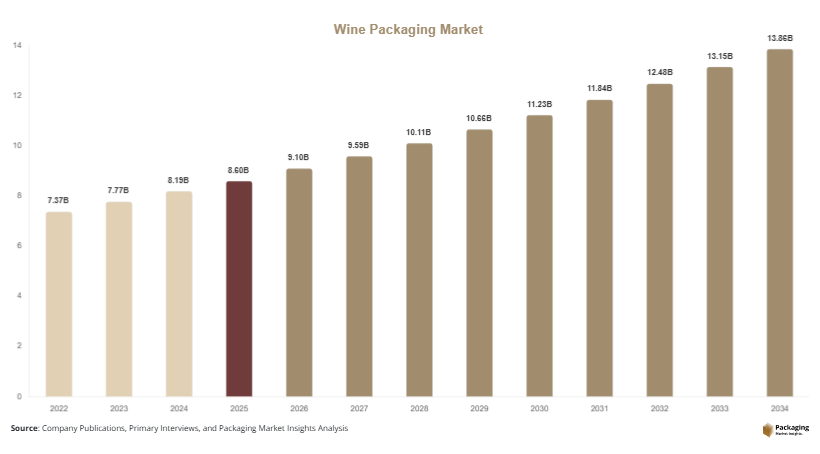
The global wine packaging market size was valued at approximately USD 8.6 billion in 2025 and is estimated to reach USD 9.1 billion in 2026. With continuous advancements in packaging materials and design innovations, the market is projected to reach USD 13.8 billion by 2034, growing at a CAGR of 5.4% during the forecast period (2025–2034). The wine packaging market is witnessing steady expansion driven by evolving consumption patterns, premiumization trends, and increasing demand for sustainable packaging solutions.
The growth of the wine packaging industry is closely linked to the expansion of the global wine industry, particularly in emerging economies where wine consumption is increasing among urban populations. Changing consumer preferences toward premium and craft wines have encouraged wineries to invest in aesthetically appealing and functional packaging formats. Additionally, the rise of e-commerce and direct-to-consumer wine sales has increased the need for durable and lightweight packaging solutions that ensure product safety during transportation.
Key Highlights:
- Asia Pacific dominated the market with a 36.8% share in 2025, while Latin America is projected to grow at the fastest CAGR of 6.1%.
- Glass bottles led the type segment with a 61.5% share, while bag-in-box packaging is expected to grow at a CAGR of 6.4%.
- Glass material dominated with a 64.2% share, while paperboard packaging is forecasted to grow at a CAGR of 6.0%.
- Wineries accounted for the largest end-use share at 58.7%, while online retail packaging is expected to grow at a CAGR of 6.6%.
- France remained the dominant country with a market size of USD 1.3 billion in 2025 and USD 1.4 billion in 2026.
Explore more data points, trends and opportunities Download Free Sample Report
Market Trends
Shift Toward Sustainable and Lightweight Packaging
The transition toward sustainable packaging solutions is one of the most influential trends shaping the wine packaging market. Manufacturers are increasingly adopting lightweight glass bottles, recycled materials, and alternative packaging formats such as bag-in-box and paper bottles. This shift is driven by environmental regulations and consumer awareness regarding carbon emissions and waste reduction.
For instance, several European wineries are adopting lightweight glass bottles that reduce transportation costs and emissions by up to 20%. Paper-based wine bottles are also emerging as a viable alternative, particularly in environmentally conscious markets such as Scandinavia and the United Kingdom. These packaging innovations not only lower environmental impact but also appeal to eco-conscious consumers.
In the future, this trend is expected to accelerate with stricter regulations on single-use plastics and increasing investments in circular economy models. Companies are likely to expand their portfolios with biodegradable and compostable packaging formats, enhancing both sustainability and brand value.
Increasing Adoption of Smart and Interactive Packaging
Smart packaging technologies are gaining traction as wineries seek to enhance consumer engagement and product traceability. Features such as QR codes, augmented reality labels, and NFC-enabled tags are being integrated into wine packaging to provide detailed product information, authenticity verification, and interactive experiences.
For example, premium wine brands are using QR codes on labels that allow consumers to access vineyard information, tasting notes, and food pairing suggestions. This not only improves customer experience but also helps brands build stronger relationships with consumers.
Looking ahead, the integration of blockchain technology with smart packaging is expected to improve supply chain transparency and combat counterfeit products. As digitalization continues to expand, smart packaging will become a key differentiator in the competitive wine market.
Market Drivers
Rising Global Wine Consumption and Premiumization
The increasing consumption of wine globally, particularly in emerging markets, is a major driver for the wine packaging market. Urbanization, changing lifestyles, and rising disposable incomes are encouraging consumers to explore wine as a preferred alcoholic beverage. This trend is especially prominent in Asia Pacific and Latin America.
Premiumization is further boosting demand for high-quality packaging. Consumers are willing to pay more for wines that are presented in visually appealing and premium packaging formats. For instance, luxury wine brands are investing in embossed glass bottles, custom labels, and decorative closures to enhance product appeal.
This shift toward premium products directly impacts packaging demand, as wineries focus on differentiation and brand positioning. As wine consumption continues to grow, the demand for innovative and high-end packaging solutions is expected to increase significantly.
Expansion of E-Commerce and Direct-to-Consumer Channels
The growth of e-commerce and direct-to-consumer wine sales is another key driver for the market. Online platforms have made wine more accessible to consumers, leading to increased demand for packaging that ensures product safety during shipping.
Packaging solutions such as corrugated boxes, molded pulp inserts, and shock-resistant materials are becoming essential for protecting wine bottles during transit. For example, wineries in the United States and Europe are adopting specialized packaging designs that minimize breakage and reduce return rates.
This trend is expected to continue as digital sales channels expand. The need for durable, lightweight, and cost-efficient packaging will drive innovation in materials and design, further supporting market growth.
Market Restraint
High Cost of Sustainable Packaging Materials
One of the primary challenges in the wine packaging market is the high cost associated with sustainable packaging materials. While eco-friendly solutions such as recycled glass, biodegradable plastics, and paper-based bottles offer environmental benefits, they often come at a higher cost compared to conventional materials.
This cost factor can be a significant barrier for small and medium-sized wineries, which may struggle to absorb the additional expenses. For example, transitioning from traditional glass bottles to lightweight or recycled alternatives requires investment in new production processes and supply chain adjustments.
Additionally, limited availability of sustainable raw materials in certain regions can further increase costs. This can impact pricing strategies and reduce profit margins for manufacturers.
Despite these challenges, ongoing technological advancements and economies of scale are expected to gradually reduce costs. However, in the short term, the high cost of sustainable packaging remains a key restraint for market growth.
Market Opportunities
Growth of Alternative Packaging Formats
The increasing adoption of alternative packaging formats presents a significant opportunity for the wine packaging market. Formats such as bag-in-box, pouches, and canned wine are gaining popularity due to their convenience, affordability, and lower environmental impact.
For instance, bag-in-box packaging is widely used for bulk wine consumption and offers extended shelf life after opening. This makes it an attractive option for both consumers and retailers. Similarly, canned wine is gaining traction among younger consumers who prefer portable and single-serve options.
In the future, these alternative formats are expected to expand into premium segments as manufacturers improve design and quality. This will create new revenue streams and broaden the market scope.
Technological Innovations in Packaging Design
Advancements in packaging technology are creating opportunities for differentiation and value addition. Innovations such as advanced barrier coatings, temperature-sensitive labels, and tamper-evident closures are enhancing product safety and quality.
For example, temperature-sensitive labels can indicate whether the wine has been stored under optimal conditions, ensuring product integrity. Such features are particularly valuable in international trade, where wines are exposed to varying climates.
As technology continues to evolve, wineries will have more options to enhance functionality and consumer engagement. This will drive demand for innovative packaging solutions and support market growth in the coming years.
Report Scope
| Report Metric | Details |
|---|---|
| Market Size in 2025 | USD 8.6 Billion |
| Market Size in 2026 | USD 9.1 Billion |
| Market Size in 2034 | USD 13.8 Billion |
| CAGR | 5.4% (2026-2034) |
| Base Year for Estimation | 2025 |
| Historical Data | 2022-2024 |
| Forecast Period | 2026-2034 |
| Report Coverage | Revenue Forecast, Competitive Landscape, Supply Chain Disruption, Growth Factors, Environment & Regulatory Landscape and Trends |
| Geographies Covered | North America, Europe, APAC, Middle East and Africa, LATAM |
| Countries Covered | U.S., Canada, U.K., Germany, France, Spain, Italy, Russia, Nordic, Benelux, Rest of Europe, China, South Korea, Japan, India, Australia, Singapore, Taiwan, South East Asia, Rest of Asia-Pacific, UAE, Turky, Saudi Arabia, South Africa, Egypt, Nigeria, Rest of MEA, Brazil, Mexico, Argentina, Chile, Colombia, Rest of LATAM |
Explore more data points, trends and opportunities Download Free Sample Report
Segmental Analysis
By Type
Glass bottles dominated the market in 2024, accounting for approximately 61.5% of the total share. This dominance is attributed to their ability to preserve wine quality, prevent oxidation, and maintain flavor integrity. Glass bottles are also preferred for premium wines due to their aesthetic appeal and traditional association with quality. For example, high-end wineries often use customized glass bottles with unique shapes and embossing to enhance brand identity. Additionally, glass is fully recyclable, making it a preferred choice in regions with strong sustainability initiatives.
Bag-in-box packaging is the fastest-growing segment, with a projected CAGR of 6.4%. This growth is driven by its cost-effectiveness, convenience, and extended shelf life after opening. Bag-in-box packaging is widely used for bulk wine consumption and is gaining acceptance in both residential and commercial settings. Innovations in design and materials are improving its appeal, making it suitable for a broader range of wine products. As consumers seek affordable and sustainable options, the demand for bag-in-box packaging is expected to increase significantly.
By Material
Glass material dominated the market in 2024 with a share of 64.2%, owing to its superior barrier properties and recyclability. Glass is widely used for wine packaging as it does not react with the product and ensures long-term storage. For instance, premium wines are typically stored in dark-colored glass bottles to protect them from light exposure. The material’s durability and aesthetic appeal further contribute to its dominance in the market.
Paperboard is the fastest-growing material segment, with a CAGR of 6.0%. This growth is driven by increasing demand for sustainable packaging solutions. Paper-based wine bottles and cartons are gaining popularity due to their lightweight nature and lower environmental impact. For example, several companies are introducing paper bottles with recyclable liners to reduce plastic usage. As sustainability becomes a key focus, the adoption of paperboard materials is expected to rise.
By End-Use
Wineries dominated the end-use segment in 2024, accounting for 58.7% of the market share. This dominance is due to the direct involvement of wineries in packaging decisions and their focus on branding and product differentiation. Packaging plays a crucial role in influencing consumer perception and purchasing decisions. For instance, wineries invest in premium labels, closures, and bottle designs to enhance product appeal and stand out in competitive markets.
Online retail packaging is the fastest-growing segment, with a CAGR of 6.6%. The growth of e-commerce platforms has increased the demand for protective and durable packaging solutions. For example, specialized shipping boxes and cushioning materials are used to prevent breakage during transit. As online wine sales continue to expand, the demand for innovative packaging solutions tailored for e-commerce is expected to grow significantly.
Wine Packaging Market Segmentations
By Type
- Glass Bottles
- Bag-in-Box
- Cans
- Pouches
By Material
- Glass
- Plastic
- Metal
- Paperboard
By End-User
- Wineries
- Retail
- Online
Regional Analysis
North America
North America accounted for approximately 24.6% of the global wine packaging market share in 2025 and is projected to grow at a CAGR of 5.2% during the forecast period. The region has a well-established wine industry supported by strong domestic consumption and advanced packaging infrastructure. The demand for premium and sustainable packaging solutions is particularly high, driven by environmentally conscious consumers and regulatory policies. Additionally, the growth of online wine sales has increased the need for protective packaging solutions, further supporting market expansion.
The United States dominates the regional market, driven by its large wine consumer base and presence of leading wineries. A key growth driver in the country is the increasing adoption of eco-friendly packaging, such as lightweight glass bottles and recyclable materials. For example, several Californian wineries are transitioning to sustainable packaging to reduce their carbon footprint. This trend is expected to continue as consumers prioritize sustainability in purchasing decisions.
Europe
Europe held a significant market share of 29.8% in 2025 and is expected to grow at a CAGR of 5.0%. The region is a major producer and exporter of wine, with countries such as France, Italy, and Spain leading the market. The demand for high-quality and aesthetically appealing packaging is strong, as packaging plays a crucial role in branding and export competitiveness. Sustainability initiatives and strict environmental regulations are also driving the adoption of recyclable and biodegradable packaging materials.
France is the dominant country in the region, supported by its strong wine heritage and export-oriented industry. A unique growth driver is the emphasis on premium packaging for luxury wines, which enhances brand value and market positioning. For instance, French wineries are increasingly using customized glass bottles and artistic labels to differentiate their products in international markets.
Asia Pacific
Asia Pacific emerged as the largest market with a 36.8% share in 2025 and is projected to grow at a CAGR of 5.8%. Rapid urbanization, rising disposable incomes, and changing consumption patterns are driving the demand for wine in the region. Countries such as China, Japan, and Australia are witnessing increased wine consumption, leading to higher demand for packaging solutions.
China dominates the regional market, driven by its expanding middle class and growing interest in wine culture. A key growth driver is the increasing demand for imported wines, which require high-quality packaging for preservation and branding. For example, imported wines in China often feature premium packaging to attract consumers and convey authenticity.
Middle East & Africa
The Middle East & Africa region accounted for 4.9% of the market share in 2025 and is expected to grow at a CAGR of 4.7%. The market is influenced by cultural factors and regulatory restrictions, but certain countries are witnessing gradual growth in wine consumption. The demand for packaging is primarily driven by imports and tourism-related consumption.
South Africa is the leading country in the region, supported by its established wine production industry. A unique growth driver is the increasing export of South African wines, which requires durable and cost-effective packaging solutions. For example, wineries are adopting bag-in-box packaging for bulk exports to reduce transportation costs.
Latin America
Latin America held a market share of 3.9% in 2025 and is projected to grow at the fastest CAGR of 6.1%. The region is experiencing steady growth in wine consumption, particularly in countries such as Brazil and Argentina. The demand for packaging is driven by both domestic production and imports.
Argentina is the dominant country in the region, supported by its strong wine production capabilities. A key growth driver is the expansion of retail and distribution networks, which increases the need for attractive and functional packaging. For instance, wineries are investing in innovative packaging designs to appeal to younger consumers and expand their market reach.
Competitive Landscape
The wine packaging market is moderately fragmented, with several global and regional players competing based on product innovation, sustainability, and pricing strategies. Companies are focusing on developing eco-friendly packaging solutions and expanding their product portfolios to meet evolving consumer demands.
Amcor Plc is identified as a leading player in the market, leveraging its strong global presence and extensive product portfolio. The company focuses on sustainable packaging innovations and has introduced recyclable and lightweight solutions for the wine industry.
Other key players are adopting strategies such as mergers, acquisitions, and partnerships to strengthen their market position. For example, companies are collaborating with wineries to develop customized packaging solutions that enhance brand identity and consumer engagement.
Technological advancements and investments in research and development are also key strategies. Companies are focusing on improving material performance, reducing costs, and enhancing packaging functionality to gain a competitive edge.
Key Players
- Amcor Plc
- Ardagh Group
- Owens-Illinois Inc.
- Verallia
- Vidrala S.A.
- Tetra Pak International S.A.
- DS Smith Plc
- Smurfit Kappa Group
- Berlin Packaging
- Graham Packaging Company
- Mondi Group
- Ball Corporation
- Crown Holdings Inc.
- Berry Global Inc.
- Silgan Holdings Inc.