Wet Glue Labelling Machine Market Size and Growth
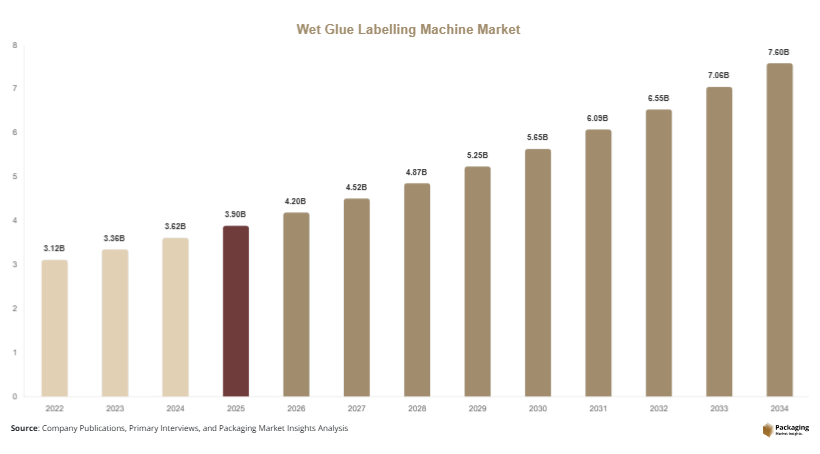
The wet glue labelling machine market size reached USD 3.9 billion in 2025 and is projected to grow to USD 4.2 billion in 2026, reflecting steady expansion driven by industrial automation and packaging standardization. Over the long term, the market is expected to reach USD 7.4 billion by 2034, registering a CAGR of 7.7% during 2025–2034. This growth trajectory highlights the continued relevance of wet glue labeling systems, especially in applications involving glass containers and rigid packaging formats.
Wet glue labeling machines are widely used in industries such as beverages, food processing, pharmaceuticals, and chemicals. These machines offer advantages such as low operational costs, strong adhesion properties, and high-speed performance, making them suitable for large-scale production environments. The beverage sector, particularly beer and carbonated soft drinks, remains a key contributor to market demand due to the widespread use of glass bottles requiring durable labeling solutions.
Key Highlights:
- Market size reached USD 3.9 billion in 2025, driven by steady demand from beverage, food, and pharmaceutical industries. Increasing automation in packaging lines is further supporting market expansion.
- Expected to grow at a CAGR of 7.7% (2025–2034), supported by rising adoption of efficient and cost-effective labeling technologies. Continuous advancements in machine performance are also contributing to growth.
- Forecast value projected at USD 7.4 billion by 2034, reflecting strong long-term demand across global packaging industries. Expansion of manufacturing capacities is expected to sustain this growth.
- Beverage industry accounts for over 50% of total demand, due to high usage of glass bottles requiring durable labeling solutions. Large-scale production volumes in this sector drive consistent machine adoption.
- Fully automatic machines contribute nearly 60% of market share, as they offer high-speed operations and improved accuracy. Their ability to reduce labor costs and increase efficiency makes them highly preferred.
Explore more data points, trends and opportunities Download Free Sample Report
Market Trends
Shift Toward Fully Automated Labeling Systems
The wet glue labelling machine market is witnessing a strong shift toward fully automated systems as manufacturers aim to improve efficiency and reduce operational costs. Automated machines are capable of handling high-speed production lines with minimal human intervention, ensuring consistent label placement and reducing errors. Industries such as beverages and pharmaceuticals are increasingly adopting these systems to meet large-scale production requirements. In addition, automated labeling machines are equipped with advanced control systems that allow real-time adjustments, enhancing flexibility and productivity. This trend is particularly evident in developed regions where labor costs are high and operational efficiency is a key focus.
Integration of Smart Monitoring and Predictive Maintenance Technologies
Another important trend in the market is the integration of smart monitoring systems and predictive maintenance technologies. Modern wet glue labeling machines are equipped with sensors and IoT-enabled devices that provide real-time data on machine performance, adhesive usage, and maintenance requirements. This enables operators to identify potential issues before they lead to downtime, improving overall efficiency. The adoption of Industry 4.0 practices is driving this trend, as manufacturers seek to optimize production processes and reduce operational risks. These advancements are also helping companies improve cost management and extend the lifespan of their equipment.
Market Drivers
Increasing Demand from Beverage and Food Industries
The beverage and food industries are major drivers of the wet glue labelling machine market, accounting for a significant share of overall demand. The widespread use of glass bottles in beverages such as beer, juices, and carbonated drinks makes wet glue labeling an ideal solution due to its strong adhesion and cost-effectiveness. As global consumption of packaged beverages continues to rise, manufacturers are expanding production capacities, leading to increased demand for high-speed labeling machines. Additionally, the food industry relies on wet glue labeling for products packaged in jars and containers, further supporting market growth.
Cost Efficiency and Suitability for High-Volume Production
Wet glue labeling machines offer significant cost advantages compared to alternative labeling technologies, particularly in large-scale production environments. The use of water-based adhesives and simple label materials reduces overall operational costs, making these machines highly attractive for manufacturers operating in price-sensitive markets. Furthermore, wet glue systems are capable of handling high-speed operations, making them suitable for industries with large production volumes. This combination of cost efficiency and performance continues to drive adoption across various sectors, including chemicals and pharmaceuticals.
Market Restraint
Growing Preference for Self-Adhesive Labeling Technologies
A key restraint impacting the wet glue labelling machine market is the increasing adoption of self-adhesive labeling systems. These systems offer advantages such as ease of application, cleaner operation, and compatibility with a wider range of packaging materials, including plastics and flexible packaging. As industries shift toward modern packaging formats, the demand for wet glue labeling machines faces challenges in certain segments.
For example, the personal care and cosmetics industries prefer self-adhesive labels due to their ability to support complex designs and premium aesthetics. These labels also eliminate the need for glue handling, reducing maintenance requirements and improving operational convenience. As a result, manufacturers in these sectors are gradually transitioning away from wet glue systems. This shift may limit market growth in applications where flexibility and design are critical, despite the continued relevance of wet glue labeling in traditional industries such as beverages.
Market Opportunities
Growth in Emerging Economies
Emerging economies present significant opportunities for the wet glue labelling machine market due to rapid industrialization and increasing consumption of packaged goods. Countries in Asia Pacific, Latin America, and Africa are witnessing strong growth in beverage and food industries, which drives demand for cost-effective labeling solutions. Wet glue labeling machines are particularly suitable for these markets due to their affordability and ability to handle high-volume production. Additionally, government initiatives aimed at promoting manufacturing and infrastructure development are supporting market expansion.
Technological Advancements in Adhesive Efficiency and Machine Design
Advancements in adhesive technology and machine design are creating new opportunities in the market. Manufacturers are developing machines that use less adhesive, reduce wastage, and improve labeling accuracy. These innovations are helping companies enhance operational efficiency and meet sustainability goals. For instance, modern wet glue labeling machines are designed to minimize glue spillage and optimize adhesive usage, reducing material costs. This focus on efficiency and sustainability is expected to drive adoption across industries seeking to improve their environmental performance and reduce operational expenses.
Report Scope
| Report Metric | Details |
|---|---|
| Market Size in 2025 | USD 3.9 Billion |
| Market Size in 2026 | USD 4.2 Billion |
| Market Size in 2034 | USD 7.4 Billion |
| CAGR | 7.7% (2026-2034) |
| Base Year for Estimation | 2025 |
| Historical Data | 2022-2024 |
| Forecast Period | 2026-2034 |
| Report Coverage | Revenue Forecast, Competitive Landscape, Supply Chain Disruption, Growth Factors, Environment & Regulatory Landscape and Trends |
| Geographies Covered | North America, Europe, APAC, Middle East and Africa, LATAM |
| Countries Covered | U.S., Canada, U.K., Germany, France, Spain, Italy, Russia, Nordic, Benelux, Rest of Europe, China, South Korea, Japan, India, Australia, Singapore, Taiwan, South East Asia, Rest of Asia-Pacific, UAE, Turky, Saudi Arabia, South Africa, Egypt, Nigeria, Rest of MEA, Brazil, Mexico, Argentina, Chile, Colombia, Rest of LATAM |
Explore more data points, trends and opportunities Download Free Sample Report
Segmental Analysis
By Type
Fully automatic wet glue labeling machines dominated the market in 2024, accounting for approximately 60% of the total share. These machines are widely used in high-volume production environments due to their efficiency and ability to maintain consistent labeling accuracy. Industries such as beverages and pharmaceuticals rely heavily on fully automatic systems to meet stringent production requirements. The integration of advanced technologies such as servo motors and digital controls further enhances their performance.
Semi-automatic machines are the fastest-growing segment, expected to register a CAGR of 7.9% during the forecast period. These machines are gaining popularity among small and medium-sized enterprises due to their affordability and flexibility. A key growth factor is the increasing adoption of automation in developing regions.
By Application
Bottle labeling emerged as the dominant application segment in 2024, accounting for over 62% of the market share. The widespread use of glass bottles in beverages drives demand for wet glue labeling machines. Their ability to handle high-speed operations makes them suitable for large-scale production.
Jar labeling is the fastest-growing segment, with a projected CAGR of 7.5%. Growth is driven by increasing demand for packaged food products such as sauces and jams. The need for efficient labeling solutions is supporting this segment’s expansion.
By End-Use Industry
The beverage industry dominated the market in 2024, accounting for approximately 50% of the total share. High demand for bottled beverages drives the adoption of wet glue labeling machines. The industry requires reliable and high-speed labeling solutions.
The pharmaceutical industry is the fastest-growing segment, expected to grow at a CAGR of 8.1%. Regulatory requirements and the need for product traceability are key growth factors driving demand in this segment.
Wet Glue Labelling Machine Market Segmentations
By Type
- Manual Wet Glue Labelling Machines
- Semi-Automatic Wet Glue Labelling Machines
- Fully Automatic Wet Glue Labelling Machines
By Application
- Bottle Labeling
- Jar Labeling
- Can Labeling
- Container Labeling
By End-Use Industry
- Beverage Industry
- Food Industry
- Pharmaceutical Industry
- Personal Care & Cosmetics
- Chemical Industry
Regional Analysis
North America
North America accounted for approximately 27% of the wet glue labelling machine market share in 2025 and is projected to grow at a CAGR of 6.3% during the forecast period. The region benefits from a well-established food and beverage industry, along with increasing adoption of automation in manufacturing processes. Companies are investing in advanced labeling equipment to improve efficiency and maintain competitiveness.
The United States dominates the regional market, supported by its large-scale beverage manufacturing sector. A key growth factor is the rising demand for craft beverages, which require efficient labeling solutions for glass bottles. This trend is encouraging manufacturers to adopt high-performance wet glue labeling machines.
Europe
Europe held around 23% of the market share in 2025 and is expected to expand at a CAGR of 6.0% through 2034. The region’s growth is driven by stringent packaging regulations and the presence of established manufacturing industries. Companies are focusing on improving labeling efficiency to comply with regulatory standards.
Germany leads the European market due to its advanced industrial base. A unique growth factor is the increasing emphasis on sustainable manufacturing practices, prompting companies to adopt efficient labeling technologies that reduce waste and energy consumption.
Asia Pacific
Asia Pacific accounted for the largest share of approximately 34% in 2025 and is projected to grow at a CAGR of 8.5%. Rapid industrialization, urbanization, and rising consumption of packaged goods are key drivers in the region. The growing middle-class population is further contributing to market expansion.
China dominates the regional market due to its extensive manufacturing capabilities. A key growth factor is the expansion of the beverage industry, which drives demand for high-speed labeling machines capable of handling large production volumes.
Middle East & Africa
The Middle East & Africa region held around 8% of the market share in 2025 and is expected to grow at a CAGR of 7.0%. Growth is driven by increasing investments in food processing and beverage industries. The region is also witnessing a shift toward organized retail, boosting demand for packaged products.
Saudi Arabia is a leading market in the region, supported by economic diversification initiatives. A unique growth factor is the expansion of the food and beverage sector, which requires efficient labeling solutions for domestic and export markets.
Latin America
Latin America accounted for approximately 8% of the market share in 2025 and is projected to grow at a CAGR of 6.8%. The region’s growth is supported by increasing demand for packaged food and beverages, along with improving economic conditions.
Brazil leads the regional market due to its large consumer base. A key growth factor is the rising demand for bottled beverages, which drives the adoption of wet glue labeling machines in the region.
Competitive Landscape
The wet glue labelling machine market is moderately competitive, with several global and regional players focusing on innovation and product development. Companies are investing in research and development to enhance machine efficiency and reduce operational costs. Strategic partnerships and expansions are common as firms aim to strengthen their market position.
Krones AG is a leading player in the market, known for its advanced labeling solutions and global presence. The company recently introduced a new energy-efficient wet glue labeling machine designed to reduce adhesive consumption and improve operational efficiency. Other key players are also focusing on expanding their product portfolios and adopting advanced technologies to remain competitive.
Key Players List
- Krones AG
- Sacmi Group
- SIDEL Group
- KHS GmbH
- Accutek Packaging Equipment Companies, Inc.
- Marchesini Group
- HERMA GmbH
- Fuji Seal International, Inc.
- ProMach Inc.
- Multivac Group
- Pack Leader Machinery Inc.
- IC Filling Systems
- CDA USA Inc.
- N.K. Industries
- Shree Bhagwati Machtech India Pvt. Ltd.