Water Soluble Packaging Market Size And Growth
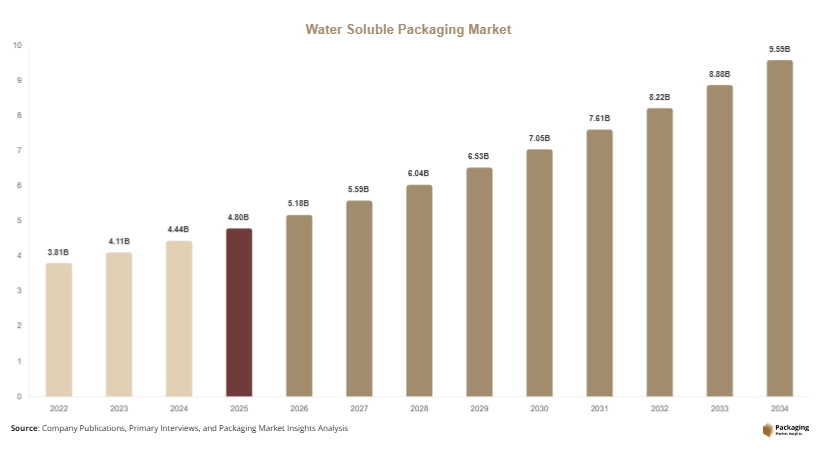
The Water soluble packaging market size was valued at approximately USD 4.8 billion in 2025 and is projected to reach USD 9.6 billion by 2034, expanding at a CAGR of 8.0% during the forecast period (2025–2034). The market is gaining traction due to its ability to reduce plastic waste and provide safe, convenient, and residue-free packaging solutions across multiple industries.
A key global factor supporting market growth is the increasing regulatory push to minimize single-use plastics and promote environmentally safe disposal methods. Water soluble packaging, primarily made from polyvinyl alcohol (PVOH), dissolves completely in water without leaving harmful residues, making it an effective alternative in sectors such as detergents, agrochemicals, and pharmaceuticals. The rising need for safe handling of hazardous materials has further enhanced the adoption of this packaging format.
The Water soluble packaging market continues to expand as manufacturers focus on sustainability and operational efficiency. Its compatibility with automated packaging systems and ability to reduce direct human contact with chemicals is further accelerating demand.
Key Highlights:
- Europe dominated the market with a 36.1% share in 2025, while Asia Pacific is projected to grow at the fastest CAGR of 9.3%.
- Film-based packaging led the type segment with a 52.4% share, while soluble pods are expected to grow at a CAGR of 9.8%.
- PVOH material dominated with a 68.7% share, while bio-based polymers are forecasted to grow at a CAGR of 10.5%.
- Detergent packaging led the application segment with 44.2% share, while agrochemical packaging is expected to grow at a CAGR of 9.1%.
- Germany remained the dominant country with a market size of USD 0.92 billion in 2025 and USD 0.99 billion in 2026.
Explore more data points, trends and opportunities Download Free Sample Report
Market Trends
Increasing Adoption in Unit-Dose Packaging
The shift toward unit-dose packaging formats is influencing the water soluble packaging market Size. Industries such as household cleaning and laundry detergents are adopting water soluble pods that provide precise dosing, reduce waste, and enhance user convenience. This trend is improving product efficiency while minimizing environmental impact. Manufacturers are investing in advanced film technologies that offer improved strength, dissolution rates, and compatibility with various formulations.
Development of Bio-Based Water Soluble Materials
The development of bio-based and compostable alternatives to traditional PVOH is emerging as a key trend. Companies are focusing on sustainable raw materials derived from renewable sources to enhance environmental compatibility. These materials aim to maintain performance characteristics such as solubility and durability while reducing carbon footprint. The growing emphasis on eco-friendly innovation is expected to reshape product offerings and expand the application scope of water soluble packaging solutions.
Market Drivers
Rising Demand for Safe Handling of Chemicals
Water soluble packaging plays a crucial role in industries dealing with hazardous chemicals, including agrochemicals and industrial cleaning agents. The packaging dissolves upon contact with water, eliminating direct exposure to harmful substances. This feature enhances worker safety and reduces the risk of contamination. Increasing safety regulations and workplace standards are encouraging industries to adopt such solutions, driving market growth.
Growth of Laundry and Dishwasher Detergent Pods
The increasing popularity of laundry and dishwasher pods is significantly driving the water soluble packaging market Size. These products offer convenience, precise dosing, and improved performance compared to traditional liquid or powder detergents. Consumers prefer easy-to-use packaging formats that reduce mess and waste. The expanding global demand for household cleaning products is supporting sustained market growth.
Market Restraint
Limited Moisture Resistance and Storage Challenges
A major restraint in the water soluble packaging market Size is the sensitivity of water soluble materials to humidity and moisture. These packaging solutions require controlled storage environments to prevent premature dissolution or degradation.
High humidity conditions, especially in tropical and developing regions, can compromise packaging integrity during transportation and storage. This creates logistical challenges and increases the need for specialized packaging and handling solutions, raising overall costs.
Additionally, limited barrier properties compared to conventional plastics restrict their use in applications requiring long shelf life or protection from external elements. These limitations can hinder adoption in certain industries and geographic regions.
Despite technological advancements, improving moisture resistance without compromising solubility remains a challenge. Addressing this issue is critical for expanding the application scope and ensuring consistent performance of water soluble packaging solutions.
Market Opportunities
Expansion in Agrochemical Packaging Applications
The agricultural sector presents a significant opportunity for the water soluble packaging market Size. Farmers increasingly prefer water soluble packaging for pesticides and fertilizers as it reduces direct contact with chemicals and improves application accuracy. This packaging format enhances safety and minimizes environmental contamination. The growing focus on sustainable farming practices is expected to drive demand in this segment.
Increasing Use in Pharmaceutical Applications
Water soluble packaging is gaining traction in the pharmaceutical industry for unit-dose drug delivery systems and dissolvable pouches. This packaging ensures precise dosing and reduces contamination risks. It is particularly beneficial for powdered medications and disinfectants. As healthcare standards and hygiene requirements continue to evolve, the adoption of water soluble packaging in pharmaceutical applications is expected to increase significantly.
Report Scope
| Report Metric | Details |
|---|---|
| Market Size in 2025 | USD 4.8 Billion |
| Market Size in 2026 | USD 5.18 Billion |
| Market Size in 2034 | USD 9.6 Billion |
| CAGR | 8.0% (2026-2034) |
| Base Year for Estimation | 2025 |
| Historical Data | 2022-2024 |
| Forecast Period | 2026-2034 |
| Report Coverage | Revenue Forecast, Competitive Landscape, Supply Chain Disruption, Growth Factors, Environment & Regulatory Landscape and Trends |
| Geographies Covered | North America, Europe, APAC, Middle East and Africa, LATAM |
| Countries Covered | U.S., Canada, U.K., Germany, France, Spain, Italy, Russia, Nordic, Benelux, Rest of Europe, China, South Korea, Japan, India, Australia, Singapore, Taiwan, South East Asia, Rest of Asia-Pacific, UAE, Turky, Saudi Arabia, South Africa, Egypt, Nigeria, Rest of MEA, Brazil, Mexico, Argentina, Chile, Colombia, Rest of LATAM |
Explore more data points, trends and opportunities Download Free Sample Report
Segmental Analysis
By Type
Film-based packaging dominated the water soluble packaging market Size with a share of 52.4% in 2025. This segment’s dominance was attributed to its versatility and widespread use across applications such as detergent pods and agrochemical packaging. Films offer flexibility, ease of use, and compatibility with automated packaging systems.
Soluble pods are projected to grow at the fastest CAGR of 9.8% during the forecast period. This growth will be driven by increasing consumer preference for convenient and pre-measured packaging formats. The demand for precise dosing and reduced product wastage will support the expansion of this segment.
By Material
Polyvinyl alcohol (PVOH) accounted for the largest share of 68.7% in 2025. Its excellent water solubility, film-forming properties, and biodegradability have made it the preferred material for water soluble packaging.
Bio-based polymers are expected to grow at a CAGR of 10.5%, driven by increasing demand for sustainable materials. Advances in material science will improve performance characteristics, enabling broader adoption across industries.
By Application
Detergent packaging held the dominant share of 44.2% in 2025. The widespread use of water soluble packaging in laundry and dishwasher pods has contributed to this segment’s leadership.
Agrochemical packaging is expected to grow at a CAGR of 9.1%, supported by increasing demand for safe and efficient chemical handling solutions. The ability to reduce direct contact with harmful substances will drive growth in this segment.
By End-Use Industry
Household products dominated the segment in 2025 due to strong demand for cleaning and laundry solutions. The convenience and efficiency of water soluble packaging have contributed to its widespread adoption.
The pharmaceutical industry is projected to grow at a CAGR of 8.8%, driven by increasing demand for precise dosing and hygienic packaging solutions. The adoption of innovative packaging formats will support growth in this segment.
Water Soluble Packaging Market Segmentations
Product Type
- Films
- Soluble Pods
- Bags & Pouches
Application
- Detergents
- Agrochemicals
- Pharmaceuticals
- Industrial Chemicals
Material
- Polyvinyl Alcohol (PVOH)
- Bio-Based Polymers
End-Use Industry
- Household
- Agriculture
- Healthcare
- Industrial
Regional Analysis
North America
North America accounted for approximately 24.7% of the water soluble packaging market Size in 2025 and will grow at a CAGR of 7.2% during the forecast period. The region has witnessed steady adoption due to increasing demand for convenient and safe packaging solutions across household and industrial applications.
The United States dominated the regional market due to strong demand for detergent pods and advanced packaging technologies. The presence of major consumer goods manufacturers and increasing focus on product innovation have contributed to market growth.
Europe
Europe held the largest share of 36.1% in 2025 and is projected to grow at a CAGR of 7.6% through 2034. The region’s growth has been influenced by strict environmental regulations and high awareness regarding sustainable packaging solutions.
Germany emerged as the leading country due to its strong manufacturing base and regulatory compliance framework. The adoption of eco-friendly packaging materials and efficient recycling systems has supported market expansion.
Asia Pacific
Asia Pacific accounted for 22.9% of the market share in 2025 and is expected to register the fastest CAGR of 9.3% during the forecast period. Rapid industrialization and increasing demand for household cleaning products have contributed to market growth.
China dominated the region due to its expanding manufacturing sector and rising consumer demand for convenient packaging formats. Government initiatives promoting environmental sustainability have further supported market development.
Middle East & Africa
The Middle East & Africa region held a share of 8.1% in 2025 and will grow at a CAGR of 6.5% during the forecast period. The market growth is supported by increasing industrial activities and rising awareness about safe chemical handling.
The United Arab Emirates led the regional market due to growing adoption of advanced packaging solutions and increasing investment in industrial sectors. The focus on improving workplace safety has driven demand for water soluble packaging.
Latin America
Latin America accounted for 8.2% of the water soluble packaging market Size in 2025 and is projected to grow at a CAGR of 6.9% during the forecast period. The region is witnessing gradual adoption driven by agricultural and industrial applications.
Brazil dominated the market due to its large agricultural sector and increasing use of water soluble packaging for agrochemicals. The need for efficient and safe packaging solutions has supported market growth in the country.
Competitive Landscape
The water soluble packaging market Size is moderately consolidated, with key players focusing on product innovation, material development, and strategic collaborations. Companies are investing in research and development to enhance product performance and expand application areas.
Kuraray Co., Ltd. is a leading player in the market, known for its strong portfolio of PVOH-based materials. The company has recently expanded its production capacity to meet increasing global demand for water soluble films used in detergent and agrochemical packaging.
Other players are emphasizing sustainability and cost efficiency while developing advanced packaging solutions. Strategic partnerships and regional expansion initiatives are shaping the competitive environment. Continuous innovation in bio-based materials and packaging technologies is expected to influence market dynamics.
Key Players List
- Kuraray Co., Ltd.
- Sekisui Chemical Co., Ltd.
- Mitsubishi Chemical Group Corporation
- Aicello Corporation
- Cortec Corporation
- Mondi Group
- Arrow Greentech Ltd.
- Changzhou Water Soluble Co., Ltd.
- AMC (UK) Ltd.
- Aquapak Polymers Ltd.
- Soltec Development Ltd.
- Plasticos Hidrosolubles S.L.
- Jiangmen Proudly Water-Soluble Plastic Co., Ltd.
- Lithey Inc.
- Guangdong Proudly New Materials Technology Corp.