Water Soluble Films Market Size and Growth
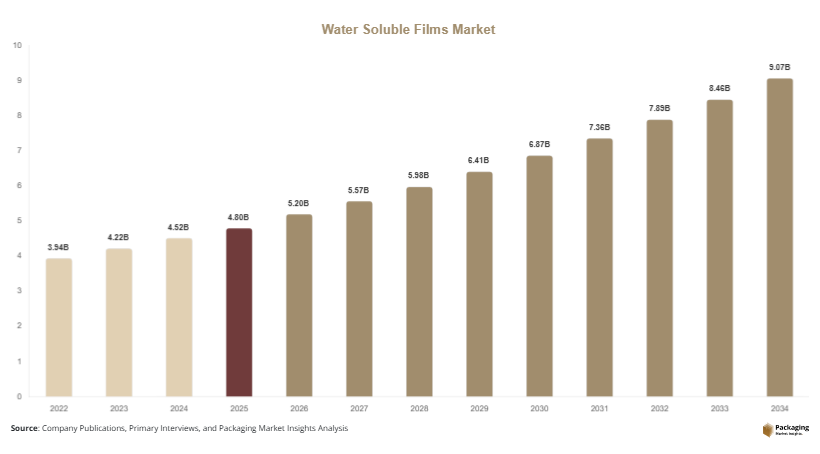
The global water soluble films market size was valued at USD 4.8 billion in 2025 and is expected to reach USD 5.2 billion in 2026. Over the forecast period from 2025 to 2034, the market is projected to grow at a CAGR of 7.2%, reaching approximately USD 9.8 billion by 2034. This growth reflects rising demand for biodegradable packaging materials and the expanding use of water soluble films across diverse end-use industries. The water soluble films market is experiencing consistent growth as industries increasingly shift toward environmentally responsible materials and efficient packaging solutions.
One of the primary growth factors driving the water soluble films market is the increasing demand for sustainable packaging solutions. As environmental concerns related to plastic waste intensify, industries are adopting water soluble films made from materials such as polyvinyl alcohol. These films dissolve in water, reducing waste and supporting eco-friendly practices. Another key factor is the growing use of water soluble films in the detergent and agrochemical sectors, where they are widely used for single-dose packaging applications. These films provide convenience, accurate dosing, and reduced product handling risks, making them highly suitable for these industries.
Key Highlights
- Asia Pacific dominated the market with a 39.8% share in 2025, while Latin America is projected to grow at the fastest CAGR of 7.6%.
- Cold water soluble films led the type segment with a 31.4% share, while hot water soluble films are expected to grow at a CAGR of 7.5%.
- Polyvinyl alcohol dominated the material segment with a 58.7% share, while bio-based polymers are forecasted to grow at a CAGR of 7.3%.
- Detergent packaging applications led the segment with 44.2% share, while healthcare applications are expected to grow at a CAGR of 7.1%.
- China remained the dominant country with a market size of USD 1.6 billion in 2025 and USD 1.8 billion in 2026.
Explore more data points, trends and opportunities Download Free Sample Report
Market Trends
Increasing adoption of eco-friendly and biodegradable packaging materials
The water soluble films market is strongly influenced by the global shift toward environmentally responsible packaging solutions. Water soluble films provide a viable alternative to conventional plastics, as they dissolve in water and reduce environmental impact. Industries such as household care, agriculture, and healthcare are increasingly adopting these materials to meet sustainability goals. Manufacturers are focusing on developing films with improved strength and controlled dissolution properties to expand their application range. This trend is supported by regulatory policies aimed at reducing plastic waste and promoting biodegradable materials, which is encouraging widespread adoption of water soluble films across industries.
Growing use of water soluble films in unit-dose and specialty packaging
The demand for unit-dose packaging solutions is rising across various industries, driving the adoption of water soluble films. These films are widely used in detergent pods, agrochemical packaging, and pharmaceutical applications due to their ability to provide precise dosing and reduce direct contact with potentially hazardous substances. The convenience and safety offered by these packaging formats are making them increasingly popular among consumers and manufacturers. Additionally, advancements in film technology are enabling customization for specific applications, further supporting market growth. This trend is expected to continue as industries prioritize efficiency, safety, and convenience in packaging solutions.
Market Drivers
Rising demand for sustainable packaging solutions across industries
The increasing emphasis on sustainability is a major factor driving the water soluble films market. Governments and organizations are implementing regulations to reduce plastic waste, encouraging the adoption of biodegradable alternatives. Water soluble films align with these initiatives, as they dissolve completely in water and leave minimal environmental impact. Industries such as consumer goods, agriculture, and healthcare are adopting these films to meet regulatory requirements and improve their environmental footprint. This shift is creating significant demand for water soluble films, supporting market growth.
Expansion of detergent and agrochemical industries
The growth of the detergent and agrochemical industries is another key driver of the water soluble films market. These industries require packaging solutions that ensure accurate dosing and minimize exposure to chemicals. Water soluble films are widely used for packaging detergents, pesticides, and fertilizers, as they dissolve easily and provide convenience. The increasing demand for household cleaning products and agricultural inputs is driving the adoption of these films. As these industries continue to expand, the demand for water soluble films is expected to grow steadily.
Market Restraint
High production costs and limited awareness in developing regions
One of the primary challenges facing the water soluble films market is the relatively high cost of production compared to conventional plastic films. The use of specialized materials and advanced manufacturing processes increases production expenses, which can limit adoption among cost-sensitive industries. Additionally, there is limited awareness about the benefits of water soluble films in certain developing regions, which can hinder market growth. For example, small-scale manufacturers may continue to use traditional packaging materials due to cost considerations and lack of knowledge about alternative solutions. These factors can slow the adoption of water soluble films and impact overall market expansion.
Market Opportunities
Development of bio-based and advanced polymer films
The development of bio-based and advanced polymer films presents significant opportunities for the water soluble films market. Manufacturers are investing in research and development to create films that are both biodegradable and cost-effective. These innovations aim to improve film performance while reducing environmental impact. As demand for sustainable packaging solutions continues to grow, bio-based water soluble films are expected to gain traction across various industries. This trend is creating new opportunities for market participants to expand their product offerings and reach new customers.
Increasing adoption in healthcare and pharmaceutical applications
The healthcare and pharmaceutical sectors are emerging as important growth areas for the water soluble films market. These films are used in applications such as laundry bags for contaminated linens, drug delivery systems, and packaging of medical products. The ability of water soluble films to reduce contamination risks and improve hygiene is driving their adoption in healthcare settings. Additionally, the growing demand for innovative drug delivery systems is creating opportunities for specialized water soluble films. As the healthcare industry continues to evolve, the demand for these films is expected to increase.
Report Scope
| Report Metric | Details |
|---|---|
| Market Size in 2025 | USD 4.8 Billion |
| Market Size in 2026 | USD 5.2 Billion |
| Market Size in 2034 | USD 9.8 Billion |
| CAGR | 7.2% (2026-2034) |
| Base Year for Estimation | 2025 |
| Historical Data | 2022-2024 |
| Forecast Period | 2026-2034 |
| Report Coverage | Revenue Forecast, Competitive Landscape, Supply Chain Disruption, Growth Factors, Environment & Regulatory Landscape and Trends |
| Geographies Covered | North America, Europe, APAC, Middle East and Africa, LATAM |
| Countries Covered | U.S., Canada, U.K., Germany, France, Spain, Italy, Russia, Nordic, Benelux, Rest of Europe, China, South Korea, Japan, India, Australia, Singapore, Taiwan, South East Asia, Rest of Asia-Pacific, UAE, Turky, Saudi Arabia, South Africa, Egypt, Nigeria, Rest of MEA, Brazil, Mexico, Argentina, Chile, Colombia, Rest of LATAM |
Explore more data points, trends and opportunities Download Free Sample Report
Segmental Analysis
By Type
Cold water soluble films dominated the market in 2024, accounting for approximately 31.4% of the total share. These films are widely used in detergent packaging applications due to their ability to dissolve quickly in cold water. The convenience and efficiency offered by these films are driving their adoption across various industries. Manufacturers are focusing on improving film performance to meet industry requirements, which is supporting segment growth.
Hot water soluble films are expected to grow at the fastest CAGR of 7.5% during the forecast period. These films are used in applications that require controlled dissolution at higher temperatures, such as industrial cleaning and healthcare. The growing demand for specialized packaging solutions is driving the adoption of hot water soluble films.
By Material
Polyvinyl alcohol accounted for the largest share of 58.7% in 2024, driven by its excellent film-forming properties and biodegradability. This material is widely used in water soluble films due to its compatibility with various applications. The demand for polyvinyl alcohol is supported by its versatility and performance.
Bio-based polymers are expected to grow at a CAGR of 7.3% during the forecast period. This growth is driven by increasing demand for sustainable materials. Manufacturers are investing in bio-based alternatives to reduce environmental impact and meet regulatory requirements.
By Application
Detergent packaging held the largest share of 44.2% in 2024, driven by the widespread use of water soluble films in laundry pods and cleaning products. The convenience and safety offered by these packaging solutions are supporting segment growth. The increasing demand for household cleaning products is also contributing to market expansion.
Healthcare applications are expected to grow at the fastest CAGR of 7.1% during the forecast period. This growth is driven by the increasing use of water soluble films in medical packaging and hygiene applications. The demand for safe and efficient packaging solutions is supporting the growth of this segment.
Water Soluble Films Market Segmentations
By Product Type
- Cold Water Soluble Films
- Hot Water Soluble Films
By Material
- Polyvinyl Alcohol
- Bio-Based Polymers
By Application
- Detergent Packaging
- Agrochemical Packaging
- Healthcare Applications
- Industrial Applications
Regional Analysis
North America
North America accounted for 23.5% of the water soluble films market share in 2025 and is projected to grow at a CAGR of 6.8% during the forecast period. The region benefits from strong demand for sustainable packaging solutions and the presence of advanced manufacturing infrastructure. Increasing regulatory pressure to reduce plastic waste is encouraging the adoption of biodegradable materials, including water soluble films. The growth of the detergent and healthcare industries is also contributing to market expansion.
The United States is the dominant country in North America, supported by its large consumer base and advanced industrial sector. A key growth factor is the increasing adoption of eco-friendly packaging solutions in consumer goods and healthcare industries. Companies are investing in innovative materials to meet sustainability goals, which is driving demand for water soluble films.
Europe
Europe held a market share of 21.7% in 2025 and is expected to grow at a CAGR of 6.5% through 2034. The region is characterized by strict environmental regulations and a strong focus on sustainability. Packaging manufacturers are adopting biodegradable materials to comply with regulatory requirements and meet consumer expectations. The demand for water soluble films is also supported by the growth of the detergent and agrochemical industries.
Germany leads the European market due to its advanced manufacturing capabilities and strong industrial base. A unique growth factor is the increasing adoption of circular economy practices, which emphasize sustainability and resource efficiency. This trend is driving demand for water soluble films in the region.
Asia Pacific
Asia Pacific dominated the water soluble films market with a 39.8% share in 2025 and is projected to grow at a CAGR of 7.4%. The region benefits from rapid industrialization, growing population, and increasing demand for consumer goods. The expansion of the detergent and agricultural sectors is driving the adoption of water soluble films. Additionally, government initiatives promoting sustainable practices are supporting market growth.
China is the leading country in the region, supported by its strong manufacturing base and large consumer market. A key growth factor is the increasing demand for household cleaning products, which is driving the adoption of water soluble films. The growth of the agricultural sector is also contributing to market expansion.
Middle East & Africa
The Middle East & Africa accounted for 6.8% of the market share in 2025 and is expected to grow at a CAGR of 7.0%. The region is gradually adopting sustainable packaging solutions, supported by increasing awareness and regulatory initiatives. The growth of the agriculture and healthcare sectors is also contributing to market demand.
The United Arab Emirates is a key market in the region, driven by its focus on sustainability and innovation. A unique growth factor is the increasing demand for eco-friendly packaging solutions in the retail and healthcare sectors, which is supporting market growth.
Latin America
Latin America held a market share of 8.2% in 2025 and is projected to grow at the fastest CAGR of 7.6%. The region is experiencing growth in the agriculture and consumer goods sectors, which is driving demand for water soluble films. Increasing awareness of environmental issues is also supporting market growth.
Brazil is the dominant country in Latin America, supported by its large agricultural industry. A key growth factor is the increasing use of water soluble films in agrochemical packaging, which is driving market expansion.
Competitive Landscape
The water soluble films market is characterized by moderate competition, with key players focusing on innovation and sustainability. Leading companies are investing in research and development to improve film performance and expand application areas. Kuraray Co., Ltd. is recognized as a leading player due to its strong product portfolio and focus on innovation. The company has recently introduced advanced water soluble films with improved strength and dissolution properties.
Other major players are focusing on strategic partnerships and product development to strengthen their market position. Companies are also expanding their production capacities to meet growing demand. The competitive landscape is expected to remain dynamic, with sustainability and technological advancements driving market competition.
Key Players List
- Kuraray Co., Ltd.
- Sekisui Chemical Co., Ltd.
- Mitsubishi Chemical Group
- Aicello Corporation
- Cortec Corporation
- AMC (UK) Ltd.
- MonoSol LLC
- Changzhou Water Soluble Co., Ltd.
- Nippon Synthetic Chemical Industry Co., Ltd.
- Arrow Greentech Ltd.
- Zhejiang PVA Water Soluble Film Co., Ltd.
- Jiangmen Proudly Water-Soluble Plastic Co., Ltd.
- Ecopol S.p.A.
- Soltec Development
- Polysolve India Pvt. Ltd.