Uv Resistant Films Market Size and Growth
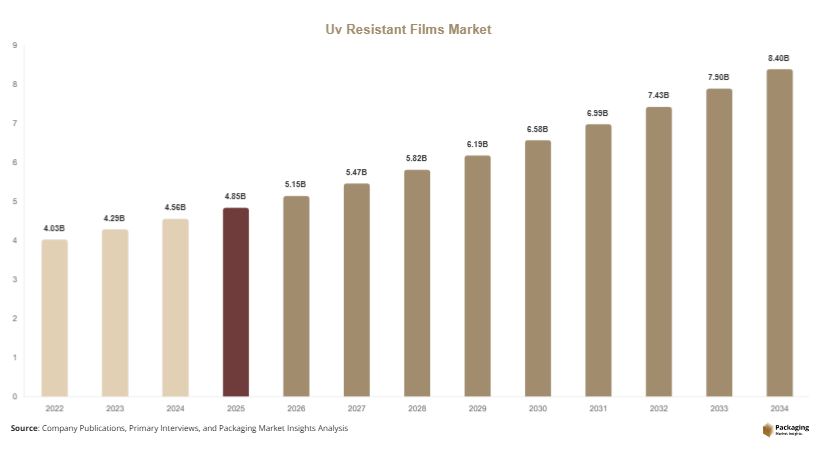
In 2025, the global Uv resistant films market size is estimated at USD 4.85 billion, and it is expected to grow to approximately USD 5.15 billion in 2026. The market is projected to reach USD 8.95 billion by 2034, expanding at a CAGR of 6.3% from 2025 to 2034. This growth reflects the rising adoption of UV-resistant materials across sectors such as agriculture, construction, automotive, and packaging.
One of the primary growth factors is the increasing demand for protective films in outdoor applications. Industries are focusing on extending the lifespan of products exposed to sunlight, where UV radiation can degrade materials, fade colors, and reduce structural integrity. UV resistant films help mitigate these issues, making them essential in construction materials, greenhouse coverings, and automotive components. Additionally, the rapid growth of the agriculture sector, especially in greenhouse farming, is significantly boosting demand for UV-resistant films that enhance crop yield while protecting plants from harmful radiation.
Key Highlights:
- Market size is projected to reach USD 8.95 billion by 2034, reflecting steady expansion across key industries. Growth is supported by rising demand for durable and protective film solutions globally.
- The market is expected to grow at a CAGR of 6.3% during 2025–2034, indicating consistent industry expansion. Increasing investments in advanced materials and technologies are contributing to this growth trend.
- There is increasing demand for UV protection in outdoor and agricultural applications, where materials are exposed to intense sunlight. These films help enhance durability and protect surfaces and crops from harmful radiation.
- Strong growth is observed in the construction and automotive industries, where UV-resistant films improve material lifespan and performance. Rising infrastructure development and vehicle production are further supporting demand.
- Advancements in film coating technologies are improving product performance and expanding application areas. Enhanced durability, clarity, and resistance properties are making these films more efficient and widely adopted.
Explore more data points, trends and opportunities Download Free Sample Report
Market Trends
Rising Adoption of Multi-Layer and High-Performance Films
A significant trend in the Uv resistant films market is the increasing adoption of multi-layer and high-performance films. Manufacturers are developing films with multiple functional layers that enhance UV protection, durability, and mechanical strength. These films are designed to withstand harsh environmental conditions, including prolonged exposure to sunlight, temperature fluctuations, and moisture. This trend is particularly evident in construction and automotive applications, where performance and longevity are critical. Multi-layer films also offer improved optical clarity and energy efficiency, making them suitable for advanced applications such as architectural glazing and solar control systems.
Growing Integration in Sustainable and Energy-Efficient Solutions
Another key trend is the integration of UV-resistant films into sustainable and energy-efficient solutions. These films are increasingly used in green building designs to reduce heat gain and improve energy efficiency. By blocking harmful UV rays, they help maintain indoor temperature and reduce reliance on air conditioning systems. Additionally, the use of UV-resistant films in agricultural applications supports sustainable farming practices by enhancing crop protection and reducing the need for chemical treatments. This trend aligns with global sustainability goals and is expected to drive market growth in the coming years.
Market Drivers
Expansion of Agricultural and Greenhouse Applications
The growing use of UV-resistant films in agriculture is a major driver of market growth. Greenhouse farming relies heavily on protective films to regulate sunlight exposure and create optimal growing conditions. UV-resistant films help prevent crop damage caused by excessive radiation while allowing sufficient light transmission for photosynthesis. This is particularly important in regions with high solar intensity. The increasing adoption of controlled environment agriculture and the need to improve crop yield are driving demand for these films. Additionally, government initiatives supporting modern farming techniques are further boosting market growth.
Increasing Demand from Construction and Infrastructure Sector
The construction and infrastructure sector is another key driver of the Uv resistant films market. UV-resistant films are widely used in building materials to enhance durability and energy efficiency. They are applied in windows, roofing systems, and exterior surfaces to protect against UV-induced degradation. The growing focus on sustainable construction practices and energy-efficient buildings is increasing the adoption of these films. Additionally, urbanization and infrastructure development in emerging economies are creating significant demand for UV-resistant materials, supporting market expansion.
Market Restraint
High Initial Costs and Limited Awareness in Developing Regions
One of the primary restraints in the Uv resistant films market is the relatively high initial cost associated with advanced UV-resistant film technologies. Compared to conventional films, UV-resistant variants require specialized materials and manufacturing processes, which increase production costs. This cost factor can limit adoption, particularly among small-scale users and in price-sensitive markets. Additionally, limited awareness about the benefits of UV-resistant films in developing regions further restricts market growth. For example, in certain agricultural markets, farmers may continue using traditional films due to lower costs, despite the long-term advantages of UV protection. This lack of awareness, combined with cost constraints, can slow market penetration and hinder overall growth.
Market Opportunities
Increasing Demand in Automotive and Transportation Sector
The automotive and transportation sector presents significant growth opportunities for the Uv resistant films market. UV-resistant films are increasingly used in vehicle interiors and exteriors to protect materials from fading and degradation. They are also applied in window tints to reduce heat and improve passenger comfort. As the automotive industry continues to evolve, there is growing demand for advanced materials that enhance durability and performance. The shift toward electric vehicles and lightweight materials further supports the adoption of UV-resistant films, creating new growth opportunities.
Technological Innovations in Smart and Functional Films
Technological innovation is creating new opportunities in the development of smart and functional UV-resistant films. Manufacturers are focusing on integrating additional features such as self-cleaning, anti-glare, and heat-reflective properties into these films. These advanced solutions are gaining traction in sectors such as construction, electronics, and automotive. The ability to combine multiple functionalities in a single film enhances product value and expands application scope. As research and development activities continue, the market is expected to witness the introduction of innovative solutions that cater to evolving industry needs.
Report Scope
| Report Metric | Details |
|---|---|
| Market Size in 2025 | USD 4.85 Billion |
| Market Size in 2026 | USD 5.15 Billion |
| Market Size in 2034 | USD 8.95 Billion |
| CAGR | 6.3% (2026-2034) |
| Base Year for Estimation | 2025 |
| Historical Data | 2022-2024 |
| Forecast Period | 2026-2034 |
| Report Coverage | Revenue Forecast, Competitive Landscape, Supply Chain Disruption, Growth Factors, Environment & Regulatory Landscape and Trends |
| Geographies Covered | North America, Europe, APAC, Middle East and Africa, LATAM |
| Countries Covered | U.S., Canada, U.K., Germany, France, Spain, Italy, Russia, Nordic, Benelux, Rest of Europe, China, South Korea, Japan, India, Australia, Singapore, Taiwan, South East Asia, Rest of Asia-Pacific, UAE, Turky, Saudi Arabia, South Africa, Egypt, Nigeria, Rest of MEA, Brazil, Mexico, Argentina, Chile, Colombia, Rest of LATAM |
Explore more data points, trends and opportunities Download Free Sample Report
Segmental Analysis
By Type
Polyethylene-based UV resistant films dominated the market in 2024, accounting for approximately 48% of the total share. These films are widely used due to their flexibility, cost-effectiveness, and strong UV protection capabilities. They are commonly applied in agricultural and construction applications, where durability and performance are essential. The increasing demand for lightweight and versatile materials is driving the adoption of polyethylene-based films.
Polycarbonate-based UV resistant films are expected to be the fastest-growing segment, with a CAGR of 7.2% during the forecast period. These films offer superior strength, transparency, and impact resistance, making them suitable for high-performance applications. The growth of this segment is driven by increasing demand in automotive and construction industries, where advanced materials are required.
By Application
Agricultural applications dominated the market in 2024, accounting for approximately 52% of the market share. UV-resistant films are extensively used in greenhouse coverings and mulching applications to protect crops and improve yield. The increasing adoption of modern farming techniques is driving demand in this segment.
The construction application segment is expected to be the fastest-growing, with a CAGR of 6.8% during the forecast period. The growth is driven by increasing demand for energy-efficient building materials. UV-resistant films are used in windows, roofing, and exterior surfaces to enhance durability and reduce energy consumption.
By End-Use Industry
The agriculture industry dominated the market in 2024, holding approximately 50% of the total share. The use of UV-resistant films in farming applications is increasing due to their ability to protect crops and improve productivity. The rising demand for food production is further supporting this segment.
The automotive industry is expected to be the fastest-growing segment, with a CAGR of 6.9% during the forecast period. The growth is driven by increasing demand for durable and high-performance materials in vehicle manufacturing. UV-resistant films are used to enhance the lifespan of automotive components.
Uv Resistant Films Market Segmentations
By Type
- Polyethylene Films
- Polycarbonate Films
- Polyester Films
By Application
- Agriculture
- Construction
- Automotive
By End-Use Industry
- Agriculture
- Construction
- Automotive
Regional Analysis
North America
North America accounted for approximately 26% of the global market share in 2025, supported by strong demand from construction and automotive sectors. The region is projected to grow at a CAGR of 6.1% during the forecast period, driven by increasing adoption of energy-efficient materials and advanced film technologies. The presence of established manufacturers and continuous innovation further supports market growth.
The United States dominates the regional market, driven by its advanced infrastructure and high adoption of sustainable building practices. A unique growth factor in this region is the increasing use of UV-resistant films in residential and commercial window applications to improve energy efficiency and indoor comfort.
Europe
Europe held around 24% of the market share in 2025 and is expected to grow at a CAGR of 6.2%. The region’s growth is driven by strict environmental regulations and a strong focus on sustainability. The adoption of UV-resistant films in construction and automotive industries is increasing steadily.
Germany leads the European market due to its strong industrial base and emphasis on innovation. A unique growth factor is the growing adoption of UV-resistant films in automotive manufacturing to enhance vehicle durability and aesthetics.
Asia Pacific
Asia Pacific accounted for approximately 32% of the global market share in 2025, making it the largest regional market. The region is projected to grow at a CAGR of 7.0%, driven by rapid industrialization and expanding agriculture and construction sectors.
China dominates the market due to its large manufacturing base and increasing demand for protective materials. A unique growth factor is the rapid expansion of greenhouse farming, which is driving demand for UV-resistant films in agriculture.
Middle East & Africa
The Middle East & Africa region held about 8% of the market share in 2025 and is expected to grow at a CAGR of 5.6%. The market is driven by increasing construction activities and rising awareness about material protection.
Saudi Arabia is a key market in this region, supported by infrastructure development projects. A unique growth factor is the need for UV-resistant materials in extreme climatic conditions, where high solar exposure accelerates material degradation.
Latin America
Latin America accounted for around 10% of the global market share in 2025 and is projected to grow at a CAGR of 6.0%. The region is experiencing steady growth due to increasing demand for agricultural and construction applications.
Brazil dominates the regional market, driven by its strong agricultural sector. A unique growth factor is the increasing adoption of greenhouse farming techniques, which require UV-resistant films for crop protection.
Competitive Landscape
The Uv resistant films market is characterized by moderate competition, with several global players focusing on product innovation and strategic expansion. Companies are investing in research and development to enhance film performance and expand their product portfolios. Strategic partnerships and acquisitions are also common, enabling companies to strengthen their market presence.
3M Company is a leading player in the market, known for its advanced film technologies and strong global presence. The company recently introduced a new range of UV-resistant films designed for energy-efficient building applications. Other major players are also focusing on developing innovative solutions to meet evolving industry demands.
Key Players List
- 3M Company
- Eastman Chemical Company
- Toray Industries, Inc.
- Mitsubishi Chemical Group
- DuPont de Nemours, Inc.
- Covestro AG
- Teijin Limited
- Saint-Gobain S.A.
- Avery Dennison Corporation
- Hexis S.A.
- Madico Inc.
- Garware Technical Fibres Ltd.
- Uflex Ltd.
- Polifilm Group
- Berry Global Inc.