US packaging market Size and Growth
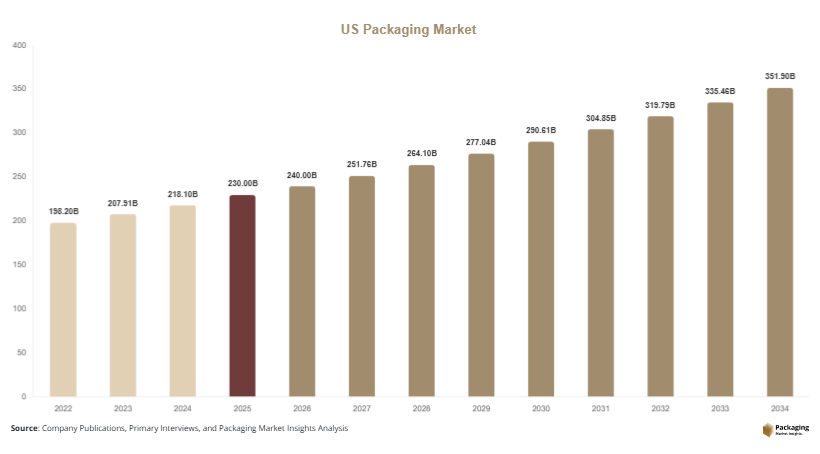
The US packaging market continues to demonstrate stable expansion, supported by rising demand across food, beverage, healthcare, and e-commerce industries. The market size was valued at approximately USD 230 billion in 2025 and is expected to reach USD 240 billion in 2026. Over the forecast period from 2025 to 2034, the market is projected to grow at a CAGR of 4.9%, reaching an estimated value of USD 360 billion by 2034. This steady growth reflects the increasing reliance on packaging solutions for product protection, branding, and logistics efficiency across various sectors in the United States.
One of the primary growth factors is the expansion of e-commerce, which continues to increase the need for durable and efficient packaging solutions. The rapid growth of online retail has driven demand for corrugated boxes, flexible packaging, and protective materials. Another key factor is the rising consumption of packaged food and beverages, driven by changing consumer lifestyles and increasing preference for convenience. Additionally, sustainability initiatives are reshaping the market, as companies invest in recyclable and biodegradable packaging materials to meet regulatory requirements and consumer expectations.
Key Highlights:
- Market size reached USD 230 billion in 2025
- Expected to grow to USD 360 billion by 2034
- CAGR of 4.9% from 2025 to 2034
- E-commerce and food sectors drive demand
- Sustainability initiatives influence innovation
Explore more data points, trends and opportunities Download Free Sample Report
Market Trends
Shift Toward Sustainable Packaging Solutions
The US packaging market is experiencing a noticeable shift toward sustainable packaging solutions as environmental concerns continue to influence consumer behavior and regulatory frameworks. Companies are increasingly adopting recyclable, compostable, and reusable materials to reduce environmental impact. This trend is supported by federal and state-level regulations aimed at minimizing plastic waste and promoting circular economy practices. Consumers are also showing a preference for brands that use eco-friendly packaging, encouraging manufacturers to invest in sustainable alternatives such as paper-based packaging and bio-based plastics. As a result, sustainability is becoming a central focus in product development and corporate strategies within the packaging industry.
Growth of Automation and Smart Packaging Technologies
Automation and smart packaging technologies are gaining traction in the US packaging market, driven by the need for efficiency and enhanced product functionality. Automated packaging systems improve production speed, reduce labor costs, and ensure consistency in packaging quality. At the same time, smart packaging solutions, including QR codes, sensors, and RFID tags, enable real-time tracking and product authentication. These technologies are particularly valuable in sectors such as pharmaceuticals and food, where safety and traceability are critical. The integration of digital technologies into packaging is expected to continue growing, offering new opportunities for innovation and customer engagement.
Market Drivers
Expansion of E-commerce and Logistics Infrastructure
The rapid expansion of e-commerce in the United States is a major driver of the US packaging market. Online retail platforms require efficient and durable packaging solutions to ensure product safety during transportation and delivery. The growth of logistics and warehousing infrastructure further supports this demand, as companies invest in packaging that can withstand handling and shipping processes. Corrugated boxes, protective packaging, and flexible materials are widely used in this sector. The increasing adoption of same-day and next-day delivery services also drives the need for optimized packaging solutions that balance cost and performance.
Increasing Demand from the Food and Beverage Industry
The food and beverage industry plays a significant role in driving the US packaging market, as it requires packaging solutions that maintain product quality and safety. The growing consumption of ready-to-eat meals and packaged foods has increased demand for convenient and reliable packaging materials. Packaging technologies that extend shelf life and preserve freshness are particularly important in this sector. Additionally, regulatory requirements related to food safety and labeling contribute to the demand for high-quality packaging solutions. This driver is expected to remain strong throughout the forecast period.
Market Restraints
Environmental Regulations and Cost Pressures
Environmental regulations and associated cost pressures present a significant restraint to the growth of the US packaging market. Government policies aimed at reducing plastic waste and promoting recycling have led to stricter compliance requirements for manufacturers. While these regulations support sustainability goals, they also increase production costs and require investments in new technologies and materials. For example, companies transitioning from conventional plastics to biodegradable alternatives may face higher raw material costs and limited availability. Small and medium-sized enterprises, in particular, may struggle to adapt to these changes due to financial constraints. This restraint impacts profitability and slows the adoption of new packaging solutions across the industry.
Market Opportunities
Development of Advanced Sustainable Materials
The development of advanced sustainable materials presents a significant opportunity for the US packaging market. Innovations in biodegradable and recyclable materials are enabling manufacturers to create packaging solutions that meet environmental standards without compromising performance. Materials such as plant-based plastics and coated paperboard are gaining popularity due to their reduced environmental impact. Companies that invest in research and development in this area can gain a competitive advantage by offering eco-friendly solutions that align with consumer preferences and regulatory requirements. This opportunity is expected to drive long-term growth in the market.
Growth in Healthcare and Pharmaceutical Packaging
The healthcare and pharmaceutical sectors offer substantial growth opportunities for the US packaging market. The increasing demand for medical products, including vaccines and biologics, requires specialized packaging solutions that ensure product safety and compliance with strict regulations. Packaging materials with enhanced barrier properties and tamper-evident features are essential in this sector. Additionally, the rise of home healthcare and telemedicine has increased the need for packaging that supports direct-to-consumer delivery. This opportunity is expected to contribute significantly to market expansion over the forecast period.
Report Scope
| Report Metric | Details |
|---|---|
| Market Size in 2025 | USD 230 Billion |
| Market Size in 2026 | USD 240 Billion |
| Market Size in 2034 | USD 360 Billion |
| CAGR | 4.9% (2026-2034) |
| Base Year for Estimation | 2025 |
| Historical Data | 2022-2024 |
| Forecast Period | 2026-2034 |
| Report Coverage | Revenue Forecast, Competitive Landscape, Supply Chain Disruption, Growth Factors, Environment & Regulatory Landscape and Trends |
| Geographies Covered | North America, Europe, APAC, Middle East and Africa, LATAM |
| Countries Covered | U.S., Canada, U.K., Germany, France, Spain, Italy, Russia, Nordic, Benelux, Rest of Europe, China, South Korea, Japan, India, Australia, Singapore, Taiwan, South East Asia, Rest of Asia-Pacific, UAE, Turky, Saudi Arabia, South Africa, Egypt, Nigeria, Rest of MEA, Brazil, Mexico, Argentina, Chile, Colombia, Rest of LATAM |
Explore more data points, trends and opportunities Download Free Sample Report
Segmental Analysis
By Material Type
Plastic packaging dominated the US packaging market in 2024, accounting for approximately 42% of the total market share. Plastics are widely used due to their versatility, lightweight nature, and cost efficiency. They offer excellent barrier properties, making them suitable for applications in food, beverage, and healthcare industries. Despite environmental concerns, plastics remain a preferred choice due to their durability and adaptability. Continuous advancements in polymer technologies are improving the performance of plastic packaging, including enhanced strength and reduced material usage, which supports its dominance in the market.
Paper and paperboard packaging is expected to be the fastest-growing segment, with a CAGR of 6.1% during the forecast period. The growth is driven by increasing demand for sustainable and recyclable packaging solutions. Paper-based materials are gaining popularity across retail and food service sectors due to their eco-friendly characteristics. Innovations in coatings and material engineering are enhancing the functionality of paper packaging, making it suitable for a wider range of applications. This segment is expected to benefit significantly from regulatory support and consumer preference for sustainable products.
By Application
The food and beverage segment held the largest share of the US packaging market in 2024, accounting for around 48% of total demand. Packaging plays a critical role in preserving product quality, ensuring safety, and extending shelf life in this sector. The increasing consumption of packaged and convenience foods has driven demand for innovative packaging solutions. Manufacturers are focusing on improving packaging design to enhance usability and product visibility, which supports growth in this segment.
The pharmaceutical application segment is projected to grow at the fastest CAGR of 5.8% during the forecast period. The growth is driven by the rising demand for secure and compliant packaging solutions. Packaging materials in this sector must meet strict regulatory standards and provide protection against contamination. Innovations such as tamper-evident and child-resistant packaging are gaining importance. This segment is expected to see continued growth due to increasing healthcare needs and advancements in medical technology.
By End-Use Industry
The consumer goods industry dominated the US packaging market in 2024, with a share of approximately 44%. Packaging is essential in this sector for protecting products, enhancing brand appeal, and providing convenience. The growing demand for personal care and household products has contributed to the dominance of this segment. Companies are investing in innovative packaging designs to attract consumers and improve product differentiation.
The e-commerce segment is expected to grow at the highest CAGR of 6.7% during the forecast period. The rapid expansion of online retail has increased the demand for durable and efficient packaging solutions. The need for lightweight materials that reduce shipping costs while ensuring product safety is driving innovation. This segment is expected to have a significant impact on the overall growth of the US packaging market.
US Packaging Market Segmentations
Material Type
- Plastic
- Paper & Paperboard
- Metal
- Glass
Application
- Food & Beverage
- Pharmaceuticals
- Personal Care
- Industrial
End-Use Industry
- Consumer Goods
- Healthcare
- E-commerce
- Retail
Regional Analysis
North America
North America accounted for approximately 78% of the US packaging market share in 2025, reflecting the dominance of the United States within the region. The market is expected to grow at a CAGR of 4.9% during the forecast period, supported by strong demand from key industries such as food, healthcare, and e-commerce. The presence of advanced manufacturing infrastructure and established supply chains further supports market stability.
The United States dominates the regional market due to its large consumer base and well-developed retail sector. A unique growth factor is the increasing investment in sustainable packaging technologies, driven by both regulatory requirements and consumer demand for environmentally responsible products.
Europe
Europe represents around 7% of the US packaging market share in 2025, primarily through trade and exports of packaging materials and technologies. The region is expected to grow at a CAGR of 4.2% over the forecast period. Strong environmental regulations and emphasis on sustainability influence the demand for innovative packaging solutions.
Germany is the dominant country contributing to this regional segment, supported by its advanced manufacturing capabilities. A key growth factor is the region’s focus on circular economy initiatives, which encourages collaboration between US and European companies in developing sustainable packaging solutions.
Asia Pacific
Asia Pacific accounted for approximately 8% of the market share in 2025, driven by increasing trade relationships and outsourcing of packaging production. The region is projected to grow at a CAGR of 5.6% through 2034. Rapid industrialization and growing consumer markets support demand for packaging materials.
China leads this regional segment due to its large-scale manufacturing and export capabilities. A unique growth factor is the cost-effective production of packaging materials, which supports supply chain efficiency for US companies operating globally.
Middle East & Africa
The Middle East & Africa region held about 3% of the market share in 2025 and is expected to grow at a CAGR of 4.5% during the forecast period. The market is driven by increasing demand for packaged goods and expanding retail infrastructure in the region.
Saudi Arabia is the dominant country in this segment, supported by investments in industrial development. A key growth factor is the rising demand for packaged food products, which drives the need for reliable packaging solutions sourced from US manufacturers.
Latin America
Latin America accounted for approximately 4% of the market share in 2025 and is projected to grow at a CAGR of 4.7% through 2034. Economic development and increasing consumer spending contribute to the demand for packaging materials.
Brazil dominates this regional segment due to its growing food processing industry. A unique growth factor is the expansion of retail and distribution networks, which increases demand for imported packaging materials and technologies from the United States.
Competitive Landscape
The US packaging market is characterized by the presence of several established players competing on the basis of innovation, sustainability, and operational efficiency. Companies are focusing on expanding their product portfolios and investing in research and development to meet evolving customer requirements. Strategic partnerships and acquisitions are commonly used to strengthen market position and enhance technological capabilities.
Amcor plc is considered a leading player in the market due to its strong focus on sustainable packaging solutions and global presence. The company has recently introduced recyclable packaging products designed to reduce environmental impact. Other major players such as Berry Global Inc., Sealed Air Corporation, WestRock Company, and International Paper Company are also investing in advanced materials and expanding their production capacities. The competitive landscape remains dynamic, with companies striving to adapt to regulatory changes and shifting consumer preferences.
Key Players List
- Amcor plc
- Berry Global Inc.
- Sealed Air Corporation
- WestRock Company
- International Paper Company
- Sonoco Products Company
- Graphic Packaging Holding Company
- Packaging Corporation of America
- Crown Holdings Inc.
- Ball Corporation
- Avery Dennison Corporation
- ProAmpac LLC
- Reynolds Group Holdings
- Silgan Holdings Inc.
- Novolex Holdings LLC