Unit Dose Packaging Market Size and Growth
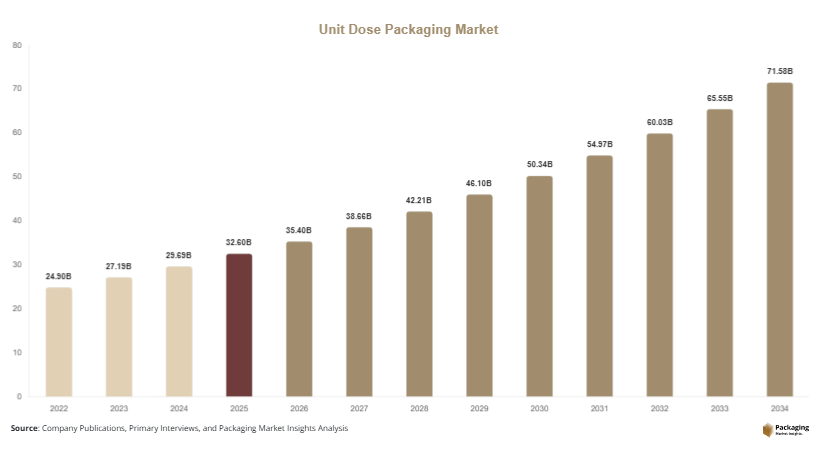
In 2025, the unit dose packaging market size is estimated at USD 32.6 billion, and it is projected to reach USD 35.4 billion in 2026. Over the long term, the market is forecast to grow significantly, reaching USD 71.8 billion by 2034, at a CAGR of 9.2% during 2025–2034. This growth trajectory reflects rising adoption of single-dose packaging formats designed to improve product safety, dosage accuracy, and user convenience. The unit dose packaging market is witnessing consistent expansion due to increasing demand for safe, convenient, and contamination-free packaging solutions across pharmaceutical, food, and personal care industries.
One of the primary growth factors driving the market is the rapid expansion of the pharmaceutical industry, particularly in the production of oral solid dosage forms, injectables, and biologics. Unit dose packaging minimizes dosage errors and ensures patient compliance, making it highly suitable for hospitals and home healthcare settings. Additionally, the increasing prevalence of chronic diseases is driving demand for precise medication delivery systems, further supporting the growth of this market.
Key Highlights:
- The market size is projected to reach USD 71.8 billion by 2034, reflecting steady expansion over the forecast period. This growth is supported by increasing adoption of advanced packaging solutions across multiple industries.
- The market is expected to grow at a CAGR of 9.2% during 2025–2034, indicating consistent demand and long-term industry stability. Rising investments in packaging technologies are contributing to this upward trend.
- There is strong demand from pharmaceutical and healthcare sectors, where precision and safety are critical. Unit dose packaging is widely used to ensure accurate medication delivery and reduce contamination risks.
- Increasing focus on patient safety and dosage accuracy is driving the adoption of unit dose systems. These packaging formats help minimize medication errors and improve treatment outcomes.
- Growing adoption of sustainable packaging materials is influencing market growth. Companies are shifting toward eco-friendly and recyclable solutions to meet environmental regulations and consumer expectations.
Explore more data points, trends and opportunities Download Free Sample Report
Market Trends
Increasing Adoption of Sustainable Unit Dose Packaging Solutions
The market is witnessing a shift toward environmentally sustainable packaging materials, driven by regulatory pressure and consumer awareness. Manufacturers are increasingly using recyclable polymers, biodegradable films, and paper-based alternatives to reduce environmental impact. This trend is particularly evident in Europe and North America, where sustainability standards are stringent. Companies are also investing in lightweight packaging designs that reduce material usage and transportation costs. As sustainability becomes a core business objective, unit dose packaging solutions are evolving to meet both functional and environmental requirements.
Integration of Smart Packaging Technologies
Smart packaging technologies are gaining traction in the unit dose packaging market, enhancing product traceability, authentication, and patient engagement. Technologies such as QR codes, RFID tags, and digital labeling systems enable real-time tracking and provide critical product information. In pharmaceutical applications, smart packaging helps improve medication adherence by providing reminders and usage instructions. This trend is supported by the increasing digitization of healthcare systems and the need for advanced supply chain visibility.
Market Drivers
Growing Demand for Accurate Dosage and Patient Safety
The increasing emphasis on patient safety and medication accuracy is a major driver of the unit dose packaging market. Unit dose packaging ensures that each dose is precisely measured, reducing the risk of overdosage or underdosage. This is particularly important in hospitals and clinical settings where medication errors can have serious consequences. The growing prevalence of chronic diseases and the need for long-term medication management are further driving demand for reliable packaging solutions.
Expansion of Pharmaceutical and Healthcare Industries
The rapid growth of the global pharmaceutical industry is significantly contributing to market expansion. Increased production of generic drugs, biologics, and vaccines is driving demand for efficient packaging solutions. Unit dose packaging is widely used for oral solid doses, injectables, and liquid medications. Additionally, the rise of home healthcare and self-administration of drugs is increasing the need for convenient and user-friendly packaging formats.
Market Restraint
High Production Costs and Equipment Investment
One of the key restraints in the unit dose packaging market is the high cost associated with advanced packaging equipment and materials. The implementation of automated filling and sealing systems requires significant capital investment, which can be challenging for small and medium-sized manufacturers. Additionally, the use of specialized materials such as high-barrier films increases production costs. These factors can limit market entry and slow down adoption in price-sensitive regions.
The impact of this restraint is particularly evident in developing markets where cost efficiency is a primary concern. For example, pharmaceutical manufacturers in emerging economies may prefer bulk packaging solutions to reduce costs, despite the benefits of unit dose packaging. This creates a gap between technological advancement and market adoption. However, ongoing innovations in cost-effective materials and manufacturing processes are expected to gradually mitigate this challenge.
Market Opportunities
Growth of Home Healthcare and Self-Medication Trends
The increasing adoption of home healthcare services is creating significant opportunities for the unit dose packaging market. Patients are increasingly managing their treatments at home, requiring packaging solutions that are easy to use and ensure accurate dosing. Unit dose packaging provides convenience and reduces the risk of medication errors, making it ideal for home use. This trend is supported by the aging population and the rising prevalence of chronic diseases.
Expansion in Emerging Markets
Emerging economies present substantial growth opportunities due to improving healthcare infrastructure and rising pharmaceutical consumption. Countries in Asia Pacific, Latin America, and the Middle East are investing in healthcare development, increasing demand for advanced packaging solutions. As regulatory standards improve, the adoption of unit dose packaging is expected to rise. Manufacturers can capitalize on these opportunities by offering cost-effective and scalable solutions tailored to local market needs.
Report Scope
| Report Metric | Details |
|---|---|
| Market Size in 2025 | USD 32.6 Billion |
| Market Size in 2026 | USD 35.4 Billion |
| Market Size in 2034 | USD 71.8 Billion |
| CAGR | 9.2% (2026-2034) |
| Base Year for Estimation | 2025 |
| Historical Data | 2022-2024 |
| Forecast Period | 2026-2034 |
| Report Coverage | Revenue Forecast, Competitive Landscape, Supply Chain Disruption, Growth Factors, Environment & Regulatory Landscape and Trends |
| Geographies Covered | North America, Europe, APAC, Middle East and Africa, LATAM |
| Countries Covered | U.S., Canada, U.K., Germany, France, Spain, Italy, Russia, Nordic, Benelux, Rest of Europe, China, South Korea, Japan, India, Australia, Singapore, Taiwan, South East Asia, Rest of Asia-Pacific, UAE, Turky, Saudi Arabia, South Africa, Egypt, Nigeria, Rest of MEA, Brazil, Mexico, Argentina, Chile, Colombia, Rest of LATAM |
Explore more data points, trends and opportunities Download Free Sample Report
Segmental Analysis
By Type
Blister packaging dominated the unit dose packaging market with approximately 48% share in 2024, driven by its widespread use in pharmaceutical applications such as tablets and capsules. Blister packs offer strong protection against moisture, oxygen, and contamination, ensuring product integrity and longer shelf life. Their cost-effectiveness, ease of use, and compatibility with high-speed packaging lines further strengthen their position in the market.
Pre-filled syringes are expected to grow at the fastest CAGR of 10.4% during 2025–2034, supported by increasing demand for injectable drugs, biologics, and vaccines. These packaging solutions provide precise dosing, reduce contamination risks, and enhance patient convenience. The rising prevalence of chronic diseases and the shift toward self-administration of injectable therapies are key factors driving growth in this segment.
By Application
Pharmaceutical applications held the dominant share of approximately 60% in 2024, driven by the increasing need for accurate dosing, patient safety, and regulatory compliance. Unit dose packaging is extensively used for oral solid doses, injectables, and liquid medications. The growing production of generic drugs and biologics is further supporting the dominance of this segment.
Food and beverage applications are projected to grow at a CAGR of 9.5% during 2025–2034, driven by increasing demand for single-serve packaging formats. Consumers are showing a strong preference for convenient, hygienic, and portion-controlled packaging. The rising consumption of ready-to-eat products and dietary supplements is further contributing to the growth of this segment.
By End-Use
Hospitals dominated the market with approximately 45% share in 2024, as they extensively use unit dose packaging systems for medication management and distribution. These systems help reduce medication errors, improve patient safety, and streamline pharmacy operations. The increasing adoption of automated dispensing systems in hospitals is further strengthening segment growth.
Home healthcare is expected to register the fastest CAGR of 10.2% during 2025–2034, driven by the growing trend of self-medication and home-based treatment. Unit dose packaging provides convenience, ease of use, and accurate dosing, making it ideal for patients managing chronic conditions. The aging population and rising healthcare costs are also contributing to the expansion of this segment.
Unit Dose Packaging Market Segmentations
By Type
- Blister Packaging
- Pre-filled Syringes
- Ampoules
- Sachets
By Application
- Pharmaceutical
- Food & Beverage
- Personal Care
By End-Use
- Hospitals
- Clinics
- Home Healthcare
Regional Analysis
North America
North America accounted for approximately 36% share of the unit dose packaging market in 2025 and is projected to grow at a CAGR of 9.0% during 2025–2034. The region’s dominance is driven by advanced healthcare infrastructure, strong pharmaceutical production, and high adoption of patient safety protocols. The increasing use of unit dose systems in hospitals and long-term care facilities continues to support steady market growth.
The United States dominates the regional market due to its large-scale pharmaceutical manufacturing and well-established healthcare systems. A key growth factor is the widespread implementation of automated unit dose dispensing systems in hospitals, which helps reduce medication errors and improves operational efficiency across healthcare settings.
Europe
Europe held around 28% market share in 2025, with a projected CAGR of 8.8% during 2025–2034. Market growth is supported by strict regulatory frameworks, increasing demand for safe pharmaceutical packaging, and growing emphasis on sustainability. The region is witnessing rising adoption of recyclable and eco-friendly unit dose packaging materials.
Germany leads the European market due to its strong pharmaceutical and packaging industries. A key growth factor is the implementation of stringent European Union regulations focused on pharmaceutical safety, traceability, and environmentally sustainable packaging solutions.
Asia Pacific
Asia Pacific accounted for approximately 26% share in 2025 and is expected to register the fastest CAGR of 10.1% during 2025–2034. Growth is driven by expanding pharmaceutical production, rising healthcare expenditure, and increasing awareness regarding medication safety. The region is also benefiting from rapid urbanization and improving healthcare access.
China dominates the regional market due to its large-scale pharmaceutical manufacturing and export capabilities. A key growth factor is increasing government investment in domestic drug production and healthcare infrastructure, which is driving demand for advanced packaging solutions including unit dose formats.
Middle East & Africa
The Middle East & Africa region held approximately 5% share in 2025, with a projected CAGR of 8.5% during 2025–2034. Growth in this region is supported by improving healthcare systems, increasing pharmaceutical imports, and rising demand for safe and hygienic packaging solutions. Adoption of modern packaging technologies is gradually increasing.
Saudi Arabia leads the regional market due to ongoing healthcare infrastructure development. A key growth factor is the expansion of pharmaceutical distribution networks and government initiatives aimed at improving medication safety and healthcare accessibility.
Latin America
Latin America accounted for approximately 5% share in 2025, with a projected CAGR of 8.7% during 2025–2034. Market growth is driven by rising pharmaceutical consumption, increasing healthcare investments, and modernization of drug distribution systems. Adoption of advanced packaging formats is steadily improving.
Brazil dominates the regional market due to its strong pharmaceutical manufacturing base. A key growth factor is increasing government investment in healthcare infrastructure and expanding domestic drug production capabilities, which is supporting demand for unit dose packaging solutions.
Competitive Landscape
The unit dose packaging market is moderately competitive, with several global and regional players focusing on innovation and expansion. Leading companies are investing in advanced packaging technologies and sustainable materials to strengthen their market position.
Amcor plc is a leading player, known for its diverse packaging portfolio and global presence. The company recently introduced recyclable unit dose packaging solutions to align with sustainability goals. Other key players are focusing on strategic partnerships and product innovation to enhance their offerings.
Key Players List
- Amcor plc
- Berry Global Inc.
- WestRock Company
- Sonoco Products Company
- Gerresheimer AG
- Schott AG
- Constantia Flexibles
- AptarGroup, Inc.
- Sealed Air Corporation
- UFlex Ltd.
- Winpak Ltd.
- Klöckner Pentaplast
- Mondi Group
- Coveris Holdings S.A.
- Huhtamaki Oyj