Uncoated Recycled Paperboard Market Size and Growth
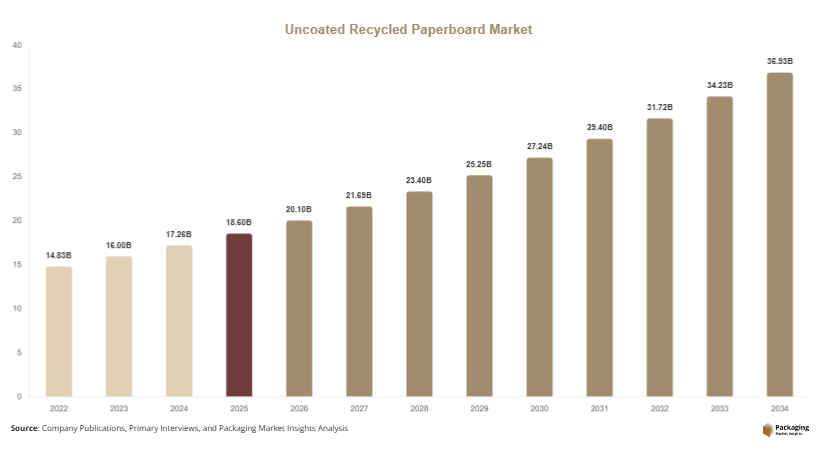
The uncoated recycled paperboard market is gaining strong momentum as industries shift toward sustainable packaging solutions. The market reached an estimated value of USD 18.6 billion in 2025 and is expected to grow to USD 20.1 billion in 2026, reflecting rising demand for eco-friendly materials across packaging, printing, and consumer goods sectors. With increasing regulatory pressure and sustainability commitments from corporations, the market is projected to reach USD 39.8 billion by 2034, expanding at a CAGR of 7.9% from 2025 to 2034.
Growth is primarily driven by the rising adoption of circular economy practices, where recycled paperboard plays a vital role in reducing waste and conserving resources. Increasing demand from e-commerce packaging, particularly for corrugated boxes and folding cartons, further accelerates market expansion. Additionally, consumer preference for environmentally responsible packaging is pushing brands to transition from plastic-based materials to recycled paperboard alternatives.
Key Highlights:
- The market is projected to reach USD 39.8 billion by 2034, expanding at a CAGR of 7.9% during 2025–2034. This reflects steady growth supported by sustainability-focused industry shifts.
- Increasing demand for sustainable and recyclable packaging solutions is driving adoption across industries. Companies are actively replacing plastic with eco-friendly paperboard materials.
- Strong growth is driven by e-commerce, retail, and food & beverage sectors, which rely heavily on cost-effective and environmentally responsible packaging solutions.
Explore more data points, trends and opportunities Download Free Sample Report
Market Trends
Shift Toward Sustainable and Circular Packaging Solutions
The growing emphasis on sustainability has led to a significant shift toward circular packaging systems, where uncoated recycled paperboard plays a central role. Companies are focusing on reducing environmental impact by incorporating recycled materials into their packaging solutions. This trend is driven by stricter environmental regulations and rising consumer awareness about plastic pollution. Brands across FMCG, retail, and e-commerce sectors are adopting recycled paperboard packaging to meet sustainability targets and enhance brand perception. Additionally, advancements in recycling infrastructure and waste management systems are improving the availability and quality of recycled paperboard, supporting its widespread adoption. This trend is expected to continue as governments and organizations prioritize sustainability and resource efficiency.
Increasing Use in E-Commerce Packaging
The rapid growth of e-commerce is significantly influencing the demand for uncoated recycled paperboard. Online retailers require durable, lightweight, and cost-effective packaging materials to ensure product protection during transportation. Recycled paperboard is widely used in corrugated boxes and protective packaging due to its strength and recyclability. As global e-commerce sales continue to expand, the need for sustainable packaging solutions is also rising. Companies are adopting customized packaging designs using recycled paperboard to reduce material usage and shipping costs. This trend is further supported by increasing consumer preference for eco-friendly packaging, encouraging retailers to adopt recycled materials in their supply chains.
Market Drivers
Rising Demand for Eco-Friendly Packaging Materials
The increasing demand for environmentally friendly packaging solutions is a major driver of the uncoated recycled paperboard market. Consumers and businesses are becoming more aware of environmental issues such as plastic pollution and deforestation, leading to a shift toward sustainable alternatives. Uncoated recycled paperboard is widely preferred due to its recyclability, biodegradability, and lower environmental impact compared to plastic materials. Regulatory frameworks promoting waste reduction and recycling are further encouraging manufacturers to adopt recycled paperboard. Industries such as food & beverage, retail, and consumer goods are increasingly using this material to align with sustainability goals and meet consumer expectations.
Growth of E-Commerce and Retail Sectors
The rapid expansion of e-commerce and retail industries is significantly driving the demand for uncoated recycled paperboard. With the increasing volume of online shipments, there is a growing need for reliable and cost-effective packaging materials. Recycled paperboard is widely used in corrugated packaging due to its durability and lightweight properties. Retailers are also adopting sustainable packaging solutions to enhance brand image and comply with environmental regulations. The rise of direct-to-consumer models and global trade is further boosting the demand for paperboard packaging, supporting market growth.
Market Restraint
Limited Strength and Moisture Resistance Compared to Coated Alternatives
One of the primary restraints in the uncoated recycled paperboard market is its limited strength and moisture resistance compared to coated paperboard products. Uncoated paperboard is more susceptible to environmental factors such as humidity and water exposure, which can affect its durability and performance. This limitation restricts its use in certain applications, particularly in food packaging where moisture resistance is critical.
For example, in the packaging of frozen or liquid products, coated paperboard or alternative materials are often preferred due to their enhanced barrier properties. This creates challenges for manufacturers aiming to expand the application scope of uncoated recycled paperboard. Additionally, industries requiring high-strength packaging for heavy goods may opt for alternative materials, limiting market penetration.
To address this restraint, manufacturers are investing in research and development to improve the structural integrity and moisture resistance of recycled paperboard. Innovations such as hybrid materials and eco-friendly coatings are being explored to enhance performance while maintaining sustainability. However, these solutions may increase production costs, creating a balance between functionality and affordability.
Market Opportunities
Expansion in Sustainable Food Packaging
The growing demand for sustainable food packaging presents a significant opportunity for the uncoated recycled paperboard market. Food and beverage companies are increasingly adopting eco-friendly packaging solutions to reduce their environmental footprint and comply with regulatory requirements. Uncoated recycled paperboard is used in secondary packaging for food products such as cereals, snacks, and beverages. The shift toward plastic-free packaging is encouraging manufacturers to explore innovative paperboard solutions that meet safety and performance standards. As consumer awareness regarding sustainable packaging increases, the demand for recycled paperboard in food applications is expected to grow steadily.
Development of Advanced Recycling Technologies
Advancements in recycling technologies offer substantial growth opportunities for the market. Improved recycling processes enable the production of high-quality paperboard with enhanced strength and durability. Innovations such as chemical recycling and fiber recovery techniques are increasing the efficiency of recycling operations, reducing waste, and lowering production costs. These developments are making recycled paperboard more competitive with virgin materials, encouraging its adoption across various industries. Additionally, investments in recycling infrastructure by governments and private organizations are supporting the availability of raw materials, further driving market growth.
Report Scope
| Report Metric | Details |
|---|---|
| Market Size in 2025 | USD 18.6 Billion |
| Market Size in 2026 | USD 20.1 Billion |
| Market Size in 2034 | USD 39.8 Billion |
| CAGR | 7.9% (2026-2034) |
| Base Year for Estimation | 2025 |
| Historical Data | 2022-2024 |
| Forecast Period | 2026-2034 |
| Report Coverage | Revenue Forecast, Competitive Landscape, Supply Chain Disruption, Growth Factors, Environment & Regulatory Landscape and Trends |
| Geographies Covered | North America, Europe, APAC, Middle East and Africa, LATAM |
| Countries Covered | U.S., Canada, U.K., Germany, France, Spain, Italy, Russia, Nordic, Benelux, Rest of Europe, China, South Korea, Japan, India, Australia, Singapore, Taiwan, South East Asia, Rest of Asia-Pacific, UAE, Turky, Saudi Arabia, South Africa, Egypt, Nigeria, Rest of MEA, Brazil, Mexico, Argentina, Chile, Colombia, Rest of LATAM |
Explore more data points, trends and opportunities Download Free Sample Report
Segmental Analysis
By Type
The folding boxboard segment dominated the market in 2024, accounting for approximately 44% share. It is widely used in packaging for consumer goods, cosmetics, and food products due to its lightweight and cost efficiency.
The corrugated board segment is the fastest-growing, with a CAGR of 8.6%, driven by e-commerce growth and demand for durable packaging.
By Application
Packaging dominated with 52% share in 2024, driven by demand in retail, food, and e-commerce sectors. Recycled paperboard is widely used for boxes, cartons, and protective packaging.
Printing is the fastest-growing segment with 8.1% CAGR, driven by demand for sustainable printing materials in publishing and commercial printing.
By End-Use
Food & beverage dominated with 40% share, driven by demand for sustainable packaging.
Retail & e-commerce is fastest-growing with 9.0% CAGR, driven by rising online sales and packaging demand.
Uncoated Recycled Paperboard Market Segmentations
Product Type
- Folding Boxboard
- Corrugated Board
- Solid Bleached Board
Application
- Packaging
- Printing
- Others
End-Use
- Food & Beverage
- Retail & E-Commerce
- Industrial
Regional Analysis
North America
North America accounted for approximately 30% of the global uncoated recycled paperboard market in 2025, with a projected CAGR of 7.2% from 2025 to 2034. The region benefits from advanced recycling infrastructure, strong regulatory support, and high consumer awareness regarding sustainable packaging. The presence of major packaging companies and growing demand from e-commerce and food sectors further contribute to market growth.
The United States dominates the regional market due to its well-established recycling systems and high adoption of sustainable packaging solutions. A unique growth factor is the increasing use of recycled paperboard in e-commerce packaging, driven by large-scale online retail operations. Companies are investing in lightweight and durable packaging solutions to reduce shipping costs and environmental impact.
Europe
Europe held around 27% of the market in 2025, with a CAGR of 7.6% through 2034. Strict environmental regulations and strong focus on sustainability drive demand for recycled paperboard. The region is witnessing increased adoption in packaging, printing, and consumer goods applications.
Germany leads the European market due to its strong manufacturing base and recycling initiatives. A unique growth factor is the implementation of circular economy policies promoting recycled materials. Companies are focusing on sustainable packaging innovations to meet regulatory requirements and consumer expectations.
Asia Pacific
Asia Pacific accounted for 26% of the global market in 2025, with a projected CAGR of 8.5%. Rapid industrialization, urbanization, and growth in e-commerce drive demand. The region offers significant growth potential due to increasing adoption of sustainable packaging.
China dominates the market with its large manufacturing sector. A unique growth factor is the expansion of domestic recycling capabilities and government support for sustainable packaging. Rising demand from food, retail, and e-commerce sectors further boosts growth.
Middle East & Africa
The Middle East & Africa held 9% of the market in 2025, with a CAGR of 6.5%. Growth is driven by increasing investments in packaging and recycling infrastructure. Rising demand from retail and food sectors supports market expansion.
UAE leads the region due to its logistics hub status. A unique growth factor is increasing demand for sustainable packaging in import-export activities. Companies are adopting recycled paperboard to meet environmental standards.
Latin America
Latin America accounted for 8% of the market in 2025, with a CAGR of 7.8%. Growth is driven by rising awareness of sustainable packaging and expanding retail sector.
Brazil dominates due to strong recycling industry. A unique growth factor is government support for recycling initiatives and increasing adoption of eco-friendly packaging in consumer goods industries.
Competitive Landscape
The market is moderately competitive with key players focusing on sustainability and innovation. International Paper Company leads the market and recently expanded recycled paperboard production capacity. Other players include WestRock, Smurfit Kappa, DS Smith, and Stora Enso. Companies are investing in recycling technologies and sustainable packaging solutions.
Key Players List
- International Paper Company
- WestRock Company
- Smurfit Kappa Group
- DS Smith Plc
- Stora Enso Oyj
- Nine Dragons Paper Holdings
- Mondi Group
- Packaging Corporation of America
- Cascades Inc.
- Georgia-Pacific LLC
- Oji Holdings Corporation
- Nippon Paper Industries
- Pratt Industries
- Mayr-Melnhof Karton AG
- Rengo Co., Ltd.