Unbleached Kraft Paperboard Market Size and Growth
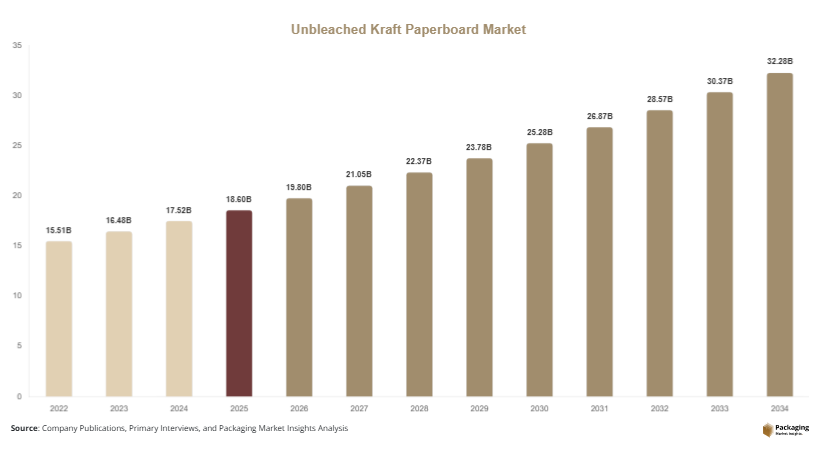
The global unbleached kraft paperboard market size was valued at approximately USD 18.6 billion in 2025 and is projected to reach USD 19.8 billion in 2026, reflecting consistent demand across food packaging, e-commerce corrugated boxes, industrial wrapping, and consumer goods packaging. Over the forecast period from 2025 to 2034, the market is expected to grow at a CAGR of 6.3%, reaching nearly USD 32.4 billion by 2034. This growth reflects increasing preference for unbleached fiber-based materials due to their natural strength, cost efficiency, and environmental compatibility.The unbleached kraft paperboard market is experiencing steady expansion as industries shift toward renewable, recyclable, and fiber-based packaging solutions.
One of the primary growth factors is the rising demand for sustainable packaging materials. Unbleached kraft paperboard is widely used due to its minimal chemical processing, making it more environmentally aligned compared to coated or bleached alternatives. Manufacturers in food, beverage, and retail industries are adopting this material to meet sustainability commitments and regulatory requirements.
Key Highlights:
- The market size reached USD 18.6 billion in 2025, supported by strong consumption across packaging-intensive industries such as e-commerce, food, and industrial goods. Demand continues to expand steadily across global supply chains.
- It is projected to reach USD 32.4 billion by 2034, driven by increasing adoption of fiber-based and recyclable packaging materials. Growth is supported by long-term sustainability shifts across industries.
- The market is expected to register a CAGR of 6.3% during 2025–2034, reflecting stable and consistent expansion. This growth is aligned with rising packaging demand in both developed and emerging economies.
- Strong demand from e-commerce, food packaging, and industrial sectors continues to support market expansion. These industries rely heavily on durable, cost-effective, and scalable packaging solutions.
- There is a growing shift toward sustainable fiber-based packaging materials as companies reduce dependence on plastic-based alternatives. This transition is driven by regulatory pressure and corporate sustainability goals.
- The market is also witnessing increasing replacement of plastic packaging with kraft paperboard solutions. This shift is strengthening demand for recyclable, renewable, and environmentally aligned packaging formats.
Explore more data points, trends and opportunities Download Free Sample Report
Market Trends
Rising Adoption of Recycled Fiber Blending in Kraft Paperboard Production
A significant trend in the unbleached kraft paperboard market is the increasing integration of recycled fibers into production processes. Manufacturers are blending virgin kraft pulp with recycled materials to reduce raw material costs and improve environmental performance. This approach supports circular economy goals and reduces pressure on forestry resources. Advanced pulping and de-inking technologies are improving fiber quality, allowing recycled blends to maintain strength and durability standards required for packaging applications. This trend is especially strong in corrugated packaging, where performance and sustainability must be balanced.
Expansion of Heavy-Duty Packaging Applications in Industrial Sectors
Another key trend is the growing use of unbleached kraft paperboard in heavy-duty industrial packaging applications. Industries such as automotive, construction, and machinery are increasingly adopting kraft-based solutions for protective wrapping, pallet liners, and export packaging. The material’s high tensile strength and resistance to tearing make it suitable for transporting heavy components. Companies are also developing multi-layer kraft paperboard formats to enhance load-bearing capacity. This trend is driven by the need for cost-efficient yet durable packaging in global supply chains, particularly in export-oriented manufacturing economies.
Market Drivers
Growth in Sustainable Packaging Regulations and Corporate Commitments
The increasing implementation of sustainability regulations is a major driver for the unbleached kraft paperboard market. Governments across North America, Europe, and parts of Asia are introducing strict guidelines to reduce plastic usage and promote recyclable materials. Unbleached kraft paperboard, being biodegradable and recyclable, aligns well with these regulatory frameworks. Additionally, multinational corporations are adopting sustainability targets that require packaging redesign. This has led to increased adoption of fiber-based materials in retail, food delivery, and industrial packaging. The combined effect of policy enforcement and corporate sustainability commitments is accelerating market growth.
Rapid Expansion of E-commerce and Retail Packaging Demand
The growth of e-commerce platforms is significantly driving demand for kraft paperboard packaging. Online retail requires durable, lightweight, and cost-effective packaging solutions that can withstand transportation and handling. Unbleached kraft paperboard is widely used in corrugated boxes and protective packaging due to its strength and affordability. The increasing frequency of online purchases, particularly in emerging markets, is expanding the need for shipping cartons and secondary packaging. Logistics companies are also investing in standardized packaging solutions, further boosting demand for kraft-based materials across global supply chains.
Market Restraint
Raw Material Supply Fluctuations and Pulp Cost Volatility
One of the key restraints in the unbleached kraft paperboard market is the fluctuation in raw material supply and pulp pricing. The production of kraft paperboard depends heavily on wood pulp, which is influenced by forestry output, seasonal variations, and global trade dynamics. Supply chain disruptions can lead to increased production costs and inconsistent material availability.
For example, in regions with strict forestry regulations, limited access to raw timber can constrain production capacity. Additionally, transportation costs and energy prices further impact manufacturing expenses. These cost fluctuations can affect pricing stability in the packaging industry, making it challenging for manufacturers to maintain consistent profit margins. Smaller producers are particularly affected, as they have limited capacity to absorb raw material price volatility.
Market Opportunities
Growth in Food Delivery and Quick-Service Restaurant Packaging
The expansion of food delivery services and quick-service restaurants presents a significant opportunity for unbleached kraft paperboard. These applications require packaging that is strong, grease-resistant, and environmentally friendly. Kraft paperboard is increasingly used for takeaway boxes, trays, and wrapping materials due to its natural composition and recyclability. As consumer demand for sustainable food packaging grows, restaurants and delivery platforms are shifting toward fiber-based alternatives. Innovations in coating technologies are also improving moisture resistance, expanding the usability of kraft paperboard in hot and cold food applications.
Technological Advancements in High-Strength Paperboard Manufacturing
Technological improvements in pulping, refining, and layering processes are creating new opportunities in the market. Manufacturers are developing high-strength unbleached kraft paperboard grades that offer enhanced compression resistance and durability. These innovations enable broader use in industrial packaging, export cartons, and heavy-duty shipping applications. Automation in paper mills is also improving production efficiency and reducing waste. As technology continues to evolve, manufacturers can achieve better performance characteristics while maintaining sustainability, opening new growth avenues in premium packaging segments.
Report Scope
| Report Metric | Details |
|---|---|
| Market Size in 2025 | USD 18.6 Billion |
| Market Size in 2026 | USD 19.8 Billion |
| Market Size in 2034 | USD 32.4 Billion |
| CAGR | 6.3% (2026-2034) |
| Base Year for Estimation | 2025 |
| Historical Data | 2022-2024 |
| Forecast Period | 2026-2034 |
| Report Coverage | Revenue Forecast, Competitive Landscape, Supply Chain Disruption, Growth Factors, Environment & Regulatory Landscape and Trends |
| Geographies Covered | North America, Europe, APAC, Middle East and Africa, LATAM |
| Countries Covered | U.S., Canada, U.K., Germany, France, Spain, Italy, Russia, Nordic, Benelux, Rest of Europe, China, South Korea, Japan, India, Australia, Singapore, Taiwan, South East Asia, Rest of Asia-Pacific, UAE, Turky, Saudi Arabia, South Africa, Egypt, Nigeria, Rest of MEA, Brazil, Mexico, Argentina, Chile, Colombia, Rest of LATAM |
Explore more data points, trends and opportunities Download Free Sample Report
Segmental Analysis
By Grade Type
The standard kraft paperboard segment dominated the market in 2024, accounting for approximately 48% share. It is widely used in corrugated boxes, packaging cartons, and industrial wrapping due to its affordability and strength. Manufacturers prefer this grade for bulk packaging applications where cost efficiency is critical. Its widespread availability and compatibility with existing packaging machinery further support its dominance across multiple industries.
The high-strength kraft paperboard segment is expected to grow fastest, with a CAGR of 7.2%. This growth is driven by increasing demand for heavy-duty packaging in logistics, automotive, and industrial sectors. Enhanced refining technologies and multi-layer fiber structures are improving load-bearing capacity, making it suitable for export packaging and high-impact applications.
By Application
Corrugated packaging dominated the market in 2024, holding around 52% share. It is extensively used in shipping boxes, retail packaging, and storage containers. Its durability and lightweight structure make it ideal for transportation and warehousing operations. The rise in global trade and e-commerce has significantly increased demand for corrugated kraft paperboard.
Industrial wrapping is expected to grow fastest at a CAGR of 6.9%. This segment benefits from increasing manufacturing activities and export packaging needs. Kraft paperboard is used for pallet wrapping, machinery protection, and bulk handling applications due to its high tear resistance.
By End-Use Industry
The food & beverage industry dominated in 2024 with approximately 45% share. Kraft paperboard is widely used for packaging dry foods, bakery items, and takeaway packaging due to its safety and recyclability. Growing demand for sustainable food packaging continues to support this segment.
The e-commerce sector is expected to grow fastest at a CAGR of 7.5%. Increasing online shopping volumes require durable and cost-effective packaging solutions. Kraft paperboard is widely used for shipping cartons, protective packaging, and returnable packaging systems.
Unbleached Kraft Paperboard Market Segmentations
By Grade Type
- Standard Kraft Paperboard
- High-Strength Kraft Paperboard
- Recycled Kraft Paperboard
By Application
- Corrugated Packaging
- Industrial Wrapping
- Retail Packaging
- Protective Packaging
By End-Use Industry
- Food & Beverage
- E-commerce & Logistics
- Industrial & Manufacturing
- Retail & Consumer Goods
Regional Analysis
North America
North America accounted for approximately 24% market share in 2025, with a projected CAGR of 5.8% during the forecast period. The region shows strong demand from e-commerce, retail, and food packaging industries. Sustainability initiatives and corporate ESG commitments are supporting adoption of kraft paperboard materials across multiple sectors.
The United States dominates the region due to its large packaging consumption base and advanced logistics infrastructure. A key growth factor is the expansion of online retail distribution centers, which require large volumes of corrugated and kraft-based packaging solutions for shipping and storage.
Europe
Europe held around 27% market share in 2025, with a CAGR of 6.1%. The region is strongly influenced by environmental regulations and circular economy initiatives. Unbleached kraft paperboard is widely used due to its recyclability and compliance with packaging waste directives.
Germany leads the European market due to its strong industrial base and packaging innovation ecosystem. A unique growth factor is the high adoption of paper-based industrial packaging in automotive and machinery exports, supporting sustained demand.
Asia Pacific
Asia Pacific accounted for approximately 32% market share in 2025, with the highest CAGR of 7.4%. Rapid industrialization, urbanization, and growth in e-commerce are major contributors. Rising consumer demand for packaged goods is also driving kraft paperboard consumption.
China dominates the region due to large-scale manufacturing and export activities. A key growth factor is the expansion of domestic logistics networks, which increases demand for durable corrugated and kraft packaging materials.
Middle East & Africa
The Middle East & Africa region held about 9% market share in 2025, growing at a CAGR of 5.5%. The market is expanding due to increasing retail development and food import activities. Demand for sustainable packaging is gradually increasing across urban centers.
Saudi Arabia leads the region due to rapid growth in retail and food distribution sectors. A unique growth factor is the development of large-scale infrastructure projects, which increases demand for industrial packaging materials.
Latin America
Latin America accounted for approximately 8% market share in 2025, with a CAGR of 6.0%. Growth is supported by expanding food processing industries and rising e-commerce penetration. The region is increasingly adopting fiber-based packaging solutions.
Brazil dominates the market due to its strong agricultural and food export industries. A key growth factor is the expansion of export-oriented packaging requirements, which increases demand for durable kraft paperboard materials.
Competitive Landscape
The unbleached kraft paperboard market is moderately consolidated, with key players focusing on capacity expansion, recycling integration, and product innovation. Major companies are investing in advanced pulping technologies to improve fiber efficiency and reduce production costs. Competition is primarily based on strength performance, pricing, and sustainability compliance.
Stora Enso is one of the leading players in the market, known for its strong presence in fiber-based packaging solutions. Recently, the company expanded its production capacity for kraft paperboard in Europe to support growing demand from e-commerce and industrial sectors. Other key players are focusing on acquisitions and sustainability-driven product development.
Key Players List
- Stora Enso
- International Paper Company
- Mondi Group
- Smurfit Kappa Group
- WestRock Company
- DS Smith Plc
- Nippon Paper Industries
- Oji Holdings Corporation
- Packaging Corporation of America
- Sappi Limited
- Georgia-Pacific LLC
- Mondi plc Packaging Division
- Nine Dragons Paper Holdings
- Canfor Corporation
- West Fraser Timber Co. Ltd.