Tuck End Box Market Size and Growth
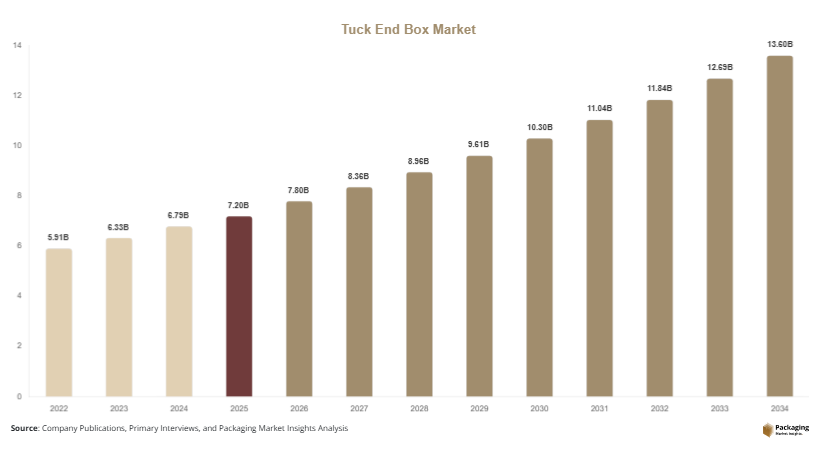
The tuck end box market is experiencing steady growth due to rising demand for cost-effective, customizable, and visually appealing packaging solutions across industries such as food & beverages, cosmetics, pharmaceuticals, and consumer goods. Tuck end boxes, characterized by their easy-to-assemble flaps that tuck into the box, offer convenience, structural integrity, and aesthetic flexibility. The global market size was valued at approximately USD 7.2 billion in 2025 and is projected to reach USD 7.8 billion in 2026, reflecting consistent expansion driven by packaging innovation and increasing retail demand. By 2034, the market is expected to grow to USD 14.6 billion, registering a CAGR of 7.2% during 2025–2034.
One of the primary growth factors is the expansion of the e-commerce sector, which has significantly increased demand for protective and visually attractive packaging. Tuck end boxes are widely used for shipping and retail display due to their durability and ease of handling. Another key factor is the growing emphasis on branding and product differentiation. Companies are investing in customized packaging designs to enhance consumer engagement and improve shelf appeal. Tuck end boxes provide ample space for printing and branding, making them a preferred choice.
Key Highlights:
- Market size is projected to grow from USD 7.2 billion in 2025 to USD 14.6 billion by 2034, reflecting steady expansion in the packaging industry. This growth is supported by rising demand for efficient and visually appealing packaging solutions.
- The market is expected to register a CAGR of 7.2% during the forecast period from 2025 to 2034. This indicates consistent growth driven by increasing investments in packaging innovation and materials.
- Increasing demand from e-commerce and retail packaging sectors is a major growth factor. These industries require durable, lightweight, and customizable packaging for safe product delivery and enhanced shelf appeal.
- Growing adoption of sustainable and customizable packaging solutions is further boosting market demand. Companies are focusing on eco-friendly materials and personalized designs to meet consumer preferences and regulatory requirements.
Explore more data points, trends and opportunities Download Free Sample Report
Market Trends
Rising Adoption of Sustainable Packaging Materials
The increasing focus on environmental sustainability is driving the adoption of eco-friendly materials in the tuck end box market. Manufacturers are shifting from plastic-based packaging to paperboard and biodegradable materials to reduce environmental impact. This transition is supported by regulatory frameworks that promote sustainable packaging practices. Additionally, consumers are becoming more environmentally conscious, influencing purchasing decisions. Companies are responding by offering recyclable and compostable tuck end boxes that meet both functional and environmental requirements. This trend is expected to continue as sustainability becomes a key priority across industries.
Growth of Customization and Digital Printing Technologies
Customization and digital printing technologies are transforming the tuck end box market. Businesses are increasingly focusing on personalized packaging to enhance brand identity and attract customers. Digital printing allows for high-quality graphics, quick turnaround times, and cost-effective production of small batches. This is particularly beneficial for e-commerce and niche brands that require unique packaging solutions. Additionally, advancements in printing technology are enabling the use of vibrant colors and intricate designs, improving the visual appeal of tuck end boxes. As competition intensifies, the demand for customized packaging is expected to grow.
Market Drivers
Expansion of E-commerce and Retail Sectors
The rapid growth of e-commerce and retail sectors is a major driver for the tuck end box market. Online shopping has increased the need for durable and lightweight packaging solutions that can protect products during transit. Tuck end boxes offer ease of assembly, secure closure, and cost efficiency, making them suitable for e-commerce applications. Additionally, retail stores rely on attractive packaging to enhance product visibility and influence consumer purchasing decisions. The expansion of online marketplaces and organized retail is expected to drive demand for tuck end boxes.
Increasing Demand for Cost-Effective Packaging Solutions
Cost efficiency is a key factor driving the adoption of tuck end boxes. These boxes are easy to manufacture and assemble, reducing labor and production costs. Their lightweight nature also helps in minimizing transportation expenses. Additionally, tuck end boxes can be produced in various sizes and designs, providing flexibility for different applications. Industries such as food and beverages and personal care are increasingly adopting these boxes to optimize packaging costs while maintaining product quality. This trend is expected to support market growth.
Market Restraint
Limited Durability for Heavy-Duty Applications
One of the primary restraints in the tuck end box market is the limited durability of these boxes for heavy-duty applications. While tuck end boxes are suitable for lightweight and medium-weight products, they may not provide sufficient strength for heavier items. This limitation can restrict their use in industries that require robust packaging solutions, such as industrial goods and heavy machinery. For example, products with high weight or fragile components may require reinforced packaging, which increases costs and complexity. As a result, some companies may opt for alternative packaging solutions such as corrugated boxes with additional support. This challenge may limit market growth in certain segments.
Market Opportunities
Growth in Sustainable Packaging Innovations
The development of sustainable packaging innovations presents significant opportunities for the tuck end box market. Manufacturers are investing in research and development to create eco-friendly materials that offer durability and recyclability. Innovations such as water-based coatings, biodegradable inks, and recyclable adhesives are enhancing the environmental performance of tuck end boxes. These advancements are attracting environmentally conscious consumers and businesses. As sustainability becomes a key focus, companies that adopt eco-friendly packaging solutions are likely to gain a competitive advantage.
Increasing Demand from Emerging Markets
Emerging markets offer substantial growth opportunities for the tuck end box market. Rapid urbanization, rising disposable income, and expanding retail sectors are driving demand for packaged goods in regions such as Asia Pacific and Latin America. These regions are experiencing a shift toward modern retail formats and branded products, which require attractive packaging solutions. Tuck end boxes provide a cost-effective and versatile option for manufacturers in these markets. As economic growth continues, the demand for packaging solutions is expected to increase.
Report Scope
| Report Metric | Details |
|---|---|
| Market Size in 2025 | USD 7.2 Billion |
| Market Size in 2026 | USD 7.8 Billion |
| Market Size in 2034 | USD 14.6 Billion |
| CAGR | 7.2% (2026-2034) |
| Base Year for Estimation | 2025 |
| Historical Data | 2022-2024 |
| Forecast Period | 2026-2034 |
| Report Coverage | Revenue Forecast, Competitive Landscape, Supply Chain Disruption, Growth Factors, Environment & Regulatory Landscape and Trends |
| Geographies Covered | North America, Europe, APAC, Middle East and Africa, LATAM |
| Countries Covered | U.S., Canada, U.K., Germany, France, Spain, Italy, Russia, Nordic, Benelux, Rest of Europe, China, South Korea, Japan, India, Australia, Singapore, Taiwan, South East Asia, Rest of Asia-Pacific, UAE, Turky, Saudi Arabia, South Africa, Egypt, Nigeria, Rest of MEA, Brazil, Mexico, Argentina, Chile, Colombia, Rest of LATAM |
Explore more data points, trends and opportunities Download Free Sample Report
Segmental Analysis
By Type
The straight tuck end boxes segment dominated the tuck end box market in 2024, accounting for approximately 49% of the market share. These boxes are widely used due to their clean design and ease of assembly. They provide a secure closure and are suitable for a variety of products, including cosmetics and pharmaceuticals. The ability to create visually appealing designs is driving the adoption of this segment.
The reverse tuck end boxes segment is expected to be the fastest-growing, with a CAGR of 7.8% during the forecast period. These boxes offer improved structural strength and are suitable for heavier products. The increasing demand for durable packaging solutions is driving the growth of this segment.
By Application
The food and beverages segment held the largest share of the tuck end box market in 2024, accounting for approximately 51% of the market. Tuck end boxes are widely used for packaging snacks, bakery products, and ready-to-eat meals. Their ability to maintain product freshness and provide attractive presentation is driving demand.
The cosmetics segment is projected to be the fastest-growing, with a CAGR of 7.6% during the forecast period. The increasing demand for premium and customized packaging is driving the adoption of tuck end boxes in this segment.
By End-Use
The retail sector dominated the tuck end box market in 2024, accounting for approximately 53% of the market share. Retailers rely on attractive packaging to enhance product visibility and influence purchasing decisions. Tuck end boxes offer flexibility in design and branding, making them suitable for retail applications.
The e-commerce sector is expected to be the fastest-growing, with a CAGR of 8.0% during the forecast period. The increasing popularity of online shopping is driving demand for durable and lightweight packaging solutions. Tuck end boxes are well-suited for e-commerce applications due to their ease of handling and cost efficiency.
Tuck End Box Market Segmentations
By Type
- Straight Tuck End Boxes
- Reverse Tuck End Boxes
By Application
- Food & Beverages
- Cosmetics
- Pharmaceuticals
- Consumer Goods
By End-Use
- Retail
- E-commerce
- Others
Regional Analysis
North America
North America accounted for approximately 28% of the tuck end box market share in 2025 and is expected to grow at a CAGR of 6.5% during the forecast period. The region benefits from a well-established packaging industry and strong demand from e-commerce and retail sectors. Advanced printing technologies and sustainable packaging initiatives are supporting market growth. Additionally, the presence of major packaging companies is contributing to the development of innovative solutions.
The United States dominates the North American market due to its large consumer base and developed retail infrastructure. A unique growth factor in the region is the increasing demand for premium packaging solutions in the cosmetics and personal care industries. This demand is driving the adoption of high-quality tuck end boxes.
Europe
Europe held a market share of approximately 25% in 2025 and is projected to grow at a CAGR of 6.3% through 2034. The region’s growth is driven by strict environmental regulations and a strong focus on sustainability. The demand for recyclable packaging materials is increasing across industries.
Germany is a key market in Europe, supported by its advanced manufacturing sector. A unique growth factor in the region is the emphasis on circular economy practices, which promote the use of sustainable packaging solutions. This trend is encouraging the adoption of tuck end boxes.
Asia Pacific
Asia Pacific is the fastest-growing region, accounting for approximately 32% of the global market share in 2025 and projected to grow at a CAGR of 8.1%. The region’s growth is driven by rapid urbanization, increasing disposable income, and expanding e-commerce activities.
China dominates the Asia Pacific market due to its large manufacturing base and growing consumer market. A unique growth factor is the increasing demand for packaged food and consumer goods, which is driving the adoption of tuck end boxes.
Middle East & Africa
The Middle East & Africa region accounted for approximately 7% of the market share in 2025 and is expected to grow at a CAGR of 7.0%. The market is driven by increasing retail activities and improving economic conditions.
Saudi Arabia is a leading market in the region, supported by investments in retail and infrastructure. A unique growth factor is the growing demand for packaged food products, which is driving the adoption of tuck end boxes.
Latin America
Latin America held around 8% of the market share in 2025 and is projected to grow at a CAGR of 7.4% during the forecast period. The region’s growth is driven by expanding retail and food industries.
Brazil dominates the Latin American market due to its large population and growing consumer base. A unique growth factor is the increasing demand for affordable packaging solutions, which is driving the adoption of tuck end boxes.
Competitive Landscape
The tuck end box market is moderately competitive, with several global and regional players focusing on product innovation and sustainability. Companies are investing in advanced printing technologies and eco-friendly materials to meet evolving customer demands. Strategic partnerships and mergers are common strategies adopted by market players to expand their market presence.
WestRock Company is a leading player in the market, known for its innovative packaging solutions. The company recently introduced sustainable tuck end box designs made from recyclable materials. Other major players are also focusing on developing customized packaging solutions to enhance brand value and customer experience.
Key Players List
- WestRock Company
- International Paper Company
- Smurfit Kappa Group
- Mondi Group
- DS Smith Plc
- Graphic Packaging International
- Amcor Plc
- Huhtamaki Oyj
- Sonoco Products Company
- UFP Technologies, Inc.
- Mayr-Melnhof Karton AG
- Stora Enso Oyj
- Packaging Corporation of America
- KapStone Paper and Packaging Corporation
- Pratt Industries