Tube Sealing Machines Market Size
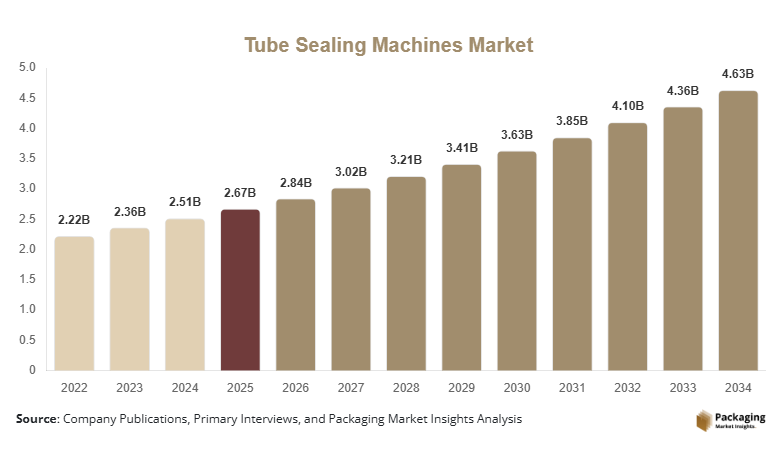
The tube sealing machines market size is projected at USD 2.84 billion in 2026 and is expected to hit USD 4.62 billion by 2034 with a CAGR of 6.3%. Rising investments in automated packaging equipment, increasing production of pharmaceutical and cosmetic tubes, and expansion of high-speed manufacturing lines continue to support market expansion. The report provides detailed analysis of market segmentation, technological developments, manufacturing capacity, and the competitive landscape across major regions.
Tube sealing machines are packaging systems designed to seal plastic, laminate, and aluminum tubes used for creams, ointments, gels, toothpaste, adhesives, and food products. Global production exceeded 186,000 machines in 2025, while automatic systems accounted for approximately 58% of total installations. Pharmaceutical applications contributed nearly 39% of equipment demand, cosmetics represented 36%, and food packaging accounted for 15%. Automated tube filling and sealing line adoption surpassed 68% among large-scale manufacturers, reinforcing the tube sealing machines market.
Explore more data points, trends and opportunities Download Free Sample Report
Tube Sealing Machines Trends
Growing Adoption of Fully Automated Packaging Equipment
Manufacturers are increasingly deploying fully automated tube sealing systems to improve productivity and reduce labor costs. More than 68,000 automatic machines were installed globally by 2026, while production efficiency improved by approximately 23% compared with conventional systems. Servo-driven sealing technology adoption exceeded 44%, allowing higher sealing precision and production speeds exceeding 120 tubes per minute, strengthening the tube sealing machines market.
Integration of Industry 4.0 technologies, touchscreen controls, and intelligent quality inspection systems continues to reshape packaging operations. Smart monitoring systems increased by 27% during 2025, while predictive maintenance reduced equipment downtime by nearly 18%. Global machine production exceeded 194,000 units in 2026, supporting continued tube sealing machine market expansion.
Tube Sealing Machines Market Drivers
Increasing Demand for Automated Pharmaceutical and Cosmetic Packaging
Growing production of pharmaceutical creams, cosmetic products, oral care products, and topical medicines is accelerating equipment demand worldwide. Global tube packaging production exceeded 42 billion tubes annually, while automated packaging lines increased by 9.2% during 2025. Manufacturers adopting automatic sealing systems reported labor savings of approximately 25% and production capacity improvements exceeding 30%, supporting sustained industry expansion.
Tube Sealing Machines Market Restraints
High Initial Equipment Investment
Advanced automatic tube sealing machines require significant capital investment ranging from USD 80,000 to over USD 500,000 depending on production capacity. Maintenance costs account for nearly 11% of annual operating expenses, while small manufacturers representing approximately 38% of industry participants often delay automation because of financial constraints.
Tube Sealing Machines Market Opportunities
Expansion of Sustainable Tube Packaging Production
Increasing use of recyclable plastic tubes and mono-material laminate packaging creates new opportunities for machine manufacturers. Sustainable tube production increased by 22% during 2025, while demand for adaptable sealing systems capable of handling recyclable materials grew by approximately 19%. Investments in flexible packaging automation continue expanding across pharmaceutical and cosmetics manufacturing facilities.
Challenges in Tube Sealing Machines Market
Compatibility with Diverse Tube Materials
Manufacturers face challenges in designing machines capable of sealing plastic, aluminum, biodegradable, and multilayer laminate tubes without compromising productivity. Nearly 43% of equipment suppliers identify material compatibility as a major engineering challenge, while advanced sealing technologies increase manufacturing costs by approximately 14% compared with conventional systems.
Report Scope
| Report Metric | Details |
|---|---|
| Market Size in 2025 | USD 2.67 Billion |
| Market Size in 2026 | USD 2.84 Billion |
| Market Size in 2034 | USD 4.62 Billion |
| CAGR | 6.3% (2026-2034) |
| Base Year for Estimation | 2025 |
| Historical Data | 2022-2024 |
| Forecast Period | 2026-2034 |
| Report Coverage | Revenue Forecast, Competitive Landscape, Supply Chain Disruption, Growth Factors, Environment & Regulatory Landscape and Trends |
| Geographies Covered | North America, Europe, APAC, Middle East and Africa, LATAM |
| Countries Covered | U.S., Canada, U.K., Germany, France, Spain, Italy, Russia, Nordic, Benelux, Rest of Europe, China, South Korea, Japan, India, Australia, Singapore, Taiwan, South East Asia, Rest of Asia-Pacific, UAE, Turky, Saudi Arabia, South Africa, Egypt, Nigeria, Rest of MEA, Brazil, Mexico, Argentina, Chile, Colombia, Rest of LATAM |
Explore more data points, trends and opportunities Download Free Sample Report
Tube Sealing Machines Market Segmentation
The market is segmented according to machine type and end-use industry. Automatic tube sealing machines account for approximately 58% of total installations, while pharmaceutical manufacturing contributes nearly 39% of global equipment demand due to stringent packaging quality requirements.
By Type
Automatic tube sealing machines account for approximately 58% of global installations, with annual production exceeding 108,000 units. These systems support production speeds above 120 tubes per minute, offering automated feeding, sealing, coding, and quality inspection for high-volume manufacturing.
Semi-automatic machines contribute nearly 29% of total production, exceeding 54,000 units annually. They provide flexible operation for medium-scale manufacturers while reducing labor requirements and maintaining consistent sealing quality.
Manual tube sealing machines represent approximately 13% of global demand, with production exceeding 24,000 units annually. These systems remain suitable for laboratory applications, pilot production, and small-batch manufacturing requiring lower capital investment.
By Application
Pharmaceutical applications account for approximately 39% of total equipment demand, supporting production of ointments, creams, gels, and medicated formulations. Annual tube packaging output exceeds 16 billion units, with automated filling and sealing adoption surpassing 72% among large pharmaceutical manufacturers.
Cosmetics and personal care contribute nearly 36% of market demand, with production exceeding 15 billion tubes annually. Tube sealing machines are widely used for toothpaste, lotions, creams, shampoos, and skincare products while ensuring leak-proof and aesthetically consistent packaging.
Food and beverage applications account for approximately 15% of equipment demand, exceeding 6 billion packaged tubes annually. Tube packaging is increasingly utilized for sauces, condiments, chocolate pastes, and specialty food products requiring hygienic sealing.
Tube Sealing Machines Market Segmentations
Machine Type
- Automatic
- Semi-Automatic
- Manual
End-Use Industry
- Pharmaceuticals
- Cosmetics & Personal Care
- Food & Beverage
Tube Sealing Machines Regional Outlook
North America
North America accounts for approximately 30% of global demand, with more than 58,000 machines installed across pharmaceutical and cosmetics manufacturing facilities. The United States contributes nearly 82% of regional equipment sales, supported by advanced automation investments.
Europe
Europe represents approximately 29% of the market, with Germany, Italy, France, and the United Kingdom accounting for more than 73% of regional demand. Strong pharmaceutical manufacturing and machinery engineering capabilities continue supporting equipment innovation.
Asia-Pacific
Asia-Pacific holds approximately 34% of global consumption and installed more than 66,000 machines during 2026. China contributes approximately 45% of regional demand, followed by India, Japan, and South Korea. Expanding pharmaceutical manufacturing and cosmetics production continues driving equipment installations.
Latin America
Latin America contributes approximately 4% of global demand. Brazil and Mexico account for nearly 69% of regional machine installations, supported by expanding consumer goods manufacturing.
Middle East & Africa
The Middle East & Africa represent approximately 3% of the market, with increasing pharmaceutical production and packaged consumer goods manufacturing supporting steady equipment demand.
Top Players In The Tube Sealing Machines Market
- IWK Verpackungstechnik GmbH
- Axomatic S.r.l.
- Norden Machinery AB
- ProSys Fill LLC
- Accutek Packaging Equipment Companies, Inc.
- Pack Leader Machinery Inc.
- Marchesini Group S.p.A.
- Romaco Group
- TurboFil Packaging Machines LLC
- APACKS
- Shanghai Joygoal Food Machinery Co., Ltd.
- NK Industries.
IWK Verpackungstechnik GmbH Estimated market share: 16%–18% Leading supplier of high-speed tube filling and sealing systems for pharmaceutical and personal care industries. Strong expertise in automated packaging technologies with production speeds exceeding 120 tubes per minute. Extensive global installation base supported by advanced engineering and customized manufacturing solutions. Continuous investment in digital automation, intelligent inspection systems, and sustainable packaging compatibility. Norden Machinery AB Estimated market share: 13%–15% Global leader specializing in precision tube filling and sealing machinery for pharmaceutical, cosmetics, and food applications. Strong focus on Industry 4.0 integration, energy-efficient systems, and flexible manufacturing solutions. Broad international distribution network with continuous product innovation supporting high-speed packaging operations. Significant investment in equipment capable of processing recyclable and mono-material tube packaging.