Tube Closures Market Size
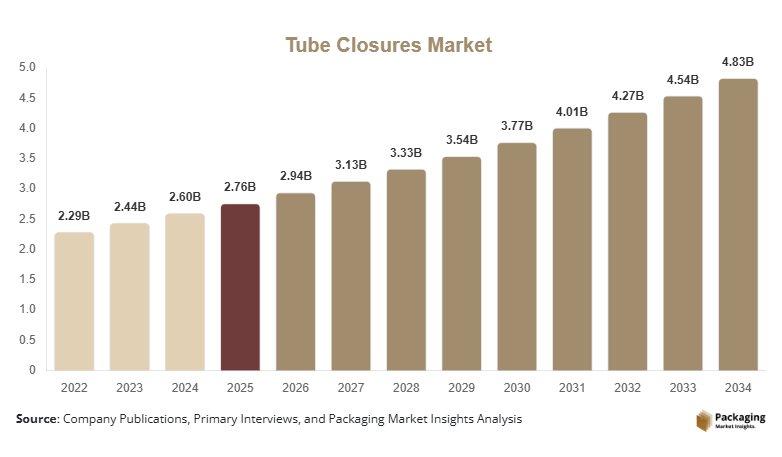
Tube closures' market size is projected at USD 2.94 billion in 2026 and is expected to hit USD 4.82 billion by 2034 with a CAGR of 6.4%. Rising consumption of tube-packaged personal care products, pharmaceutical formulations, and food products continues to support market expansion. The report evaluates production capacity, product innovation, material developments, application trends, and the competitive landscape across major manufacturing regions.
Tube closures are dispensing components designed for laminated, plastic, and aluminum tubes used in cosmetics, pharmaceuticals, food products, adhesives, and industrial formulations. Global production exceeded 32.8 billion units in 2025, while flip-top closures accounted for approximately 54% of total output, screw closures represented 29%, and nozzle closures contributed nearly 17%. Personal care applications generated around 51% of total consumption, while recyclable closure adoption exceeded 39%, reinforcing the tube closures market.
Explore more data points, trends and opportunities Download Free Sample Report
Tube Closures Market Trends
Increasing Adoption of Sustainable and Lightweight Closure Designs
Manufacturers are introducing lightweight polypropylene and polyethylene closures that reduce resin consumption by approximately 14% while maintaining sealing performance. Annual production of recyclable tube closures exceeded 12.4 billion units during 2025, and the use of post-consumer recycled materials increased beyond 27%. Sustainability initiatives and mono-material packaging developments continue strengthening the tube closures market.
Digital manufacturing technologies and automated injection molding systems are improving production efficiency across global facilities. High-speed molding lines now produce over 850 closures per minute, while automated quality inspection adoption surpassed 81%. Tamper-evident closures, precision dispensing designs, and child-resistant solutions continue supporting premium packaging applications and the tube closures market.
Tube Closures Market Drivers
Growing Demand from Personal Care and Pharmaceutical Packaging
Global personal care tube production exceeded 18 billion units, while pharmaceutical tube packaging surpassed 7.5 billion units annually. Consumer demand for hygienic dispensing solutions increased by approximately 16%, and premium cosmetic packaging adoption grew by nearly 13%. These developments continue driving the tube closures market.
Tube Closures Market Restraints
Fluctuating Polymer Prices and Regulatory Compliance
Polypropylene and polyethylene resin prices fluctuated between 10% and 18% during recent years, increasing manufacturing costs. Compliance with packaging sustainability regulations and food-contact safety standards has increased production expenditures by nearly 9%, while raw material volatility continues affecting profitability within the tube closures market.
Tube Closures Market Opportunities
Expansion of Recyclable Mono-Material Tube Packaging
Demand for mono-material tube packaging solutions is increasing by over 15% annually, while recyclable closure adoption expanded by approximately 21%. Investments exceeding USD 420 million in sustainable injection molding technologies, recycled polymers, and lightweight closure development continue creating opportunities across the tube closures market.
Challenges in Tube Closures Market
Maintaining Precision and Leak-Proof Performance
Manufacturers produce more than 32 billion tube closures annually while maintaining dimensional tolerances within ±0.15 mm. Leak-proof sealing efficiency above 99%, compatibility with multiple tube materials, and high-speed manufacturing consistency remain significant technical challenges. Continuous automation and process optimization are essential for maintaining competitiveness across the tube closures market.
Report Scope
| Report Metric | Details |
|---|---|
| Market Size in 2025 | USD 2.76 Billion |
| Market Size in 2026 | USD 2.94 Billion |
| Market Size in 2034 | USD 4.82 Billion |
| CAGR | 6.4% (2026-2034) |
| Base Year for Estimation | 2025 |
| Historical Data | 2022-2024 |
| Forecast Period | 2026-2034 |
| Report Coverage | Revenue Forecast, Competitive Landscape, Supply Chain Disruption, Growth Factors, Environment & Regulatory Landscape and Trends |
| Geographies Covered | North America, Europe, APAC, Middle East and Africa, LATAM |
| Countries Covered | U.S., Canada, U.K., Germany, France, Spain, Italy, Russia, Nordic, Benelux, Rest of Europe, China, South Korea, Japan, India, Australia, Singapore, Taiwan, South East Asia, Rest of Asia-Pacific, UAE, Turky, Saudi Arabia, South Africa, Egypt, Nigeria, Rest of MEA, Brazil, Mexico, Argentina, Chile, Colombia, Rest of LATAM |
Explore more data points, trends and opportunities Download Free Sample Report
Tube Closures Market Segmentation
The market is segmented by type and application according to dispensing functionality and end-use industries. Flip-top closures account for approximately 54% of market demand, while personal care & cosmetics contribute nearly 51% of global consumption because of convenience, hygiene, and consumer preference.
By Type
Flip-top closures represent approximately 54% of the global market, with annual production exceeding 17.7 billion units. These closures provide one-handed operation, leak resistance, and repeated opening performance exceeding 5,000 cycles. They are extensively used in shampoos, creams, lotions, and toothpaste packaging.
Screw closures contribute nearly 29% of total demand, with production surpassing 9.5 billion units annually. Featuring threaded designs with diameters ranging from 16 mm to 50 mm, they deliver secure sealing and are widely utilized for pharmaceutical ointments, adhesives, and cosmetic creams.
Nozzle closures account for approximately 17% of market consumption, exceeding 5.6 billion units annually. Precision dispensing capabilities, narrow outlet diameters between 1 mm and 5 mm, and controlled product flow make them suitable for gels, adhesives, medicinal products, and specialty food applications.
By Application
Personal care & cosmetics account for approximately 51% of global demand, consuming over 16.7 billion closures annually. High consumer preference for hygienic dispensing, premium appearance, and ease of use has increased adoption beyond 74% across skincare, haircare, and oral care products.
Pharmaceutical applications contribute nearly 28% of market demand, with annual consumption exceeding 9.2 billion closures. These closures provide tamper evidence, chemical resistance, and leak-proof performance while supporting ointments, gels, creams, and topical medicines with adoption rates above 67%.
Food & beverage applications represent approximately 21% of total consumption, utilizing over 6.9 billion closures annually. Products including sauces, condiments, honey, and nutritional gels increasingly rely on precision dispensing closures that improve convenience and reduce product waste.
Tube Closures Market Segmentations
Product Type
- Flip-Top Closures
- Screw Closures
- Nozzle Closures
Application
- Personal Care & Cosmetics
- Pharmaceuticals
- Food & Beverage
Distribution Channel
- Direct Sales
- Packaging Distributors
- Online B2B Platforms
- Industrial Packaging Suppliers
- Wholesale Packaging Suppliers
Tube Closures Regional Outlook
Asia-Pacific
Asia-Pacific accounts for approximately 44% of global market revenue and manufactures more than 14.6 billion closures annually. China contributes nearly 61% of regional production, followed by India, Japan, and South Korea. Expanding cosmetics and pharmaceutical manufacturing continue driving regional demand.
Europe
Europe represents approximately 24% of global consumption. Germany, France, Italy, and the United Kingdom collectively account for over 70% of regional production. Sustainable packaging regulations continue accelerating adoption of recyclable tube closures.
North America
North America contributes nearly 22% of global revenue, producing over 7.1 billion closures annually. The United States accounts for approximately 83% of regional demand, supported by premium personal care brands and pharmaceutical packaging.
Latin America
Latin America represents approximately 6% of the market. Brazil and Mexico contribute more than 68% of regional production, supported by expanding cosmetics manufacturing and food processing industries.
Middle East & Africa
The Middle East & Africa account for approximately 4% of global demand. Increasing healthcare investments, personal care consumption, and packaged food production continue supporting gradual market expansion.
Top Players in Tube Closures Market
- Berry Global Inc.
- AptarGroup, Inc.
- Silgan Holdings Inc.
- Albéa Group
- Amcor plc
- Closure Systems International, Inc.
- Weener Plastics Group
- Bericap Holding GmbH
- TekniPlex, Inc.
- United Caps
- Menshen Packaging
- Georg MENSHEN GmbH & Co. KG
Berry Global Inc.
- Estimated global market share of approximately 13%.
- Leading manufacturer of plastic packaging and closure systems.
- The company offers a broad portfolio of flip-top, screw, and dispensing closures for personal care, healthcare, food, and industrial applications. Investments in lightweight packaging, recycled polymers, and high-speed injection molding technologies have strengthened manufacturing efficiency and sustainability. Its global production footprint and continuous product innovation enable strong positioning across developed and emerging packaging markets.
AptarGroup, Inc.
- Estimated global market share of approximately 11%.
- Global leader in dispensing and closure technologies.
- AptarGroup specializes in advanced dispensing systems, precision closures, and sustainable packaging solutions for cosmetics, pharmaceuticals, and food products. The company focuses on recyclable mono-material designs, smart dispensing innovations, and consumer-friendly packaging. Ongoing investments in research, automation, and environmentally responsible manufacturing continue reinforcing its competitive position across the global tube closure industry.