Transparent Barrier Packaging Films Market Size and Growth
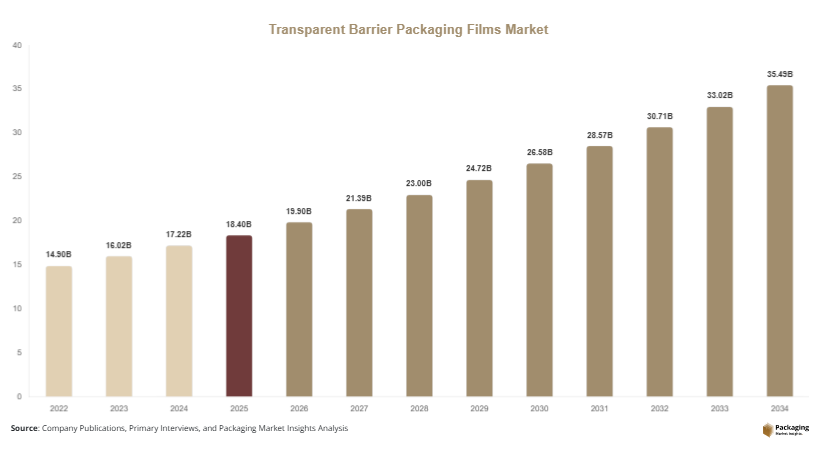
The global Transparent Barrier Packaging Films Market size reached approximately USD 18.4 billion in 2025 and is projected to grow to USD 19.9 billion in 2026. Over the forecast period, the market is expected to attain a value of USD 37.6 billion by 2034, registering a CAGR of 7.5% from 2025 to 2034. This growth reflects the rising need for packaging materials that offer moisture, oxygen, and UV protection while maintaining product visibility for consumers. The transparent barrier packaging films market is witnessing consistent expansion driven by the increasing demand for high-performance packaging solutions that combine visibility with protection.
Transparent barrier films are widely used across food, pharmaceutical, personal care, and electronics packaging applications. The ability of these films to extend shelf life while allowing visual inspection of products has made them highly attractive for manufacturers and retailers. In the food sector, transparent barrier films are extensively used for fresh produce, dairy products, snacks, and ready-to-eat meals. Similarly, pharmaceutical packaging relies on these films to maintain product integrity and prevent contamination.
Key Highlights:
- The market size reached USD 18.4 billion in 2025, reflecting steady growth driven by increasing demand for advanced packaging solutions. The rising need for product protection and visibility is supporting market expansion.
- The market is expected to grow at a CAGR of 7.5% from 2025 to 2034, indicating stable long-term growth. Continuous innovation in packaging materials and technologies is contributing to this upward trend.
- The forecast value is projected to reach USD 37.6 billion by 2034, driven by expanding applications across multiple industries. Growth in global trade and packaged goods consumption is further supporting this increase.
- Strong demand from food and pharmaceutical sectors is a key growth factor. These industries require packaging that ensures product safety, extended shelf life, and compliance with regulatory standards.
- Increasing adoption of sustainable and high-barrier materials is shaping the market. Manufacturers are focusing on eco-friendly solutions that offer improved performance while reducing environmental impact.
Explore more data points, trends and opportunities Download Free Sample Report
Market Trends
Growing Adoption of Sustainable Transparent Films
The shift toward sustainable packaging is a prominent trend shaping the transparent barrier packaging films market. Manufacturers are increasingly focusing on developing recyclable, compostable, and bio-based films to reduce environmental impact. Consumers are becoming more aware of plastic waste and are demanding eco-friendly packaging solutions. As a result, companies are investing in research and development to create films that maintain high barrier performance while being environmentally responsible. Innovations in mono-material structures and biodegradable coatings are gaining traction, enabling easier recycling processes. This trend is expected to continue as governments implement stricter regulations on single-use plastics and promote circular economy practices across packaging industries.
Advancements in Multi-Layer and Nano-Coating Technologies
Technological advancements in multi-layer film structures and nano-coating technologies are significantly influencing market growth. These innovations enhance barrier properties such as resistance to oxygen, moisture, and light without compromising transparency. Multi-layer films combine different materials to achieve superior performance, making them suitable for complex packaging requirements. Nano-coatings, on the other hand, provide ultra-thin protective layers that improve durability and extend shelf life. These technologies are particularly beneficial in food and pharmaceutical applications, where product safety and longevity are critical. The increasing adoption of these advanced solutions is expected to drive product differentiation and improve overall market competitiveness.
Market Drivers
Rising Demand for Packaged and Convenience Foods
The increasing consumption of packaged and convenience foods is a major driver of the transparent barrier packaging films market. Rapid urbanization, busy lifestyles, and changing dietary habits have led to a growing preference for ready-to-eat and processed food products. These products require packaging solutions that ensure freshness, safety, and extended shelf life. Transparent barrier films provide an ideal solution by offering protection against moisture, oxygen, and contaminants while allowing consumers to view the product. The expansion of retail chains and online grocery platforms is further boosting demand, as visually appealing packaging plays a crucial role in purchasing decisions.
Growth in Pharmaceutical and Healthcare Packaging
The pharmaceutical and healthcare industries are experiencing significant growth, driving the demand for high-performance packaging materials. Transparent barrier films are widely used in medical packaging for products such as tablets, capsules, and diagnostic kits. These films help maintain product stability and prevent contamination, ensuring compliance with regulatory standards. The increasing prevalence of chronic diseases and the growing need for advanced medical treatments are contributing to higher demand for pharmaceutical packaging. Additionally, the rise of home healthcare and telemedicine is creating new opportunities for packaging solutions that are safe, reliable, and easy to use.
Market Restraint
High Cost of Advanced Barrier Materials
One of the key challenges in the transparent barrier packaging films market is the high cost associated with advanced barrier materials and technologies. Multi-layer films, nano-coatings, and high-performance polymers require significant investment in raw materials and manufacturing processes. This increases the overall cost of production, making these solutions less accessible for small and medium-sized enterprises. Additionally, fluctuations in raw material prices, particularly petrochemical-based plastics, can impact profit margins and pricing strategies.
The high cost also affects adoption in price-sensitive markets, where manufacturers may opt for conventional packaging materials instead of advanced barrier films. For example, small food processing units in developing regions often rely on low-cost packaging solutions, limiting the penetration of high-performance films. Furthermore, the complexity of recycling multi-layer structures poses additional challenges, as it requires specialized infrastructure and technology.
These factors collectively hinder market growth, especially in emerging economies where cost considerations play a critical role in decision-making. Addressing these challenges will require innovation in cost-effective materials and improved recycling solutions.
Market Opportunities
Expansion in Emerging Economies
Emerging economies present significant growth opportunities for the transparent barrier packaging films market. Rapid industrialization, urbanization, and increasing disposable incomes are driving demand for packaged goods in regions such as Asia Pacific, Latin America, and Africa. As consumer awareness regarding food safety and quality increases, the adoption of advanced packaging solutions is expected to rise. Governments in these regions are also investing in infrastructure and promoting manufacturing activities, creating a favorable environment for market growth. Companies that focus on affordable and scalable solutions can capitalize on this expanding demand and establish a strong presence in these markets.
Integration of Smart Packaging Technologies
The integration of smart packaging technologies with transparent barrier films is creating new opportunities for innovation. Features such as QR codes, freshness indicators, and temperature-sensitive labels are being incorporated into packaging to enhance functionality and consumer engagement. These technologies provide real-time information about product condition, improving transparency and trust. In the pharmaceutical sector, smart packaging can help track medication usage and ensure compliance. The combination of barrier properties with intelligent features is expected to drive demand for advanced packaging solutions and open new avenues for growth in the market.
Report Scope
| Report Metric | Details |
|---|---|
| Market Size in 2025 | USD 18.4 Billion |
| Market Size in 2026 | USD 19.9 Billion |
| Market Size in 2034 | USD 37.6 Billion |
| CAGR | 7.5% (2026-2034) |
| Base Year for Estimation | 2025 |
| Historical Data | 2022-2024 |
| Forecast Period | 2026-2034 |
| Report Coverage | Revenue Forecast, Competitive Landscape, Supply Chain Disruption, Growth Factors, Environment & Regulatory Landscape and Trends |
| Geographies Covered | North America, Europe, APAC, Middle East and Africa, LATAM |
| Countries Covered | U.S., Canada, U.K., Germany, France, Spain, Italy, Russia, Nordic, Benelux, Rest of Europe, China, South Korea, Japan, India, Australia, Singapore, Taiwan, South East Asia, Rest of Asia-Pacific, UAE, Turky, Saudi Arabia, South Africa, Egypt, Nigeria, Rest of MEA, Brazil, Mexico, Argentina, Chile, Colombia, Rest of LATAM |
Explore more data points, trends and opportunities Download Free Sample Report
Segmental Analysis
By Material Type
Polyethylene (PE) dominated the transparent barrier packaging films market in 2024, accounting for approximately 35–38% of the total share. This dominance is attributed to its excellent moisture resistance, clarity, flexibility, and cost-effectiveness. PE films are widely used in food and pharmaceutical packaging due to their ability to protect products while maintaining transparency. Additionally, their compatibility with multi-layer structures enhances barrier performance, making them a preferred material across industries.
Ethylene Vinyl Alcohol (EVOH) is the fastest-growing segment, expected to register a CAGR of around 8.5% during the forecast period. EVOH films offer superior oxygen barrier properties, making them ideal for packaging perishable food products. The increasing demand for extended shelf life and high-performance packaging is driving the adoption of EVOH-based films. Additionally, its use in multi-layer film structures is enhancing its applicability across various industries.
By Application
Food & beverage packaging dominated the market in 2024, accounting for approximately 40–42% of the total share. The segment is driven by the rising demand for packaged and convenience foods, along with the need to maintain freshness and extend shelf life. Transparent barrier films are widely used in packaging fresh produce, snacks, dairy products, and ready-to-eat meals. The ability to showcase product quality while ensuring protection is a key factor supporting segment growth.
Pharmaceutical packaging is the fastest-growing segment, expected to grow at a CAGR of around 8.7%. The increasing demand for safe, sterile, and tamper-resistant packaging solutions is driving this segment. Transparent barrier films are widely used for packaging tablets, capsules, and medical devices. The growing prevalence of chronic diseases and the expansion of healthcare infrastructure are further contributing to segment growth.
By End-Use Industry
The food & beverage industry dominated the market in 2024, accounting for approximately 45–48% of the total share. The increasing consumption of packaged food products, along with the need for extended shelf life, is driving demand for transparent barrier films. The industry’s focus on product visibility and quality assurance is also contributing to the widespread adoption of these films.
The healthcare industry is the fastest-growing segment, projected to grow at a CAGR of around 8.8–9.0%. The increasing demand for pharmaceutical products, medical devices, and diagnostic kits is driving the need for high-performance packaging solutions. Transparent barrier films help maintain product integrity and comply with regulatory standards, making them essential in healthcare applications.
Transparent Barrier Packaging Films Market Segmentations
By Type
- Flexible Films
- Rigid Films
By Application
- Food Packaging
- Pharmaceutical Packaging
- Personal Care Packaging
By End-Use
- Food & Beverage Industry
- Healthcare Industry
- Consumer Goods Industry
Regional Analysis
North America
North America accounted for approximately 30–32% of the transparent barrier packaging films market share in 2025 and is expected to grow at a CAGR of around 6.8% during the forecast period. The region benefits from strong demand across food, pharmaceutical, and personal care industries. Advanced packaging technologies, high consumption of packaged food, and stringent safety standards continue to support market expansion across the U.S. and Canada.
The United States dominates the regional market due to its large-scale packaged food industry and strong pharmaceutical sector. A unique growth factor is the increasing penetration of e-commerce packaging, where transparent barrier films are used to ensure both product visibility and durability during transit. Additionally, strict regulatory frameworks such as FDA compliance are encouraging adoption of high-performance barrier films.
Europe
Europe held approximately 25–27% of the global market share in 2025 and is projected to grow at a CAGR of 6.5%. The region is driven by strong environmental regulations and growing demand for sustainable packaging solutions. Countries across the European Union are actively promoting recyclable and biodegradable barrier films, which is influencing product innovation and adoption.
Germany leads the European market due to its advanced manufacturing base and packaging technology expertise. A unique growth factor is the region’s focus on organic and premium food products, where transparent packaging plays a key role in showcasing product quality and freshness. Increasing consumer preference for eco-friendly materials is also pushing manufacturers toward mono-material and recyclable film solutions.
Asia Pacific
Asia Pacific accounted for the largest share of around 35–38% in 2025 and is expected to grow at the fastest CAGR of approximately 8.0–8.5%. Rapid urbanization, population growth, and rising disposable income are driving demand for packaged goods. The expansion of food processing, pharmaceutical, and personal care industries is further boosting the market across the region.
China dominates the Asia Pacific market due to its large manufacturing base and growing middle-class population. A unique growth factor is the rising demand for packaged and branded consumer goods, which require high-quality transparent packaging. Additionally, the rapid growth of online retail platforms and food delivery services is significantly increasing the need for durable and protective packaging solutions.
Middle East & Africa
The Middle East & Africa region held around 6–8% of the market share in 2025 and is projected to grow at a CAGR of 7.0–7.3%. The market is driven by increasing urbanization, rising disposable income, and expanding retail infrastructure. Growth in food imports and processed food consumption is also contributing to demand for barrier packaging films.
Saudi Arabia is a key contributor to the regional market, supported by strong investments in food processing and logistics sectors. A unique growth factor is the development of modern retail chains and supermarkets, which require high-quality packaging for product display and preservation. Increasing demand for packaged food due to changing lifestyles is also supporting market growth.
Latin America
Latin America accounted for approximately 6–7% of the global market share in 2025 and is expected to grow at a CAGR of 7.0%. The region is witnessing increasing demand for packaged food, beverages, and pharmaceuticals. Economic development and urbanization are contributing to higher consumption of convenience products, which require effective barrier packaging solutions.
Brazil dominates the Latin American market due to its large population and expanding food processing industry. A unique growth factor is the increasing investment in domestic manufacturing and packaging industries, which is improving the availability of advanced packaging materials. Additionally, the growth of retail and e-commerce sectors is further driving demand for transparent barrier films.
Competitive Landscape
The transparent barrier packaging films market is moderately competitive, with several key players focusing on product innovation and strategic partnerships. Companies are investing in research and development to enhance barrier properties and develop sustainable solutions.
Amcor plc is a leading player in the market, known for its extensive product portfolio and global presence. The company recently introduced recyclable high-barrier films to meet sustainability goals. Other major players include Berry Global Inc., Sealed Air Corporation, Mondi Group, and Huhtamaki Oyj. These companies are focusing on expanding their production capacities and strengthening their distribution networks to maintain a competitive edge.
Key Players List
- Amcor plc
- Berry Global Inc.
- Sealed Air Corporation
- Mondi Group
- Huhtamaki Oyj
- Sonoco Products Company
- Uflex Ltd.
- Constantia Flexibles
- Coveris Holdings S.A.
- ProAmpac LLC
- Toray Industries, Inc.
- Mitsubishi Chemical Group
- DuPont de Nemours, Inc.
- Cosmo Films Ltd.
- Jindal Poly Films Ltd.