Track And Trace Packaging Market Size and Growth
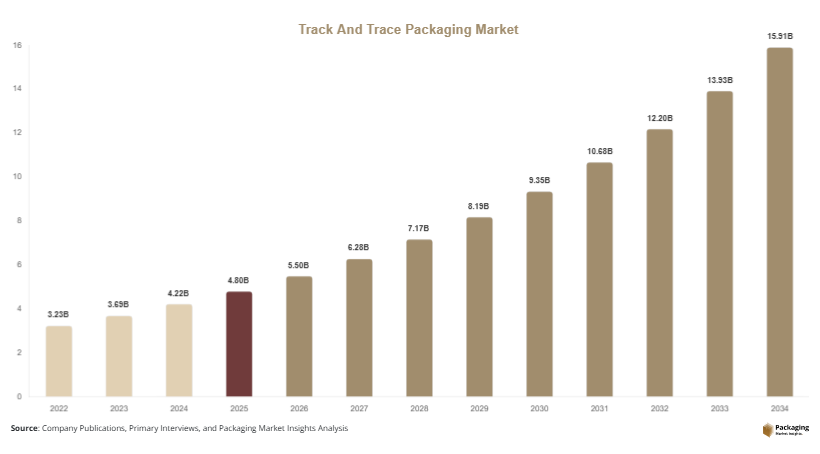
The global track and trace packaging market size was valued at approximately USD 4.8 billion in 2025 and is projected to reach USD 5.5 billion in 2026, driven by rising adoption across pharmaceuticals, food & beverage, and high-value consumer goods. Over the forecast period from 2025 to 2034, the market is expected to grow at a CAGR of 14.2%, reaching nearly USD 16.3 billion by 2034. This growth reflects the increasing integration of digital technologies such as RFID, QR codes, and blockchain into packaging systems. The track and trace packaging market is experiencing strong expansion as global supply chains increasingly prioritize transparency, anti-counterfeiting measures, and regulatory compliance.
One of the primary growth factors is the rising need for product authentication and anti-counterfeit solutions. Counterfeit goods in pharmaceuticals, cosmetics, and luxury products have created significant risks for both consumers and manufacturers. Track and trace packaging helps verify product authenticity across the supply chain, ensuring brand protection and regulatory compliance.
Key Highlights:
- The market size reached USD 4.8 billion in 2025, supported by rising adoption of serialization and traceability solutions across global supply chains. Growth is primarily driven by pharmaceutical, FMCG, and logistics industries seeking better product visibility and anti-counterfeit protection.
- It is projected to reach USD 16.3 billion by 2034, reflecting strong long-term expansion across regulated and high-value product segments. Increasing digital transformation in packaging and supply chain operations is supporting this upward trajectory.
- The market is expected to register a CAGR of 14.2% during 2025–2034, indicating rapid adoption of track and trace technologies worldwide. This growth reflects the shift toward intelligent packaging systems and data-driven supply chain management.
- Strong demand from pharmaceutical, FMCG, and logistics sectors continues to be a major growth driver. These industries require high levels of traceability to ensure product safety, regulatory compliance, and operational efficiency.
- Increasing regulatory focus on serialization and product authentication is further accelerating market expansion. Governments and regulatory bodies are enforcing strict tracking requirements to reduce counterfeit risks and improve supply chain transparency.
- Rapid integration of RFID, QR codes, and blockchain technologies is transforming the packaging landscape. These technologies enable real-time tracking, secure data exchange, and improved end-to-end visibility across global distribution networks.
Explore more data points, trends and opportunities Download Free Sample Report
Market Trends
Adoption of Blockchain-Enabled Traceability Systems
A key trend in the track and trace packaging market is the growing use of blockchain-based traceability systems. Blockchain technology provides secure, immutable records of product movement across supply chains, ensuring transparency and reducing the risk of fraud. Manufacturers are integrating blockchain with packaging identifiers such as QR codes and RFID tags to enable end-to-end visibility. This trend is particularly strong in pharmaceutical and food supply chains, where safety and authenticity are critical. Blockchain integration also improves data sharing between stakeholders, including manufacturers, distributors, and retailers, enhancing overall supply chain efficiency and trust.
Increasing Use of Smart Labels and Digital Serialization
Another major trend is the widespread adoption of smart labels and digital serialization technologies. These labels contain unique identifiers that allow real-time tracking of individual products throughout their lifecycle. Industries such as pharmaceuticals and cosmetics are increasingly using serialized packaging to comply with regulatory requirements and prevent counterfeit products from entering the market. Advances in printing technology and low-cost RFID tags have made large-scale implementation more feasible. This trend is also being supported by growing consumer demand for product transparency and origin verification.
Market Drivers
Rising Counterfeit and Illicit Trade Activities
The increasing prevalence of counterfeit goods is a major driver of the track and trace packaging market. Industries such as pharmaceuticals, luxury goods, and electronics are particularly affected by fake products that pose safety risks and cause financial losses. Track and trace packaging solutions help manufacturers verify product authenticity and maintain brand integrity. Governments are also enforcing stricter anti-counterfeit regulations, further pushing companies to adopt serialization and traceability systems. This growing threat of illicit trade continues to accelerate demand across multiple sectors.
Expansion of Pharmaceutical Serialization Requirements
The pharmaceutical industry is a key driver of market growth due to mandatory serialization regulations in many countries. Governments require drug manufacturers to assign unique identifiers to each product unit to ensure traceability across the supply chain. These regulations are aimed at reducing counterfeit medicines and improving patient safety. As pharmaceutical production expands globally, particularly in emerging markets, compliance with these regulations is driving widespread adoption of track and trace packaging systems.
Market Restraint
High Implementation and Integration Costs
One of the major restraints in the track and trace packaging market is the high cost associated with implementation and system integration. Deploying technologies such as RFID, blockchain platforms, and serialization software requires significant capital investment, which can be a barrier for small and medium-sized enterprises.
In addition to initial setup costs, companies must also invest in upgrading existing packaging lines, training personnel, and maintaining digital infrastructure. For example, pharmaceutical manufacturers must integrate serialization systems into high-speed production lines, which increases operational complexity and costs. These financial and technical challenges limit adoption in price-sensitive markets and small-scale production environments, slowing overall market penetration.
Market Opportunities
Expansion of Smart Supply Chain Ecosystems
The development of smart supply chain ecosystems presents a major opportunity for the track and trace packaging market. Companies are increasingly adopting integrated digital platforms that combine IoT sensors, cloud analytics, and real-time tracking systems. These ecosystems allow businesses to monitor product movement, inventory levels, and delivery performance with greater accuracy. This improves operational efficiency and reduces supply chain disruptions. The integration of track and trace packaging into these systems enables seamless data flow and enhances decision-making capabilities across industries.
Growth in Emerging Markets and Regulatory Expansion
Emerging economies present significant opportunities due to increasing regulatory adoption of serialization and traceability standards. Countries in Asia Pacific, Latin America, and parts of Africa are gradually implementing frameworks to improve supply chain transparency. As pharmaceutical manufacturing and export activities expand in these regions, demand for track and trace packaging is expected to grow. Additionally, increasing foreign investment in manufacturing sectors is driving the need for globally compliant packaging solutions.
Report Scope
| Report Metric | Details |
|---|---|
| Market Size in 2025 | USD 4.8 Billion |
| Market Size in 2026 | USD 5.5 Billion |
| Market Size in 2034 | USD 16.3 Billion |
| CAGR | 14.2% (2026-2034) |
| Base Year for Estimation | 2025 |
| Historical Data | 2022-2024 |
| Forecast Period | 2026-2034 |
| Report Coverage | Revenue Forecast, Competitive Landscape, Supply Chain Disruption, Growth Factors, Environment & Regulatory Landscape and Trends |
| Geographies Covered | North America, Europe, APAC, Middle East and Africa, LATAM |
| Countries Covered | U.S., Canada, U.K., Germany, France, Spain, Italy, Russia, Nordic, Benelux, Rest of Europe, China, South Korea, Japan, India, Australia, Singapore, Taiwan, South East Asia, Rest of Asia-Pacific, UAE, Turky, Saudi Arabia, South Africa, Egypt, Nigeria, Rest of MEA, Brazil, Mexico, Argentina, Chile, Colombia, Rest of LATAM |
Explore more data points, trends and opportunities Download Free Sample Report
Segmental Analysis
By Technology
Barcode technology dominated the market in 2024, accounting for approximately 44% share. Its dominance is attributed to low implementation cost, ease of integration with existing packaging lines, and widespread compatibility across industries. Barcodes are extensively used in pharmaceuticals, food packaging, and retail supply chains for basic product identification and tracking. Despite being a mature technology, barcode systems remain highly relevant due to their affordability and global standardization across logistics operations.
RFID technology is expected to be the fastest-growing segment, expanding at a CAGR of 15.2% during the forecast period. Growth is driven by increasing demand for real-time visibility, automated data capture, and enhanced accuracy in supply chain tracking. RFID is widely adopted in pharmaceuticals and high-value goods logistics, where anti-counterfeit protection and traceability are critical. Continuous cost reductions in RFID tags and improvements in cloud integration are further accelerating adoption.
By Application
Pharmaceutical packaging dominated the application segment in 2024 with approximately 48% share. The segment is driven by mandatory serialization regulations, rising counterfeit drug concerns, and strong demand for secure and traceable packaging solutions. Track and trace systems ensure compliance with global regulatory standards while safeguarding patient safety across supply chains.
Food and beverage packaging is expected to be the fastest-growing application segment, registering a CAGR of 15.4%. Growth is driven by increasing consumer demand for transparency in food sourcing, safety assurance, and supply chain visibility. Regulatory focus on food traceability and rising adoption of smart labeling solutions are further supporting segment expansion.
By End-Use Industry
Healthcare and pharmaceuticals dominated in 2024 with approximately 50% share of the global market. This dominance is due to strict regulatory requirements for drug serialization, anti-counterfeit measures, and growing demand for biologics and specialty medicines. The industry heavily relies on track and trace systems to ensure product safety, authenticity, and compliance across global supply chains.
Logistics and transportation is expected to be the fastest-growing end-use segment, expanding at a CAGR of 15.6%. Growth is driven by increasing global trade complexity, rising e-commerce shipments, and demand for real-time shipment tracking. Logistics companies are increasingly adopting integrated digital tracking solutions to improve efficiency, reduce losses, and enhance delivery transparency.
Track And Trace Packaging Market Segmentations
By Technology
- Barcode
- RFID
- QR Code
- Blockchain-Based Solutions
By Application
- Pharmaceutical Packaging
- Food & Beverage Packaging
- Cosmetics Packaging
- Electronics Packaging
By End-Use Industry
- Healthcare & Pharmaceuticals
- Logistics & Transportation
- FMCG
- Industrial Manufacturing
Regional Analysis
North America
North America accounted for approximately 32% market share in 2025, with the region projected to grow at a CAGR of 13.5% during 2025–2034. The market is strongly driven by strict regulatory frameworks, advanced digital infrastructure, and early adoption of serialization and traceability technologies across industries. The presence of major pharmaceutical and logistics companies further strengthens regional demand for track and trace packaging solutions.
The United States dominates the North American market due to mandatory drug serialization laws and strong investment in supply chain digitalization. A key growth factor is the widespread adoption of RFID and cloud-based tracking systems in pharmaceutical and healthcare supply chains, enabling real-time visibility, compliance, and anti-counterfeit protection across distribution networks.
Europe
Europe held around 28% market share in 2025, with a projected CAGR of 13.8% during the forecast period. The region benefits from stringent EU regulations on pharmaceutical traceability and strong emphasis on product safety and transparency. Adoption of advanced packaging identification technologies is widespread across healthcare, food, and industrial sectors.
Germany leads the European market due to its strong pharmaceutical manufacturing base and advanced industrial ecosystem. A key growth factor is the implementation of EU Falsified Medicines Directive (FMD)-driven serialization systems, which require end-to-end tracking of prescription drugs across the supply chain, boosting demand for compliant packaging solutions.
Asia Pacific
Asia Pacific accounted for approximately 25% market share in 2025, with the highest regional CAGR of 15.6%. Rapid industrialization, expansion of pharmaceutical exports, and growing concerns over counterfeit products are key factors driving strong market growth. Increasing government focus on supply chain transparency is further supporting adoption.
China dominates the Asia Pacific market due to its large-scale manufacturing ecosystem and expanding healthcare exports. A key growth factor is the increasing enforcement of anti-counterfeit regulations in pharmaceuticals and FMCG sectors, which is accelerating the adoption of digital serialization and track and trace packaging systems.
Middle East & Africa
The Middle East & Africa region held approximately 8% market share in 2025, with a projected CAGR of 12.9%. Market growth is supported by rising healthcare investments, increasing pharmaceutical imports, and gradual modernization of supply chain infrastructure. Adoption remains in early stages but is gaining momentum in key economies.
Saudi Arabia leads the region due to strong healthcare modernization programs and increasing investment in digital healthcare systems. A key growth factor is the growing implementation of track and trace solutions in pharmaceutical import and distribution networks to improve drug safety and regulatory compliance.
Latin America
Latin America accounted for approximately 7% market share in 2025, with a projected CAGR of 13.2%. Growth is driven by increasing pharmaceutical production, improving regulatory frameworks, and rising demand for supply chain transparency across FMCG sectors.
Brazil dominates the regional market due to its large pharmaceutical manufacturing base and expanding healthcare infrastructure. A key growth factor is the increasing adoption of serialization systems in drug production and distribution to reduce counterfeit risks and improve regulatory compliance across domestic and export markets.
Competitive Landscape
The track and trace packaging market is highly competitive, with companies focusing on digital integration, serialization technologies, and cloud-based tracking systems. Competition is driven by innovation in RFID, barcode, and blockchain-based solutions.
Zebra Technologies is a leading player in the market, known for its advanced tracking and identification solutions. The company has recently expanded its RFID product portfolio to support pharmaceutical serialization and logistics automation, strengthening its global presence.
Key Players List
- Zebra Technologies Corporation
- Avery Dennison Corporation
- Honeywell International Inc.
- Siemens AG
- Systech International
- SAP SE
- IBM Corporation
- Impinj Inc.
- Axway Software
- TraceLink Inc.
- Kezzler AS
- Markem-Imaje (Dover Corporation)
- Antares Vision Group
- Optel Group
- SEA Vision S.r.l.