Topical Drugs Plastic Packaging Market Size and Growth
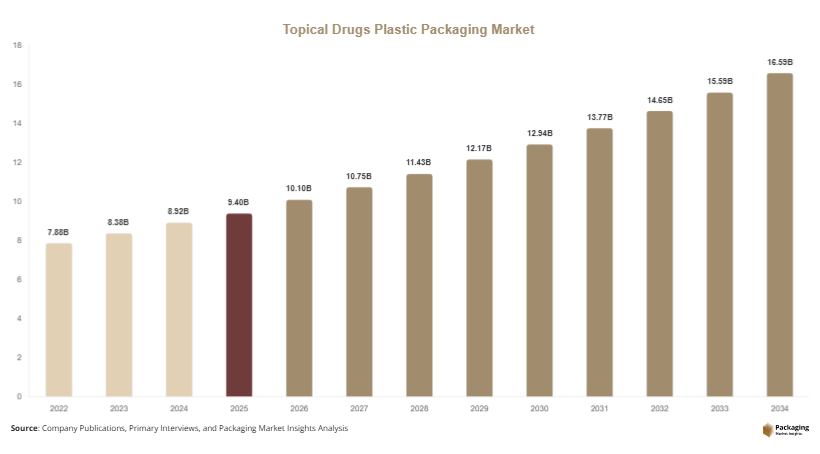
The global topical drugs plastic packaging market size was valued at USD 9.4 billion in 2025 and is projected to reach USD 10.1 billion in 2026. Over the forecast period, the market is expected to reach approximately USD 17.6 billion by 2034, growing at a CAGR of 6.4% from 2025 to 2034. This growth is supported by the increasing prevalence of skin-related conditions, including infections, allergies, and chronic dermatological disorders, which require effective topical drug formulations. The topical drugs plastic packaging market is experiencing steady expansion due to increasing demand for dermatological treatments, rising pharmaceutical production, and advancements in packaging materials.
One of the key growth factors is the increasing demand for convenient and user-friendly packaging solutions. Plastic packaging formats such as tubes, bottles, and jars provide ease of use, portability, and product protection. These features are essential for topical drugs that require controlled dispensing and extended shelf life. Pharmaceutical companies are focusing on packaging designs that enhance patient compliance and reduce contamination risks.
Key Highlights:
- Asia Pacific dominated the market with a 36.8% share in 2025, while Latin America is projected to grow at the fastest CAGR of 6.9%.
- Tubes led the type segment with a 42.7% share, while airless pumps are expected to grow at a CAGR of 7.5%.
- Polyethylene (PE) dominated with a 48.9% share, while biodegradable plastics are forecasted to grow at a CAGR of 7.2%.
- Dermatology applications led the segment with 44.3% share, while wound care is expected to grow at a CAGR of 6.8%.
- The United States remained the dominant country with a market size of USD 2.7 billion in 2025 and USD 2.9 billion in 2026.
Explore more data points, trends and opportunities Download Free Sample Report
Market Trends
Increasing Adoption of Sustainable and Recyclable Packaging Materials
The topical drugs plastic packaging market is witnessing a growing shift toward sustainable materials as environmental concerns continue to influence industry practices. Manufacturers are focusing on reducing plastic waste by introducing recyclable, reusable, and biodegradable packaging solutions. This trend is driven by regulatory pressure and increasing consumer awareness regarding environmental impact. Companies are investing in advanced polymer technologies to develop materials that maintain product safety while minimizing ecological footprint. The use of mono-material packaging and post-consumer recycled plastics is gaining traction, enabling easier recycling processes. Additionally, pharmaceutical companies are aligning their sustainability goals with packaging innovations, which is encouraging collaboration across the value chain. This transition is expected to play a significant role in shaping the future of the market.
Technological Advancements in Packaging Design and Functionality
Technological innovation is playing a crucial role in enhancing the functionality of topical drug packaging. Advanced packaging solutions such as airless pumps, metered-dose dispensers, and tamper-evident closures are becoming increasingly popular. These designs improve product protection, reduce contamination risks, and ensure precise dosage delivery. Smart packaging technologies, including QR codes and digital tracking systems, are also being integrated to improve traceability and patient engagement. The development of high-barrier plastic materials is further enhancing the stability of sensitive formulations. As pharmaceutical companies focus on improving patient experience and product safety, the demand for technologically advanced packaging solutions is expected to grow steadily.
Market Drivers
Rising Prevalence of Skin Disorders and Chronic Conditions
The increasing incidence of skin disorders and chronic dermatological conditions is a major factor driving the demand for topical drug packaging. Conditions such as eczema, psoriasis, acne, and fungal infections require long-term treatment, leading to higher consumption of topical medications. This trend is increasing the need for reliable and protective packaging solutions that ensure product efficacy and safety. Plastic packaging formats such as tubes and bottles are widely used due to their convenience and ability to preserve product quality. As the global population continues to grow and awareness about skin health increases, the demand for topical drug packaging is expected to rise significantly.
Expansion of Pharmaceutical and Over-the-Counter Drug Markets
The growth of the pharmaceutical industry, particularly in the over-the-counter (OTC) segment, is significantly contributing to market expansion. Topical drugs are widely used for self-medication and minor treatments, increasing their demand across various regions. The availability of a wide range of products, including creams, gels, and ointments, is driving the need for diverse packaging solutions. Pharmaceutical companies are focusing on improving packaging design to enhance product appeal and usability. Additionally, the increasing distribution of topical drugs through online and retail channels is boosting the demand for durable and efficient packaging solutions.
Market Restraint
Stringent Regulatory Requirements and Environmental Concerns
The topical drugs plastic packaging market faces challenges related to strict regulatory requirements and environmental concerns. Regulatory bodies impose stringent guidelines on packaging materials to ensure product safety, compatibility, and quality. Compliance with these regulations often requires extensive testing and certification, which can increase production costs and time. Additionally, growing concerns about plastic waste and environmental impact are pushing manufacturers to adopt sustainable alternatives. This transition can be challenging, as eco-friendly materials may not always provide the same level of protection as traditional plastics. For example, replacing conventional plastic tubes with biodegradable materials may require adjustments in manufacturing processes and quality control measures. These challenges can limit market growth and create barriers for new entrants.
Market Opportunities
Growth in Emerging Markets and Healthcare Infrastructure Development
Emerging markets present significant opportunities for the topical drugs plastic packaging market. Rapid urbanization, increasing healthcare expenditure, and improving access to medical facilities are driving demand for pharmaceutical products. Countries in Asia Pacific, Latin America, and the Middle East are witnessing strong growth in the healthcare sector, which is increasing the consumption of topical drugs. This trend is creating demand for cost-effective and reliable packaging solutions. Manufacturers can capitalize on this opportunity by expanding their presence in these regions and developing products tailored to local market needs.
Increasing Demand for Personalized and Specialty Packaging Solutions
The growing focus on personalized medicine and specialty pharmaceuticals is creating new opportunities for packaging innovation. Pharmaceutical companies are developing customized formulations that require specialized packaging solutions to maintain product integrity and ensure precise dosage. This is driving the demand for advanced packaging formats such as airless pumps and multi-compartment containers. Additionally, the increasing use of digital technologies in healthcare is enabling the development of smart packaging solutions that enhance patient engagement and adherence. Companies that invest in research and development to create innovative packaging solutions are likely to gain a competitive advantage in the market.
Report Scope
| Report Metric | Details |
|---|---|
| Market Size in 2025 | USD 9.4 Billion |
| Market Size in 2026 | USD 10.1 Billion |
| Market Size in 2034 | USD 17.6 Billion |
| CAGR | 6.4% (2026-2034) |
| Base Year for Estimation | 2025 |
| Historical Data | 2022-2024 |
| Forecast Period | 2026-2034 |
| Report Coverage | Revenue Forecast, Competitive Landscape, Supply Chain Disruption, Growth Factors, Environment & Regulatory Landscape and Trends |
| Geographies Covered | North America, Europe, APAC, Middle East and Africa, LATAM |
| Countries Covered | U.S., Canada, U.K., Germany, France, Spain, Italy, Russia, Nordic, Benelux, Rest of Europe, China, South Korea, Japan, India, Australia, Singapore, Taiwan, South East Asia, Rest of Asia-Pacific, UAE, Turky, Saudi Arabia, South Africa, Egypt, Nigeria, Rest of MEA, Brazil, Mexico, Argentina, Chile, Colombia, Rest of LATAM |
Explore more data points, trends and opportunities Download Free Sample Report
Segmental Analysis
By Packaging Type
Tubes accounted for the largest share of 42.7% in 2024, driven by their widespread use in packaging creams, ointments, and gels. Tubes offer convenience, portability, and controlled dispensing, making them suitable for topical drug applications. Their ability to protect products from contamination and environmental factors further supports their dominance. The availability of various materials and designs allows manufacturers to meet diverse product requirements. Additionally, advancements in tube manufacturing technologies have improved durability and functionality, enhancing their appeal in the market.
Airless pumps are expected to grow at a CAGR of 7.5% due to their ability to provide precise dosing and prevent product contamination. These packaging solutions are particularly suitable for sensitive formulations that require protection from air exposure. The increasing demand for premium and specialty pharmaceutical products is driving the adoption of airless pump packaging. Their ability to enhance product shelf life and improve user experience makes them a preferred choice for advanced applications.
By Material
Polyethylene (PE) dominated the market with a share of 48.9% in 2024 due to its versatility, durability, and cost-effectiveness. PE is widely used in the production of bottles, tubes, and containers for topical drugs. Its excellent barrier properties and compatibility with various formulations make it a preferred material. The availability of different grades of PE allows manufacturers to customize packaging solutions according to product requirements.
Biodegradable plastics are projected to grow at a CAGR of 7.2%, driven by increasing environmental concerns and regulatory pressure. These materials offer a sustainable alternative to conventional plastics and are gaining popularity among manufacturers and consumers. The development of high-performance biodegradable materials is enabling their use in pharmaceutical packaging. As sustainability becomes a key focus area, the demand for biodegradable plastics is expected to increase significantly.
By Application
Dermatology applications accounted for the largest share of 44.3% in 2024, driven by the high prevalence of skin-related conditions. Topical drugs used in dermatology require protective and user-friendly packaging solutions to ensure product efficacy and patient compliance. The increasing demand for skincare treatments is driving the growth of this segment. Packaging solutions that offer controlled dispensing and protection from contamination are widely used in dermatology applications.
Wound care applications are expected to grow at a CAGR of 6.8%, supported by the increasing incidence of injuries and chronic wounds. The demand for effective wound care products is driving the need for advanced packaging solutions that ensure product safety and ease of use. Innovations in packaging design, such as easy-to-use dispensers and protective containers, are enhancing the usability of wound care products. This trend is expected to support segment growth.
Topical Drugs Plastic Packaging Market Segmentations
By Packaging Type
- Tubes
- Bottles
- Jars
- Airless Pumps
By Material
- Polyethylene (PE)
- Polypropylene (PP)
- Polyethylene Terephthalate (PET)
- Biodegradable Plastics
By Application
- Dermatology
- Wound Care
- Pain Relief
- Anti-Infective Treatments
Regional Analysis
North America
North America accounted for a 30.6% share of the topical drugs plastic packaging market in 2025 and is projected to grow at a CAGR of 5.9% during the forecast period. The region benefits from a well-established pharmaceutical industry and advanced healthcare infrastructure. The presence of major pharmaceutical companies and strong regulatory frameworks ensures consistent demand for high-quality packaging solutions. Additionally, increasing awareness about skincare and dermatological treatments is contributing to market growth.
The United States dominates the regional market due to its large healthcare sector and high consumption of pharmaceutical products. A key growth factor is the increasing adoption of innovative packaging technologies that improve product safety and patient compliance. The country’s focus on research and development further supports the adoption of advanced packaging solutions.
Europe
Europe held a market share of 25.1% in 2025 and is expected to grow at a CAGR of 6.0%. The region’s growth is driven by strong regulatory standards and increasing emphasis on sustainable packaging. European countries are actively promoting eco-friendly materials, which is influencing the development of recyclable plastic packaging solutions. The presence of established pharmaceutical companies also supports market expansion.
Germany is the leading country in the European market, supported by its strong manufacturing base and advanced healthcare system. A unique growth factor is the country’s commitment to environmental sustainability, which encourages the adoption of innovative and eco-friendly packaging solutions. This trend is expected to drive market growth in the region.
Asia Pacific
Asia Pacific dominated the market with a 36.8% share in 2025 and is projected to grow at a CAGR of 7.2%. The region’s growth is driven by increasing population, rising healthcare expenditure, and expanding pharmaceutical production. Countries such as China, India, and Japan are witnessing significant growth in the demand for topical drugs, which is boosting the need for plastic packaging solutions.
China is the dominant country in the region, supported by its large pharmaceutical manufacturing base and growing consumer demand. A key growth factor is the rapid expansion of healthcare infrastructure and increasing investment in pharmaceutical production. This is driving demand for efficient and cost-effective packaging solutions.
Middle East & Africa
The Middle East & Africa region accounted for 5.1% of the market share in 2025 and is expected to grow at a CAGR of 6.3%. The region is experiencing growth in healthcare infrastructure and increasing adoption of pharmaceutical products. Governments are investing in healthcare development, which is supporting the demand for packaging solutions.
The United Arab Emirates is a key market in the region due to its advanced healthcare facilities and strategic location. A unique growth factor is the expansion of pharmaceutical distribution networks, which is increasing the demand for reliable packaging solutions. This trend is expected to support market growth.
Latin America
Latin America held a 3.4% share in 2025 and is projected to grow at a CAGR of 6.9%. The region’s growth is driven by increasing healthcare awareness and rising demand for pharmaceutical products. The expansion of retail and online distribution channels is also contributing to market growth.
Brazil dominates the regional market, supported by its large population and growing healthcare sector. A key growth factor is the increasing availability of over-the-counter medications, which is driving demand for convenient packaging solutions. This is expected to boost market growth in the region.
Competitive Landscape
The topical drugs plastic packaging market is moderately competitive, with several global and regional players focusing on innovation and sustainability. Companies are investing in advanced materials and technologies to enhance product performance and meet regulatory requirements. Strategic partnerships, mergers, and acquisitions are common strategies used to strengthen market position.
Berry Global Group is recognized as a leading player in the market, offering a wide range of plastic packaging solutions for pharmaceutical applications. The company recently introduced sustainable packaging products made from recycled materials, aligning with industry trends. Other major players are also focusing on expanding their product portfolios and improving manufacturing capabilities to remain competitive in the market.
Key Players List
- Berry Global Group Inc.
- Amcor plc
- Gerresheimer AG
- AptarGroup Inc.
- Albea Group
- Silgan Holdings Inc.
- West Pharmaceutical Services Inc.
- Constantia Flexibles
- Huhtamaki Oyj
- Sonoco Products Company
- Schott AG
- Winpak Ltd.
- RPC Group Plc
- Mondi Group
- Sealed Air Corporation